Morocco for Digital Nomads: Complete 2026 Guide
Is Morocco good for digital nomads?
Yes — visa-free 90 days for most Western passports, decent 4G/5G in cities, fibre in Marrakech/Casablanca/Rabat, cost of living €800-1500/month for comfort, growing coworking scene (Sundesk Taghazout, 7AYA Marrakech). Best bases: Taghazout (surf), Marrakech (culture), Tanger (Europe-close).
Why Morocco is emerging as a serious nomad base in 2026
| Where | Best bases: Taghazout, Marrakech, Tangier, Essaouira, Rabat |
| Visa | 90 days visa-free for most Western passports (see our visa and entry guide) |
| Cost | Around €800–1,300/month comfortable, cheaper in Taghazout/Tangier |
| Getting there | Direct flights from most European capitals into Marrakech, Casablanca, or Agadir |
| Best time | October–April for most cities; Taghazout works year-round |
Morocco has quietly built a case that most nomads only discover once they arrive. It sits two hours from Madrid, shares a time zone with London in winter (GMT+1 all year, unlike Europe’s clock changes), and the cost of living is roughly half of Lisbon and a third of Amsterdam. The infrastructure story has improved dramatically: Marrakech and Casablanca both have patchy-but-workable fibre, the national telco Maroc Telecom pushed 5G rollout across urban centres in 2024, and a new wave of coworking spaces has replaced the “just use the riad wifi” era.
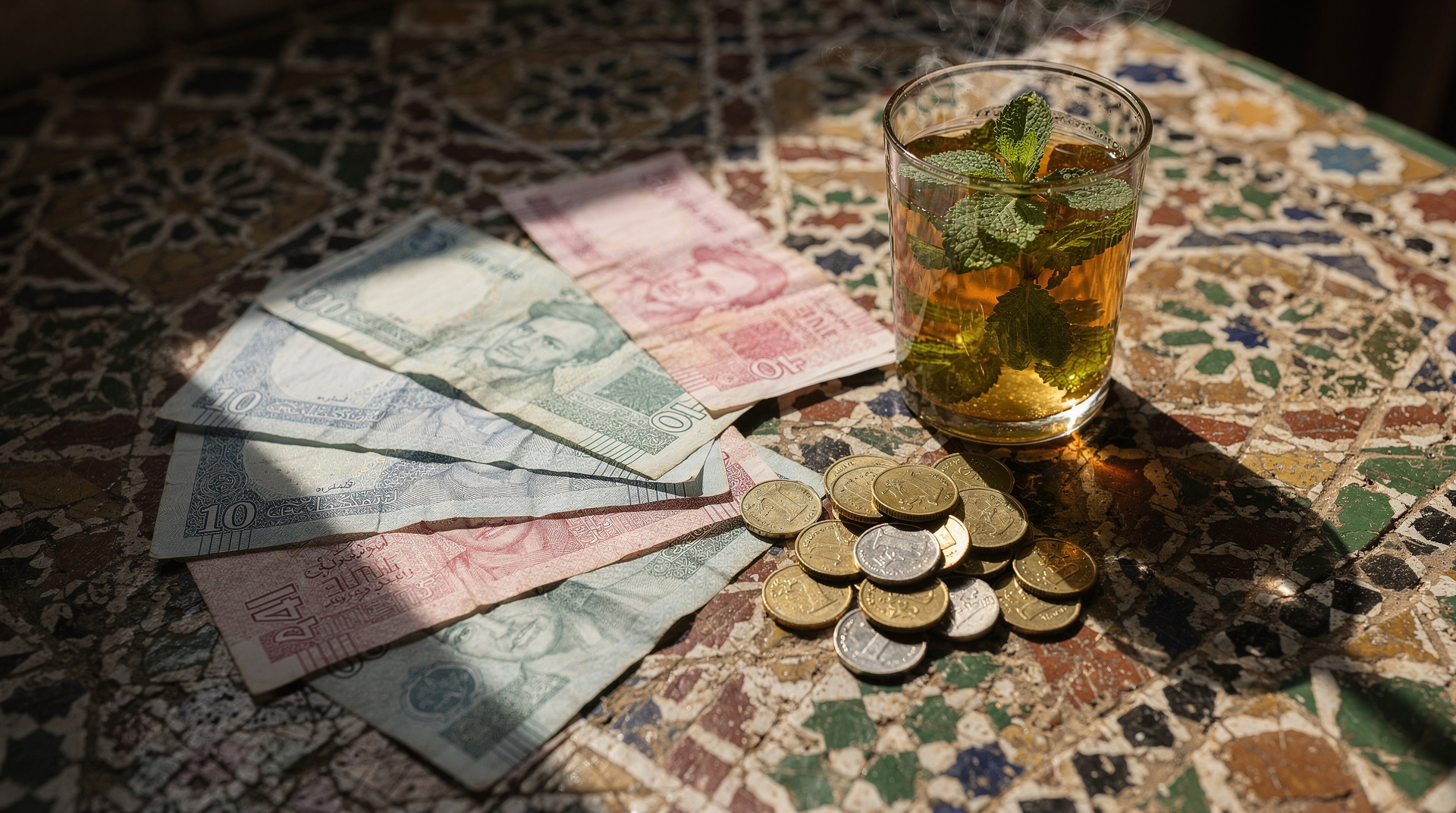
The culture is a genuine draw beyond the economics. You can be coding over mint tea in a converted medina house at 9 AM and hiking in the High Atlas by 3 PM. The food is world-class and cheap. And unlike Southeast Asia’s crowded nomad hubs, Morocco still feels like a real country you are a guest in, not a destination engineered for remote workers. That asymmetry — real place, growing infrastructure — is exactly where the interesting nomad spots emerge.
The main caveats are real: banking is friction-heavy without the right setup, Arabic and Darija are the daily languages in smaller towns (French is widely spoken in cities), and internet reliability still has bad days. This guide cuts through the noise so you can plan properly.
Visa and legal status for remote workers
The 90-day tourist entry
Morocco offers visa-free entry for 90 days to citizens of the EU, UK, USA, Canada, Australia, New Zealand, Japan, and most Western countries. You receive a stamp at the border; no advance application required. The 90 days is consecutive from your entry date, not per calendar year — so you cannot reset it with a weekend trip to Spain.
After 90 days, the technically correct approach is to exit Morocco and re-enter. In practice, many long-term nomads do a “visa run” to Tarifa (30-minute ferry from Tangier) or to Ceuta (Spanish enclave reachable by foot). The re-entry is generally smooth, but officers have discretionary authority and some nomads with multiple recent stamps report longer questioning. Do not rely on this indefinitely.
The grey zone on working remotely
Morocco has no official digital nomad visa as of mid-2026. Remote workers earning income from abroad technically fall in a grey area: tourist entry does not grant work authorisation for Morocco-based clients, but it imposes no restriction on working for foreign employers while physically in the country. In practice, no nomad has been deported or fined for working remotely on a tourist visa. The situation is functionally identical to Portugal pre-D8 visa or Bali’s arrangements before the Second Home Visa.
If you plan to stay longer than 90 days recurrently, the cleanest option is to register as a self-employed person (“auto-entrepreneur”) under Moroccan law and obtain a residency permit. The process takes roughly 6–8 weeks, requires proof of income, and gives you legal tax residency. This is relevant mainly if Morocco is your primary base for 6+ months and you want access to the local banking system without restrictions.
Tax considerations
Morocco does not tax income sourced abroad if you are a non-resident. If you establish residency, you become liable for Moroccan income tax on worldwide income, with a top rate of 38%. For most nomads on shorter stints, the tourist status is clean and simple. Consult a tax professional if your stay exceeds 183 days in a calendar year — that threshold typically triggers tax residency in your home country’s rules as well.
Internet reliability by city
The honest picture: Morocco is not Tallinn. But it is considerably better than most of Southeast Asia for consistency.
Marrakech has the best coworking infrastructure in the country. Fibre connections in modern apartments and coworking spaces reach 100–300 Mbps. The medina itself is patchier — old wiring in riads means shared WiFi that degrades badly with multiple users. A dedicated SIM as backup is non-negotiable.
Casablanca and Rabat have the most reliable urban infrastructure, with business-grade fibre widely available. For productivity-focused work, both cities perform as well as a mid-tier European city.
Tangier has improved substantially. The new city (Ville Nouvelle) has solid fibre and 5G coverage. The medina is spottier but workable.
Taghazout is the outlier. The village has built an entire coworking ecosystem precisely because the residential wifi is unreliable. Dedicated coworking spaces (Sundesk, Surf Maroc’s work facilities) have invested in satellite and redundant connections and are the only reliable option for video calls.
Essaouira is honest-small-town internet. Fast enough for asynchronous work, unreliable for consistent video calls without a SIM backup.
SIM and eSIM recommendations
Buy a local SIM on arrival. Maroc Telecom (IAM), Orange Maroc, and Inwi all offer prepaid data plans. Maroc Telecom has the broadest rural coverage. For a month of intensive use, a 50 GB data plan costs roughly MAD 150–200 (€14–19).
For eSIM, Airalo and Holafly both offer Morocco plans. These work well as a backup but are 3–4x more expensive per GB than local SIMs. The better reference is our full guide at best eSIM for Morocco — it benchmarks speed by city and operator.
The five best cities for digital nomads
1. Taghazout — surf, sun, and the best nomad community
Taghazout is a small surf village 19 km north of Agadir that has become Morocco’s most recognisable nomad spot. The draw is obvious: perfect surf breaks (Anchor Point, Hash Point, Panoramas), year-round sunshine, and a concentrated nomad community that means you will find accountability partners on your first afternoon.
Pros: Sundesk coworking (MAD 3 500/month, ~€320, includes surf storage and beach access), relaxed pace, strong community events, cheap accommodation by the sea (MAD 2 500–4 500/month for a decent flat).
Cons: Village infrastructure — one main street, limited restaurant variety, nightlife is zero, healthcare is basic (Agadir for anything serious). Internet in residential buildings is unreliable; you live at Sundesk or Surf Maroc’s work space.
Best for: Surfers, people who want a focused heads-down sprint, those who have done the Marrakech medina life and want contrast.
When you need a weekend off the laptop, a surf lesson at Taghazout is the obvious choice:
Book a beginner surf lesson at Taghazout on GetYourGuideAlso see our dedicated guide to surf camps in Taghazout for multi-week packages that bundle accommodation, coaching, and workspace.
2. Marrakech — culture, infrastructure, and the best coworking scene
Marrakech is the obvious first stop for most Morocco nomads and for good reason. It has the widest range of accommodation types, the most developed coworking infrastructure, direct flights from most European capitals, and an energy that is genuinely stimulating.
Pros: 7AYA Coworking (MAD 2 500/month, fast fibre, air conditioning, meeting rooms), Guéliz neighbourhood has excellent cafés with good wifi, diverse food scene, proximity to Atlas day trips, strong nomad Facebook groups.
Cons: Tourist-zone costs in the medina (riad accommodation commands a premium), heat in July–August (regularly 40°C+), aggressive hassle in the souks if you don’t know the neighbourhoods.
Coworking options: 7AYA in Guéliz is the standard recommendation (MAD 2 500/month, day passes MAD 150). Rabai Hub offers MAD 2 000/month plans. NUMA Marrakech, though primarily an accelerator, has hot-desk options.
Accommodation: A furnished apartment in Guéliz (quieter, better internet) costs MAD 4 500–7 000/month. Medina riads run higher and have less reliable wifi. For long stays, look outside the tourist zones.
When you surface from the laptop on a weekend, a hot-air balloon over the Palmeraie is the Marrakech experience:
Hot-air balloon over Marrakech with breakfast — book on GetYourGuideAnd for orientation when you first arrive, a walking tour of the medina is worth the two hours:
Marrakech medina private walking tour — book on GetYourGuide3. Tanger — closest to Europe, fastest culture shock recovery
Tangier is the obvious choice if you need to cross into Europe regularly, want a more cosmopolitan North African city, or are drawn to the city’s literary history (Bowles, Burroughs, Kerouac all lived and wrote here).
Pros: 35-minute ferry to Tarifa, direct trains to Casablanca and Rabat (via high-speed Al-Boraq), mild climate year-round, improving café and restaurant scene, lower apartment costs than Marrakech (MAD 3 500–5 500/month for a good flat in Ville Nouvelle).
Cons: Fewer dedicated coworking spaces, the nomad community is smaller than Marrakech or Taghazout, the medina can be overwhelming.
Internet: Ville Nouvelle has solid fibre coverage. Cafés in the new city districts have reliable connectivity. Coworking options include Business Hub Tangier and several flex-desk cafés near the port.
Best for: Nomads who want to use Morocco as a base while maintaining regular European trips, writers and creative workers drawn to the atmosphere.
4. Essaouira — wind, art, and a slower gear
Essaouira is the anti-Marrakech within Morocco. The wind is constant (this is the kitesurfing and windsurfing capital of the country), the medina is walkable and genuinely liveable rather than tourist-performance, and costs are lower than anywhere else on this list.
Pros: Medina apartments from MAD 2 500/month (studios), excellent fish and seafood, relaxed pace, creative community (artists, musicians, craftspeople), kitesurfing and surfing.
Cons: The trade wind (Alizée) is not a metaphor — it blows hard most afternoons, which is invigorating or exhausting depending on your temperament. Internet is the weakest of the five cities. No dedicated coworking space; cafés and co-work-from-café is the norm.
Best for: Writers, designers, and artists who do mostly asynchronous work. Not the right base for regular video calls without a reliable SIM as primary connection.
5. Rabat — underrated, business-functional, genuinely liveable
Rabat is Morocco’s capital and consistently underrated by the nomad community. It has the most European city feel of any Moroccan city, excellent public transport, the calmest medina in the country, and genuine residential neighbourhoods where you can live like a local rather than a tourist.
Pros: Business-grade internet is accessible, strong café culture in the Agdal and Hassan neighbourhoods, well-developed public transport, affordable and high-quality apartments (MAD 4 000–6 500/month for a good two-bedroom in Agdal), lower tourist pressure than Marrakech or Fes.
Cons: Less dramatic culturally than Marrakech, fewer nomad-specific services, coworking space options are growing but still limited compared to Casablanca.
Coworking: Work In (near Agdal) and Darna Hub are the main options, both around MAD 2 200–2 800/month. Day passes MAD 100–130.
Coworking scene in detail
| City | Space | Monthly (MAD) | Monthly (EUR) | Notes |
|---|---|---|---|---|
| Taghazout | Sundesk | 3 500 | ~320 | Beach access, surf storage, community events |
| Taghazout | Surf Maroc Workspace | 3 000 | ~275 | Attached to Surf Maroc camp |
| Marrakech | 7AYA | 2 500 | ~230 | Fast fibre, meeting rooms, AC |
| Marrakech | Rabai Hub | 2 000 | ~183 | Smaller, quieter |
| Rabat | Work In | 2 500 | ~230 | Professional environment, Agdal location |
| Rabat | Darna Hub | 2 200 | ~200 | Community-oriented |
| Casablanca | La Caserne | 2 800 | ~256 | Startup-focused, strong network |
| Casablanca | CoWorking 212 | 2 500 | ~230 | Flexible plans available |
| Tangier | Business Hub Tangier | 2 000 | ~183 | City-centre location |
Day passes are typically MAD 100–150 across all cities. Most spaces offer a free trial day.
Cost of living breakdown
These are realistic figures for a comfortable but not extravagant lifestyle, based on 2025–2026 prices.
Marrakech
- Apartment (Guéliz, 1-bed): MAD 4 500–6 500/month (€410–595)
- Coworking: MAD 2 500/month (€230)
- Food (eating mostly local, some restaurants): MAD 2 500–3 500/month (€230–320)
- Transport (taxis, occasional day trips): MAD 800–1 200/month (€73–110)
- SIM data + utilities: MAD 500–700/month (€46–64)
- Total comfortable monthly: MAD 11 000–14 000 (~€1 000–1 280)
Taghazout
- Apartment or shared house: MAD 2 500–4 500/month (€230–410)
- Sundesk coworking: MAD 3 500/month (€320)
- Food: MAD 2 000–2 800/month (€183–256)
- Transport (Agadir taxi for anything medical/practical): MAD 600–1 000/month
- Total comfortable monthly: MAD 9 000–12 000 (~€820–1 100)
Tanger
- Apartment (Ville Nouvelle, 1-bed): MAD 3 500–5 500/month (€320–500)
- Café/flex-desk budget: MAD 1 500/month (€137)
- Food: MAD 2 200–3 000/month (€200–275)
- Total comfortable monthly: MAD 8 000–11 000 (~€730–1 000)
Comparison vs other nomad hubs
| City | Comfortable monthly (EUR) |
|---|---|
| Marrakech | 1 000–1 300 |
| Taghazout | 820–1 100 |
| Tangier | 730–1 000 |
| Lisbon | 1 800–2 500 |
| Bali (Canggu) | 1 200–1 800 |
| Tbilisi | 700–1 000 |
Morocco sits roughly at the Tbilisi/Bangkok price point with the advantage of being two hours from Western Europe.
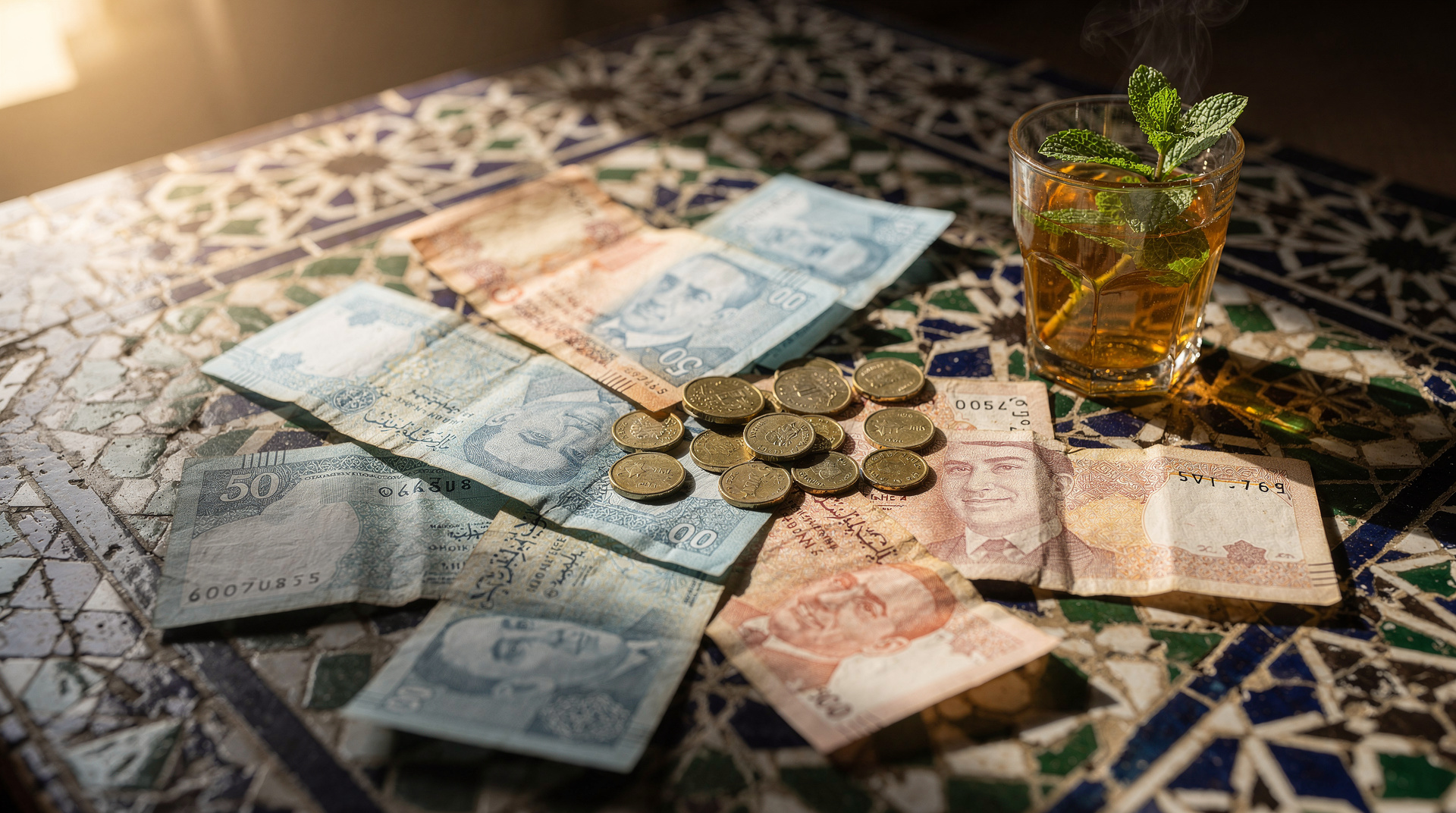
For currency fundamentals and the best way to access dirhams, see our Morocco currency and money guide.
Climate and seasonal strategy
Morocco’s climate varies dramatically by region, which means you can mostly outrun bad weather by moving.
October–April is the prime productivity season for most cities. Temperatures are mild (15–25°C), crowds are thinner, and prices for accommodation drop 20–30% outside Christmas/New Year.
Marrakech is best October–May. June–September is survivable in air-conditioned coworking spaces but the heat above 38°C is draining.
Taghazout is a year-round base. Summer brings consistent small swells and reliable sunshine. Winter (November–March) has the best surf and the most concentrated nomad community.
Tanger has a Mediterranean microclimate — mild winters, warm but not brutal summers. It is one of the few Moroccan cities where you can reasonably work outdoors year-round.
Essaouira runs cool year-round (rarely above 28°C) due to the constant Atlantic breeze. It is the best escape from the Marrakech heat in July–August.
See the seasonal planning guides for month-by-month detail: Morocco in February and Morocco in July.
Community and finding people
The nomad community in Morocco is smaller but more cohesive than in Southeast Asia. A few reliable channels:
Facebook groups: “Digital Nomads Morocco”, “Marrakech Digital Nomads”, “Taghazout Expats” — all active with weekly meetups posted.
Meetup.com: Casablanca and Rabat have regular tech meetups through the local startup ecosystem (Startups in Casablanca, Open Source Maroc community in Rabat).
Coworking space communities: Sundesk in Taghazout and 7AYA in Marrakech both organise monthly community dinners and skills exchanges. The best way into the local community is simply showing up to the coworking space rather than working from your apartment.
Couchsurfing events still run weekly meetups in Marrakech and Casablanca — they have evolved into general expat/nomad socialising events well beyond the accommodation-sharing origin.
Instagram: Search the geotag for Sundesk Taghazout to find current residents and reach out directly. The nomad community in Morocco is notably open to connecting with newcomers.
Practical setup: banking, taxes, and booking patterns
Banking without friction
Moroccan ATMs accept international Visa/Mastercard but impose fees of MAD 25–45 per withdrawal. The best solutions:
- Wise (multi-currency account): withdraw at local ATMs with low conversion fees, top up in EUR/GBP/USD
- Revolut (Premium or Metal): fee-free ATM withdrawals up to a monthly limit, good conversion rates
- N26: works well but limits vary by plan
Avoid changing cash at airport bureaux de change — rates are 3–5% worse than in-city exchange offices. The medina money changers have competitive rates but always count the bills before leaving.
Direct debit from a Moroccan bank account requires residency documents and is only practical for stays of 6+ months.
Long-term accommodation booking
For stays of 1–3 months, Airbnb is the most accessible option but has a 15–20% premium versus direct. For better rates:
- Facebook groups (“Appartements Marrakech”, “Logements Taghazout”) for landlord-direct bookings
- Avito.ma — Morocco’s version of Craigslist, landlord listings in Darija and French, cheaper than Airbnb by 30–40%
- Mubawab.ma — more formal listings, useful for Casablanca and Rabat
- Arrive and negotiate 3–7 day rates before committing to a month; most landlords will negotiate
Transport setup
Morocco is one of the cheapest countries for internal transport. See our full getting around Morocco guide for comprehensive options. The key points for nomads:
- CTM buses between major cities are comfortable, air-conditioned, and reliable. Marrakech–Essaouira costs around MAD 80–100.
- ONCF trains connect Casablanca, Rabat, Fes, Meknes, and Tangier. The Al-Boraq high-speed train cuts Casablanca–Tangier to 2h15.
- Grand taxis (shared long-distance taxis) are faster than buses between smaller towns and cost a fixed per-seat rate.
- Bolt and inDrive operate in Casablanca, Rabat, and Marrakech as cheaper alternatives to Petit taxis.
Best weekend experiences when you’re not coding
Morocco’s density of experiences within a few hours of any base is what makes longer stays genuinely rewarding. A few high-value options that are worth booking in advance:
From Taghazout: The surf is the weekend. A morning surf lesson followed by a hammam in Agadir is a complete reset.
From Marrakech: A hot-air balloon flight at dawn over the Palmeraie and Atlas foothills is the definitive Marrakech experience — book early, slots fill fast:
Marrakech hot-air balloon with breakfast — GetYourGuideThe Sahara long weekend: Three days from Marrakech via Aït Benhaddou and the Draa Valley, with a night in a desert camp at Merzouga. One of the most rewarding trips you can do in North Africa. This is the excursion that makes nomads extend their Morocco stays:
3-day Sahara desert tour Marrakech to Merzouga — GetYourGuideFor planning the longer desert route, see our Merzouga guide and the Marrakech region hub for day-trip ideas within a two-hour radius.
For surf context before you go, the surfing Morocco guide covers every Atlantic break worth knowing.
Frequently asked questions about Morocco for Digital Nomads
How long can I stay in Morocco without a visa?
Most Western passport holders (EU, UK, USA, Canada, Australia, New Zealand, Japan) receive visa-free entry for 90 consecutive days. This is a single continuous period, not 90 days per year. After 90 days you must exit the country. The ferry from Tangier to Tarifa or Tangier to Algeciras is the standard exit point, and many nomads re-enter immediately — though immigration officers have discretion and may question repeat short visits.
Is the wifi reliable enough for remote work in Morocco?
In dedicated coworking spaces in Marrakech, Casablanca, and Taghazout, yes — 50–200 Mbps fibre connections are standard. In residential apartments and cafés, quality is variable. The reliable rule: always have a local SIM with 4G/5G as a backup. Maroc Telecom and Inwi both offer 50 GB prepaid plans for MAD 150–200/month. Do not rely on residential wifi alone for video-call-heavy work.
What is the best Moroccan city for surf and remote work?
Taghazout is the clear answer. It has world-class surf breaks (Anchor Point, Hash Point, Killers), dedicated coworking spaces built around the surf lifestyle (Sundesk at MAD 3 500/month), and a year-round nomad community. Essaouira is a secondary option for windsurfing and kitesurfing, though the internet is weaker. See our full Taghazout surf camp guide for multi-week packages.
How does the monthly cost compare to Lisbon or Bali?
Morocco is roughly 40–50% cheaper than Lisbon and 20–30% cheaper than Canggu (Bali). A comfortable Marrakech setup (apartment in Guéliz, coworking, eating out most meals) costs €1 000–1 300/month. The equivalent lifestyle in Lisbon runs €1 800–2 500. Bali’s Canggu neighbourhood has converged toward €1 200–1 800 for similar quality. Taghazout or Tangier push the Morocco figure closer to €800–1 000 if you are budget-conscious.
How do I find a long-term apartment without using Airbnb?
Three reliable channels: (1) Avito.ma for direct landlord listings in French and Darija — prices are 30–40% below Airbnb for equivalent apartments. (2) Facebook groups: search “Appartements [city name]” or “Logement [city name]” — most major cities have active groups with landlords posting directly. (3) Arrive on a short booking for 3–5 days and ask at your riad or guesthouse — owners almost always know local landlords with furnished apartments available monthly. Negotiating in person consistently beats online rates by 15–25%.
Does Morocco have a digital nomad visa?
Not as of mid-2026. Morocco has discussed introducing a nomad/talent visa modelled on Spain’s Digital Nomad Visa, but no formal programme exists yet. Most remote workers enter on tourist visas and work legally for foreign clients. If you plan to spend more than 6 months per year in Morocco, registering as an auto-entrepreneur and obtaining a residency permit is the cleanest long-term option.
What is the internet like in the medina versus the new city?
Medinas (historic walled cities) in Marrakech, Fes, and Tangier have old infrastructure that limits fibre penetration. Shared riad wifi degrades quickly with multiple users on old cabling. The new city neighbourhoods (Guéliz in Marrakech, Ville Nouvelle in Tangier, Agdal in Rabat) have modern cabling and consistently better residential internet. For serious work, prioritise apartments in the new city or use a dedicated coworking space in the medina rather than relying on riad wifi.
Do I need a visa before arriving to work remotely from Morocco?
No — most Western passport holders simply get a 90-day stamp on arrival, no advance application. There is no separate “remote work” visa category to apply for. Full entry requirements, including which nationalities need advance visas, are covered in our Morocco visa and entry guide.