Morocco Trip Cost: Complete Budget Breakdown
How much does a trip to Morocco cost per day?
Budget travellers can manage on 40-60 EUR/day (dorm, local food, buses). Mid-range is 100-150 EUR/day per person (good riads, mix of local and tourist restaurants, some tours). Luxury runs 250-500+ EUR/day. Desert tours and internal flights are significant one-off costs outside the daily average.
What Morocco actually costs in 2026
Morocco has a reputation as a cheap destination, and for budget travellers it still is. But mid-range and luxury Morocco can cost as much as southern Europe once you factor in quality riads, desert tours, and guided excursions. The range is genuinely wide.
This guide breaks down costs category by category, gives realistic daily budget examples at three travel styles, and flags the spending categories where people consistently underestimate.
At a glance
| Budget daily spend | around 40-60 EUR/day (excludes Sahara tour) |
| Mid-range daily spend | around 100-150 EUR/day per person |
| Luxury daily spend | around 250-500+ EUR/day |
| Currency | Moroccan dirham (MAD), cash-heavy, closed currency |
| Biggest one-off cost | Sahara tour, roughly 250-450 EUR/person for 3 days |
| Best value | Street food, local buses, local hammams |
Currency basics
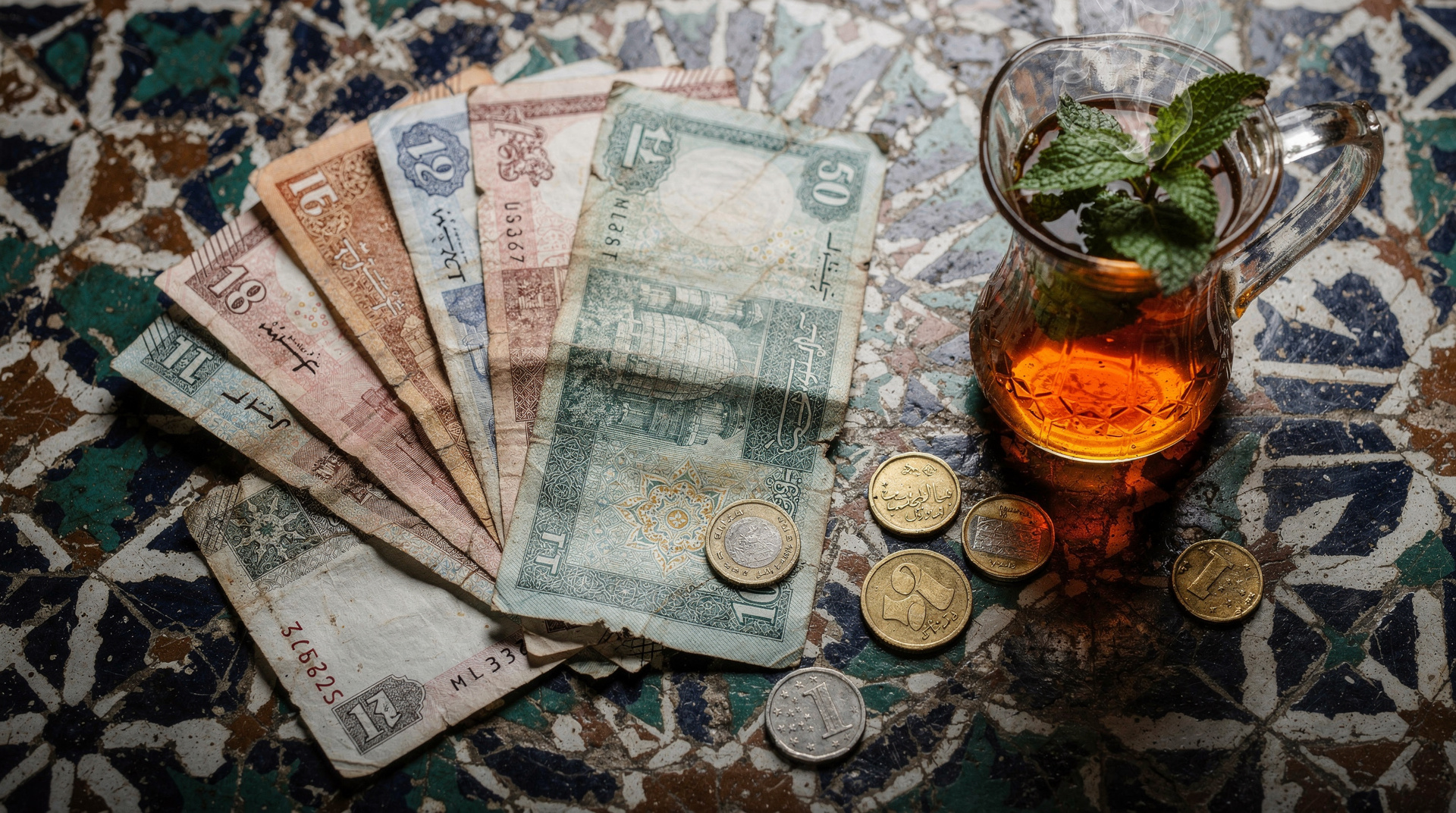
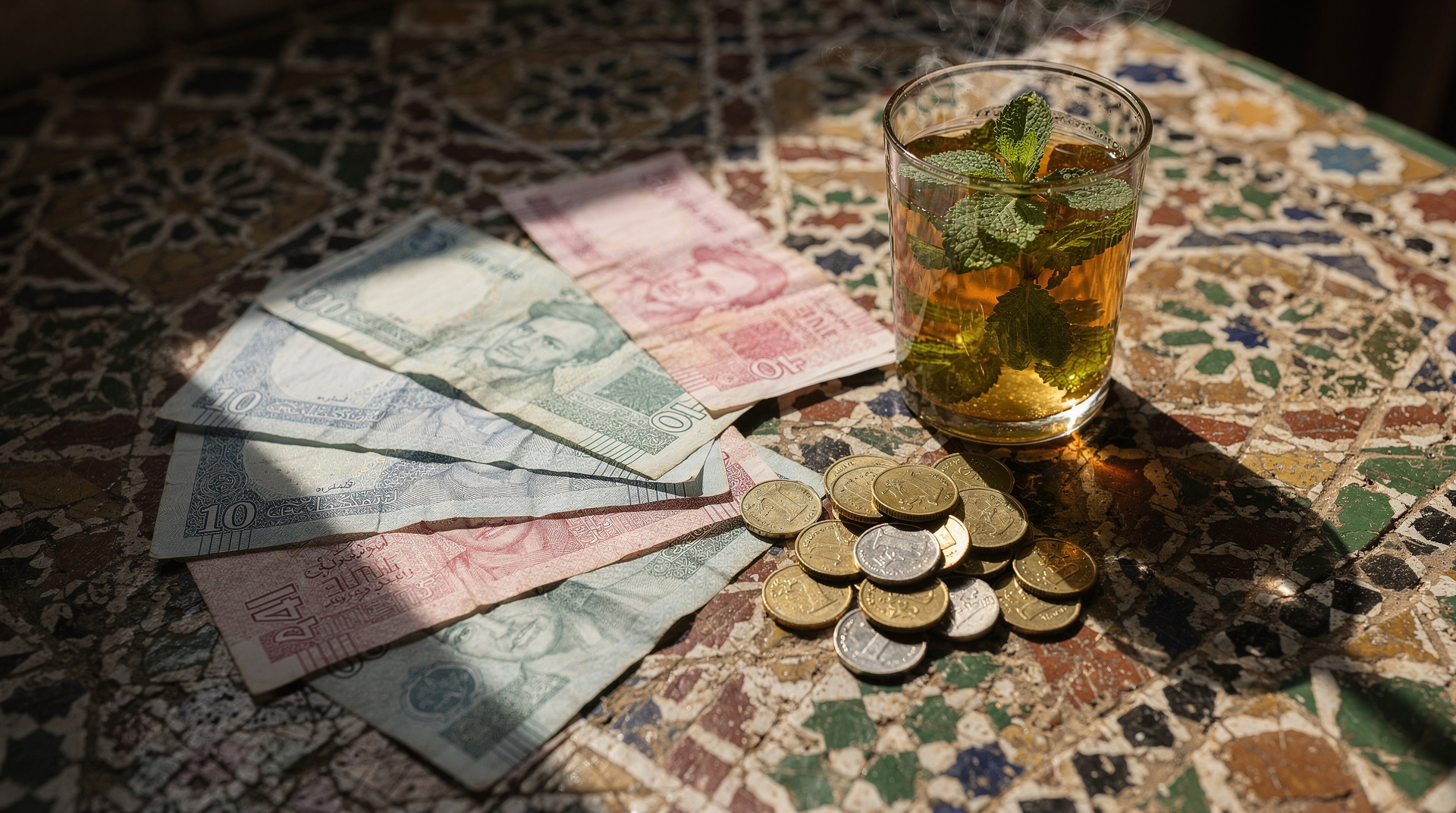
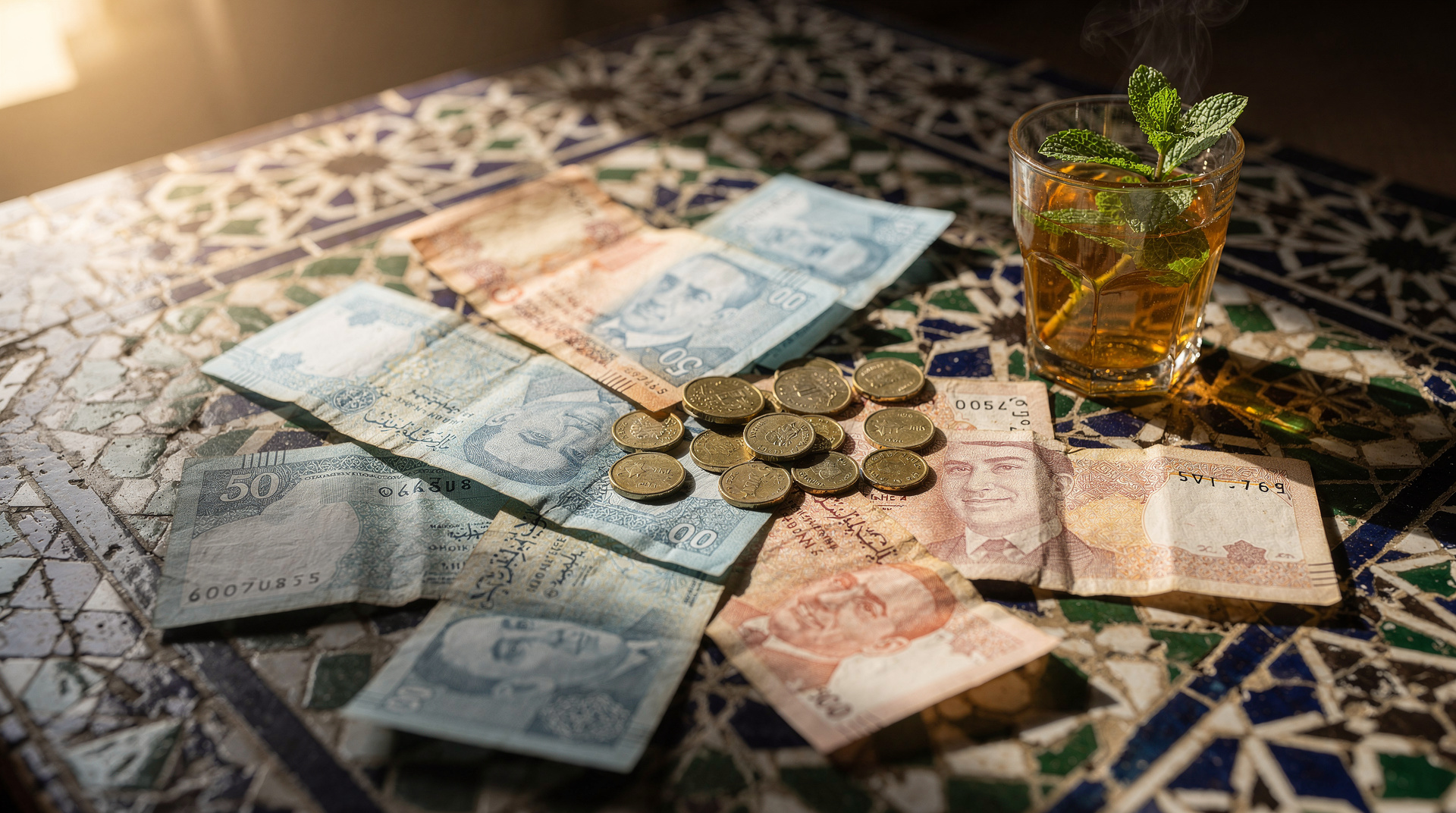
Morocco uses the Moroccan Dirham (MAD). The dirham is a closed currency — you cannot buy it outside Morocco, and you cannot take large amounts out. Exchange at the airport on arrival or use ATMs once in the country.
Approximate rates in 2026:
- 1 EUR = roughly 11 MAD
- 1 USD = roughly 10 MAD
- 1 GBP = roughly 13 MAD
These fluctuate — use “roughly” when planning and check rates before departure. Credit cards are accepted at most hotels, better restaurants, and organised tour operators. The medinas, small riads, and all market transactions run on cash. Budget for significant cash needs.
ATM fees: Moroccan ATMs charge a flat fee per withdrawal (typically 20-30 MAD plus your home bank’s foreign transaction fee). Withdraw larger amounts less frequently rather than small amounts multiple times.
Accommodation costs
| Category | Type | Nightly cost (per room) |
|---|---|---|
| Budget | Hostel dorm | 8–15 EUR |
| Budget | Basic guesthouse (private room) | 20–35 EUR |
| Mid-range | Riad (medina guesthouse), decent quality | 60–120 EUR |
| Mid-range | Hotel, 3-star equivalent | 50–90 EUR |
| Luxury | Premium riad, Marrakech or Fes | 150–350 EUR |
| Luxury | 5-star hotel | 200–500 EUR |
| Desert camp, standard | Merzouga or Zagora | 40–80 EUR/person |
| Desert camp, luxury | Merzouga, Agafay | 200–400 EUR/person |
Important note on riads: The difference between a 70 EUR and 120 EUR riad in Marrakech is often enormous — courtyard design, breakfast quality, service, room size. Read reviews carefully; price in the medina does not always reflect quality. The luxury end genuinely delivers: a well-run riad at 200 EUR/night is a different product entirely.
Food costs
Moroccan food at local restaurants is extraordinarily cheap. Tourist-facing restaurants charge significantly more. Here’s the realistic picture:
| Meal type | Cost per person |
|---|---|
| Street food (msemen, sfinge, harira) | 2–5 MAD |
| Lunch at a local restaurant (tajine, couscous) | 30–60 MAD (3-5 EUR) |
| Coffee at a local cafe | 5–10 MAD |
| Tourist restaurant dinner, main course | 80–150 MAD (7-14 EUR) |
| Good restaurant dinner with drinks | 200–400 MAD (18-36 EUR) |
| Rooftop tourist cafe, Djemaa el-Fna | 40-80 MAD for a drink (often mediocre quality) |
| Fine dining, Marrakech | 500–900 MAD per person (45-80 EUR) |
Budget travellers eating mostly local food (market stalls, neighbourhood restaurants, bakery breakfast) can feed themselves for 15-25 EUR/day. Mid-range travellers mixing local lunches with tourist-area dinners: 30-50 EUR/day. Luxury travellers at good restaurants with wine: 60-100+ EUR/day.
Alcohol note: Morocco is a Muslim-majority country. Alcohol is available but not everywhere. Marrakech and Casablanca have wine bars and hotel bars; medina areas have fewer options. Beer runs 35-60 MAD at venues that serve it; wine 100-200 MAD/bottle at restaurants. Budget for this separately.
Transport costs
| Journey | Mode | Cost |
|---|---|---|
| Marrakech airport to city centre | Grand taxi | 70-100 MAD (fixed rate, negotiate before getting in) |
| Within Marrakech (short ride) | Petit taxi | 10-25 MAD |
| Marrakech to Casablanca (train) | ONCF | 80-180 MAD (2nd/1st class) |
| Casablanca to Tangier (Al Boraq high-speed) | ONCF | 120-250 MAD (2h10) |
| Marrakech to Fes (CTM bus) | CTM | 180-220 MAD (8-9h) |
| Marrakech to Agadir (shared taxi/bus) | Various | 100-150 MAD |
| Domestic flight (Marrakech-Casablanca) | RAM/Air Arabia | 60-200 EUR depending on timing |
| Private transfer Marrakech to Merzouga | Car rental or operator | 200-400 EUR (round trip, driver) |
For detailed transport options, the getting around Morocco guide covers ONCF trains, CTM buses, taxis, and rental cars in depth. For desert-specific costs, the how to book a Sahara tour guide gives a full price breakdown. The luxury desert camps guide explains the premium camp price tiers. For timing your trip to align with budget seasons, see the best time to visit Morocco guide.
Tour and activity costs
This is the budget category most travellers underestimate. If your Morocco trip includes the Sahara, some activities, and guided experiences, tour costs can easily exceed accommodation costs.
| Activity | Cost |
|---|---|
| 3-day Sahara tour from Marrakech (shared) | 250-400 EUR/person |
| 3-day Sahara tour (private, couple total) | 500-900 EUR |
| Marrakech medina private tour | 50-120 EUR/person |
| Fes medina full-day guided tour | 40-80 EUR/person |
| Aït Ben Haddou entry | 10-15 MAD |
| Quad biking in Agafay or Merzouga (1h) | 30-50 EUR |
| Hammam (traditional bathhouse) | 10-20 EUR (local); 40-100 EUR (riad spa) |
| Cooking class, Marrakech | 40-80 EUR/person |
| Majorelle Garden entry | 170 MAD (combined ticket) |
A private Marrakech medina tour covering palaces and tombs gives proper context for the old city. For Fes, a Fes full-day cultural tour is worth the cost — the medina genuinely requires a guide to navigate effectively.
Daily budget examples
Budget traveller (40-60 EUR/day)
- Hostel dorm or cheap guesthouse: 15-25 EUR
- Food mostly local restaurants and markets: 12-20 EUR
- Local transport (taxis, buses): 5-10 EUR
- 1-2 small activities or museum entries: 5-10 EUR
- Does not include Sahara tour (budget that separately as a one-off cost)
Mid-range traveller (100-150 EUR/day per person)
- Good riad or 3-star hotel: 40-70 EUR (shared room)
- Mix of local and tourist restaurants: 30-45 EUR
- Taxis and some bus journeys: 10-15 EUR
- 1 activity or guided experience per day: 20-30 EUR
- Some tours budgeted separately
Luxury traveller (250-500+ EUR/day per person)
- Premium riad or 5-star hotel: 100-250 EUR
- Good restaurants with drinks: 60-100 EUR
- Private transfers: 30-50 EUR
- Private guided tours and premium activities: 60-100 EUR
One-off costs to budget separately
These are significant costs that don’t fit into a daily average:
- Sahara tour (3 days): 250-450 EUR/person — budget this as a separate line item
- International flights: Hugely variable; from Europe 80-300 EUR return; from North America 600-1200 EUR return
- Travel insurance: 40-80 EUR for 1-2 weeks (strongly recommended)
- Visas: Free for US/UK/EU/Canadian/Australian citizens (90-day stamp on arrival in 2026)
For full entry requirements, the Morocco visa and entry guide covers all nationalities and rules.
Where Morocco is cheaper than expected
- Street food and local restaurants: extraordinary value
- Local intercity buses: very cheap for long distances
- Hammam experiences at local (non-tourist) bathhouses: 5-15 MAD
- Fresh produce at markets: genuinely cheap
- Petit taxi rides within cities: usually 10-25 MAD for short trips
Where Morocco is more expensive than expected
- Quality riads in Marrakech and Fes: comparable to mid-range European cities
- Organised desert tours: not budget even at the low end
- Alcohol at restaurants: expensive relative to food costs
- Tourist-facing medina restaurants: can charge European prices for average food
- Djemaa el-Fna food stalls: dramatically overpriced for their quality (the experience is worth it once; the food is not the point)
Tipping culture
Tipping is standard and expected in Morocco. Amounts:
- Restaurant: 10-15% in tourist-facing restaurants; rounding up at local places
- Driver-guide on tours: 100-150 MAD per day minimum; more for excellent service
- Riad staff: 50-100 MAD at end of stay
- Anyone who helps you find something: 10-20 MAD
- Hammam staff: 10-20 MAD
Carry small bills (10, 20 MAD notes) specifically for tipping and small purchases.
Frequently asked questions about Morocco costs
Is Morocco cheaper than Spain or Portugal?
For budget and mid-range travellers, yes — food and local transport are significantly cheaper. Accommodation is comparable or slightly cheaper than Portugal once you’re in good riads. But luxury Morocco (premium riads, desert tours, guides) can match or exceed southern European costs.
Can I use euros in Morocco?
Some tourist-facing businesses accept euros, particularly in Marrakech. But exchange rates will not favour you — use MAD wherever possible. ATMs are reliable and widely available in cities.
How much cash should I carry?
For a week-long trip, budget to access 3,000-5,000 MAD in cash (roughly 270-450 EUR). Markets, taxis, small restaurants, hammams, and tips all require cash. Most riads accept card for the main booking; extras and tips are cash.
Are there hidden costs in Moroccan markets (souks)?
The medina souk price system works differently from fixed-price retail. Initial asking prices are typically 3-5x what an item sells for. This is a negotiation starting point, not a hidden cost. The “hidden cost” to watch for is guides steering you into specific shops where they earn commission — your 100 MAD carpet tour guide fee is a hidden surcharge in that sense.
How much should I budget for a 10-day Morocco trip?
Very roughly: budget traveller 600-800 EUR all-in (excluding flights), mid-range 1,500-2,500 EUR (including Sahara tour), luxury 4,000-8,000 EUR. These assume you’re booking accommodation, tours, and transport — flights are additional and variable.
Is it cheaper to book tours in advance or on arrival?
Booking a few days ahead online is usually similar in price to negotiating in Marrakech, but gives you a confirmed spot and a reviewable operator. Peak season (spring, autumn) sees prices rise and availability shrink closer to the date, so booking ahead is safer for the Sahara tour specifically — see the how to book a Sahara tour guide for the full process.
Saving money in Morocco: practical tips
Eat where locals eat. The price difference between a tourist restaurant (with a menu in multiple languages and photos on the walls) and a neighbourhood restaurant (plastic chairs, chalkboard menu, Darija only) is often 3-5x. The neighbourhood version is usually better food.
Buy water in large bottles. A 1.5L bottle from a supermarket (Carrefour, Marjane, or local épicerie) is 5-7 MAD. The same bottle from a tourist cafe is 20-30 MAD. Buy large, refill a reusable bottle.
Use petit taxis with the meter. Negotiated flat rates for tourists are almost always higher than what the meter would show. In Marrakech especially, insist on the meter (“conteur, SVP”).
Stay slightly outside the medina. The Gueliz area in Marrakech and the Ville Nouvelle in Fes have cheaper hotels than medina riads, with easy taxi access to the historic areas. You lose the immersive medina atmosphere but save 30-50% on accommodation.
Book Sahara tours as shared rather than private. For solo travellers, the shared tour delivers essentially the same experience at half the cost. For couples, running the numbers often shows a private tour is only 20-30% more per person — worth it for the flexibility, but the gap is smaller than many people assume.
Negotiate craft and souvenir prices. This is not optional in the souks — the first price is always inflated. Starting at 30-40% of the quoted price and working up to 50-60% is the standard approach. Buying multiple items from the same vendor gives additional leverage.
Use Careem/Uber for airport transfers. In Marrakech and Casablanca, app-based rides are transparent and often cheaper than negotiating with unofficial taxis outside arrivals.
What drives the cost up unexpectedly
Several Morocco costs consistently surprise first-timers by being higher than expected:
Quality riad prices in Marrakech: The gap between a 50 EUR/night basic guesthouse and a 150 EUR/night proper riad is enormous in terms of experience. Many travellers book cheap and regret it — the riad experience (courtyard, breakfast, service) is a core part of what makes Marrakech worthwhile.
Alcohol: Available but expensive compared to food. A glass of wine at a Marrakech restaurant runs 80-120 MAD. A beer at a hotel bar is 40-70 MAD. Budget for this separately if drinking is part of your trip.
Desert tour upgrades: The gap between standard and luxury camps at Merzouga (100-200 EUR per person per night) is significant. Travellers who book the cheaper option and then see the luxury camp photos afterwards often feel they left the best part of the experience on the table.
Shopping: Morocco’s craft markets are genuinely excellent and prices are good by European standards — but easy spending on carpets, ceramics, leather goods, and argan products adds up fast. Set a firm shopping budget before you arrive and stick to it.
How costs vary by city and region
Not all of Morocco costs the same. Marrakech and Fes have the widest range of riad prices and the most tourist-inflated food and activity pricing — expect to pay a premium in the medina compared to the same quality elsewhere. Chefchaouen and Essaouira are noticeably cheaper for accommodation and food than Marrakech, while still offering good riads and restaurants.
Casablanca and Rabat, as working cities rather than tourist hubs, often have cheaper everyday costs but less charming budget accommodation. For a full regional trip, the 7 vs 10 days itinerary guide and the 10 vs 14 days guide are useful for estimating total cost by trip length, since longer trips generally reduce the average daily cost (fewer one-off transfers, more time to shop for value).
Choosing where to save vs where to spend
Experienced Morocco travellers tend to converge on a similar strategy: spend on accommodation (a good riad meaningfully changes the trip) and the Sahara tour (this is a once-per-trip experience, and the gap between a rushed budget version and a well-run mid-range one is large), and save on food, local transport, and souvenirs. The luxury vs budget Morocco guide goes deeper into this trade-off across every spending category, and the airbnb vs riad guide helps decide the single highest-impact accommodation choice in Marrakech specifically.