Quick facts
- Language
- Darija, French
- Population
- ~1 million
- Airport
- Marrakech Menara (RAK)
- Best for
- Medina, souks, riads, culture
Why Visit Marrakech
Marrakech earns its reputation as Morocco’s most intoxicating city the moment you step through the ancient city gates. The Red City — so called for the salmon-hued earthen walls that encircle its 1,000-year-old medina — operates at a sensory pitch unlike anywhere else in North Africa. Snake charmers, acrobats, and storytellers crowd Jemaa el-Fnaa at dusk. Henna artists call from doorways. The smell of cumin, saffron, and argan oil drifts through labyrinthine alleyways that dead-end into 14th-century fountains or open into sunlit courtyards where tea is already being poured.
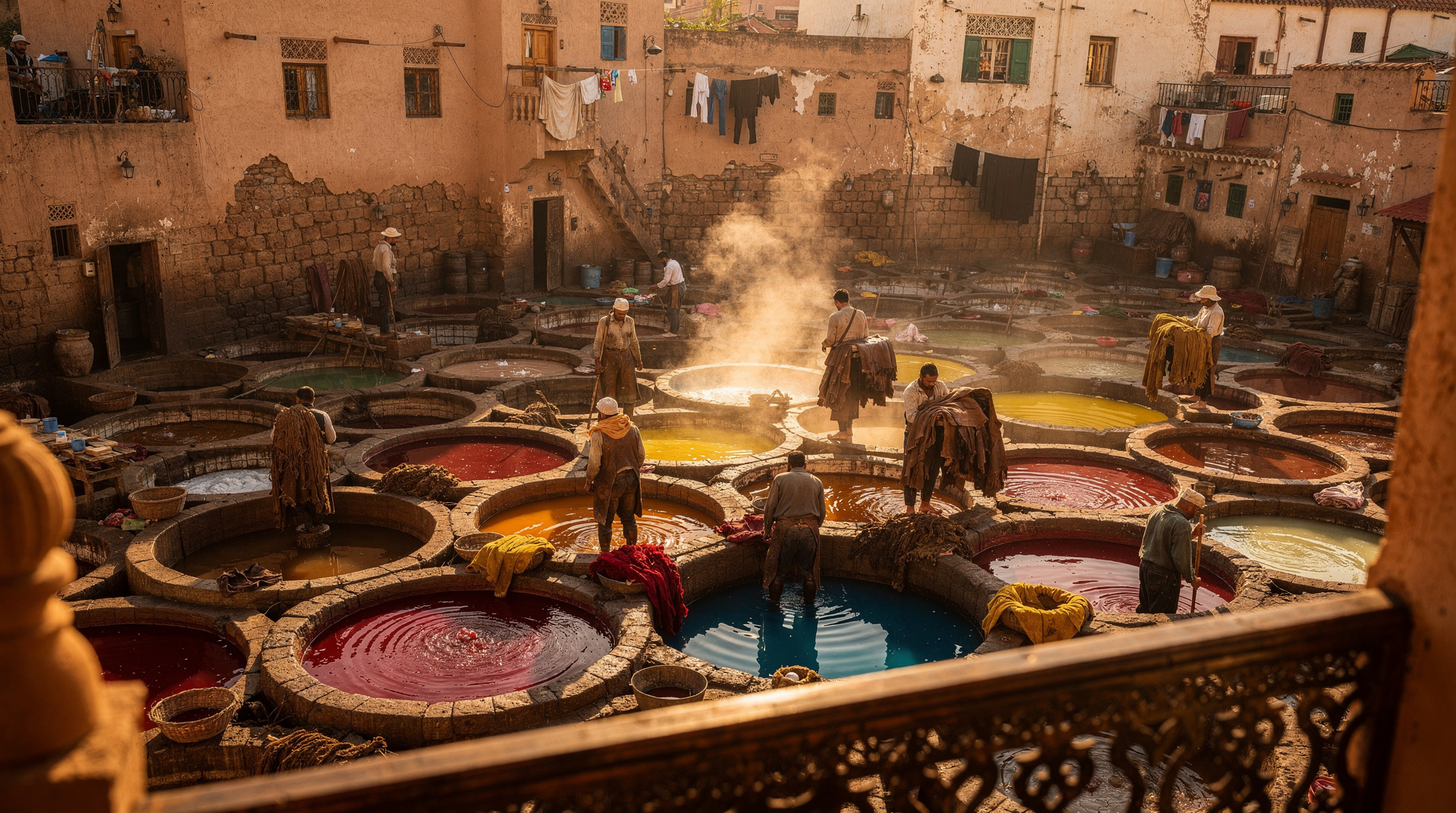
What surprises first-timers most is the layering. Marrakech is not merely a heritage stop — it is a living, breathing metropolis where a century-old tannery sits beside a rooftop cocktail bar, and where the call to prayer echoes over boutique hotels that once hosted Winston Churchill and Yves Saint Laurent. The city rewards slow, purposeful exploration: the traveller who wanders off the main tourist drag into the dyers’ souk or the blacksmiths’ quarter discovers a Marrakech that has barely changed in centuries.
Marrakech is also the ideal base for Morocco’s greatest hits. The Sahara, the High Atlas, Essaouira, and Aït Benhaddou are all within a day’s reach. Many visitors find themselves staying longer than planned.
At a glance
| Where | Southern Morocco, foothills of the High Atlas, Marrakech-Safi region |
| Cost level | Budget riads from around €30-40/night; mid-range €70-200; a day of sightseeing (2-3 monuments plus lunch) around 300-400 MAD per person |
| Time needed | 3-4 days for the city; add 1-2 days for a Sahara or Atlas day trip |
| Getting there | Marrakech Menara Airport (RAK), 6 km from the medina; direct trains from Casablanca and Fes |
| Best time | March-May and September-November; avoid July-August unless you can handle 38-42°C |
Getting There
By air: Marrakech Menara International Airport (RAK) sits 6 km from the medina. Ryanair, easyJet, Royal Air Maroc, and Air Arabia serve it from most European cities. Budget fares from London or Paris can drop below €60 return in shoulder season. From the airport, a petit taxi to the medina costs 70–100 MAD (roughly €7–10); agree on the price before you get in, or insist on the meter.
By train: The Oncf network connects Marrakech to Casablanca (2 hr 15 min, from 90 MAD), Rabat, and Fes via Casa-Voyageurs. The train station is 1 km from Jemaa el-Fnaa — walkable with light luggage or a short taxi ride.
By bus: CTM and Supratours run comfortable overnight coaches from Fes (9 hr), Casablanca (3.5 hr), and Agadir (3 hr). Prices are competitive with trains, and buses drop you centrally.
By car: The A7 motorway from Casablanca is fast, well-maintained, and toll-based (roughly 70 MAD). Driving inside the medina is impossible — park outside the walls and walk.
Getting Around
On foot: The medina is designed for pedestrians and mules, not cars. Almost every major sight sits within a 30-minute walk of Jemaa el-Fnaa. Good shoes and a downloaded offline map (Maps.me or Google Maps with offline area saved) are essential — the 9,000 alleys do not forgive overconfidence.
Petit taxis (small orange taxis): These metered three-person cars cover the newer Guéliz and Hivernage neighbourhoods and short medina runs. Meter starts at about 7 MAD. Flag one down or ask your riad to call one.
Caleches (horse-drawn carriages): A romantic option for a city circuit, especially at sunset along the ramparts. Agree on a price first (expect 150–250 MAD per hour for the carriage, not per person).
Ride-hailing: inDriver operates in Marrakech and is generally cheaper than negotiating with taxi drivers. Uber is not present.
Top Things to Do
Jemaa el-Fnaa
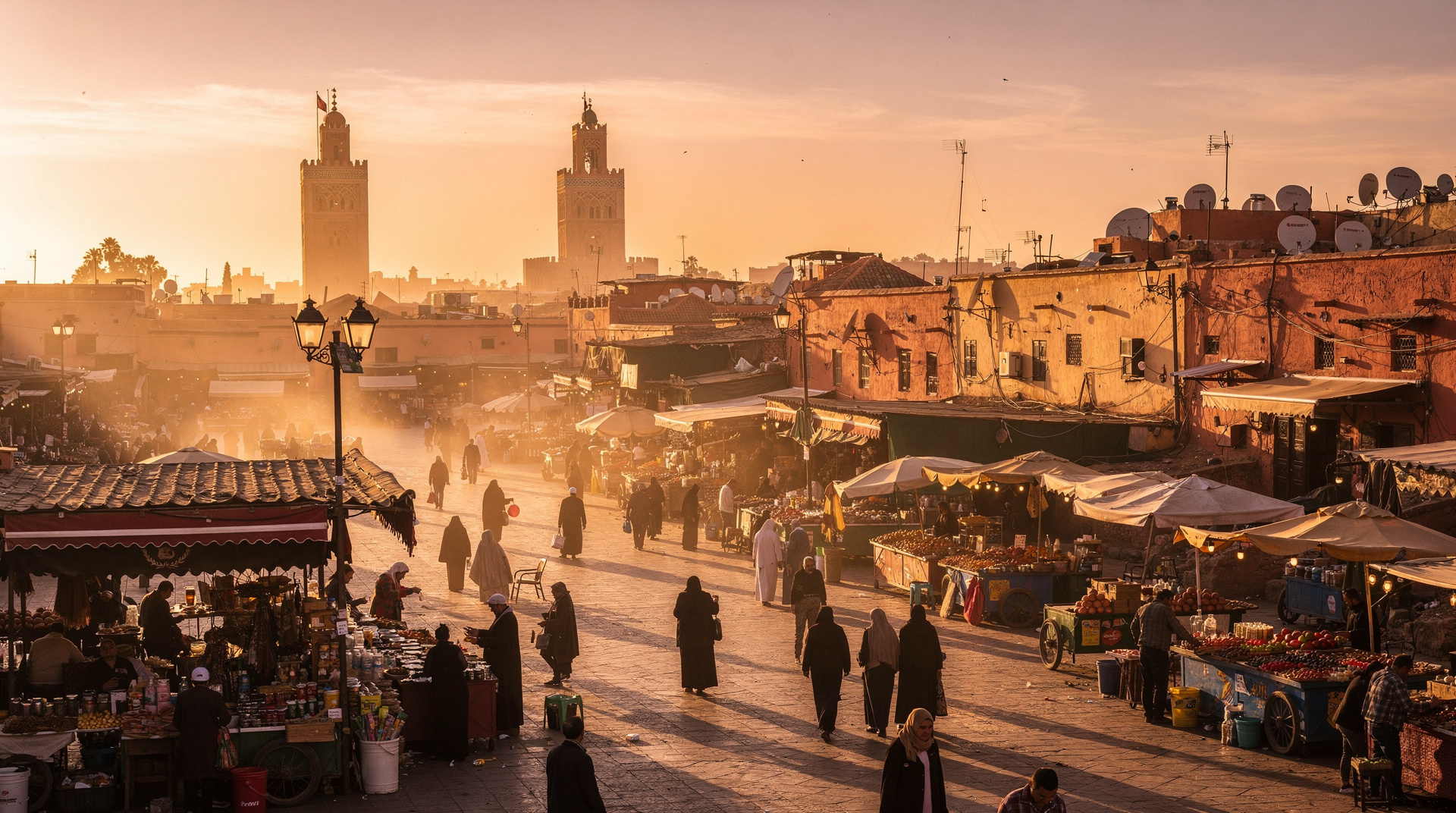
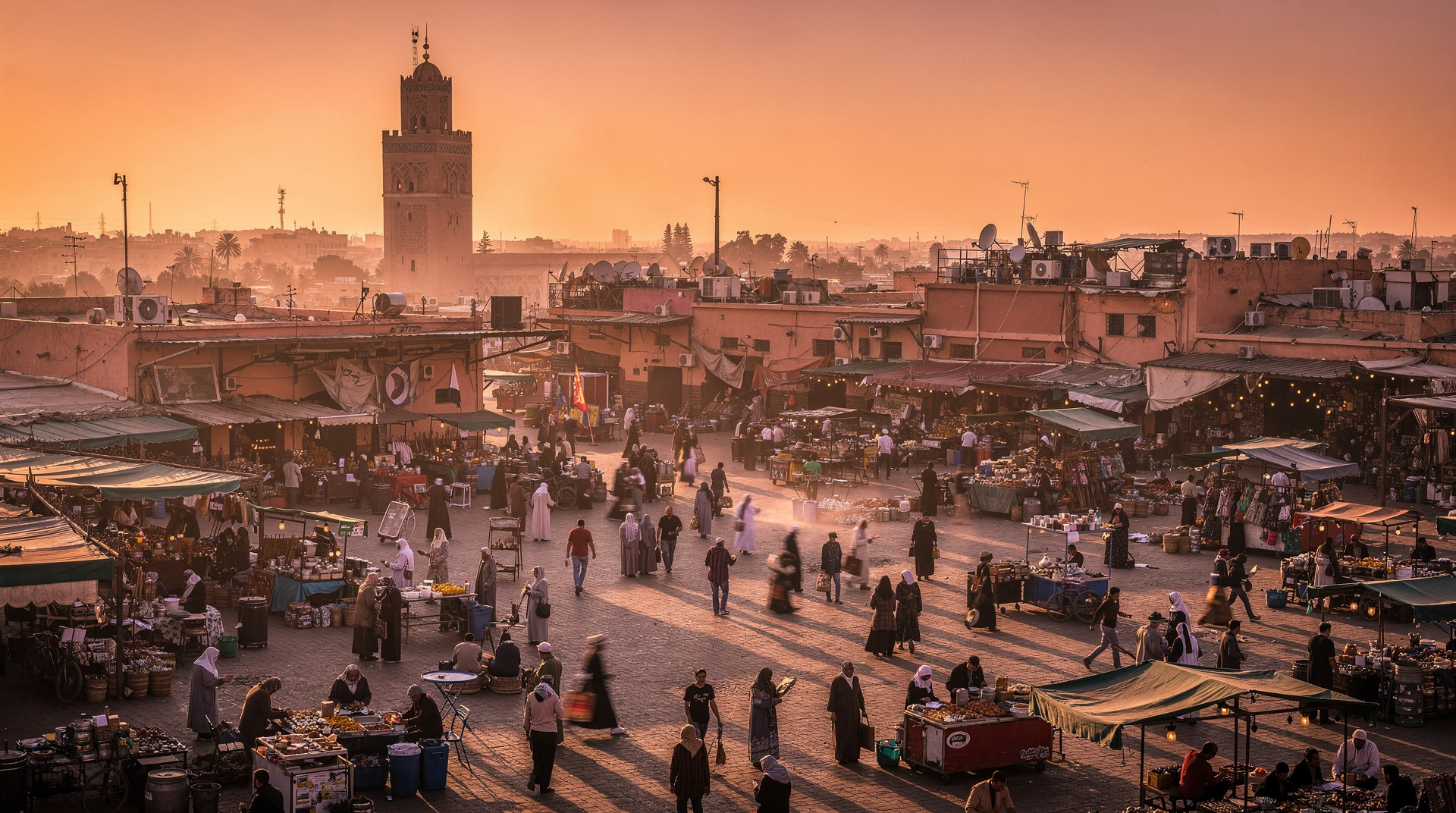
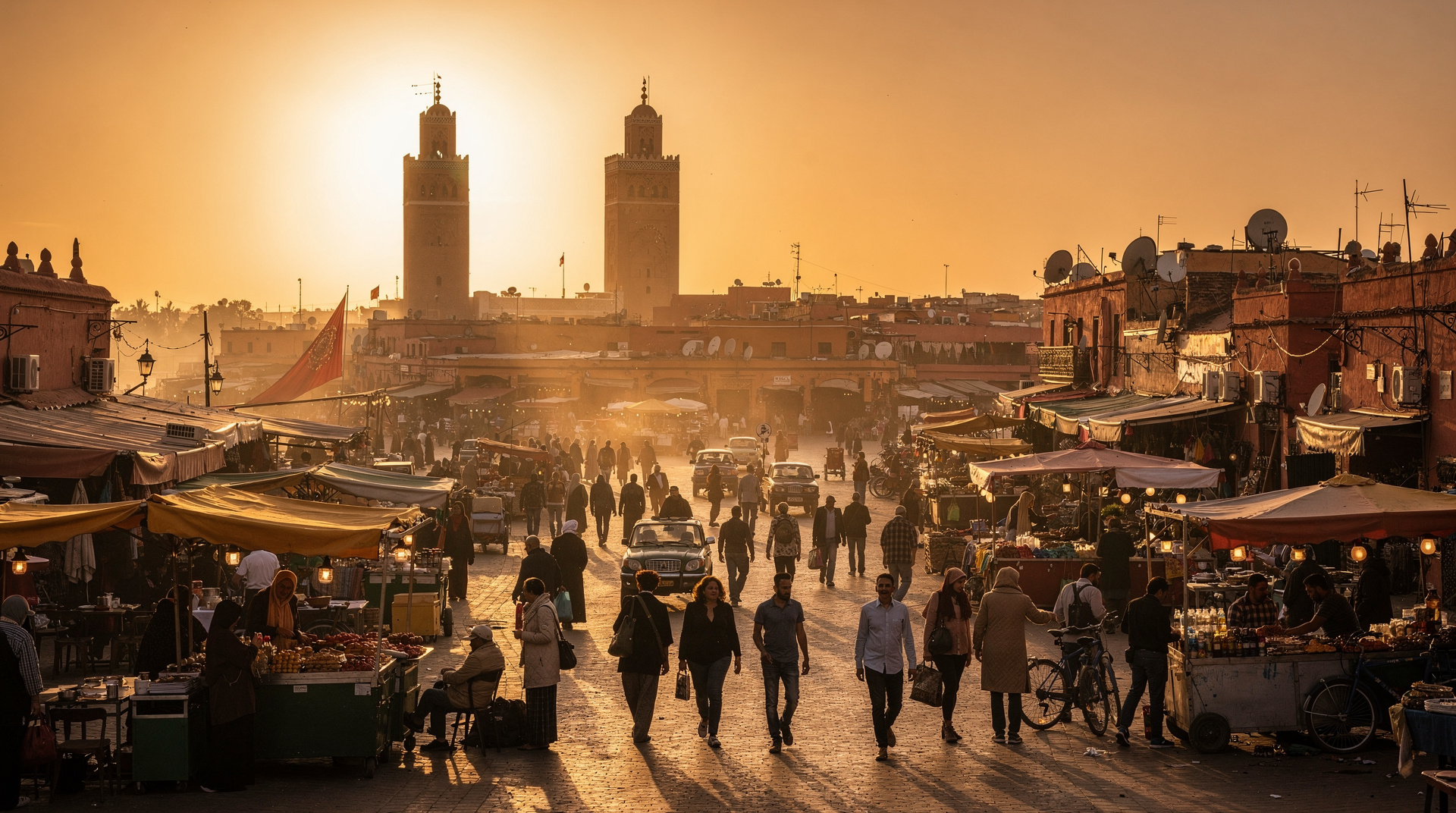
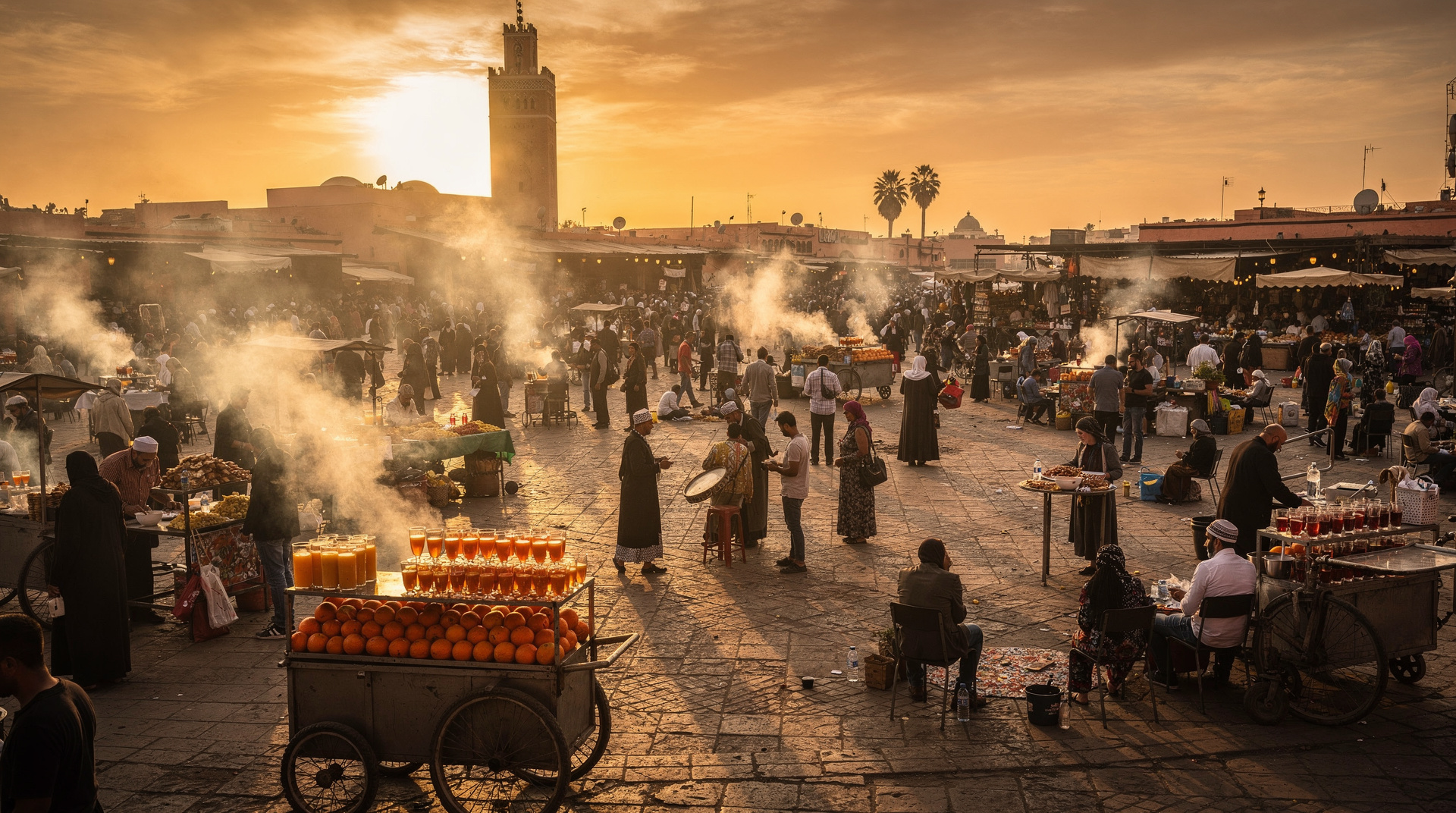
The UNESCO-listed square is the pulsing heart of Marrakech. By day it hosts orange juice sellers (fresh-squeezed, 4 MAD a glass — the best deal in town), snake charmers, and fortune tellers. By dusk it transforms into an open-air theatre: smoke rising from a hundred food stalls, gnaoua musicians competing with Berber storytellers, and the minarets of the Koutoubia Mosque glowing above it all. Go more than once: morning, afternoon, and after 9 pm are three completely different experiences.
Koutoubia Mosque
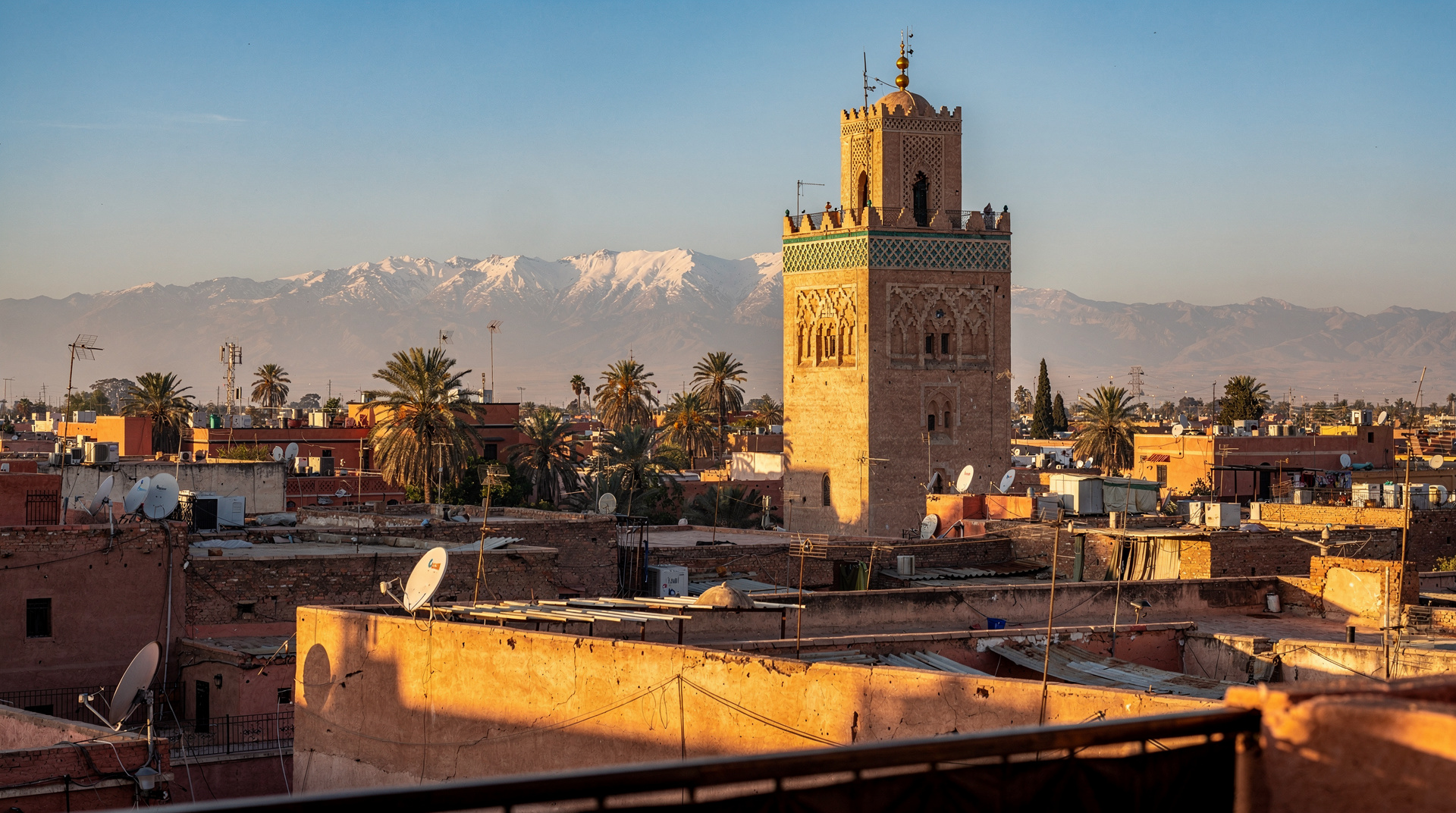
The 12th-century Koutoubia Mosque and its 70-metre minaret are Marrakech’s most recognisable landmark — visible from almost everywhere in the medina. Non-Muslims cannot enter, but the surrounding gardens are public and lovely at dusk.
The Souks
North of Jemaa el-Fnaa, the souks fan out into specialist quarters: the Souk Semmarine for fabrics and clothing, the Souk des Bijoutiers for silver and gold, and the Souk Cherratin for leather goods. Bargaining is expected; start at roughly 40% of the opening price. Don’t rush — the souks reward wandering.
Bahia Palace
Built for a 19th-century grand vizier and his harem, Bahia Palace showcases the finest Moroccan craftsmanship of its era: carved cedarwood ceilings, intricate zellij tilework, and cool marble courtyards. Entry is 70 MAD. Arrive early (before 10 am) to beat tour groups.
Book a guided Bahia Palace, Ben Youssef Madrasa & Medina tourSaadian Tombs
Discovered behind a sealed wall in 1917, these 16th-century royal tombs contain over 60 decorated mausoleums. The craftsmanship rivals the Alhambra — and entry is only 70 MAD. Visit midweek in the morning to avoid the worst of the crowds.
Ben Youssef Madrasa
Once the largest Quranic school in North Africa, this 14th-century madrasa (with major 16th-century renovations) features 67 student cells surrounding a central pool and some of the most intricate stucco and cedar carvings in Morocco. Entry around 70 MAD.
Jardin Majorelle and the Berber Museum
Yves Saint Laurent and Pierre Bergé bought this electric-blue botanical garden from Jacques Majorelle in 1980 and restored it to immaculate condition. The cobalt-blue studio now houses the remarkable Berber Museum. Crowds are heavy from 10 am–3 pm; arrive at opening (9 am) or late afternoon.
Get Jardin Majorelle and Berber Museum entry ticketsHammam
A traditional hammam is one of Marrakech’s non-negotiable experiences. Local hammams charge 15–30 MAD and involve a vigorous kessa (exfoliating glove) scrub. Tourist hammams such as Hammam de la Rose and Les Bains de Marrakech offer a gentler, more guided experience at 200–600 MAD.
Book a traditional Moroccan hammam experienceCooking Class
Learning to make a proper tagine and bastilla from a local cook is one of the most satisfying things you can do in Marrakech. La Maison Arabe runs acclaimed workshops that include a morning market visit.
Book a Moroccan cooking workshop at La Maison ArabeNeighbourhoods
Medina (old city): This is Marrakech’s soul — 1,000 years of dense alleyways, riads, mosques, and souks. Most visitors base themselves here, and rightly so. It is loud, beautiful, and endlessly disorienting, which is part of the charm.
Guéliz: The French-built new town (Ville Nouvelle) 2 km west of the medina walls. Wide boulevards, international restaurants, art galleries, and chain hotels. Less atmospheric but calmer and easier to navigate. Worth an afternoon browse.
Hivernage: The upscale hotel and entertainment district adjacent to Guéliz. Quiet, manicured, home to five-star properties and the Palais des Congrès.
Mellah (Jewish Quarter): Directly south of Bahia Palace, the old Jewish quarter contains a fascinating covered market, 19th-century synagogues open to respectful visitors, and a quieter energy than the main medina. Largely Muslim-inhabited today, but the architecture reflects its history.
Where to Stay
Luxury (from 4,000 MAD / €400 per night)
La Mamounia is arguably the world’s most famous riad-hotel, a Winston Churchill favourite set within 8 hectares of Andalusian gardens. Its three pools, multiple restaurants, and legendary spa justify the price tag for special occasions.
Royal Mansour was built on the personal orders of King Mohammed VI, who reportedly wanted guests to experience a private medina. Each of its 53 riads comes with a private plunge pool. Service is extraordinary.
Mid-range (700–2,000 MAD / €70–200 per night)
Riad BE Marrakech is a stylish, design-forward riad in the heart of the medina with plunge pool, excellent breakfast, and genuinely helpful staff. Consistently rated among the best mid-range options.
Palais Sebban offers 15 individually decorated rooms around two courtyards, rooftop terrace, and warm service near the Bahia Palace. Very good value.
La Sultana sits just outside the Saadian Tombs and combines five historic riads into a seamless hotel with rooftop pool and hammam.
Budget (under 500 MAD / €50 per night)
Riad Yasmine is a popular, well-run budget riad with a famous splash pool that photographs beautifully. Rooms are basic but clean, and staff are helpful with directions and bookings.
Riad Laz Mimoun offers simple rooms, a rooftop terrace, and a central medina location at prices that are hard to beat.
Food and Drink
Nomad (Pl. Bab Fleuh, medina) is the city’s most reliably good contemporary Moroccan restaurant. The slow-cooked lamb, rooftop terrace, and thoughtful wine list attract both locals and visitors. Budget around 250–350 MAD per person.
Dar Yacout (20 Rue Mohammed Abdel Aziz) is a classic dinner destination: a multi-room palace with rooftop aperitifs, Gnaoua musicians, and a lavish set menu of Moroccan specialities. Expect to pay 500–700 MAD per person. Reserve several days ahead.
Café Arabe (184 Rue Mouassine) serves solid Moroccan-Italian fusion on a beautiful terrace. The lamb with caramelised onions and prunes is a consistent highlight. Dinner for two: 400–600 MAD.
Latitude 31 (Guéliz district) is a breezy, airy spot popular with Marrakech’s creative class. Good for lunch or a relaxed dinner with light Moroccan dishes and well-priced wine.
Jemaa el-Fnaa food stalls: Eating at the numbered stalls in the square is the classic Marrakech dinner experience. Stall 14 and stall 32 are consistently praised for their harira soup, merguez, and lamb chops. Budget 60–120 MAD per person. Not the finest cuisine, but the atmosphere is unbeatable.
Café de France (overlooking Jemaa el-Fnaa) is a perfectly positioned terrace for a mint tea and people-watching at any time of day.
Day Trips from Marrakech
Aït Benhaddou and the Draa Valley: A 3-hour drive takes you to the UNESCO-listed ksar of Aït Benhaddou and beyond into the extraordinary Draa Valley. Best done as a guided day trip or the first stop on a longer south-Morocco loop.
The Sahara via Merzouga: A 3-day trip from Marrakech over the High Atlas to Merzouga and Erg Chebbi is the most popular multi-day excursion in Morocco. The road through the Tizi n’Tichka pass (2,260 m) is spectacular.
Book a 3-day desert tour from Marrakech to MerzougaEssaouira: The breezy Atlantic port of Essaouira sits 2.5 hours west by bus or shared taxi. Its whitewashed medina, ramparts, and seafood restaurants make for a perfect day or overnight trip.
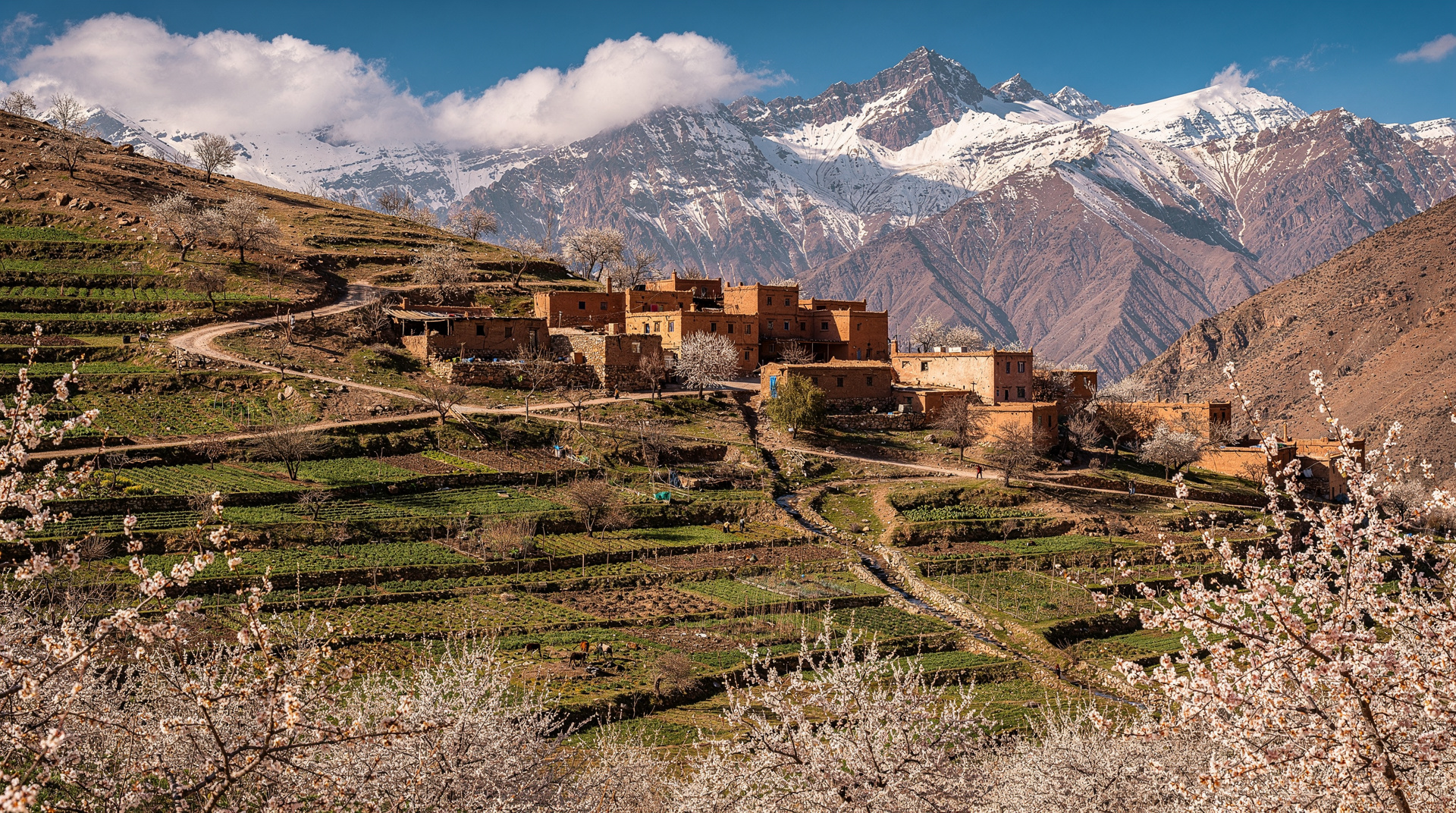
Ourika Valley and High Atlas villages: Just 60 km from the city centre, the Ourika Valley offers Berber villages, terraced gardens, and a rewarding hike to Setti Fatma waterfalls. Easily arranged as a half-day.
Hot air balloon over the Atlas foothills: One of Marrakech’s most memorable experiences — a sunrise balloon flight over the Haouz plain and palm groves, followed by a Berber breakfast.
Book a hot air balloon ride with breakfastSample 3-Day Marrakech Itinerary
Day 1 — The Medina Morning: Arrive, check into your riad, and orient yourself with a slow walk to Jemaa el-Fnaa. Drink fresh orange juice (4 MAD). Visit the Koutoubia Mosque gardens. Afternoon: Ben Youssef Madrasa, then get deliberately lost in the souks heading south toward Rahba Kedima. Evening: Aperitif on a rooftop overlooking the square, dinner at Nomad, then back to the square as the storytellers take over.
Day 2 — Palaces, Gardens, and Hammam Morning: Bahia Palace at 9 am before crowds, then Saadian Tombs, then the Mellah market. Midday: Lunch at Café Arabe. Afternoon: Jardin Majorelle and the Berber Museum. Late afternoon: Traditional hammam at Les Bains de Marrakech. Evening: Rooftop dinner at Dar Yacout.
Day 3 — Day Trip or Deeper Exploration Option A: Half-day cooking class, afternoon Guéliz galleries, evening at Latitude 31. Option B: Full-day drive to the Ourika Valley and the waterfalls. Option C: Early start for the Ouzoud Waterfalls (3 hr each way) — Morocco’s most impressive falls, 110 m high.
Practical Tips
Dress code: The medina is a working Muslim neighbourhood. Cover shoulders and knees out of respect (and to avoid harassment). Loose linen clothing works well in summer heat.
Bargaining: Expected in the souks, not in restaurants or fixed-price shops. Never feel obligated to buy because you’ve started negotiating.
Hassle and touts: Marrakech has significantly cleaned up its act since the early 2000s, but unsolicited “guides” still lurk near the entrance to the souks. A confident “la shukran” (no thank you) in Darija usually does the trick. Buy a proper guided tour to see the souks in peace.
Money: ATMs are widely available around Jemaa el-Fnaa and in Guéliz. Bring cash for souks, taxis, and food stalls. Credit cards are accepted in restaurants and hotels but often with a surcharge.
Safety: Marrakech is generally very safe. The main risks are pickpockets in crowded areas and motorbikes in medina alleyways. Keep valuables secured and use the sides of alleys.
Temperature: Summer (June–August) is genuinely hot — often above 38°C. The spring and autumn windows (March–May, September–November) are ideal. Winters are mild by day but cold at night.
Language: Darija (Moroccan Arabic) is the local tongue; French is widely understood in hotels and restaurants. Basic French goes a long way.
Marrakech as a Base: How It Compares
Marrakech is often the default first stop, but it’s worth weighing against Morocco’s other imperial and coastal bases before committing several nights to it.
| Base | Best for | Trade-off vs Marrakech |
|---|---|---|
| Marrakech | Souks, nightlife, day trips to Sahara and Atlas | Busiest and most tourist-saturated medina |
| Fes | Deeper medieval atmosphere, fewer touts | Larger, more disorienting medina; fewer direct flights |
| Essaouira | Relaxed coastal pace, seafood, cooler climate | Fewer major monuments, smaller nightlife scene |
| Marrakech vs Casablanca | Casablanca for business/transit hub | Casablanca has far less heritage appeal |
If you’re trying to decide between Morocco’s two most-compared cities, the Marrakech vs Fes guide goes deeper into which imperial city suits your trip style, and the Marrakech vs Essaouira base guide is useful if you’re choosing a single base for a shorter trip.
Riad Etiquette and Medina Navigation
Staying in a riad is part of the Marrakech experience, but it comes with a learning curve first-timers underestimate. Riads have no street-facing signage beyond a small numbered door — arrange for your host to meet you at a nearby landmark (a mosque, a known shop) rather than trying to navigate the final 200 metres yourself with luggage. Most riads employ a porter service for exactly this reason; use it.
Inside, riads run on a different rhythm than hotels: breakfast is typically served on the rooftop between 8 and 10 am, and many close their reception between activities, so confirm check-in and check-out windows in advance. Removing shoes before stepping onto carpeted salon areas is appreciated though rarely enforced. If you’re travelling with young children, see our guide to kid-friendly riads in Marrakech — pool depth and stair layout vary enormously between properties.
For getting between riads, restaurants, and sights after dark, note that medina alleys are unevenly lit; a phone flashlight and a downloaded offline map are more useful after 9 pm than during the day. Comparing Airbnb against a traditional riad is worth doing before booking if you value having staff on hand versus more space and a kitchen.
Frequently Asked Questions about Marrakech
How many days do you need in Marrakech?
Three full days covers the main sights comfortably. Two days is feasible for a focused visit. Four or five days allows for day trips to the Atlas mountains, Essaouira, or Aït Benhaddou without feeling rushed.
Is Marrakech safe for solo female travellers?
Yes, though the medina souks involve a level of persistent attention that some find uncomfortable. Dressing conservatively, walking purposefully, and knowing a few words of French or Darija helps significantly. Evening solo walks around Jemaa el-Fnaa are generally fine.
What is the best area to stay in Marrakech?
Inside the medina, within walking distance of Jemaa el-Fnaa, is the classic choice — the atmosphere is unbeatable. Guéliz is quieter and better for light sleepers. Budget travellers often find good value in the southern medina near Bab Agnaou.
When should I avoid Marrakech?
July and August can be brutally hot (regularly 38–42°C). Jemaa el-Fnaa is also at peak saturation during European school holidays. March–May or October–November offers the best combination of weather and manageable crowds.
Do I need a visa for Morocco?
Citizens of the EU, UK, USA, Canada, and Australia do not need a visa for stays under 90 days. Check the Moroccan foreign ministry website for the current list of visa-exempt nationalities before travelling.
Can I drink alcohol in Marrakech?
Yes — alcohol is available in licensed restaurants, hotel bars, and some upscale supermarkets. It is not sold in the medina souks or traditional cafés. Drinking publicly in non-licensed settings is not appropriate.
Is Marrakech or Fes better for a first trip to Morocco?
Marrakech is the easier first stop: more direct flights, a more navigable medina despite the maze, and a wider range of riads and restaurants for every budget. Fes rewards travellers who want a deeper, less commercialised medieval atmosphere and don’t mind a steeper learning curve. See the Marrakech vs Fes comparison for a full breakdown.
How much does a day in Marrakech cost?
Budget travellers can manage on 300-400 MAD per day (guesthouse, street food, one paid sight). Mid-range travellers combining a mid-range riad, sit-down meals, and 2-3 paid attractions should budget 800-1,200 MAD per day. Luxury stays at properties like La Mamounia push this well beyond 3,000 MAD per day.