Quick facts
- Language
- Darija, Spanish, French
- Population
- ~1 million
- Airport
- Tangier Ibn Battouta (TNG)
- Best for
- Gateway, kasbah, literary history, beaches
Why Visit Tangier
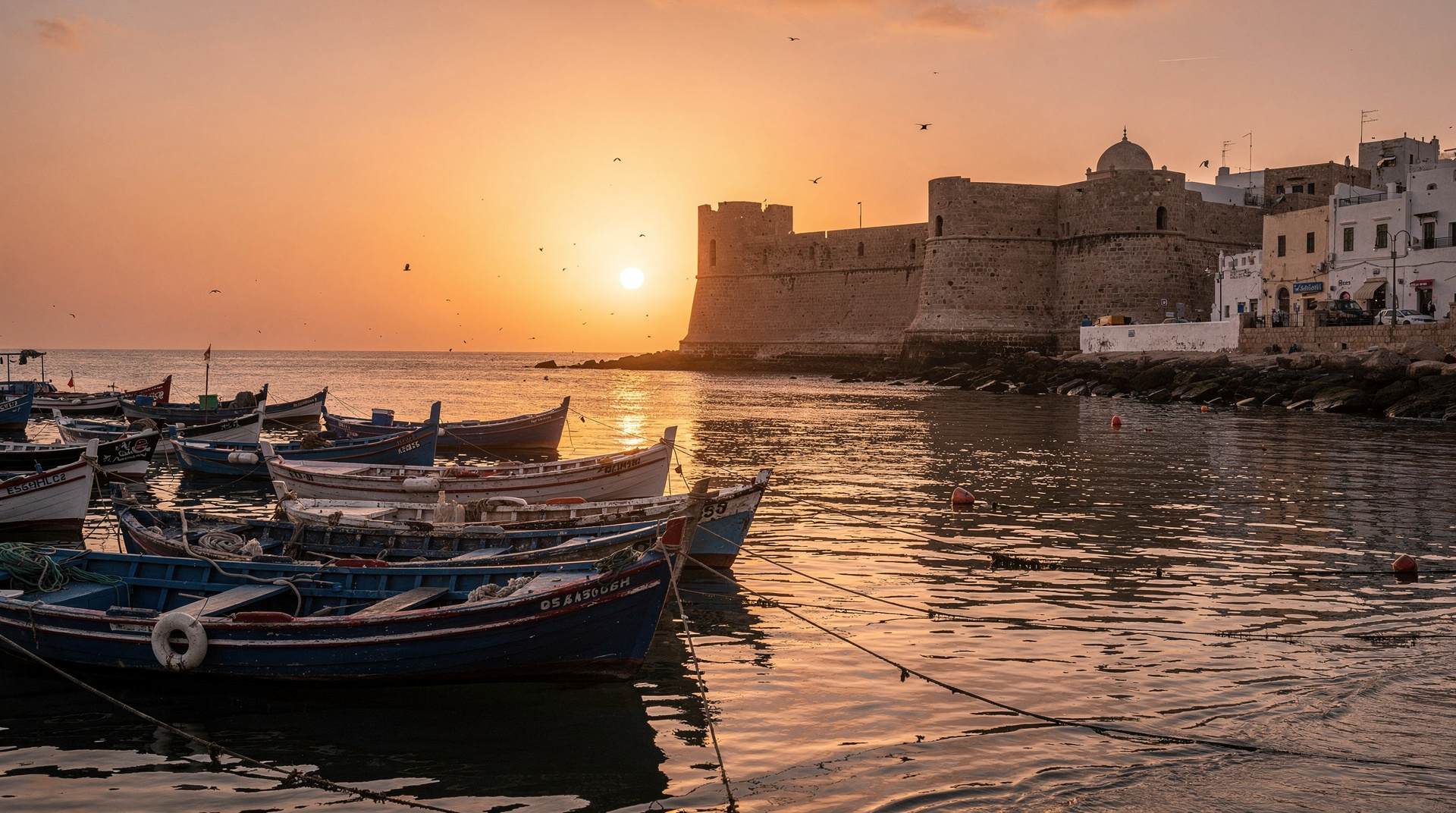
Tangier occupies one of the most strategically charged positions in the world: the point where the Strait of Gibraltar narrows to just 14 kilometres, where Africa and Europe gaze at each other across blue water, where the Atlantic and the Mediterranean meet. This geography has made Tangier a gateway city for millennia — Phoenician, Roman, Moorish, Portuguese, Spanish, and French in sequence — and given it a layered, cosmopolitan energy unlike any other Moroccan city.
The 20th century added another chapter. Between 1923 and 1956, Tangier was an International Zone administered jointly by multiple foreign powers, a legal and moral no-man’s-land that attracted spies, exiles, writers, artists, and the morally flexible from across the world. William S. Burroughs wrote Naked Lunch here. Paul Bowles lived in Tangier for 52 years. Tennessee Williams, Jack Kerouac, Truman Capote, and Cecil Beaton all passed through. The writer and the fugitive were equally welcome in the International Zone, and something of that quality — a city comfortable with ambiguity and outsiders — persists today.
What surprises first-timers about Tangier is how dramatically it has changed in the past decade. The city that was synonymous with seediness and hassle in the 1990s has undergone a major regeneration: the port has been redesigned, the medina restored, the Corniche upgraded, and the Al-Boraq TGV rail line has brought Casablanca within 2 hours. Modern Tangier is confident, energetic, and well worth more than a perfunctory transit stop.
The gateway framing remains powerful: Tangier is the ideal starting point for a Morocco circuit heading south to Chefchaouen, Fes, and beyond.
| At a glance | |
|---|---|
| Where | Northern Morocco, on the Strait of Gibraltar |
| Cost | Mid-range city — mid-range hotels 500–1,500 MAD, meals 80–150 MAD |
| Time needed | 1–2 days, more if using it as a base for day trips |
| Getting there | Ferry from Spain, Al-Boraq TGV from Casablanca/Rabat, or flights into TNG |
| Best time | April–June and September–October |
Getting There
By ferry from Spain: Tarifa to Tangier Med (35 min crossing, multiple operators including FRS and Baleària) is the fastest crossing. Algeciras to Tangier Med (around 1.5 hr) and Algeciras to Tangier Ville Port (2 hr) are alternatives. Tangier Med port is 45 km east of the city; Tangier Ville Port is directly in the city centre. If arriving at Tangier Med, buses and shared taxis connect to the city centre (50 MAD, 30–45 min).
By train (Al-Boraq TGV): Morocco’s high-speed rail service connects Tangier Ville station to Casablanca in 2 hr 10 min (from 290 MAD) and to Rabat in 1 hr 30 min. The station is 5 km from the medina; a petit taxi costs 20–30 MAD.
By air: Tangier Ibn Battouta Airport (TNG) receives flights from European cities (Ryanair serves Madrid, Brussels, London Luton, Paris Beauvais, and others). A grand taxi from the airport to the medina costs 100–150 MAD.
By bus: CTM and Supratours connect Tangier to Casablanca, Fes, Marrakech, and Chefchaouen. The central bus station is 3 km from the medina.
Getting Around
Petit taxis: Small blue taxis metered within the city. Most journeys: 15–40 MAD. Essential for trips between the medina, the train station, the beach, and Cap Spartel.
On foot: The medina and kasbah are entirely walkable. The distance between the Kasbah Museum and the Grand Socco (main square) is about 10 minutes. The beach (Plage Malabata) is 3 km from the medina and reachable by taxi.
Grand taxis: For longer trips — Cap Spartel (10 km west), Hercules Caves, or Tangier Med port. Negotiate price upfront.
Train: For the day trip to Chefchaouen or the Al-Boraq to Casablanca or Rabat.
Top Things to Do
The Kasbah
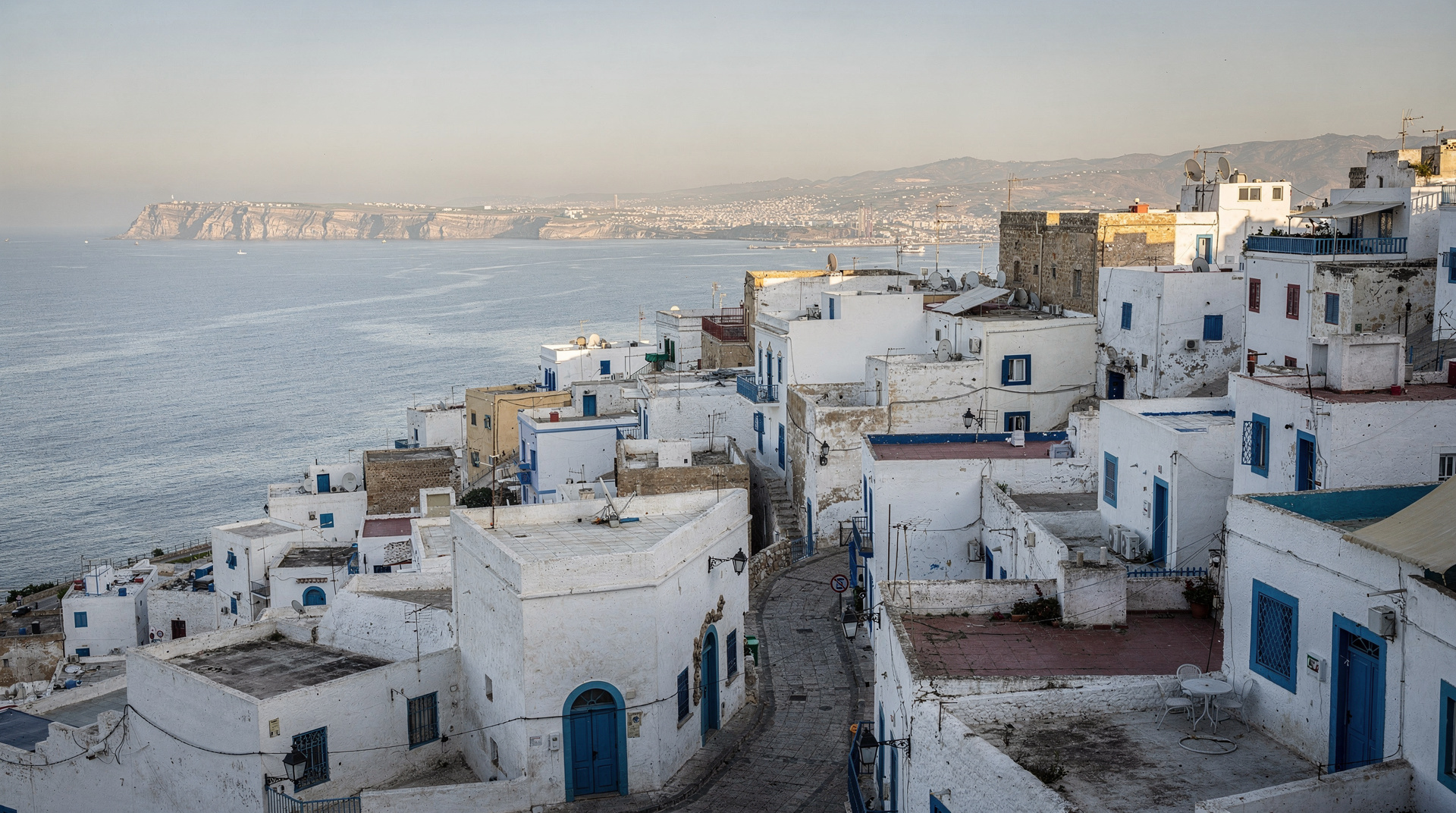
Tangier’s Kasbah is the most atmospheric part of the city: a walled citadel at the highest point of the medina, with panoramic views over the Strait of Gibraltar, Spain visible on clear days, and a tangle of quiet alleyways that descend steeply toward the Grand Socco. The Kasbah Museum (Dar el-Makhzen), housed in the former sultan’s palace, covers Moroccan art, Roman antiquities from Volubilis, and archaeological finds from the Tangier region. Entry: 20 MAD.
Book a guided Tangier medina and kasbah tourThe Medina and the Petit Socco
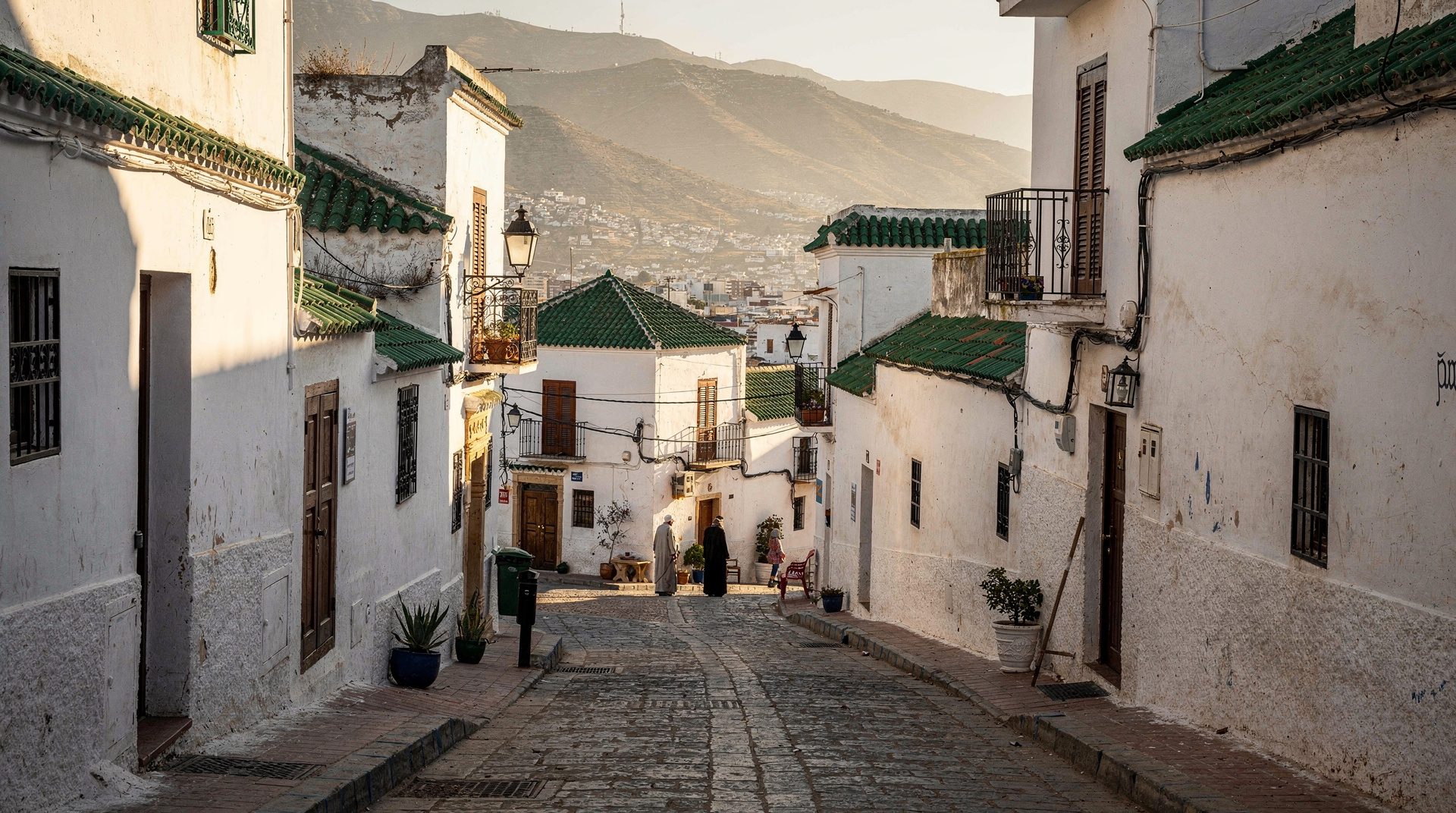
Below the kasbah, Tangier’s medina is smaller and more manageable than those of Fes or Marrakech — easy to navigate in an afternoon. The Petit Socco (Small Market) is its historic centre: a small square ringed by cafés that were once the nerve centre of the International Zone’s espionage, commerce, and bohemian social life. The Café Central, where Burroughs and Bowles both held court, still serves mint tea at marble tables.
Cap Spartel and the Lighthouse
12 km west of Tangier, Cap Spartel marks the meeting point of the Atlantic and the Mediterranean — the northwesternmost point of the African continent. The 19th-century lighthouse and the forested headland above it are genuinely beautiful, and the symbolic weight of standing where two oceans and two continents converge gives the place an almost theatrical grandeur.
Book a Tangier city tour with Hercules Caves and Cap SpartelHercules Caves
3 km from Cap Spartel, the Caves of Hercules are a series of sea caves in the Spartel headland with an extraordinary natural opening in the rock face shaped — famously — like Africa viewed from space. The caves are genuinely impressive, with thundering Atlantic swells visible through the Africa-shaped aperture. Mythology claims Hercules rested here before performing his 11th labour. Entry: 15 MAD.
Book a private half-day Tangier city tour with Hercules CavesPaul Bowles and the Literary Trail
The American expatriate writer Paul Bowles — author of The Sheltering Sky — lived at Apartment 20, Immeuble Itesa, in Tangier from 1949 until his death in 1999. The American Legation Museum (8 Zankat America, in the medina) is the first American diplomatic building on African soil and houses an excellent collection of Bowles-related material: original manuscripts, photographs, correspondence. Entry: 20 MAD. A pilgrimage stop for literary travellers.
The Beach
Tangier’s Plage Malabata stretches 3 km east of the medina along the bay. Clean, with good facilities and views back toward the city. The western beach, below Cap Spartel, is wilder and less populated. Avoid August when Moroccan and Spanish summer holidaymakers fill every available space.
View from Café Hafa
Perched on terraced cliffs overlooking the Strait of Gibraltar, Café Hafa is one of Morocco’s most famous cafés — not for its food (simple mint tea and pastries) but for its spectacular position and its literary pedigree. Rolling Stones, Paul Bowles, Jack Kerouac, and Tennessee Williams all sat at these plastic tables watching Spain materialise and dissolve in the sea haze. A mint tea here is as close as Tangier gets to mandatory.
Neighbourhoods
Medina: The historic old city, entered from the Grand Socco. Compact and manageable — the Petit Socco, the kasbah, and the main souk are all within 15 minutes of each other on foot. The medina was significantly restored after 2010 and is cleaner and less intimidating than it was.
Kasbah: The walled citadel above the medina, accessed via steep stairs or the Bab el-Assa gate. More residential and quieter than the medina below.
Grand Socco (Place du Grand Socco): The main square connecting the old medina with the Ville Nouvelle. The cinema, market days (Thursday and Sunday), and the main medina gate all converge here.
Ville Nouvelle: The French-planned modern town with boulevards, restaurants, hotels, and the main commercial activity. Less atmospheric than the medina but comfortable for a base.
Malabata: The eastern beach district, popular with local families and summer visitors. Several large hotels are situated here.
Where to Stay
Luxury (from 2,000 MAD / €200 per night)
El Minzah Hotel is Tangier’s grande dame — a 1930 International Zone-era hotel that has accommodated every significant figure in the city’s 20th-century history, from Winston Churchill to various Cold War spies. The bar, the pool, the location at the top of the city, and the faded glory make it an experience rather than just accommodation. Doubles from 1,800 MAD.
La Tangerina is a beautifully restored riad-style hotel inside the kasbah with 10 rooms, a stunning terrace overlooking the Strait, and genuinely warm service. The most romantic option in the city. Doubles from 1,500 MAD.
Mid-range (500–1,500 MAD / €50–150 per night)
Dar Chams Tanja is a tastefully decorated guesthouse in the heart of the medina with a rooftop terrace and individually styled rooms. Helpful staff, excellent breakfast, and a quiet location away from the main tourist drag. Doubles from 700 MAD.
Hotel Rembrandt in the Ville Nouvelle is a reliable mid-range hotel with pool and restaurant, popular with business visitors and those who prefer a standard hotel format over riad-style accommodation.
Budget (under 400 MAD / €40 per night)
Dar Nour is a friendly guesthouse in the medina with simple rooms, a rooftop terrace, and genuine local character. Good for solo travellers and those on tight budgets. Dorms available from 150 MAD.
Food and Drink
Tangier’s food scene reflects its hybrid identity — more Spanish and Mediterranean in influence than the tagine-dominated south, with good seafood, tapas-adjacent small plates, and a more relaxed attitude toward alcohol than most Moroccan cities.
El Morocco Club (Place du Grand Socco) is Tangier’s most glamorous restaurant, occupying a beautifully restored 1950s villa. The Moroccan cuisine is excellent — lamb mechoui, bastilla, and fish tagine — and the bar stocks a full range of Moroccan wines and cocktails. Dinner for two: 500–800 MAD.
Le Saveur du Poisson (2 Escalier Waller, near the Petit Socco) is a small, unpretentious fish restaurant that is one of Morocco’s most famous cheap eats: a fixed-price set menu (around 200 MAD) of soup, salads, and whatever fish came in that morning, prepared simply and brilliantly. No menu, no choice, no alcohol — just excellent fish cooked by a Tangier institution.
Salon Bleu (near the Kasbah Museum) is a rooftop terrace café with a sweeping view over the Strait and the city’s rooftops. Good for a mint tea, a light lunch, or a sunset pause between sightseeing.
Restaurant Populaire Saveur de Poisson (medina) serves a different take from the above — a broader menu, cheaper prices, and no reservation required. Popular with local workers and backpackers.
Café Central (Petit Socco) is not a food destination but a historical experience: the café where the International Zone’s legendary mix of expats, artists, and spies used to gather. Mint tea and people-watching only.
Day Trips from Tangier
Chefchaouen: The Blue Pearl of the Rif mountains sits 3 hours from Tangier by bus or shared grand taxi. Chefchaouen is technically doable as a long day trip, though staying overnight is much better. This is one of the most popular itinerary routes in northern Morocco.
Book a Chefchaouen day trip from TangierTetouan: 40 km east of Tangier, Tetouan’s medina is a UNESCO World Heritage Site and significantly less visited than those of Fes or Marrakech. The Spanish influence is strong (the city was the capital of Spanish Morocco) and the Andalusian architecture is distinct. Easy half-day by grand taxi.
Asilah: 45 km south of Tangier, this small whitewashed Atlantic port has beautifully painted murals throughout its medina (renewed each August during the Asilah International Cultural Festival), excellent seafood, and a relaxed pace. Easy day trip by train or taxi.
Ceuta: The Spanish enclave, accessible by grand taxi to the border crossing at Fnideq (30 min from Tangier), then walking across. Worth visiting for the contrast, the duty-free shopping, and the sense of straddling two continents simultaneously.
Asilah day trip guide: For the full logistics on murals, timing, and the festival season, see our Asilah day trip from Tangier guide. For Tetouan, see our Tetouan day trip from Tangier guide, and for Akchour’s waterfalls further into the Rif, our Akchour day trip from Tangier guide.
Sample 2-Day Tangier Itinerary
Day 1 — Medina, Kasbah, and Literary Tangier Morning: Enter medina via Grand Socco. Walk to Petit Socco and Café Central for mint tea. Continue uphill to the Kasbah. Kasbah Museum (1 hr). Rooftop views over the Strait. 12:30 pm: Lunch at Salon Bleu terrace. Afternoon: American Legation Museum (literary trail). 4 pm: Café Hafa for tea and Spain-gazing. Evening: El Morocco Club for dinner.
Day 2 — Cap Spartel, Hercules Caves, and Beach Morning: Grand taxi to Cap Spartel (10 km). Lighthouse and headland walk (1 hr). Hercules Caves (30 min). Seafood lunch in the Cap Spartel restaurant overlooking the Atlantic. Afternoon: Return to city; walk along Plage Malabata. Late afternoon: Le Saveur du Poisson for early dinner. Evening: Al-Boraq train onward to Casablanca or bus to Chefchaouen.
Practical Tips
The hassle factor: Tangier has historically been associated with aggressive touts — a legacy of the 1990s when the city was genuinely rough. The regeneration since 2010 has improved things significantly, but the port arrival area and Grand Socco still attract persistent offers of unofficial guiding. A confident manner and a pre-arranged hotel contact number go a long way.
Spanish is useful here: Tangier’s proximity to Spain, its history as a Spanish protectorate capital, and the heavy summer presence of Moroccan-Spanish dual nationals make Spanish the most useful European language after French.
Ferry arrival logistics: If arriving at Tangier Med port (35–45 km from the city), do not accept rides from individuals approaching on the boat — the journey to the city centre should cost 50–80 MAD by shared bus or 200–300 MAD by grand taxi. Agree the price before departing.
Day trip from Spain: Tangier is fully achievable as a day trip from Tarifa or Algeciras. The crossing takes 35 minutes from Tarifa. Allow at minimum 5 hours in the city to cover the medina, kasbah, and lunch. Day-trippers should book a return ferry before departing.
Money: The city centre has ATMs near the Grand Socco and along the main Ville Nouvelle boulevard. Euros are sometimes accepted near the port; dirhams are always better value.
Frequently Asked Questions about Tangier
Is Tangier worth visiting?
Yes, particularly for travellers interested in the International Zone literary history, the gateway-between-continents geography, and northern Morocco’s more European-flavoured culture. It is not the Morocco of the southern medinas — but that is part of its appeal. Allow at least one full day; two is better.
What is the best way to get from Spain to Tangier?
The Tarifa–Tangier Med crossing (FRS or Baleària Ferries) is the fastest: 35 minutes. The Algeciras–Tangier Med crossing is cheaper and runs more frequently (2 hr). Book online in advance during summer when ferries fill quickly. Arrive at the port 30–45 minutes before departure.
Is Tangier safe?
Modern Tangier is significantly safer than its 1990s reputation suggests. Standard urban precautions apply — secure valuables, don’t flash expensive gear, avoid the unlit medina backstreets late at night. The kasbah, medina, and Ville Nouvelle are all safe for daytime exploration.
Can I do Chefchaouen as a day trip from Tangier?
Technically yes — the journey is 3 hours each way by bus. But it is a very long day with only 2–3 hours in Chefchaouen. An overnight stay in Chefchaouen is strongly recommended for a meaningful visit.
What is the Tangier International Zone?
From 1923 to 1956, Tangier was jointly administered by an international committee (France, Spain, UK, Belgium, Portugal, the Netherlands, and later Italy and the USA). This created a uniquely permissive legal environment — no extradition, relaxed currency controls, open borders — that attracted a remarkable cast of writers, spies, exiles, and adventurers. Paul Bowles, William Burroughs, Jean Genet, and Truman Capote were among those drawn to the city during this era.
How do I get from Tangier to Marrakech?
The most comfortable route is Al-Boraq TGV to Casablanca (2 hr 10 min) then a connecting train to Marrakech (2 hr 15 min) — total journey time around 5 hours. Overnight buses also run directly (8–9 hr) at lower cost. Flying (via Casablanca) is also an option but rarely faster door-to-door.
Should I base myself in Tangier or Chefchaouen for northern Morocco?
Tangier makes the better base if you want a city with an airport, ferry access, and day-trip flexibility to Asilah, Tetouan, and Ceuta. Chefchaouen makes the better base if the blue medina and Rif mountain hiking are your priority. Many itineraries do both — see our Chefchaouen vs Fes guide for how the northern loop typically connects.