Surfing in Morocco: complete guide to waves, seasons and surf camps
When is the best time to surf in Morocco and which region is best for beginners?
October to April brings the strongest Atlantic swells — best for advanced surfers. For beginners, May to September offers smaller, more manageable conditions. Taghazout (20km north of Agadir) is Morocco's premier surf hub with the best beginner infrastructure. Imsouane has the longest wave in Africa — ideal for longboarders.
Morocco’s Atlantic coast: a surfing geography
| Where | Atlantic coast from Tangier to Dakhla; Taghazout region is the main hub, 20km north of Agadir |
| Cost | Around 250-350 MAD for a group lesson, 400-600 MAD private; board rental around 100-150 MAD/day |
| Time needed | A week minimum to see real progress; most camps sell 5- or 10-day packages |
| Getting there | Fly into Agadir (AGA) for Taghazout/Imsouane; Essaouira has its own small airport (ESU, seasonal) |
| Best time | October-April for consistent swell; May-September for beginner-friendly, smaller conditions |
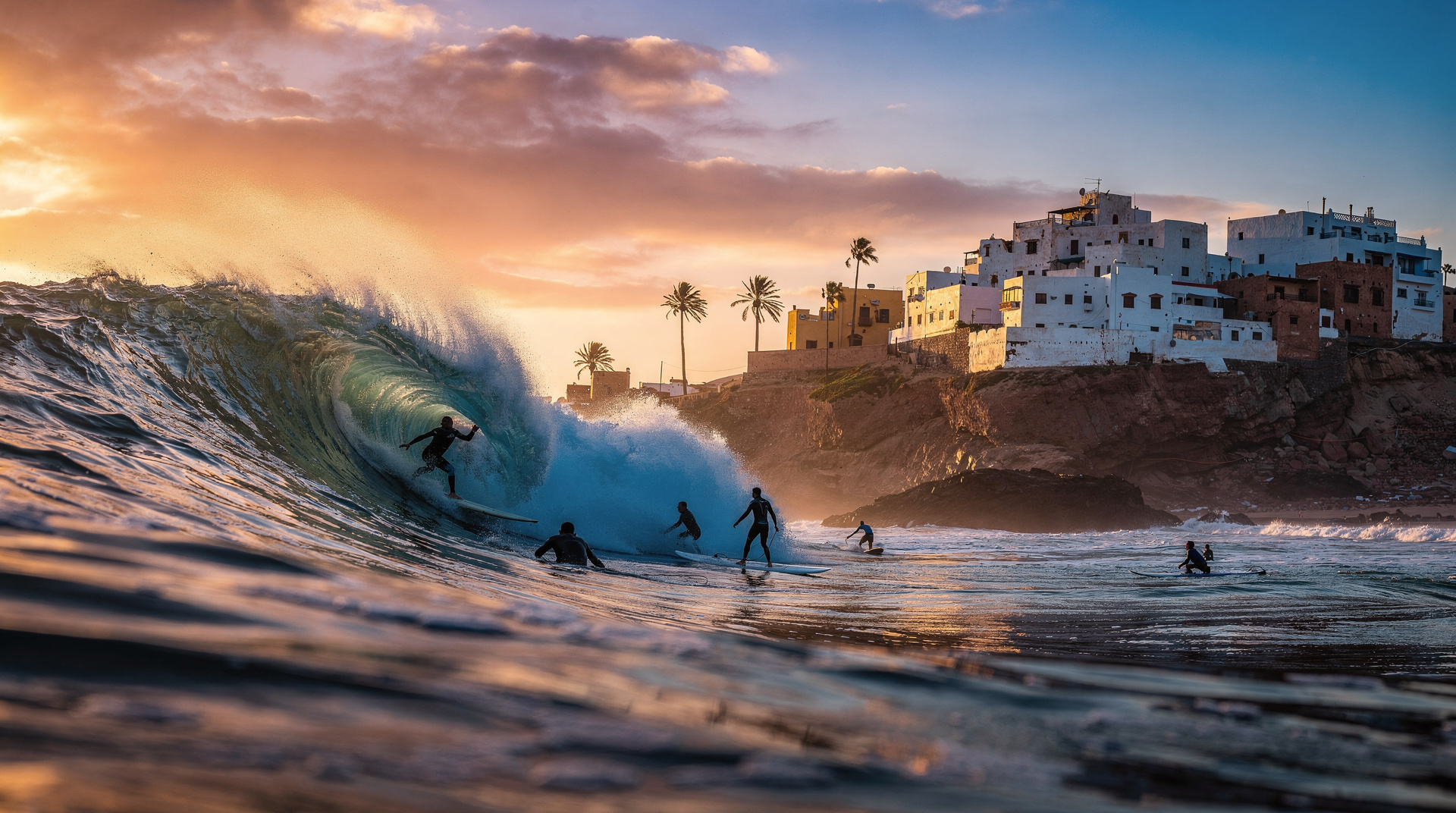
Morocco’s Atlantic coast has been one of surfing’s open secrets for decades. The combination of consistent North Atlantic swells, multiple break types within short radius, warm winters by European standards (water temperature 16–19°C in winter, 20–23°C in summer), and prices that are a fraction of European or Hawaiian equivalents has been drawing surfers since the 1970s. The infrastructure has caught up to the reality: Morocco now has a functioning surf industry from Tanger to Dakhla, with hundreds of camps, schools, and equipment suppliers.
The coast breaks down into four main surfing regions, each with a distinct character:
Taghazout region (Agadir coast): The premier destination. Multiple point breaks within a 15km radius, established surf camp ecosystem, beginner to expert wave options. The most-visited surf destination in Morocco.
Imsouane: 80km north of Agadir, home to the longest right-hand wave in Africa. A bay break producing waves of 400m+ that are perfect for longboarding. One of Africa’s most relaxed surf towns.
Essaouira and Sidi Kaouki: Wind-dominated coast producing consistent wave and kite conditions. Better for intermediate surfers — the strong Alizé wind makes paddling out more demanding.
Safi: A working fishing port with world-class, rarely surfed left-hand point break. Better for experienced surfers who can self-organise. No surf camp infrastructure.
Quick comparison
| Region | Best for | Wave type | Camp infrastructure |
|---|---|---|---|
| Taghazout | Beginners to advanced | Point breaks, right-hand | Extensive |
| Imsouane | Longboarders, intermediates | Long bay wave, right-hand | Growing, low-key |
| Essaouira/Sidi Kaouki | Intermediate, wind/kite | Beach break, wind-affected | Moderate |
| Safi | Experienced, self-organised | Left-hand point break | None |
Undecided between the two closest options? The dedicated Taghazout surf guide breaks down every point break at Africa’s best-known surf hub in more depth than this overview can.
The Taghazout region in detail
The breaks
Anchor Point: Taghazout’s most famous break — a right-hand point break that produces long, clean waves of 200–400m in good swell. Works best on southwest to northwest swell, 6–12 foot range. An intermediate to advanced break that requires duck-diving experience and comfort in solid surf. Gets crowded when swell arrives.
Hash Point: A shorter right-hand point below the old hash dealer quarter (hence the name). Works at smaller swell sizes than Anchor, making it more accessible to intermediate surfers. Still not a beginner break.
Killer Point: The most powerful break in the region — a long right-hand wall that fires on big northwest swell. Not for casual visitors. Expert-only in serious conditions.
Panoramas: A more forgiving right-hand point north of the main village. Works on smaller swells that don’t reach Anchor Point quality. Often the best option for intermediate surfers on days when the main breaks are too big.
Banana Village beach break: Just south of Taghazout, a beach break that produces waves suitable for beginner surf lessons. The majority of surf schools use this break for first-timers.
Surf lessons at Taghazout
Book a beginner surf lesson in TaghazoutA standard 2-hour beginner lesson at Taghazout includes board (foam longboard), wetsuit, and instruction on the beach break. Group lessons (4–6 people): 250–350 MAD per person. Private lessons: 400–600 MAD for a 2-hour session. Most camps offer package deals of 5 or 10 lessons at reduced per-lesson rates.
The surf camp ecosystem
Taghazout and the adjacent village of Tamraght have the highest concentration of surf camps in Africa outside South Africa. The camps range from budget hostels (100–200 MAD per night with surf package) to premium retreats (2,500–5,000 MAD per week all-inclusive with yoga, guided breaks, and quality meals).
What to look for in a surf camp:
- Ratio of instructors to students (maximum 6:1 for water safety)
- Whether the camp goes with you into the water or just watches from the beach
- Board variety — a good camp has foam longboards for beginners, fish and shortboards for intermediates, and performance boards for advanced surfers
- Location — camps in Tamraght are quieter than those directly in Taghazout; both are close to the breaks
Budget camps (100–300 MAD/night): Hostel-style accommodation, surf guiding included, equipment rental extra. Typical examples: Ocean Surfers Club, Surf Club Amazigh.
Mid-range camps (500–1,000 MAD/night): Private or semi-private rooms, meals included, equipment included, daily surf guiding. Typical examples: Surf Maroc (established, consistently rated), Mint Surf (smaller, more personal).
Premium (1,500+ MAD/night): Boutique surf retreat with yoga, massage, excellent food, personalised coaching. Taghazout Bay area has several property-level retreats in this category.
Imsouane: the longest wave in Africa
The break
Imsouane’s bay break is one of the most extraordinary waves in the world for a very specific type of surfer — the longboarder or intermediate surfer who wants sustained, mellow, long-duration riding rather than power and speed. On good swell, the bay produces right-hand waves of 400m+ — long enough that you genuinely run out of wave before you run out of skill.
The wave works because of the bay’s geometry: the swell refracts around the headland and runs parallel to the beach rather than hitting it straight on, producing a slow-peeling wall that allows long, casual riding. In good conditions, a single wave takes 90 seconds to ride — an experience that is meditative rather than adrenaline-driven.
Best conditions: November to April, southwest swell, 3–6 feet. The wave works in larger swells but becomes more powerful and less relaxed.
The town: Imsouane is a small fishing village (population around 2,000) with a handful of surf camps, guesthouses, and restaurants. It has none of Taghazout’s commercial development — which is either its appeal or its limitation, depending on what you’re looking for. The sunset from the café above the bay is one of the coast’s best.
Getting there: 80km north of Agadir on the N1 coastal road. Accessible by grand taxi from Agadir (2.5 hours, with change at Ait Baha junction) or by rental car. No regular CTM service. Surf camps in Imsouane typically arrange transfers from Agadir.
Essaouira: wind-assisted surf
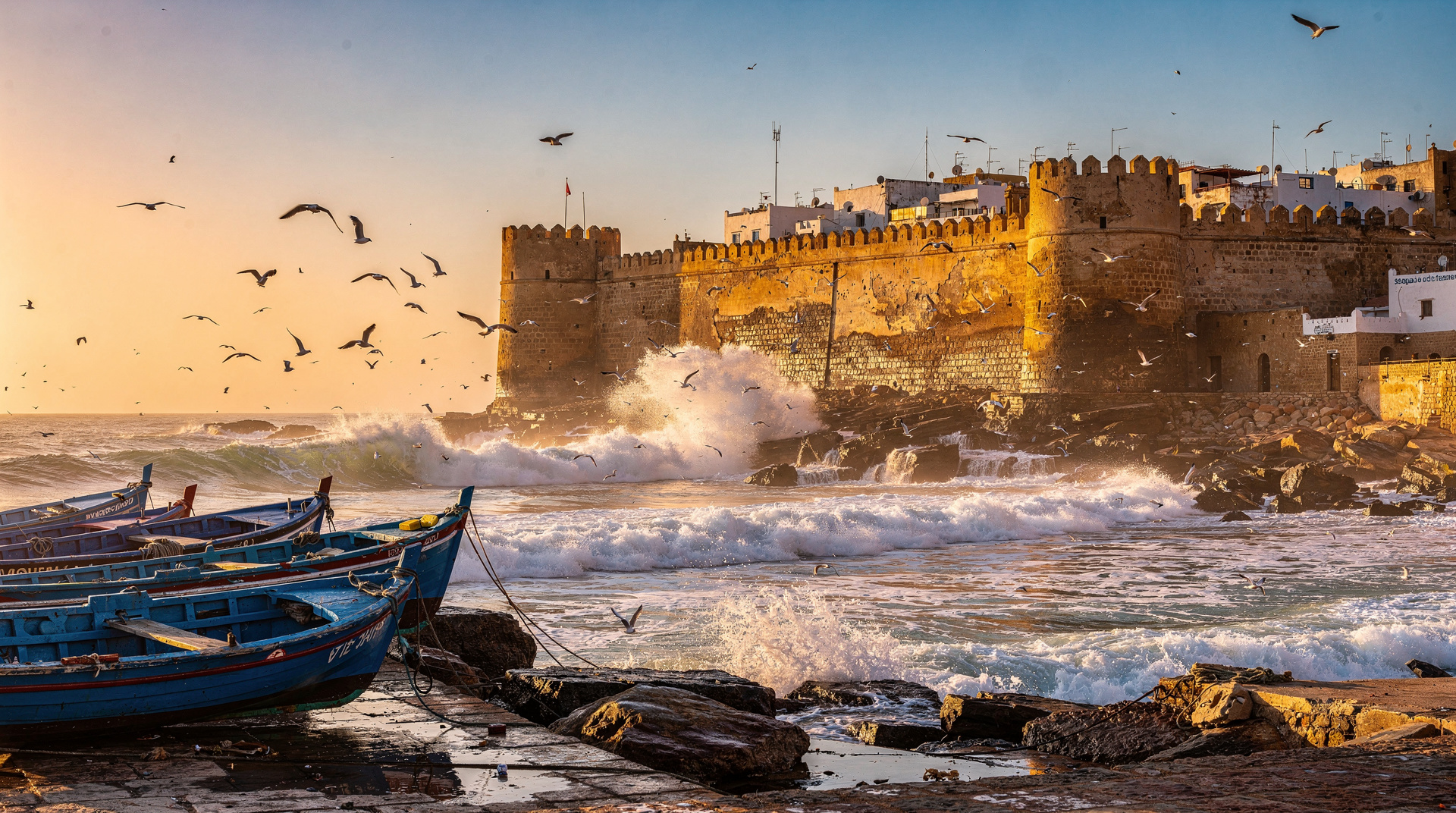
Essaouira’s surfing conditions are dominated by the Alizé trade wind — a northeast trade wind that blows consistently from April to October at 25–35 knots. For surfing, this creates cross-shore to onshore conditions that produce choppy, powerful waves rather than the clean, groomed swells of Taghazout’s point breaks.
This wind character makes Essaouira better for intermediate and advanced surfers comfortable with less-than-ideal surface conditions, and excellent for windsurfers and kitesurfers who benefit from the consistent wind direction and power. For beginners, Taghazout is more suitable for developing foundational skills.
The primary surf spots are the main beach (in front of the medina) and the breaks along the coast toward Sidi Kaouki (25km south). Sidi Kaouki is quieter, with more consistent surfable waves but the same wind character.
Book a surf lesson in EssaouiraEssaouira surf schools: Multiple schools operate on the main beach (Explora Surf, Ocean Vagabonds). Group lesson: 250–350 MAD. Equipment rental: 150–200 MAD per day for board and wetsuit.
Safi: the undiscovered left
Safi is Morocco’s most underrated surf destination — a working fishing port and industrial city (Morocco’s largest phosphate-exporting harbour) with a world-class left-hand point break that fires on northwest swell into a deep, long wall. The wave is rarely in the international surfing press, which keeps it uncrowded even when the conditions are excellent.
The break works off the southern headland of the bay, peeling for 300–500m when the swell is right. It is not a beginner wave — the current is significant and the power is real. But for intermediate-to-advanced surfers who are comfortable self-organising (there are no surf camps at the break itself), Safi produces some of the best surfing in Morocco.
Practicalities: No dedicated surf camp in Safi. Stay in the city centre hotels, rent equipment from the small surf shop near the port, and hire a local guide (ask at the surf shop) to show the best entry points.
Getting there: Safi is on the N1 coastal road between Marrakech and Essaouira (150km north of Essaouira, 220km from Marrakech). CTM buses run from Casablanca and Essaouira. See the Atlantic coast road trip guide for incorporating Safi into a coastal itinerary.
Seasonal surf calendar
October to December: peak season
The North Atlantic storm track activates, sending consistent swell south to Morocco’s coast. October and November produce some of the year’s best conditions — clean 4–8 foot waves at Taghazout, excellent conditions at Anchor Point, and the first winter swells reaching Safi.
Best for: Intermediate to advanced surfers. Water temperature: 19–21°C (wetsuit in 3/2mm).
January to March: big swell season
The largest swells of the year arrive in January and February — consistent 8–12 foot+ conditions at Anchor Point and Killer Point. This is when experienced big-wave surfers visit. For beginners, these months are too powerful for the main breaks but Banana Village and other beach breaks remain manageable.
Best for: Advanced and experienced surfers. Water temperature: 16–18°C (wetsuit in 4/3mm).
April to June: ideal transition
Swell drops from winter maximums but remains consistent. Wave size is generally 3–5 feet at Taghazout — ideal for intermediate surfers. Beginners can progress quickly in these conditions. Crowds start building from Easter onwards.
Best for: All levels. Water temperature: 17–20°C (wetsuit optional in June).
July to September: summer conditions
Summer swell is smaller and less consistent — many days at 1–3 feet with occasional swell events. The wind picks up (particularly at Essaouira). Best for beginners, longboarders, and the first-visit surf lesson.
Best for: Beginners and first-timers. Water temperature: 21–23°C (no wetsuit needed).
Board rental and equipment
At Taghazout
Board rental from the dozens of surf shops along the main street: 100–150 MAD per day for a foam longboard; 80–120 MAD for a fibreglass shortboard. Wetsuit rental: 50–80 MAD per day.
Buying vs renting: For a stay of more than 3 weeks, buying second-hand from departing surfers (check the camp notice boards) is often more economical. For most visitors, rental makes more sense.
Bringing your own board
If you have your own board, airlines charge surfboard fees (typically €30–60 each way for a standard board bag). Check your specific carrier’s policy before booking. A board bag with internal padding is essential.
Wetsuits
Water temperature off Morocco’s Atlantic coast ranges from 16°C (January/February) to 23°C (August/September). Wetsuit requirements:
- January–March: 4/3mm full wetsuit
- April–June: 3/2mm full wetsuit or springsuit
- July–September: Springsuit or boardshorts depending on personal tolerance
- October–December: 3/2mm full wetsuit
Choosing between Taghazout, Imsouane and Essaouira
First-time surf travellers to Morocco often default to Taghazout because it is the most-written-about destination, but it is not automatically the right base. If you are a genuine beginner who wants gentle, forgiving waves and doesn’t mind a quieter town, Imsouane rewards patience over power — you will spend more time actually riding waves and less time getting worked over in the impact zone.
If you want variety (multiple breaks for different swell sizes, a big camp scene, nightlife and restaurants), Taghazout wins outright — see the dedicated Taghazout surf guide for a break-by-break breakdown. If wind sports interest you as much as surfing, Essaouira lets you swap a flat surf day for a kitesurfing session without changing towns — the kitesurfing Essaouira and Dakhla guide covers that side of the coast.
Combining a surf trip with the rest of Morocco
Surf-only visitors often underestimate how easy it is to combine a week at Taghazout with a short inland loop. Marrakech is roughly 3 hours from Agadir by road or coach, making a 2-day add-on realistic without derailing the surf week. If you are planning a longer trip around the country, the surf-focused Morocco itinerary lays out how to sequence coast and interior days properly, and the Morocco trip planning guide covers logistics for anyone building a first Morocco itinerary from scratch.
What to combine with a surf trip
Taghazout is 20km from Agadir, which has the airport (AGA) and a full range of accommodation, restaurants, and transport connections. The Paradise Valley day trip from Agadir is a popular non-surf day option. From Agadir, Essaouira is 2.5 hours north and worth a day or overnight for the medina and port atmosphere — see the Essaouira day trip from Marrakech guide if you are approaching from the north instead.
For the kitesurfing equivalent of this guide, see the kitesurfing Essaouira and Dakhla guide. For beach comparisons across the country, the best beaches guide covers the full Atlantic and Mediterranean coast.
Frequently asked questions about Surfing in Morocco
Do I need prior experience to take a surf lesson in Morocco?
No — beginner lessons at Taghazout are genuinely designed for complete first-timers. A 2-hour lesson covers beach safety, paddling technique, how to read waves, and standing up. Most first-timers ride at least a few waves by the end of the session.
How long does it take to learn to surf in Morocco?
A realistic timeline: a full week of daily instruction gets most beginners to the point of independently catching and riding smaller waves. A second week allows meaningful progression to more challenging conditions. Morocco’s surf camp model (5-day or 10-day packages) is designed around this reality.
Is Taghazout better for surfing than Bali or Portugal?
Comparison depends on priorities. Taghazout offers excellent waves at a significantly lower price than Portugal’s prime spots, with more consistent winter swell than Bali’s surf season. The infrastructure is well-developed. The main disadvantage: Morocco’s Atlantic water is colder than Bali year-round, and the cultural environment is more conservative.
What happens if I break a rental board?
Most rental agreements include a damage deposit (200–500 MAD). Major damage (snapping a board) is generally billed at repair cost (150–400 MAD depending on severity). Rental boards are typically foam learner boards that are designed to withstand beginner use without breaking.
Is Imsouane or Taghazout better for a first surf trip?
For genuine beginners, Imsouane’s forgiving bay wave and low-key atmosphere often make faster, less intimidating progress possible. Taghazout has more infrastructure, more break options for when you improve, and a livelier social scene — better if you want variety over multiple weeks. Many surfers base at Taghazout and day-trip to Imsouane.
Do I need travel insurance that covers surfing?
Yes — standard travel insurance often excludes “extreme” or “adventure” sports, and surfing is sometimes classed this way. Check your policy explicitly covers surfing before booking a camp, particularly if you plan to surf breaks like Anchor Point or Killer Point at size.