Getting Around Morocco: Transport Guide
What's the best way to get around Morocco?
It depends on the route. ONCF trains are excellent for the Casablanca-Marrakech-Tangier corridor. CTM buses cover most cities reliably. For the south (Sahara, Draa Valley), car rental or an organised tour is most practical. Petit taxis handle city travel. Domestic flights save time on very long routes.
At a glance
| Best for the north | ONCF trains — Casablanca, Rabat, Marrakech, Tangier corridor |
| Best for the south | Car rental or an organised Sahara tour — trains don’t reach Merzouga or Zagora |
| Typical city taxi fare | Around 10-25 MAD for a short petit taxi ride |
| Booking lead time | 24-48h ahead for ONCF/CTM in peak season; longer around holidays |
| Getting oriented | The Morocco trip planning guide covers how transport ties into an itinerary |
Morocco’s transport options: what works, what doesn’t
Morocco has a better transport network than many travellers expect. The ONCF rail system runs clean, punctual trains on the main northern corridor. Long-distance buses connect most cities. In Marrakech and Fes, taxis are cheap and reliable for city movement.
The gap is the south. Once you’re heading for the Sahara, Atlas Mountains, or the Draa Valley, public transport becomes sparse and organised tours or car rental become the practical options.
This guide covers every mode of transport with realistic information about cost, reliability, and where each option works best.
ONCF trains
Morocco’s national rail operator (Office National des Chemins de Fer) runs one of Africa’s most functional rail networks. The core network connects:
- Casablanca ↔ Marrakech: 3h journey, frequent services, 80-180 MAD (2nd/1st class)
- Casablanca ↔ Rabat: 1h, very frequent
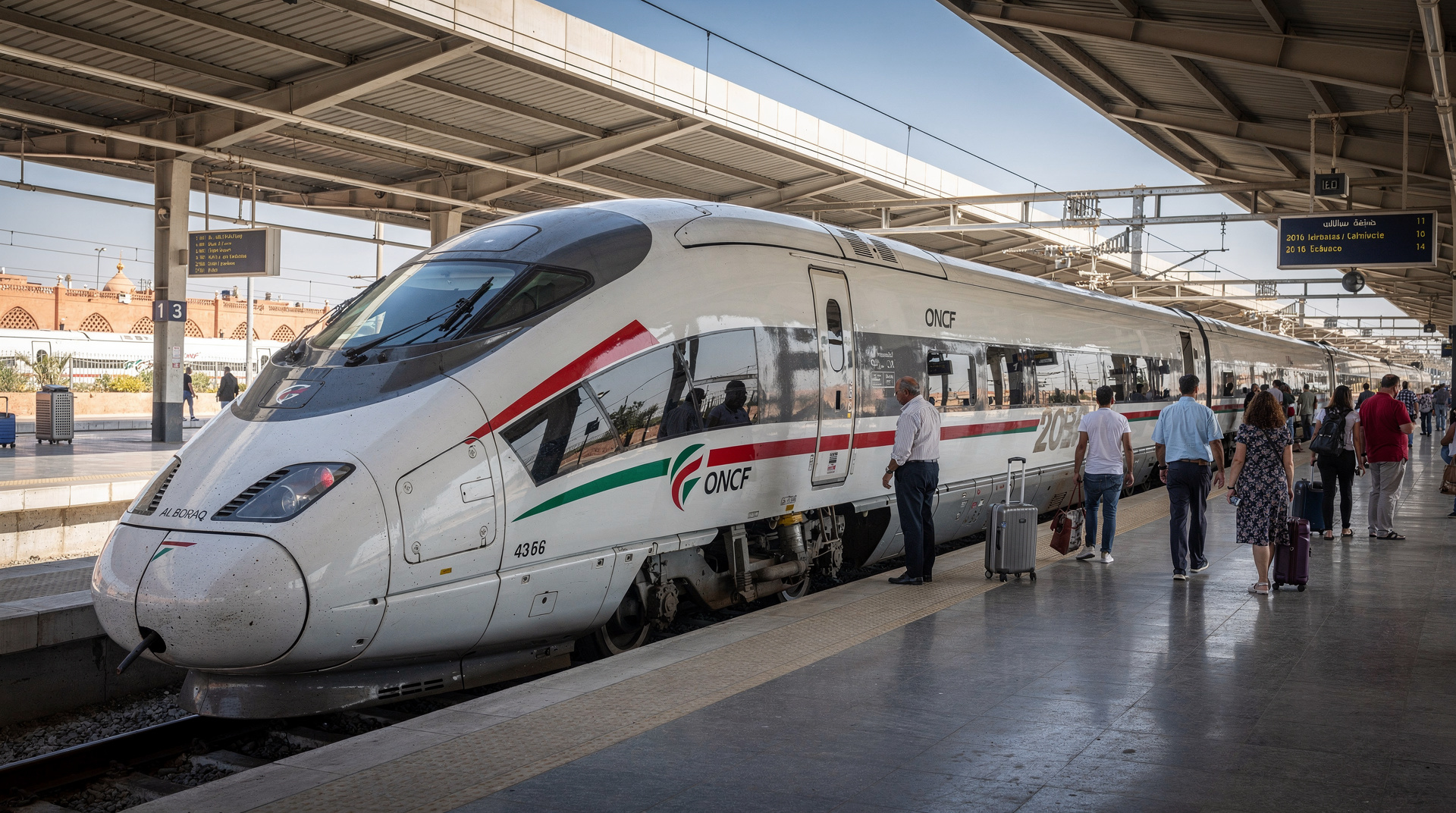
- Casablanca ↔ Tangier: 4h30 (classic service), or 2h10 on the Al Boraq high-speed train
- Casablanca ↔ Fes/Meknes: 4h to Fes via Rabat
Al Boraq high-speed train: Launched in 2018, Morocco’s flagship TGV-style service runs between Tangier and Casablanca. At 320km/h, it covers the 350km route in 2h10. Tickets: 120-250 MAD (2nd/1st class). The train is clean, air-conditioned, and punctual. It makes Tangier reasonably accessible from Casablanca as a day trip.
Booking: Online at oncf.ma or at station ticket windows. Booking 24-48h ahead is usually sufficient except public holidays. First class (around double the price) is worth it for longer journeys — wider seats, better air conditioning.
Key limitation: The rail network does not extend to Marrakech-Agadir, Fes-Merzouga, or any of the southern circuits. For destinations south of Marrakech, trains aren’t the answer.
Long-distance buses: CTM and Supratours
CTM (Compagnie de Transports au Maroc)
CTM is Morocco’s premier bus operator — air-conditioned, usually punctual, assigned seats, luggage storage underneath. The network is extensive:
- Marrakech → Agadir: 3h30, ~100-130 MAD
- Marrakech → Casablanca: 3h30, ~90-120 MAD (though train is often faster and similar price)
- Marrakech → Fes: 8-9h, ~180-220 MAD
- Marrakech → Zagora: 6-7h, ~120-150 MAD
- Fes → Chefchaouen: 4h, ~100 MAD
- Fes → Tangier: 5h, ~120 MAD
Book at ctm.ma or at the CTM station (separate from the main bus gare routière in most cities).
Supratours
ONCF’s bus subsidiary covering routes that complement the rail network — particularly Marrakech to Agadir and to Essaouira. Generally comparable quality to CTM. Useful for Essaouira (Marrakech → Essaouira: 3h, ~100 MAD).
Standard (gare routière) buses
Cheaper than CTM/Supratours but less comfortable, no assigned seats, schedules less reliable. For budget travellers, these are functional for many routes. Buy at the gare routière (main bus station) in person.
Taxis: petit vs grand
Petit taxis
Small metered city taxis for urban movement within a single city. Each city has its own colour (red in Marrakech, blue in Fes, yellow in Casablanca). They seat 3 passengers and meters are required.
In practice: In Marrakech especially, drivers sometimes claim the meter is broken or try to negotiate a fixed price before you get in. Get in, point to the meter, and say “conteur” (counter). If the driver refuses to use the meter, get out and find another taxi. Typical fares within Marrakech: 10-25 MAD for short to medium journeys.
Drivers in major cities often speak some French and occasionally basic English.
Grand taxis
Shared long-distance taxis operating specific routes, carrying up to 6 passengers (the front seat takes 2 people besides the driver — it’s tight). They depart when full and cover routes that buses don’t serve, particularly between smaller towns.
Fares are fixed per route and cheap — sometimes the fastest option for a specific town-to-town journey. Ask at your accommodation what the standard fare is before getting in.
Grand taxis are also available for private hire. Negotiating a private grand taxi for a half-day excursion can be excellent value (200-400 MAD for 3-4 hours depending on distance).
Car rental
When it makes sense
Car rental gives Morocco at a different level of freedom — pull over for an Atlas mountain view, stop at a roadside argan cooperative, take a detour to a remote kasbah without asking anyone’s permission.
The south is where car rental makes the most sense: the Draa Valley, the circuit through Ouarzazate, the Dadès Gorge, and the approach to Merzouga are all significantly better experienced at your own pace than on an operator’s schedule.
Cost
Rental rates vary considerably by operator and season:
- Small car (Dacia Sandero / Renault Clio): 200-400 MAD/day
- SUV (recommended for mountain roads and piste tracks): 400-700 MAD/day
- Including CDW (collision damage waiver): add 100-150 MAD/day
Book in advance through international operators (Europcar, Hertz, Avis all operate in Morocco) or reliable local operators. Local operators at the airport can be significantly cheaper but read reviews carefully.
Driving practicalities
Roads: National routes (N) and regional routes (R) are generally paved and in reasonable condition. Mountain roads (particularly the Tizi n’Tichka and Tizi n’Test passes) are paved but narrow with significant drop-offs — require attention.
Night driving: Strongly not recommended on mountain roads. Unlit sections, livestock on the road, and poor road edge markings make nighttime driving in the Atlas genuinely dangerous.
Speed cameras: Automated speed cameras are common on national routes. Fines are issued to the rental company and passed back to you. Drive at or below posted limits.
Fuel: Petrol (essence) and diesel (gasoil) available throughout the country. Remote areas have longer gaps between stations — fill up when below half tank in the south.
Parking: In cities, paid parking attendants (gardiens) manage street spaces. Give them 5-10 MAD on return to your car. Most hotels have parking; riads often do not.
Piste tracks: Some areas (particularly into Erg Chigaga and remote Atlas) require genuine 4WD. A standard rental car will not handle serious piste tracks — rent a 4WD or take an operator’s vehicle.
Domestic flights
Royal Air Maroc (RAM) and Air Arabia Maroc connect Morocco’s cities with multiple daily frequencies on main routes. For travellers whose primary destination is the desert, an organised tour handles all transport logistics in one booking — the 3-day Sahara desert trip from Marrakech is the most common approach.
The Marrakech to Fes via Merzouga 3-day tour handles the one-way routing as a single transfer, eliminating the need to manage transport between the two gateway cities independently. Useful routes:
- Casablanca → Marrakech: 50min flight vs 3h train; cost 60-150 EUR vs 15-20 EUR train — the flight only makes sense if time is extremely tight
- Casablanca → Agadir: 1h flight; no train equivalent; comparable to the bus on time but much more expensive
- Marrakech → Casablanca: Rarely worth it unless connecting to international flight with tight connection
- Casablanca → Fes: 1h flight; the train is nearly as fast and much cheaper
In general, Morocco is compact enough that domestic flights rarely make sense unless you’re specifically transferring to international connection or have very limited time. The train from Marrakech to Casablanca airport (CMN) for an international connection is the most common sensible use case.
Book at royalairmaroc.com or through comparison sites.
City-specific transport notes
Marrakech: Petit taxis for everything within the city. Marrakech is walkable within the medina (though complex); the new city (Gueliz) is 20 minutes walk from the medina or a short taxi ride.
Fes: Petit taxis essential for the new medina (Fes el-Jdid) to old medina (Fes el-Bali) transfer and to Bou Jeloud gate. Inside the medina itself, everything is on foot.
Casablanca: The city has a tram network (Al Bidaoui) covering the main urban axis — useful for avoiding traffic. Taxis are also plentiful.
Chefchaouen: Small enough to walk everywhere. No taxis needed within the medina.
Transport summary by route type
| Journey type | Best option | Alternative |
|---|---|---|
| City to city (north) | ONCF train | CTM bus |
| City to city (south) | CTM bus or car rental | Grand taxi |
| Within a city | Petit taxi | Walking |
| Sahara tour | Organised tour | Car rental + camp booking |
| Airport transfer | Pre-booked hotel transfer or official taxi rank | Grand taxi |
| Remote Atlas/desert | 4WD rental or tour | Grand taxi (some routes) |
Practical transport tips
- Book CTM and ONCF tickets at least 24h ahead for popular routes in peak season
- Have the address of your accommodation in Arabic for taxi drivers (your riad will have a card)
- Negotiate grand taxi fares before departure; ask your accommodation for the standard rate
- Keep small bills (10, 20 MAD) for taxis and tips
- Airport official taxi stands are safer than negotiating outside arrivals
For overall trip planning including how transport integrates with your itinerary, the Morocco trip planning guide covers the full picture. The Morocco budget guide includes transport cost breakdown by travel style. For the Sahara desert specifically, the how to book a Sahara tour guide explains how transport is typically bundled into tour packages. The Sahara from Marrakech vs Fes guide compares driving routes to the desert. The best time to visit Morocco guide helps align transport planning with seasonal conditions.
Frequently asked questions about getting around Morocco
Is the train from Marrakech to Casablanca reliable?
ONCF has a decent punctuality record by regional standards. Expect occasional 15-30 minute delays. For international flight connections, build at least 3h buffer between scheduled train arrival at Casablanca Voyageurs and your flight departure.
Can I take a bus directly from Marrakech to Merzouga?
CTM does not run directly to Merzouga. The closest option is a bus to Rissani or Erfoud (via Fes or Marrakech), then a petit taxi negotiation to Merzouga (~60km). Total journey time from Marrakech: 12-14h. An organised tour or car rental is significantly more practical for the Sahara.
Is driving in Morocco difficult?
In cities, yes — Casablanca and Marrakech have aggressive traffic and limited signage. On national routes and mountain roads, it’s manageable but requires attention. Night driving on mountain roads is not recommended. For first-time visitors, getting a feeling for Moroccan driving dynamics in a smaller city before tackling Casablanca makes sense.
Do Moroccan taxi drivers speak English?
Major cities (Marrakech, Casablanca): some English. Smaller cities: usually French. Rural areas: Darija and Amazigh. Having your destination written in French or Arabic on your phone covers most situations.
Is Uber available in Morocco?
Careem (acquired by Uber) operates in Morocco’s major cities. The app-based ride experience eliminates meter negotiation. In Marrakech and Casablanca, this is genuinely useful — consistent pricing and no language barrier for destination entry.
How do I get from Casablanca airport to Fes?
Best option: train from Casa Voyageurs (take the shuttle train from the airport to Casa Port, then transfer). Journey to Fes runs approximately 4h. The CTM bus option is also available from Casablanca city. A direct airport taxi to Fes (200-250 EUR) is expensive but convenient if arriving late with luggage.
Should I hire a private driver instead of self-organising transport?
For a first trip covering several regions in a short window, a private driver removes a lot of the friction covered above — no ticket booking, no grand taxi negotiation, no night driving. It costs more than public transport but less than most people expect for a small group. The private tour vs self-drive guide and the should you use a private driver in Morocco blog post both weigh this against car rental and organised tours in more detail.
Getting around within the medinas
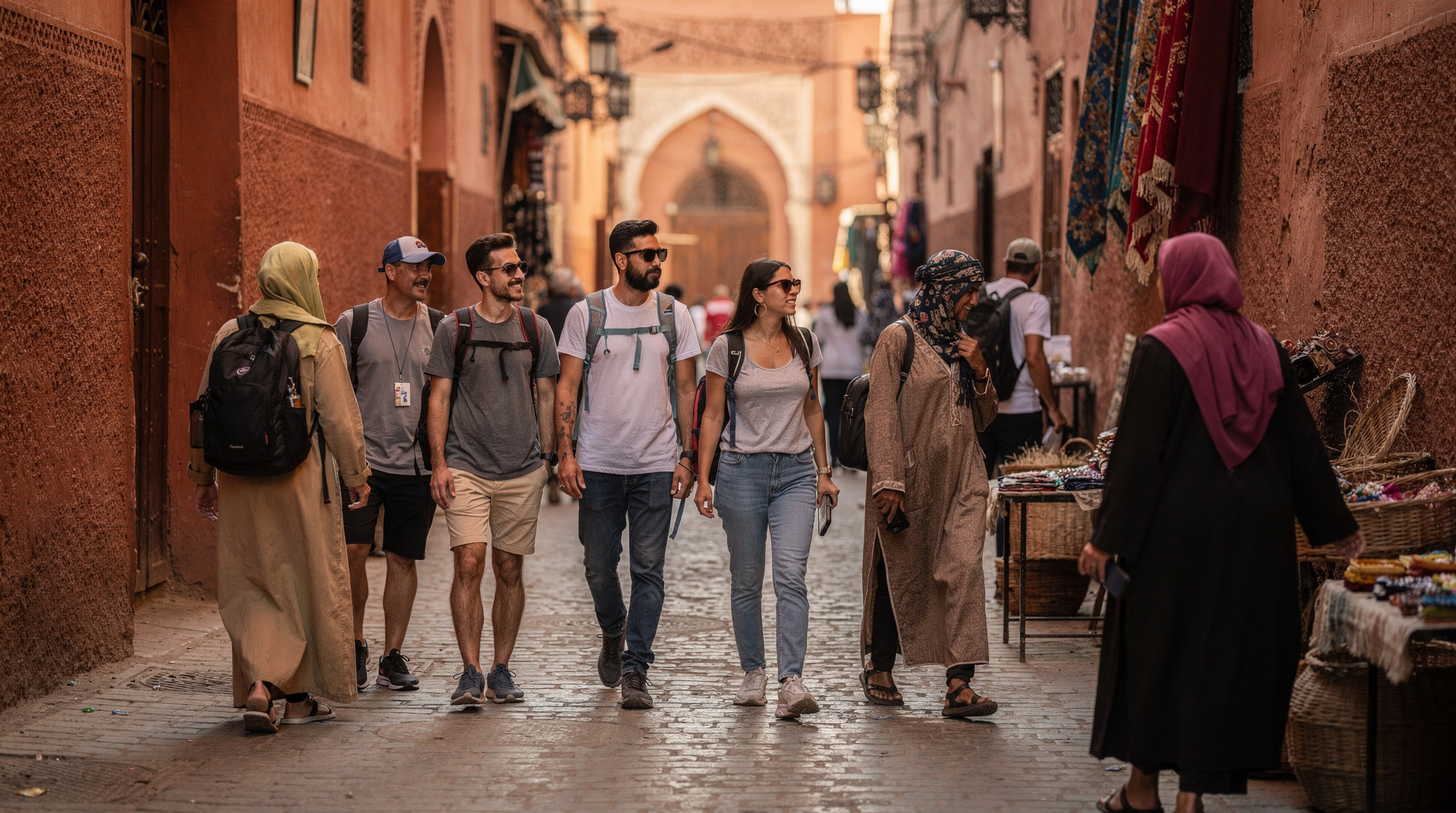
The historic medinas of Marrakech, Fes, Chefchaouen, and other Moroccan cities are navigated exclusively on foot. No vehicles enter the main medina lanes (though motorbikes sometimes do in Fes, which is a hazard in narrow alleys — listen for them).
Key medina navigation tips:
In Marrakech, the medina is divided by the main souk axis running north from Djemaa el-Fna. The Bab Doukkala gate (north-west), Bab Debbagh (east), and Bab Agnaou (south) are the main entry/exit points. Your riad will send you a pin or a card — save the location on your phone.
In Fes, the two main orientation anchors are Bab Bou Jeloud (the blue ornamental gate, western entry to Fes el-Bali) and the Chouara tanneries (eastern section of the medina). Navigating between these two points takes you through most of the main medina sights. Every other lane is a potential maze.
In Chefchaouen, the small size makes getting lost essentially impossible — the blue-painted kasbah is visible from most streets and the medina takes 15-20 minutes to walk end to end.
Motorised transport inside medinas: Not possible for taxis. Some locals use motorbikes and donkey carts for goods transport in wider lanes. In Fes especially, donkey carts appear without warning in narrow lanes — step against the wall.
Negotiating grand taxi fares
Grand taxis have fixed per-seat fares for specific routes, but these are rarely posted and tourists frequently pay tourist rates.
The reliable approach:
- Ask your accommodation what the standard fare is for your destination before leaving
- At the taxi stand, ask for the fare before getting in — state the destination clearly
- If offered a significantly higher price, counter with the amount you were told
- For private hire (taking all 6 seats yourself), the fare is typically 5-6x the individual seat rate — negotiate from there
Common tourist mistake: agreeing to a shared grand taxi but discovering the driver won’t leave until all seats are full, then waiting 45 minutes. If time matters, pay for 2 seats to get the taxi moving (this works for couples or can be negotiated alone for 1.5-2x the single-seat fare).
Crossing into Spain: the Ceuta and Melilla border
For travellers doing a Morocco-Spain combination, the Spanish enclave crossings deserve specific mention.
Ceuta crossing (Bab Sebta): Pedestrian and vehicle crossing open 24 hours. Queue times vary enormously — busy weekends can mean 2-4 hour waits, slow days 20 minutes. EU rules apply inside Ceuta; Moroccan immigration is at the boundary. Frequent ferry services from Algeciras to Ceuta (35 minutes) and Tarifa to Tangier Med (45 minutes).
Tangier Med port: The main car and passenger ferry terminal for vehicle crossings. Located 45km east of Tangier city — taxi or bus required between the port and city. Multiple operators run ferries to Algeciras and other Spanish ports. Journey time to Algeciras: 90 minutes.
Combining transport modes on a real itinerary
Most trips end up mixing two or three of these options rather than picking one. A common pattern: ONCF train for the Casablanca-Marrakech leg, then a car rental or organised tour for the Atlas/Sahara loop, then the train again for the return to the airport.
The morocco by train itinerary shows how far you can get on rail alone before you need to switch modes, while the self-drive Morocco itinerary and with-driver Morocco itinerary map out the two main alternatives for the sections trains don’t reach. If you’re deciding how much ground to cover in total, the 7 vs 10 days guide and 10 vs 14 days guide both factor in how much time transport itself eats into a trip.