Best Photography Locations in Morocco: A Photographer's Guide
What are the must-shoot photography locations in Morocco?
Top six: Chefchaouen blue medina (early morning), Aït Benhaddou (golden hour from the riverbed), Erg Chebbi dunes Merzouga (sunrise), Fes tanneries from rooftop (mid-morning), Bahia Palace Marrakech (warm hour), Essaouira ramparts at sunset. Avoid 11am-3pm flat light.
At a glance
| Best regions | North (Chefchaouen, blue tones) vs. south (Marrakech/Aït Benhaddou, warm ochres) |
| Golden window | Roughly 60 min before sunset, October–April, for the warmest low-angle light |
| Avoid | 11am-3pm flat light, April-September, especially on kasbahs and dunes |
| Drone permit | Advance DGAC authorisation required; frequently confiscated without one |
| Best trip length for full circuit | 10-14 days to cover north, south, and desert without rushing |
Morocco’s photographic logic: light, palette, and what the algorithm misses
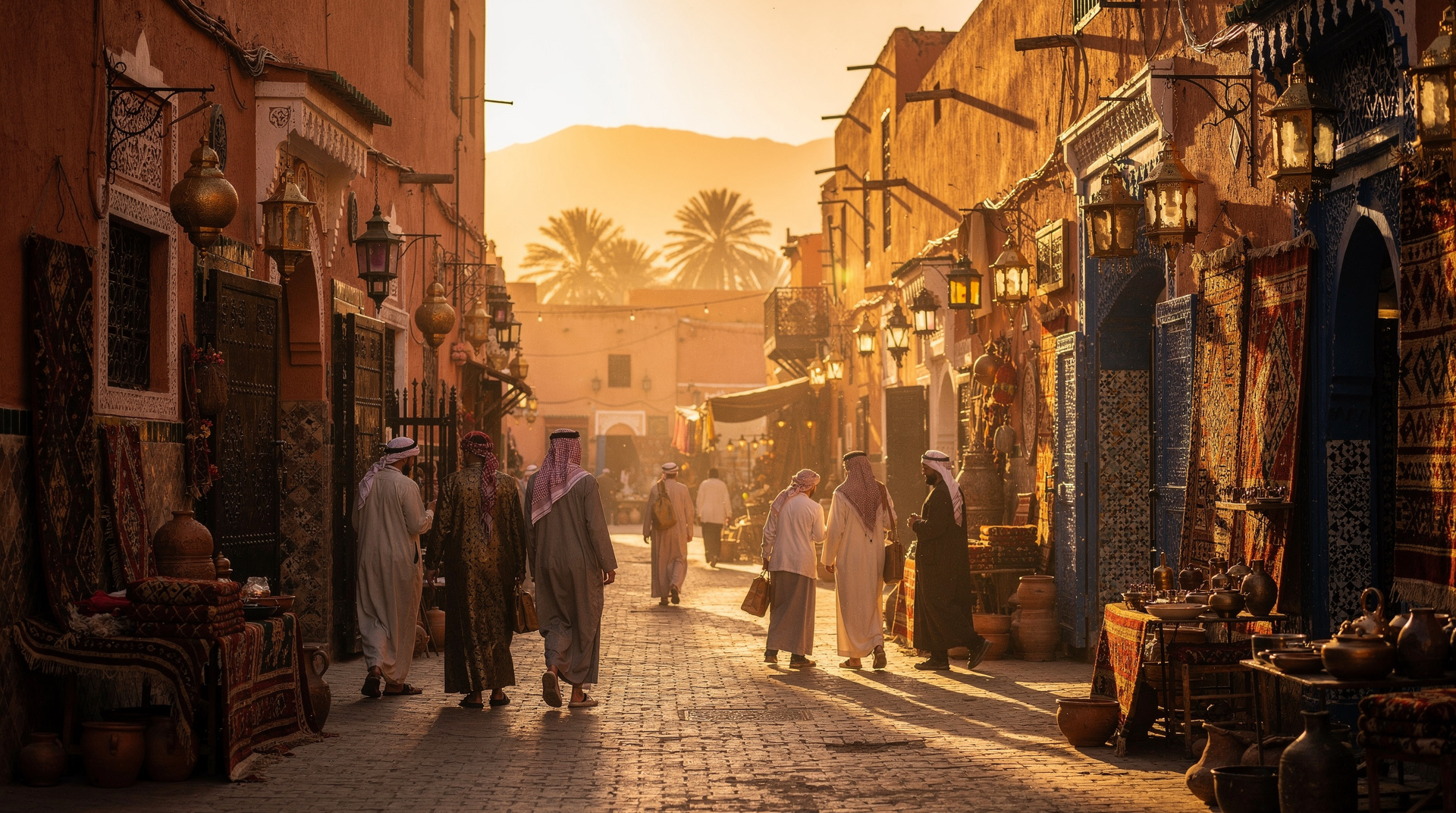
Morocco rewards photographers who understand its internal rhythm. The country is divided between two entirely different palettes — the cool, ceramic blue of the north (Chefchaouen, Tetouan) and the warm ochres of the south (Marrakech, Aït Benhaddou, Ouarzazate). These palettes do not mix gently, and your shooting strategy should shift accordingly. Blue medinas photograph best in overcast light or at blue hour, when the walls glow without competing shadows. Southern kasbahs and desert dunes need the full drama of low raking sun at golden hour to separate textures.
The flat light trap runs from roughly 11am to 3pm from April through September. During those hours the Moroccan sun is directly overhead, washing out the warm sandstone tones that make places like Aït Benhaddou remarkable. Serious landscape and architectural photographers in Morocco structure their days around this fact: shoot from 6am to 9am, rest in a café from 10am to 4pm, then shoot from 5pm to sunset.
What the algorithm doesn’t show you: the most-shared shots of Morocco are taken in precisely the same five locations, at the same hour, showing the same composition. The Chefchaouen staircase with painted pots. The Fes tanneries from the Chouara viewpoint. The dune ridge at Erg Chebbi with a camel silhouette. These are genuinely beautiful photographs — but they’re also what every visitor sees. This guide covers both the iconic and the adjacent: where to stand for the well-known shot and, for each location, where to move afterward to find something closer to your own.
The 12 must-shoot locations
1. Chefchaouen medina
Where to be: The Uta el-Hammam plaza (centre of the medina) for wide establishing shots; the upper staircase off Rue Targhi for the painted-pot lane; the rooftop of the Spanish Mosque for the full medina-to-mountain panorama.
Best time of day: Blue hour (30–45 minutes before sunrise) is the definitive Chefchaouen window. The city’s blue plaster matches the sky tone perfectly, and the lanes are empty. Second-best: overcast mid-morning (the diffuse light suits the blues better than harsh midday sun). Avoid the 10am–4pm tourist rush on the main alleys.
Best season: Late March to May (wildflowers on the surrounding hills) and October–November (low crowds, good light). August is peak season — lines for the popular stairs.
What to capture: The geometry of the blue lanes disappearing into mountain haze. The layering of doorways, painted pots, and cats. From the Spanish Mosque rooftop: the terracotta-tiled medina against the forested Rif ridge.
What to avoid: Shooting from the famous staircase between 9am and 6pm in summer without expecting crowds in every frame. The “clean” shot requires arriving before 6:30am.
For a guided dawn walk through the medina with a local photographer, this private Chefchaouen local tour can be arranged for early-morning start. See our full Chefchaouen destination guide for neighbourhood logistics.
2. Aït Benhaddou kasbah
Where to be: The sandy riverbed on the west bank of the Oued Marghen (dry most of the year) for the classic full-kasbah composition. Walk 200m south along the bank to cut the tourist shops out of frame. Cross the ford (ankle-deep when there’s water) and climb the kasbah interior for rooftop shots across the ksar.
Best time of day: Golden hour (60 minutes before sunset, October–April) is unbeatable — the light turns the pisé walls deep amber and the ksar glows against a darkening blue sky. Sunrise also works well and has fewer people; you lose the warm backlight from the west but gain a pink sky reflection.
Best season: November through February (low-angle winter sun stays golden for 90 minutes, not 20). Summer golden hour is shorter and the heat haze dulls distant ridgelines.
What to capture: The full ksar reflection in the shallow river when there’s water (November–March). The detail of mud-brick tower finials against sky. The interior’s crumbling towers and narrow alleys are largely tourist-free after 5pm.
What to avoid: Shooting from the road on the east bank (the angle flattens the ksar). The shops along the main crossing path are a constant intrusion in wide shots — get low or long to exclude them.
Day trips combining Aït Benhaddou and Ouarzazate from Marrakech: this day trip departs Marrakech early enough for golden-hour arrival. More on Aït Benhaddou including the Atlas Film Corporation studios nearby.
3. Erg Chebbi dunes (Merzouga)
Where to be: 3–4km into the dunes from the Merzouga village edge. The ridgeline directly north of the Kasbah Mohayut camp gives an unobstructed 270-degree dune panorama. Go on foot or camel; the ridge at coordinates roughly 31.095°N, 4.006°W (use offline Maps.me) is above the camp cluster.
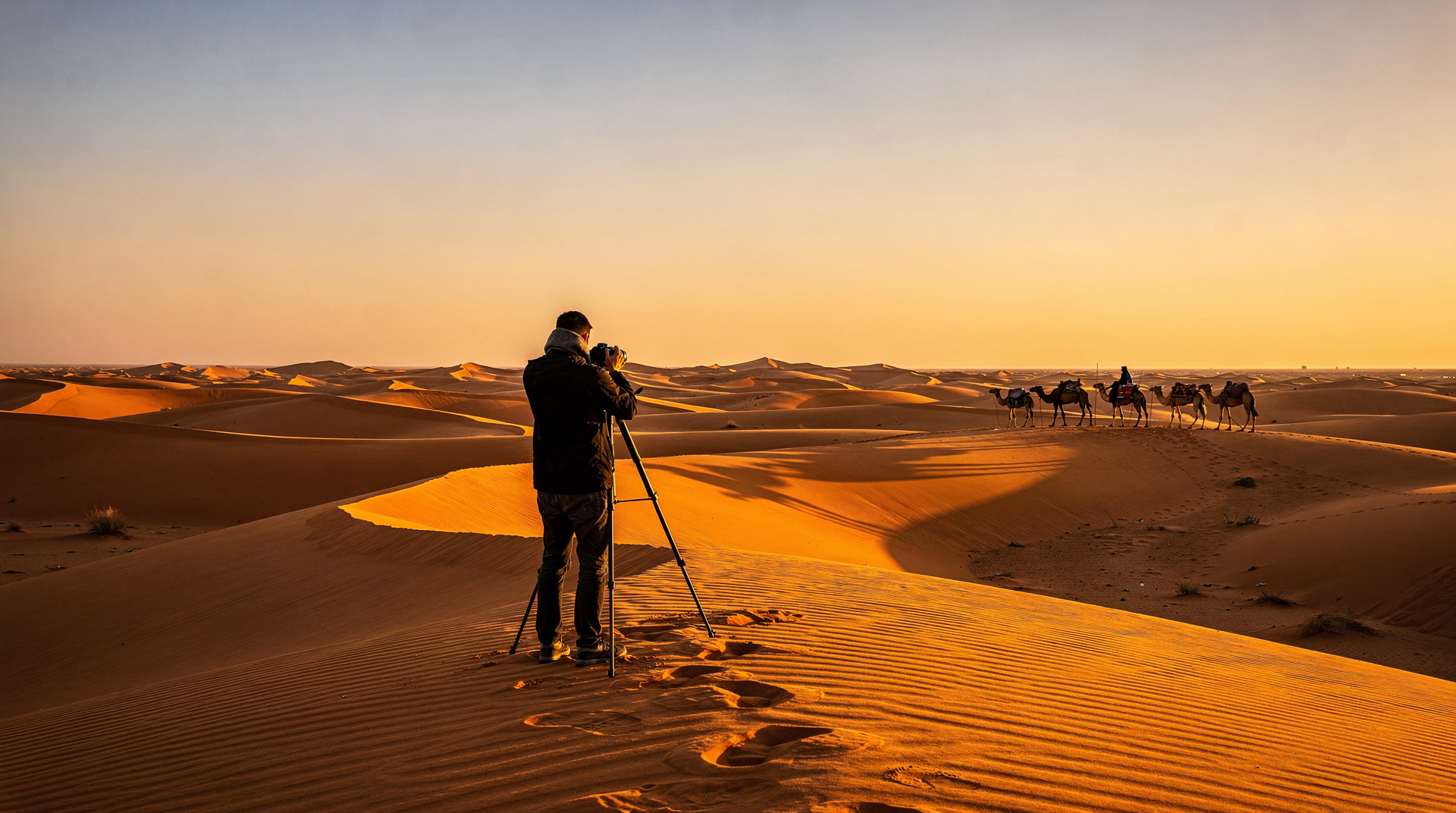
Best time of day: Sunrise (5:30–6:30am in summer, 7:00–8:00am in winter). The low eastern light skims across the dune faces, defining every wind ripple in raking shadow. Blue hour before sunrise, when the dunes go cold blue-grey, is equally compelling for abstract landscape work. Avoid midday; the dunes go flat white.
Best season: November through February — the low winter sun stays golden for over an hour after sunrise. March and October are strong. Summer sunrises are spectacular but the heat is punishing by 8am.
What to capture: Dune ridgelines with perfect wind-carved crests (shoot parallel to the ridge, 70–200mm). Camel shadow sequences in the first 20 minutes of light. Star trails overnight (Erg Chebbi has minimal light pollution — Milky Way visible from June to September around new moon).
What to avoid: The most-photographed dune (right next to the main camel parking area) has footprints constantly raked into it and visible camp infrastructure in frame. Walk 20 minutes further.
For three-day access with sunrise camel trek included: 3-day Merzouga luxury desert camp from Marrakech (includes camel trek at both sunrise and sunset). Full destination context at Merzouga.
4. Fes tanneries (Chouara)
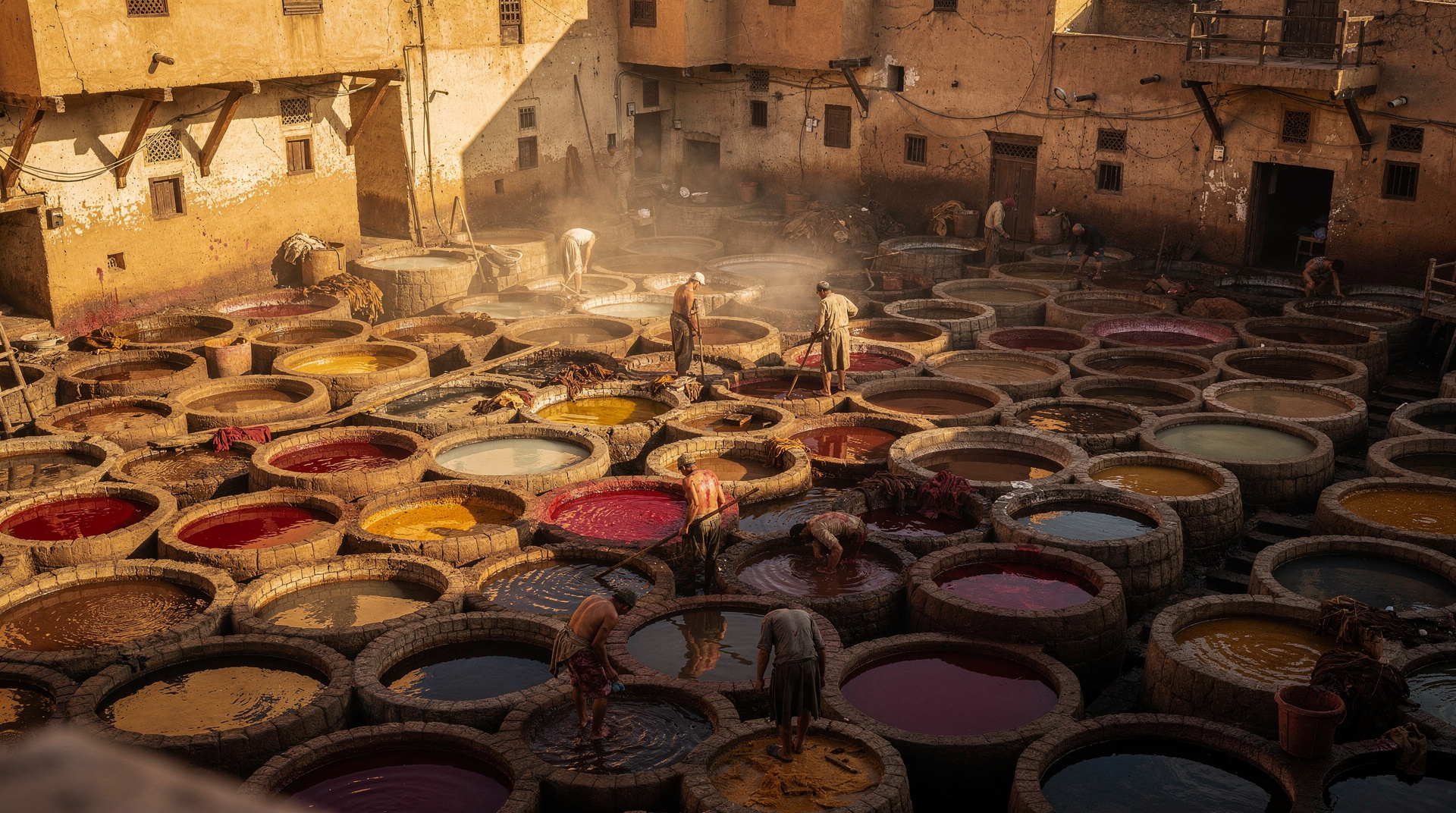
Where to be: The rooftop terraces of the leather shops directly overlooking Chouara tannery. The best vantage is the terrace of the shop immediately to the left (north) as you enter from Rue Chouara — it’s slightly elevated and gives a wider angle than the main terrace. Entry is technically free if you say you’re only there to photograph (the mint sprig is offered at the door).
Best time of day: Mid-morning, roughly 9am–11am. This is when workers are most active and the lime, saffron, and poppy vats are freshest. The light hits the vats directly from the east before 10am; after 11am the tannery floor falls into partial shadow from the surrounding buildings. Avoid rainy days (workers stay home; vats look muted).
Best season: Late spring (May–June) when hides are being dyed for the summer trade. November–March is also good activity-wise, but winter clouds can dull the vat colours.
What to capture: The grid of vats from directly above (wide angle, 16–24mm). Individual dyers at work (70–200mm from the terrace). The geometric colour fields from a slightly higher vantage. The contrast of medieval craft against the modern city skyline in the background.
What to avoid: Shooting on Friday morning (the tannery typically closes or operates with reduced staff). The main Chouara terrace is very crowded — use the side terraces.
For a guided tour that includes tannery access plus the medina’s other highlights: Fes tannery, museum, and medina tour. Full context at our Fes guide.
5. Bahia Palace and Madrasa Ben Youssef (Marrakech)
Where to be: Bahia Palace courtyard garden (arrive at 9am opening for empty frames). Madrasa Ben Youssef: the central courtyard from ground level (16–24mm for the full tiled dome and gallery), and from the upper gallery for the downward compression shot.
Best time of day: 9–10:30am at both sites. The riad-style courtyards are designed for indirect natural light, and this early window gets soft bounce light before the overhead midday sun creates hard contrast. By 11am both sites are crowded.
Best season: Year-round, but winter (November–February) has a lower visitor baseline. Avoid Ramadan midday rush.
What to capture: The Bahia Palace’s painted cedar ceilings and zellij floor patterns (detail shots, 50mm macro-range). The madrasa’s courtyard symmetry from low angle. The play of light through carved stucco windows in the upper galleries.
What to avoid: Shooting the main courtyard fountain at Bahia with tourists in the foreground — get there at opening. The madrasa’s main courtyard gets full at 10am; use a wide aperture to blur crowds.
6. Jardin Majorelle (Marrakech)
Where to be: The cobalt blue Villa Bou Saf Saf building (the landmark blue structure) — best composition from the main pond with the yellow cactus arms on both sides. The bamboo grove behind the main villa for green-on-blue abstract work.
Best time of day: Opening (8am in summer, 9am in winter). The garden’s intense Majorelle blue pops best in flat morning light before harsh shadows appear. Overcast days actually photograph better here than bright sun.
Best season: April–May (jacaranda in flower) and October (lower tourist volume). August is crowded and harsh.
What to capture: The Majorelle blue walls against terracotta pots and electric yellow planters. Water lily detail in the ponds (macro, 100mm). The pattern interplay between the Islamic tile fountain and surrounding cactus.
What to avoid: The central walkway from 11am onwards is a continuous stream of visitors. The garden is small (2.5 acres); work the perimeter paths for isolated compositions.
7. Essaouira ramparts and harbour
Where to be: The Skala de la Ville (the main sea bastion) for the cannon-lined rampart walk with Atlantic backdrop. The blue fishing boats in the port for colour-saturated harbour work. The medina walls from the beach side for the classic white-and-blue city-against-ocean shot.
Best time of day: 30 minutes before sunset. Essaouira faces west, making it one of the few Moroccan cities where sunset over the sea is unobstructed. The fishing harbour is most active 6–9am (boats returning, catch being sorted).
Best season: March–May and September–November. Essaouira is windy year-round (it’s a kite-surfing hub), and summer wind is constant enough to challenge long-lens work. The wind also blows spray across the ramparts, which can be dramatic or frustrating.
What to capture: Silhouetted fishermen repairing nets at golden hour. The cannon row on the Skala de la Ville looking north (classic shot, best in morning when shadows point away from camera). Seagulls and Atlantic waves crashing against the base of the city walls.
What to avoid: Shooting the harbour fish stalls from directly above — the angle makes the compressed chaos feel messy. Get low and use the rigging of the boats to frame the stalls.
8. Volubilis Roman ruins
Where to be: The Triumphal Arch of Caracalla for the best structural focal point. The mosaic floors (House of Orpheus, House of Dionysus) for detail work. Climb the hill 400m northeast of the basilica for the panoramic shot of the full site against the Zerhoun massif.
Best time of day: Sunrise to 9am. The low eastern light rakes across the mosaic floors at a shallow angle, revealing texture and colour that disappears in flat midday sun. The site opens at 8am.
Best season: March–April (wildflowers carpet the surrounding countryside, storks nest on the triumphal arch). October–November also excellent.
What to capture: The Triumphal Arch backlit at sunrise against blue sky. The Orpheus mosaic with side-raking light to make the tesserae pop. The panoramic view of the ruined basilica against the distant Meknes plain.
What to avoid: Visiting only as part of a crowded coach group (the mosaics are roped off to group tours at peak hours). Arrive independently for access to the floor-level detail. See our Volubilis guide for how to get there by taxi from Meknes.
9. Ouzoud waterfalls
Where to be: The main viewing platform 50m from the cascade base for the full three-tier fall. Descend to the river below the falls (30-minute walk) for upward compositions with rainbow spray. The Barbary macaque habitat on the left bank for wildlife portraits.
Best time of day: Mid-morning (9–11am) when the sun is angled toward the spray and produces consistent rainbows in the mist. Avoid midday overhead sun, which bleaches the spray.
Best season: December–March (peak water flow from winter rains). By July the flow is significantly reduced, though the site remains beautiful.
What to capture: The three-tier cascade framed through olive trees (16–24mm, polarising filter to cut spray glare). Rainbow in the mist against the red canyon walls. Barbary macaques — the colony near the upper trail is accustomed to visitors; use 70–200mm for natural-looking portraits.
What to avoid: Shooting from the main café terrace, which gives a flat frontal angle. Descend to the river level for compositions with depth.
10. Atlas Berber villages (Imlil and Ourika Valley)
Where to be: Imlil village (1,740m) — the trail above the village toward the Toubkal trailhead gives the classic Atlas village panorama (stacked terraces, walnut orchards, snow-capped peaks). Ourika Valley floor for the oleander-lined riverbank compositions in summer.
Best time of day: Early morning in Imlil for peak reflections and valley mist. Late afternoon in Ourika for warm sidelighting on the terraced fields.
Best season: April–May (snow on peaks, cherry blossom in lower valleys) and October–November (golden walnut trees, low-angle light). Summer is hazy but the valley green is lush.
What to capture: The geometric terracing of the Imlil terraces against the Toubkal massif (50–100mm for compression). Village women doing field work (always ask permission). The red-and-white patterning of traditional Berber weaving hung to dry outside homes.
What to avoid: Photographing specific individuals, particularly women, without explicit consent. Cultural norms in Atlas villages are traditional; see the ethics section below.
11. Todra Gorge
Where to be: Inside the gorge itself, at the narrowest section (the walls are 300m high, 10m apart). Position 200m into the gorge from the hotel cluster for the maximum vertical compression shot looking up. Early morning when the sun briefly reaches the gorge floor.
Best time of day: 8–10am in summer (when the gorge floor gets direct light for about 90 minutes). In winter the gorge floor receives no direct sun, but the reflected light on the upper walls turns amber.
Best season: April–May and October–November for the best light-to-wall reflection.
What to capture: The massive vertical walls in a 16–24mm ultra-wide for maximum disorientation. Climbers on the rock faces (the gorge is a major sport climbing destination) with telephoto compression. The stream along the gorge floor for leading lines.
What to avoid: The gorge fills with tour buses between 10am and 4pm. The main road through it becomes chaotic. Shoot from the far end of the accessible section to include fewer vehicles.
12. Hassan II Mosque (Casablanca)
Where to be: The ocean-side terrace to the north (from the main Corniche entrance, walk left) for the mosque reflected in the tidal pool when the tide is right. The interior courtyard (open on guided tours only) for the carved cedar, hand-painted tilework, and retractable roof.
Best time of day: Blue hour just after sunset. The mosque’s floodlighting turns the white marble warm amber while the sky behind goes deep blue — one of the strongest blue-hour compositions in Morocco. Interior tours at 9am (no competing light issues inside).
Best season: Year-round for exterior. Interior is most atmospheric in winter when natural light enters obliquely through clerestory windows.
What to capture: The 210m minaret against a blue-hour sky. The ocean crashing against the lower platform in long exposure (1/4 second at f/11, polariser to manage spray). Interior: the carved plaster ceiling patterns with detail lens.
What to avoid: The main frontal approach on the Avenue Hassan II — this is the postcard angle everyone shoots. The north-side tidal terrace angle is both more dramatic and less photographed.
Guided interior access: Hassan II Mosque guided tour with entry ticket.
Golden hour and blue hour windows by month
The times below apply to Morocco (UTC+1 year-round). All times are approximate to ±15 minutes depending on your latitude within the country (Chefchaouen is farther north than Merzouga by 4°).
| Month | Sunrise | Golden hour ends | Sunset | Blue hour ends |
|---|---|---|---|---|
| January | 08:00 | 09:00 | 18:00 | 18:45 |
| February | 07:30 | 08:30 | 18:30 | 19:15 |
| March | 07:00 | 08:00 | 19:00 | 19:45 |
| April | 06:30 | 07:30 | 19:30 | 20:15 |
| May | 06:10 | 07:10 | 20:00 | 20:45 |
| June | 06:00 | 07:00 | 20:20 | 21:05 |
| July | 06:10 | 07:10 | 20:15 | 21:00 |
| August | 06:30 | 07:30 | 19:50 | 20:35 |
| September | 07:00 | 08:00 | 19:10 | 19:55 |
| October | 07:20 | 08:20 | 18:30 | 19:15 |
| November | 07:50 | 08:50 | 17:55 | 18:40 |
| December | 08:10 | 09:10 | 17:50 | 18:35 |
Key planning note: Morocco observes Ramadan adjustments in timekeeping (clocks revert to UTC+0 during Ramadan in some years), and since 2018 the country has remained on permanent summer time (UTC+1), eliminating the autumn clock change that used to disrupt planning.
Drone rules in Morocco: the honest picture
Morocco officially requires a permit to fly a drone issued by the Direction Générale de l’Aviation Civile (DGAC). In practice, the permit process is bureaucratic, slow, and rarely completed by tourists. The real-world situation is considerably more uncertain:
Customs confiscation: Drones are regularly confiscated at Casablanca Mohamed V airport (CMN) and Marrakech Menara (RAK) on arrival. This is discretionary — some photographers pass through without issue, others have equipment held for the duration of their stay or permanently seized.
Royal palace and military exclusion zones: These are absolute no-fly zones and drone operation near them risks confiscation, fines, and potential detention.
National parks and UNESCO sites: Aït Benhaddou (UNESCO), Toubkal National Park, and the areas around Hassan II Mosque are all considered sensitive. Local guards will challenge you if they see a drone in the air.
The practical recommendation: Unless you have obtained formal DGAC permission before arrival (which requires a Moroccan entity to co-sign the application), do not bring a drone to Morocco with the expectation of flying it. The risk of losing a UAV worth 1,000–3,000 EUR at customs is real and documented frequently in photography forums. Standard camera and mirrorless systems raise no customs issues at all.
Photography ethics: people, religious sites, and women
The full ethics guide is at our Morocco photography etiquette guide. The core principles:
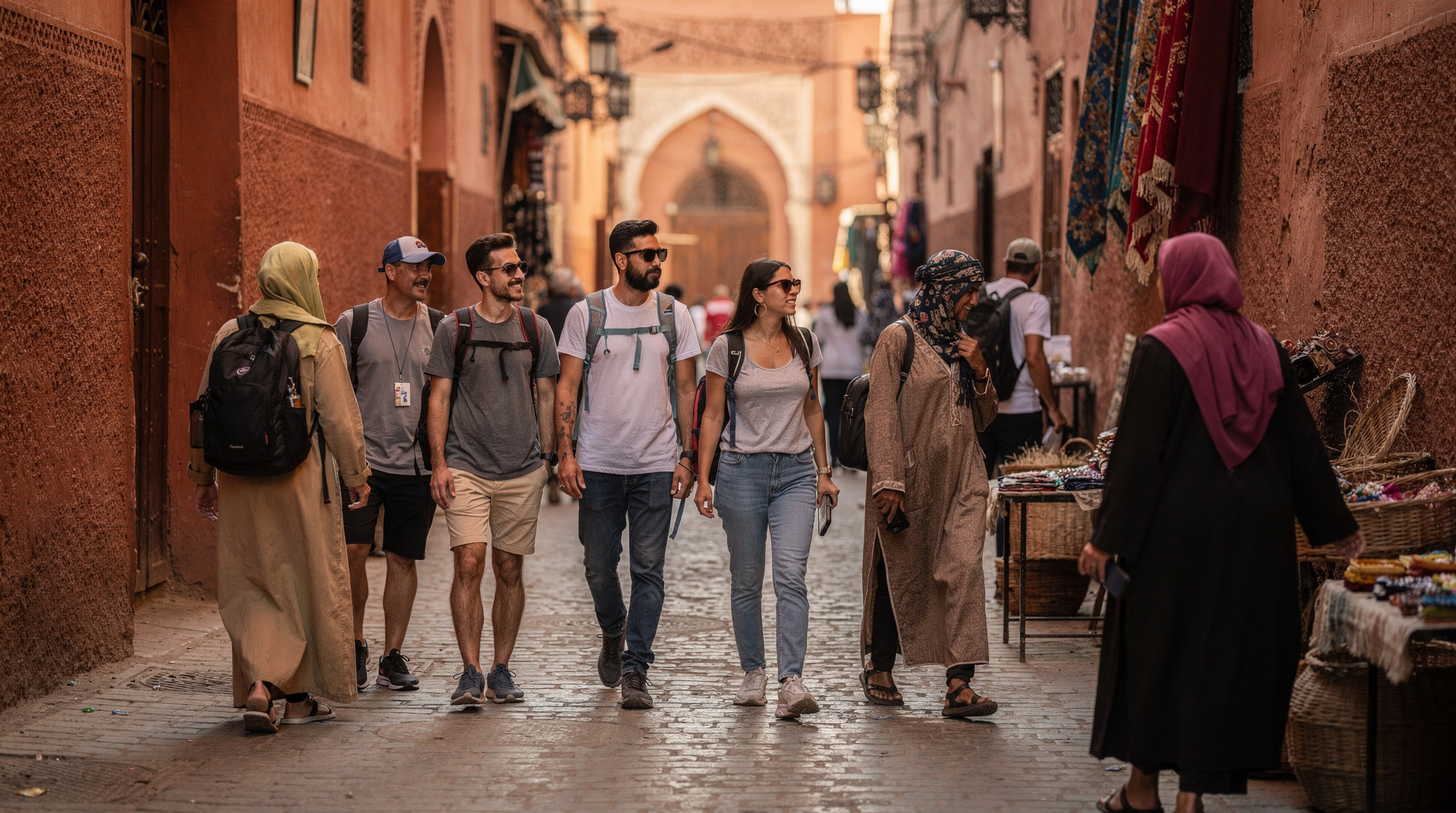
People: Always ask before photographing individuals. The approach that works in all markets: make eye contact, gesture to your camera, say “photo?” with a questioning intonation. Accept no gracefully. Attempting to photograph people who have refused — with a long lens, from the hip, by pretending to look at your phone — is a betrayal of trust that local guides and fixers remember and report. It makes their work harder.
Religious sites: Non-Muslims cannot enter most Moroccan mosques (Hassan II Mosque is the main exception). Photography of mosque exteriors is fine. Do not photograph people mid-prayer from a distance. During the call to prayer, be especially discreet around mosque doors.
Women: Photographing women without explicit consent is particularly sensitive, especially in rural areas and conservative medinas. A woman who turns her back or covers her face with her djellaba when she sees a camera raised is declining clearly. Honour it.
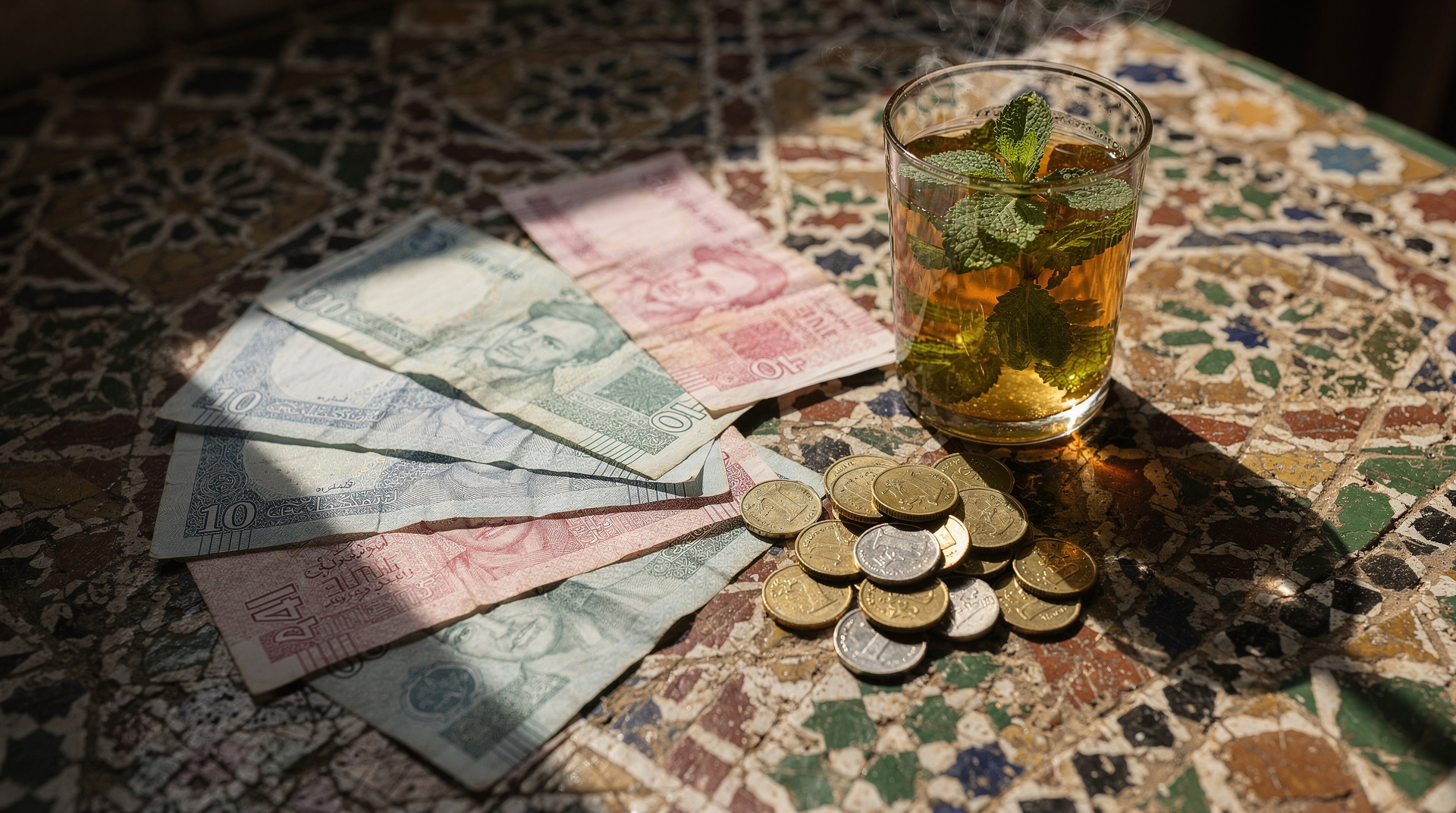
Tips vs exploitation: Some Moroccans in tourist areas — market vendors, water sellers in jemaa el-Fnaa, snake charmers — will pose for photos and then demand payment aggressively. Be aware that once you photograph someone in these performative contexts, payment is expected. If you don’t want to pay, don’t photograph. 10–20 MAD (1–2 EUR) is standard.
Best gear setup for a 10-day Morocco trip
Morocco tests wide-angle and telephoto more than any single-focal-length setup. The recommended kit for one carry-on body:
Primary body: Any full-frame or APS-C mirrorless (Sony A7R V, Nikon Z8, Canon R5). Full-frame advantages in the low-light medina situations and blue-hour work are material.
Essential lenses:
- 16–35mm f/2.8 (or equivalent): Tanneries rooftop, kasbah courtyards, interior architecture, wide dune landscapes.
- 70–200mm f/2.8: Portrait compression in markets (allows respectful distance), dune texture, tannery worker activity from the terrace, Triumphal Arch at Volubilis.
- 50mm f/1.4 or 1.8: Low-light evening medina work, detail and abstract shots.
Filters (high priority):
- Circular polariser: Essential for Ouzoud waterfalls (cuts spray glare, deepens water colour) and Atlantic coastal work at Essaouira.
- 3-stop ND (optional): Useful for long-exposure water shots at Ouzoud and wave shots at Hassan II Mosque.
Accessories:
- Carbon fibre travel tripod (under 1.5kg): Blue-hour and sunrise dune work requires one; a flimsy tripod defeats the purpose.
- Extra batteries (minimum 3 for mirrorless): Cold Atlas nights and long desert mornings drain batteries faster than European travel.
- Dust-sealed bag: Merzouga sand is fine and invasive. Budget cameras without weather sealing risk sensor contamination.
What to leave home: Expensive zoom lenses above 300mm (no practical use), studio flash equipment (customs scrutiny), drones (see above).
How to handle “no photo” pushback in markets
Marrakech and Fes medinas generate a specific friction: locals who initially say yes to a photograph and then demand payment well above what you expected, or who say no and then position themselves repeatedly in front of what you’re trying to shoot. A calm handling strategy:
- Pre-agree on price before raising the camera if you’re in a known tip-demand area (spice market, dyer’s quarter, snake charmers at Jemaa el-Fnaa). Say “kam?” (how much?) before shooting.
- If the demand comes after: Pay reasonable rates (20–50 MAD per portrait session, not per frame) and walk away politely. Arguing creates a scene that draws more attention.
- If someone physically blocks your shot: Lower your camera, make no eye contact, and move to a different composition. Do not argue or try to “power through” — this escalates.
- Use a local guide: A trusted local guide in a medina context creates an entirely different atmosphere. Locals understand he/she is accompanying you and the dynamic shifts. See the section below on hiring guides who let you shoot.
Hiring a local guide who lets you shoot
Standard group tours move too fast for meaningful photography. What to look for when hiring a photography-friendly local guide:
Key questions to ask before booking:
- “Can we stop at locations for 20–30 minutes minimum?”
- “Do you know the Chouara tannery side terraces, not just the main one?”
- “Can we schedule the tannery visit for 9am rather than afternoon?”
- A guide who hedges on these questions is optimised for tick-box sightseeing, not photography.
Private walking tours in Marrakech medina (such as the private Bahia Palace and Ben Youssef medina tour) allow you to set pace. Private is materially better than group for photography — request the guide confirm an early-morning start.
In Fes: The tannery guides who work the leather shop terraces have a financial interest in moving you through quickly (they earn commissions from the shops). Tip them directly for time rather than being hurried out. The independent guides who operate from the official Fes tourism office (Syndicat d’Initiative, near the Andalusian quarter) are typically more flexible.
In Merzouga: The camel guides for sunrise dune treks will accommodate photographers if you brief them the evening before. Explain you want to reach the ridge before dawn; this means leaving camp at 4:30–5:00am (not the typical 6am departure). Most camps will arrange this for a modest supplement.
Where the serious photographers go
Marrakech: The widely photographed rooftop of Café Arabe (overlooking the medina) is fine but generic. The better views are from the rooftop of Dar Cherifa (the cultural house at 8 Derb Chorfa Lakbir) and the top floor of La Mamounia’s tower (hotel access required, but the Atlas panorama from the gardens is exceptional). The Mellah neighbourhood on Friday evening (Jewish quarter, now largely Muslim) has a different architectural character — older, more worn — than the main medina circuits.
Fes: Al-Quaraouiyine mosque area at Fajr (dawn prayer) — the streets empty out except for locals going to prayer, and the medina in the pre-dawn light is extraordinary. The tannery workers’ neighbourhood south of Chouara (not on any tourist route) shows the city’s working face: bales of raw hide, dye-stained hands, workshop doors.
Aït Benhaddou: After the day-trippers leave (after 5pm), the ksar is almost deserted. The guardian families who live inside the walls are visible going about their evening. With a guide introduction, you may be invited to photograph the interior communal spaces. A night at the small guesthouses inside the ksar is the single best access investment a Morocco photographer can make.
Chefchaouen: The viewpoint above the Spanish Mosque (another 15 minutes walk uphill past the mosque) is rarely visited. At sunrise you’re looking down on the entire city as it wakes up — calls to prayer drifting up, smoke rising from the bakeries. Genuinely one of the most moving morning views in Morocco.
For a complete itinerary integrating all these locations: see our 14-day Morocco photography itinerary with day-by-day shot schedules and accommodation recommendations.
Frequently asked questions about Best Photography Locations in Morocco
Can I bring a drone to Morocco?
Technically you need a DGAC permit before arrival. In practice, drones are frequently confiscated at customs without return. The risk-reward calculation strongly favours leaving your drone at home unless you have established a formal permit through official channels. Confiscations happen at both CMN and RAK airports and have been reported consistently since 2020.
Is photography allowed in mosques?
Morocco’s mosques are generally closed to non-Muslim visitors. Hassan II Mosque in Casablanca is the primary exception — it runs official guided tours that include interior photography. Photography of mosque exteriors from public streets is fine everywhere. Never attempt to enter a mosque as a non-Muslim to photograph, regardless of how open the door appears.
Best month for Sahara dune photography?
November through February for golden-hour quality. The low winter sun stays in the golden zone for 60–90 minutes after sunrise, compared to 20–30 minutes in summer. The trade-off is cold nights (can reach -5°C at Erg Chebbi). March is the best balance: still-low sun, warming temperatures, no summer haze.
What is the best time to photograph the Fes tanneries?
9–11am on a weekday (not Friday). This window combines active workers, fresh vat colours, and directional morning light that skims the vat surfaces. Arriving after 11am risks the shadow zone that falls across the vats from the surrounding buildings. The entry to the rooftop terraces is technically included when you visit the leather shops; you don’t have to buy anything.
Camera safety in the souks?
Petty theft of cameras is rare but not unknown in the most crowded sections of Marrakech medina (around Jemaa el-Fnaa and the main souk entrance). Keep camera straps wrapped around your wrist rather than hanging loose. The DSLRs and mirrorless systems that attract attention are the large white telephoto lenses — a 70–200mm on a full-frame body draws curiosity. Compact systems and smaller mirrorless draw much less. No need for paranoia, but awareness is reasonable.
Should I tip people I photograph?
In performative contexts (market entertainers, costumed water sellers, snake charmers), yes — 10–20 MAD per photo stop is the norm and refusing after photographing creates friction. For candid environmental portraits of ordinary people going about their day, tipping is not expected if permission was genuinely given freely. The distinction matters: don’t photograph someone asking for tips and then decline to pay, and don’t create a tip expectation with ordinary people who consented as a gesture of hospitality.
What is the best photography guide for understanding Moroccan light?
Our best time to visit Morocco guide covers seasonal light quality by region. For the cultural and ethical framework, see the dedicated Morocco photography etiquette guide. For a day-by-day shooting schedule across two weeks, the photography Morocco itinerary provides structured logistics.
How many days should a dedicated photography trip be?
10-14 days if you want the full palette contrast — north (Chefchaouen), imperial cities (Fes, Marrakech), and desert (Merzouga). A shorter 7-day trip works if you pick one region rather than the whole country; see the plan your trip guide for how duration shapes itinerary structure generally.
Should I hire a local photography guide?
For Fes and Marrakech medinas, yes — a guide who understands photo-stop pacing gets you the side terraces and off-route angles noted throughout this guide, rather than the standard tourist viewpoint. For landscape locations like Aït Benhaddou or Erg Chebbi, a guide is less essential but still useful for timing golden hour around your transport.