Quick facts
- UNESCO Status
- World Heritage Site since 1997
- Period
- 1st century BC – 3rd century AD (peak)
- Nearest City
- Meknes, 33 km (30 min)
- Entry Fee
- 70 MAD per person
Two thousand years in an open field
The road from Meknes climbs gently through olive groves and wheat fields before the first columns appear at the horizon — white stone against a flat-topped hill, the triumphal arch visible from half a kilometre away. Volubilis sits in a shallow plain at the edge of the Zerhoun mountains, isolated enough to feel genuinely remote despite being only 33 km from a major Moroccan city, and the approach prepares you properly for what the site delivers: one of the best-preserved Roman ruins in North Africa, in an extraordinary landscape setting, with some of the finest in-situ mosaic floors anywhere on the continent.
The ancient city was settled by Berber tribes from at least the 3rd century BC and became a client kingdom of Rome. Under Roman administration (roughly 40 AD onwards), it grew into the capital of the province of Mauritania Tingitana — a prosperous trading and agricultural centre of around 20,000 inhabitants at its peak. The city produced olive oil, grain, and wild animals for the arenas of Rome, and the wealth this generated is visible in the quality of the domestic architecture that survives. When Rome withdrew in 285 AD, Volubilis continued under the Berber Kingdom of Oualili for several centuries before decline and eventual abandonment.
The site was designated a UNESCO World Heritage Site in 1997, and the combination of intact mosaic floors, standing columns, an arch, and the beautiful rural setting makes it unique in Morocco — a genuine archaeological wonder rather than a reconstructed heritage attraction.
| At a glance | |
|---|---|
| Where | Imperial Cities region, 33 km from Meknes, 90 km from Fes |
| Cost | 70 MAD entry; guides around 200-300 MAD |
| Time needed | Half-day (2-3 hours on site) |
| Getting there | Grand taxi via Moulay Idriss, or organised half/full-day tour |
| Best time | March-May, September-October; early morning or late afternoon light |
Getting to Volubilis
From Meknes (most common): Volubilis is 33 km from Meknes — a 30-minute drive. Options from Meknes:
- Grand taxi: The most practical option. Take a grand taxi from the Meknes main taxi stand to Moulay Idriss (20 km, 20–25 MAD per seat), then a local taxi or another 7-seat taxi for the final 4 km to Volubilis. Alternatively, negotiate a direct Meknes-Volubilis-Meknes return for 200–300 MAD for the car (including waiting time). This is the best value option for 2–4 people.
- Organised half-day tour from Meknes: Several operators run morning half-day excursions combining Moulay Idriss and Volubilis. Convenient if you’re staying in Meknes for a short time.
From Fes (full day out): Volubilis is 90 km from Fes and works very well as a full day trip combining Meknes, Moulay Idriss, and Volubilis — three distinct attractions in a logical circuit. Most visitors from Fes do this by organised day tour.
Book a Fes to Volubilis, Moulay Idriss and Meknes day trip Volubilis, Meknes and Chefchaouen 2-day tour from FesBy car from Fes or Meknes: The route is well-signed. From Meknes, take the Route de Moulay Idriss north and follow signs for Volubilis. The final approach road is a narrow rural lane but manageable. Paid parking on site.
On the Site: What to See
Allocate a minimum of 2 hours for the site — ideally 2.5–3 hours if you have interest in Roman archaeology. The site covers approximately 40 hectares of the ancient city, of which perhaps a third is excavated and accessible.
The entrance is at the southern end, with the primary residential and civic areas accessed by walking north toward the Triumphal Arch.
The Mosaic Houses
The domestic houses in the residential quarter contain the finest mosaic floors in Morocco and among the finest surviving in-situ Roman mosaics anywhere. The mosaics were created by Moroccan artisans working within Roman visual conventions — geometric borders combined with mythological scenes depicting Orpheus, Hercules, Bacchus, Diana, and the sea creatures of the Roman imagination.
Key houses to visit:
- House of Orpheus: The largest house on the site, with three exceptional mosaics including the Orpheus panel showing the mythological figure charming animals with his lyre — the most famous single image at Volubilis.
- House of the Labours of Hercules: Named for the mosaic depicting the twelve labours, with individual panels for each challenge.
- House of Venus: Contains the most extensive surviving mosaic sequence, depicting Diana surprised while bathing and Hylas abducted by nymphs.
- House of the Ephebe: Named for a bronze youth statue found here (now in the Rabat archaeological museum), with floor mosaics in exceptional condition.
The mosaics are exposed to weather — some have deteriorated since excavation — but the overall quality remains extraordinary. Walking between houses requires crossing uneven rubble and original Roman paving stones; wear shoes with grip.
The Triumphal Arch
The Arch of Caracalla (217 AD) stands at the northern end of the decumanus maximus — the main east-west street. It was built to honour Emperor Caracalla and his mother Julia Domna. Largely reconstructed from original stones in the 1930s, the arch is 8 metres tall and represents the defining image of Volubilis. The view south down the main street toward the olive groves and the Atlas foothills in the distance is the photograph that appears in every guide to Morocco.
The Forum and Capitol
Adjacent to the arch is the forum — the civic heart of the Roman city. The capitoline temple (dedicated to Jupiter, Juno, and Minerva) overlooks the forum plaza. Substantial columns remain standing, and the overall scene of temple stairs, forum paving, and the arch visible beyond creates the most complete Roman urban landscape in Morocco.
The Basilica
The basilica — the main judicial and commercial building — sits between the forum and the main street, with two apses at either end and the original column bases still visible. The scale of the building (approximately 65m long) conveys the prosperity of the city at its peak.
The Decumanus Maximus
The main street of the Roman city runs north-south for around 400 metres and is lined with the remains of shops, olive presses, and private houses. Walking its length — on original Roman paving stones worn smooth by two millennia of use — is the quietest way to appreciate the scale of the city.
Moulay Idriss: The Sacred City Nearby
Volubilis is almost always combined with a visit to Moulay Idriss, 4 km away — a pilgrimage town built around the tomb of Moulay Idriss I, the founder of the Idrissid dynasty and considered the founder of the Moroccan state. The town cascades down a narrow valley in two distinct hills, with the tomb complex at the centre.
Non-Muslims cannot enter the tomb itself, but the town’s narrow streets, the views across the valley from the terraces, and the atmosphere of a genuine pilgrimage centre (not tourist-oriented) make it worth 1–1.5 hours of exploration. The Thursday souk is particularly lively.
Until 2005, non-Muslims were not permitted to stay overnight in Moulay Idriss. The restriction has been lifted, and a few basic guesthouses now operate in the town — an increasingly popular option for visitors who want to experience the evening atmosphere after the day-trippers have left.
Meknes: The Imperial City Base
Most visitors pair Volubilis with Meknes, 33 km away. Meknes is one of Morocco’s four imperial cities and receives a fraction of the visitor attention lavished on Marrakech and Fes — making it significantly calmer and more navigable.
The main sights in Meknes:
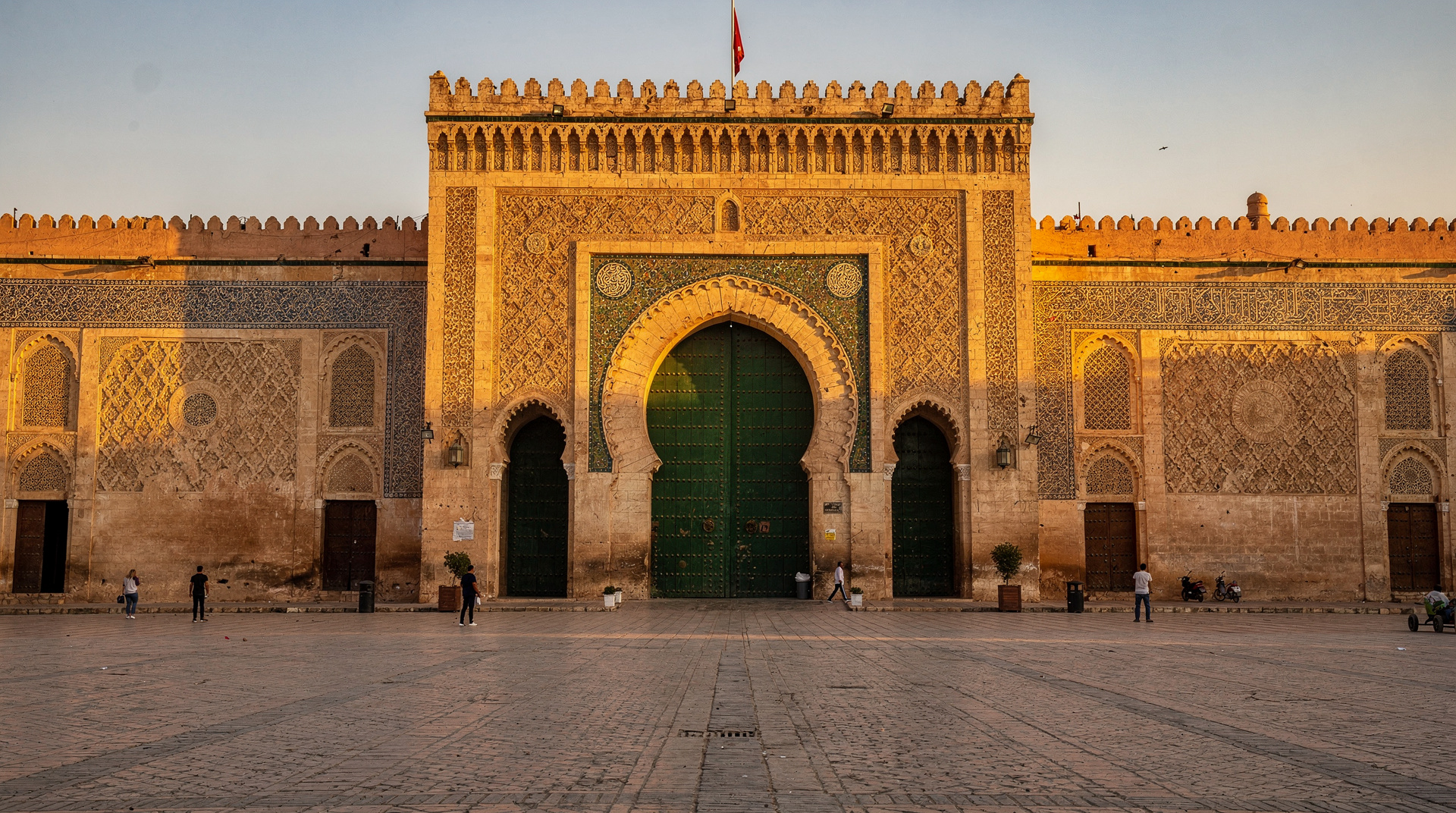
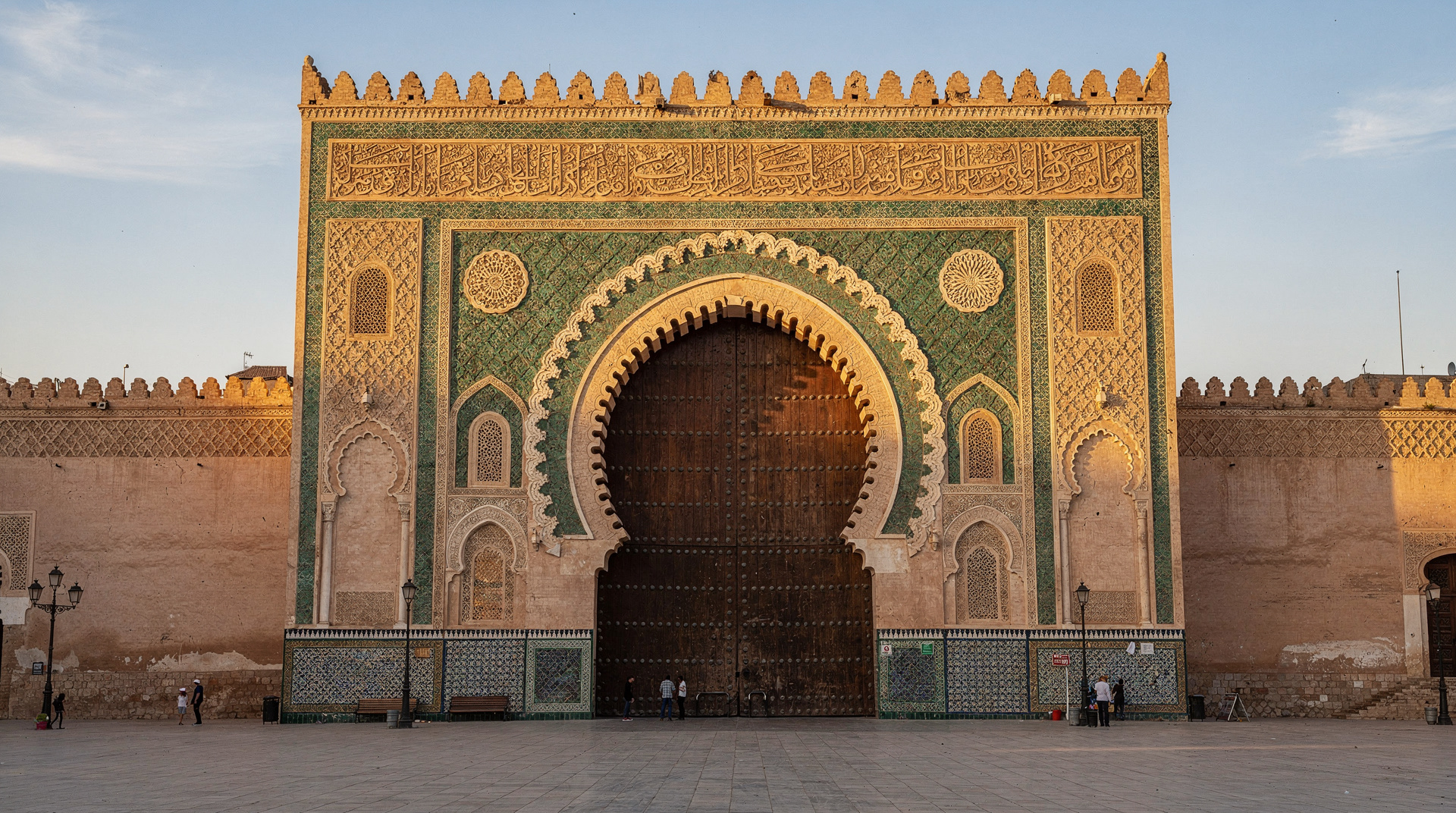
- Bab Mansour: The finest ornamental gate in Morocco — a colossal baroque triumphal arch covered in intricate zellij and stucco that took 20 years to build (1672–1732).
- Moulay Ismail Mausoleum: The tomb of Morocco’s most ambitious sultan, the ruler who made Meknes his imperial capital and is responsible for most of the monumental architecture.
Non-Muslims can visit the outer courtyards.
- Heri es-Souani: The massive granaries and stables of Sultan Moulay Ismail — a complex of barrel-vaulted chambers covering 15,000 square metres. The scale is genuinely staggering.
- Meknes medina: Less visited and less taut with commercial pressure than the Fes medina. The Place el-Hedim (the main square) is a functional social space rather than a tourist amphitheatre.
The Fes to Meknes and Volubilis day tour typically allocates 2–3 hours for Meknes, which covers Bab Mansour, the Heri es-Souani, and a walk through the medina before moving on to Volubilis and Moulay Idriss.
Planning Your Visit to Volubilis
Opening hours: The site is open daily from 8 am to sunset (approximately 7 pm in summer, 5 pm in winter).
Entry fee: 70 MAD per person. Guides are available at the entrance for around 200–300 MAD for a 2-hour tour.
Best time of day: Early morning (8–10 am) and late afternoon (3–5 pm) offer the best light for photography and avoid the midday heat. The site has no shade — sun protection is essential from April onward.
Best time of year: Spring (March–May) is ideal — the surrounding fields are green, wildflowers grow between the ruins, storks nest in the columns, and temperatures are moderate. Autumn (September–October) is similarly pleasant. Summer is very hot with direct sun on the stone; a hat and 2+ litres of water are non-negotiable.
Getting a guide: The quality of the site experience improves substantially with a knowledgeable guide who can contextualise the mosaics and identify the buildings. Official guides at the entrance charge around 200–300 MAD. If coming from Fes or Meknes on an organised tour, the guide is typically included.
Photography: The mosaics are not behind glass and photography is permitted. Bring a wide-angle lens for the interior mosaic floors (context is important) and a telephoto for the arch against the sky. Morning light from the east illuminates the triumphal arch most effectively.
Volubilis in Context: Rome’s Frontier City
Volubilis was never a major Roman metropolis on the scale of Carthage or Lepcis Magna, but its position as the westernmost significant Roman city in Africa gives it particular historical interest. The city marked the effective edge of direct Roman administrative control — beyond Volubilis to the south and west lay only client tribal territories, never formally incorporated provinces. This frontier status shaped the city’s character: a working agricultural and trading centre rather than a purely ceremonial capital, its wealth built on olive oil production (the extensive olive press remains scattered through the site attest to industrial-scale operations) and trade routes connecting Roman Mauritania to sub-Saharan Africa.
After Rome’s formal withdrawal in 285 AD, Volubilis did not simply collapse — the Berber Kingdom of Oualili continued to function from the site for several more centuries, and later, in the 8th century, it briefly served as the base from which Moulay Idriss I founded the Idrissid dynasty, the polity considered the origin of the modern Moroccan state. This continuity — from Berber settlement, to Roman provincial capital, to the birthplace of Moroccan sovereignty — is part of what makes the site significant beyond its archaeological value; it connects directly to the sacred town of Moulay Idriss visible from the ruins.
How Volubilis Fits into a Wider Itinerary
Volubilis works best as a component in a broader imperial cities circuit rather than as a standalone destination. The most logical combinations are:
From Fes (day trip): Fes → Volubilis → Moulay Idriss → Meknes → Fes. This is 90–100 km each way and takes a full day. Return to Fes the same evening.
From Fes to Chefchaouen (transfer route): Fes → Meknes → Volubilis → Moulay Idriss → Chefchaouen. This 2-day route breaks the journey between two major destinations with substantial content en route.
Imperial Cities circuit: Casablanca → Rabat → Meknes → Volubilis → Fes → Chefchaouen is the classic 7-day northern Morocco itinerary and gives each imperial city its proper weight.
Practical Tips
Dress code: There is no strict dress code at Volubilis as it is an archaeological site. However, the sun exposure is significant — lightweight long sleeves make more sense than shorts in summer.
Water and food: No food is sold inside the site. One café at the main entrance offers cold drinks and simple snacks. Bring water. Lunch is best taken in Moulay Idriss or Meknes before or after the site.
Accessibility: The site terrain is uneven — original Roman paving, exposed rubble, and some sections with significant slope. Not wheelchair-accessible without assistance. Sturdy closed shoes are strongly recommended.
Storks: White storks nest on the column capitals of Volubilis from roughly February to August. The combination of stork nests on ancient columns against a blue Moroccan sky is one of the site’s incidental pleasures and worth noting with a telephoto.
Frequently asked questions about Volubilis
How long does Volubilis take to visit?
A thorough visit takes 2–2.5 hours. Budget visitors doing a quick pass cover the main mosaics and the arch in 1.5 hours. If you have genuine interest in Roman archaeology or photography, 3 hours is comfortable.
Is Volubilis worth visiting without a guide?
The site has some interpretive boards in French and English, but they are limited. A guide adds substantial context — identifying which buildings are which, explaining the mythological scenes in the mosaics, and pointing out details that are easily missed. For visitors with background knowledge of Roman history, self-guided works fine; for casual visitors, a guide is recommended.
Can I visit Volubilis from Marrakech in a day?
Technically possible but exhausting — Volubilis is 4.5 hours from Marrakech by road. The more sensible approach is to visit Volubilis from Fes or Meknes as part of a multi-city itinerary rather than attempting it as a day trip from Marrakech.
What’s the best option from Fes for a combined Volubilis-Meknes-Moulay Idriss visit?
An organised day tour from Fes is the simplest approach — transport, guide, and the logical circuit are all managed. The Meknes and Volubilis day trip from Fes covers the standard circuit efficiently.
Are the mosaics the originals or reproductions?
The mosaics at Volubilis are original — created in the 2nd and 3rd centuries AD and exposed in place since excavations beginning in the late 19th century. Some peripheral mosaics have been removed to the Rabat Archaeological Museum for preservation; what remains at the site is in-situ and authentic.
Is Volubilis suitable for kids?
Reasonably so — the open site, ruins to explore, and stork nests overhead tend to hold children’s attention better than an indoor museum, but there’s no shade and limited facilities, so bring water, hats, and snacks. A guide who can tell the mythological stories behind the mosaics helps keep younger visitors engaged.