Quick facts
- Language
- Darija, French
- Population
- ~800,000
- Nearest Hub
- Fes (60 km), Rabat (140 km)
- Best for
- Imperial history, Volubilis, authentic medina
The Forgotten Imperial City
Of Morocco’s four imperial cities — Marrakech, Fes, Rabat, and Meknes — the last tends to be visited in passing if at all, a footnote in itineraries that have already allocated days to Fes and Marrakech. This oversight is the visitor’s loss and Meknes’s considerable gain: the city retains an authenticity that the more heavily touristed imperial capitals have partly surrendered, and its monuments — including what is arguably the finest monumental gate in Africa — are extraordinary.
Meknes reached its apogee under Sultan Moulay Ismail (1672–1727), one of Morocco’s most formidable rulers. He chose this city as his capital and spent 55 years building it into a Versailles of the south: 40 km of defensive walls, vast granaries that could sustain 50,000 troops, stables for 12,000 horses, and a series of gates and palaces that were intended to project imperial power on a biblical scale. Much of this remains standing, and the contrast between these titanic monuments and the city’s small-scale, low-key daily life is part of what makes Meknes so engaging.
Getting There
From Fes: Meknes is 60 km from Fes — 1 hour by train (trains run roughly every hour, from 40 MAD) or 1.5 hours by bus. This makes Meknes an easy day trip from Fes, though an overnight stay allows a more relaxed visit.
From Rabat: 2 hours by train (from 60 MAD) or 2.5 hours by CTM bus. Meknes can be combined with a Rabat visit on a 2-night stay.
From Marrakech: No direct train — change at Casablanca. Total journey time is around 5 hours. Most travellers visiting Meknes from Marrakech do so as part of an imperial cities circuit rather than as a direct trip.
By car: The N6 from Fes is fast and well-maintained. Meknes is well-signposted. Parking is available near Place el-Hedim, the city’s main square.
Getting Around
The medina and imperial monuments are within walking distance of each other, clustered around Place el-Hedim. From the Place, Bab Mansour is immediately adjacent, the medina entrance is 50 metres away, and Moulay Ismail’s mausoleum is a 10-minute walk.
Petit taxis: Cheap and plentiful. Useful for crossing between the medina, the new city (Ville Nouvelle), and the royal stables district. Meter starts around 7 MAD; most journeys cost under 20 MAD.
Volubilis: 33 km north of Meknes. Grand taxis from the Avis roundabout near the medina run to Volubilis for approximately 150–200 MAD round trip (negotiate before departure). Alternatively, most Fes-based tour operators include Meknes and Volubilis on the same day trip.
Top Things to Do
Bab Mansour Gate
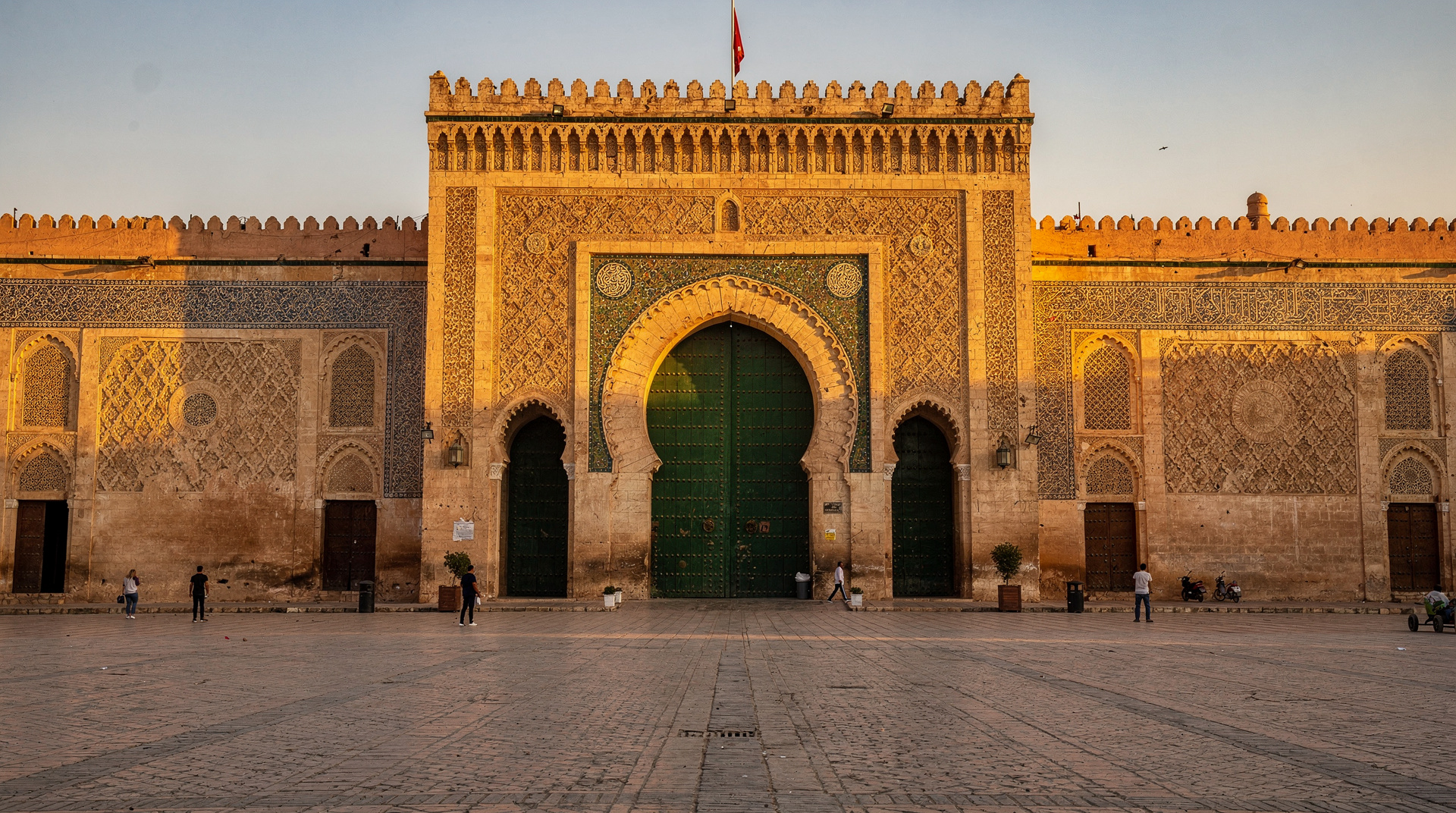
Built by Sultan Moulay Ismail and completed by his son in 1732, Bab Mansour is one of the most impressive pieces of Islamic architecture in all of Morocco — a triumphal gate of monumental scale decorated with intricate zellij tilework, marble columns salvaged from Volubilis, and carved cedarwood. The gate is best appreciated from Place el-Hedim, the large square opposite, especially in the morning light. Entry to the gate complex itself is around 20 MAD; the square is always accessible.
Moulay Ismail Mausoleum
The tomb of the sultan who built Meknes into an imperial capital is one of the few Moroccan mausolea open to non-Muslim visitors. The interior is a progression of tiled courtyards and carved stucco chambers leading to the burial chamber itself — which visitors may approach but not enter. The restraint and piety of the space is moving. The sultan’s remains rest beneath a large black-and-white marble slab. Open daily except Friday morning; entry is free, though respectful dress (shoulders and knees covered) is essential.
Book a private guided walking tour of MeknesHeri es-Souani (Royal Granaries and Stables)
The scale of Moulay Ismail’s ambition is nowhere more apparent than in this vast complex of granaries and stables, built to supply his enormous standing army. The roof of the granary has collapsed over centuries, leaving a sequence of roofless chambers open to the sky — an accidental ruin of haunting beauty, overgrown with fig trees and populated by nesting swallows. Entry is 30 MAD. The adjacent Agdal Basin — an enormous reservoir — reflects the sky in an eerie, still expanse.
The Medina and Souks
Meknes’s UNESCO-listed medina is among Morocco’s most authentic urban environments. Unlike Fes’s labyrinthine complexity or Marrakech’s tourist-oriented organisation, Meknes’s medina is a living market town that happens to be 1,000 years old. The central covered souk (Kissaria) specialises in traditional fabrics and embroidery — the region’s Meknes brocades and stitched caftans are nationally renowned. The brass and leather souks south of the Kissaria are equally rewarding.
Bou Inania Medersa
Built in the 14th century under the Merinid dynasty, the Bou Inania Medersa is Meknes’s finest example of Islamic scholarship architecture — a madrasa (Quranic school) arranged around a central marble-paved courtyard, with carved cedar screens, zellij tilework to shoulder height, and stucco arabesque carvings above. Entry is 20 MAD. Small enough to appreciate without crowds, and genuinely fine craftsmanship.
Volubilis Roman Ruins
Thirty-three kilometres north of Meknes on the edge of the Zerhoun massif, Volubilis is the best-preserved Roman city in North Africa and a UNESCO World Heritage Site. The ruins date from the 1st to 3rd centuries AD, when this was the administrative capital of the Roman province of Mauretania Tingitana. The standing remains include a triumphal arch, forum, basilica, bathhouses, and — most spectacularly — a series of mosaic-floored town houses whose tesserae depict mythological scenes in extraordinary detail. Allow 2–3 hours. Entry is 70 MAD.
Book a half-day trip from Meknes to Volubilis and Moulay IdrissMoulay Idriss Zerhoun
Just 3 km from Volubilis, the holy city of Moulay Idriss Zerhoun drapes over twin hilltops above the plain — a whitewashed pilgrimage town built around the tomb of Moulay Idriss I, the founder of the first Moroccan dynasty and the man who brought Islam to Morocco in the 8th century. Non-Muslims may explore the town and its market but may not enter the mausoleum. The views over the surrounding countryside are exceptional, and the town’s serene atmosphere contrasts beautifully with Meknes’s monumental scale.
Where to Eat
Restaurant Zitouna (Rue Jemaa Zitouna, medina) is Meknes’s most consistently praised traditional restaurant — a converted riad serving Moroccan set menus of soup, salads, tagine, and pastries in a beautiful courtyard. Lunch or dinner runs 120–180 MAD per person. Reserve ahead in high season.
Restaurant Riad (near Place el-Hedim) is a solid lunch spot popular with tour groups for exactly the right reasons — large portions, reliable quality, and efficient service. Good harira soup (30 MAD) and kefta brochettes (70 MAD).
Place el-Hedim cafés: The terraces overlooking the great square serve adequate mint tea and coffee and are the best spot for watching Meknes daily life play out before Bab Mansour. Avoid the overpriced tourist menus.
Where to Stay
Mid-range (600–1,500 MAD / €60–150 per night)
Riad Meknes (near Bab Mansour) is a beautifully restored 18th-century riad with painted cedarwood ceilings, a courtyard fountain, and 7 individually decorated rooms. Breakfast included; warm host family atmosphere. From 800 MAD.
Hotel Transatlantique (on the edge of the new city) is a grand old French-era hotel with pool, gardens, and sweeping views over the medina valley. Slightly dated but atmospheric and well-run. From 700 MAD.
Budget (under 400 MAD / €40 per night)
Riad Bab Berdaine (medina) and several guesthouses around the medina offer simple rooms from 200–350 MAD — basic but clean, with central locations. Better for independent travellers comfortable navigating without much English-language signage.
Day Trips from Meknes
Fes: 60 km east — the most logical combination. Spend a night in Meknes arriving from Fes or departing to Fes, and you comfortably cover both imperial cities in a single arc.
Volubilis and Moulay Idriss: The essential Meknes half-day — Roman ruins and holy city combined. Virtually every Fes-based tour also includes Meknes on this circuit.
Book a Meknes and Volubilis day trip from FesMiddle Atlas forests: The cedar forests around Azrou (50 km south) harbour a population of Barbary macaques — friendly and photogenic. Azrou’s mountain air and Berber market make for a refreshing contrast to urban Meknes.
Rabat: 140 km west by train (2 hours), easily combined with Meknes on a longer imperial cities circuit.
Practical Tips
Visiting Volubilis: Go in the morning (8–11 am) before tour buses arrive from Fes. Bring water and sun protection — the site is completely exposed. The museum at the entrance contains artefacts (bronzes, ceramics) that contextualise the ruins. A local guide (available at the gate) adds significant depth; expect to pay 150–200 MAD for a 1.5-hour tour.
Meknes medina orientation: Unlike Fes, Meknes’s medina is small enough to navigate without getting comprehensively lost. The main axis runs from Place el-Hedim through the kissaria to the northern medina entrance. A phone offline map suffices.
The tourist trap: Restaurant touts near Place el-Hedim can be aggressive. Smile, decline, and keep walking — the good restaurants are one alley deeper in, not the ones facing the square.
Timing: Meknes can be visited comfortably in a single day from Fes if you start early (monuments open at 9 am) and include Volubilis. An overnight stay removes the rush and allows a more leisurely medina exploration.
When to Visit
Spring (March–May) is ideal — warm, clear, and relatively uncrowded. The surrounding countryside is green after winter rains, making Volubilis especially beautiful.
Autumn (September–November) is equally good. Meknes has a continental climate — hotter summers and cooler winters than the coastal cities.
Summer: Hot (35–40°C) but manageable with early morning and late afternoon exploration. Volubilis is brutal midday in July–August — strictly a morning visit.
Winter: Cold nights (near freezing January–February) but crisp sunny days. Meknes is worth visiting year-round.
How to Fit Meknes into a Longer Itinerary
Imperial cities loop (7–10 days): Rabat (1 night) → Meknes (1 night) → Fes (2 nights) → Chefchaouen (1–2 nights) → return. Meknes-Volubilis fills a full day perfectly, and the onward train to Fes takes under an hour.
Fes base with day trip: Stay 3 nights in Fes and dedicate one full day to the Meknes–Volubilis–Moulay Idriss circuit. All major Fes hotels and riads can arrange this easily.
Marrakech to Fes north loop: Marrakech → Atlas → Merzouga → Fes → Meknes → Rabat → Casablanca. A classic 10-day circuit covering imperial cities and desert.
Read our guides on planning your Morocco trip, Marrakech vs Fes comparison, and getting around Morocco for detailed planning help.