Honeymoon Morocco itinerary: 10 days of romance
Why Morocco makes a perfect honeymoon destination
Morocco offers something few honeymoon destinations can match: the contrast of senses. You move from the lantern-lit intimacy of a riad courtyard to the silence of a star-canopied desert camp in a single day. You eat long private dinners under carved cedar ceilings, bathe in centuries-old hammam traditions designed for two, and watch the sun vanish behind Atlantic ramparts. It is theatrical in the best possible way — and the infrastructure for luxurious, slow travel has never been better.
This 10-day circuit is built around three iconic zones: Marrakech and its luxury riad scene, the Sahara loop via Aït Benhaddou and Erg Chebbi, and the windswept Atlantic coast of Essaouira. The pace is deliberately unhurried. No site-a-day ticking. The goal is depth, beauty, and time to simply be together.
Route at a glance: Marrakech (3 nights) → Agafay sunset dinner → Aït Benhaddou → Ouarzazate → Merzouga dunes (2 nights) → Skoura rose valley → Marrakech (1 night) → Essaouira (3 nights) → Marrakech airport
Best season: October, November, March, or April. Temperatures are perfect — warm days, cool evenings in the Sahara, and the dune light is golden rather than bleaching. Avoid July and August (desert temperatures exceed 45°C).
Total estimated cost (per couple, flights excluded): €3,500–6,500 depending on riad grade and whether you choose private or shared desert tours.
At a glance
| Where | Marrakech, Agafay, Aït Benhaddou, Ouarzazate, Merzouga (Sahara), Skoura, Essaouira |
| Duration | 10 days / 9 nights |
| Cost per couple | around €3,000–6,500 (flights excluded) |
| Getting there | fly into Marrakech Menara Airport (RAK) |
| Getting around | private driver for the Sahara loop; private transfer to Essaouira |
| Best time | October, November, March, April |
Day-by-day summary
| Day | Route | Overnight |
|---|---|---|
| 1–3 | Marrakech: riad, palaces, hammam, Agafay sunset dinner | Marrakech riad |
| 4 | Tizi n’Tichka pass → Aït Benhaddou → Ouarzazate | Boumalne Dades / Tinghir area |
| 5 | Todra Gorge → Merzouga dunes | Luxury desert camp |
| 6 | Sahara sunrise, dune day, return via Skoura | Ouarzazate / Aït Benhaddou area |
| 7 | Aït Benhaddou revisit → back to Marrakech | Marrakech riad |
| 8 | Hot air balloon, souks, farewell dinner | Marrakech riad |
| 9–10 | Essaouira: ramparts, seafood, beach walk | Essaouira riad |
Day 1: Marrakech — arrive into your riad world
Morning: arrival
Menara Airport to your medina riad is a 10-minute petit taxi or pre-arranged private transfer. For a honeymoon, arrange a private airport transfer with your riad (typically €25–40) — you will be welcomed with mint tea on arrival rather than haggling a taxi price after a long flight.
For a romantic Marrakech stay, look at Riad Farnatchi (10 suites, private plunge pools, extraordinary service: €350–550/night), Riad BE Marrakech (rooftop pool, intimacy: €200–300/night), or La Mamounia for full grandeur (€600–1,200/night but genuinely legendary). Book direct for the best rates and any honeymoon extras.
Afternoon: gentle medina orientation
Do not attempt to do everything on Day 1. The medina is overwhelming at first — a feature, not a bug, but best approached with patience. Walk south from Djemaa el-Fna to the Bahia Palace neighbourhood. The Mellah (historic Jewish quarter) has a quieter rhythm than the main souks — wrought iron balconies, crumbling grandeur, small workshops.
Stop at a rooftop café for Moroccan tea (atai — fresh mint, gunpowder tea, pyramids of sugar) and simply watch the city.
Evening: private dinner in the riad
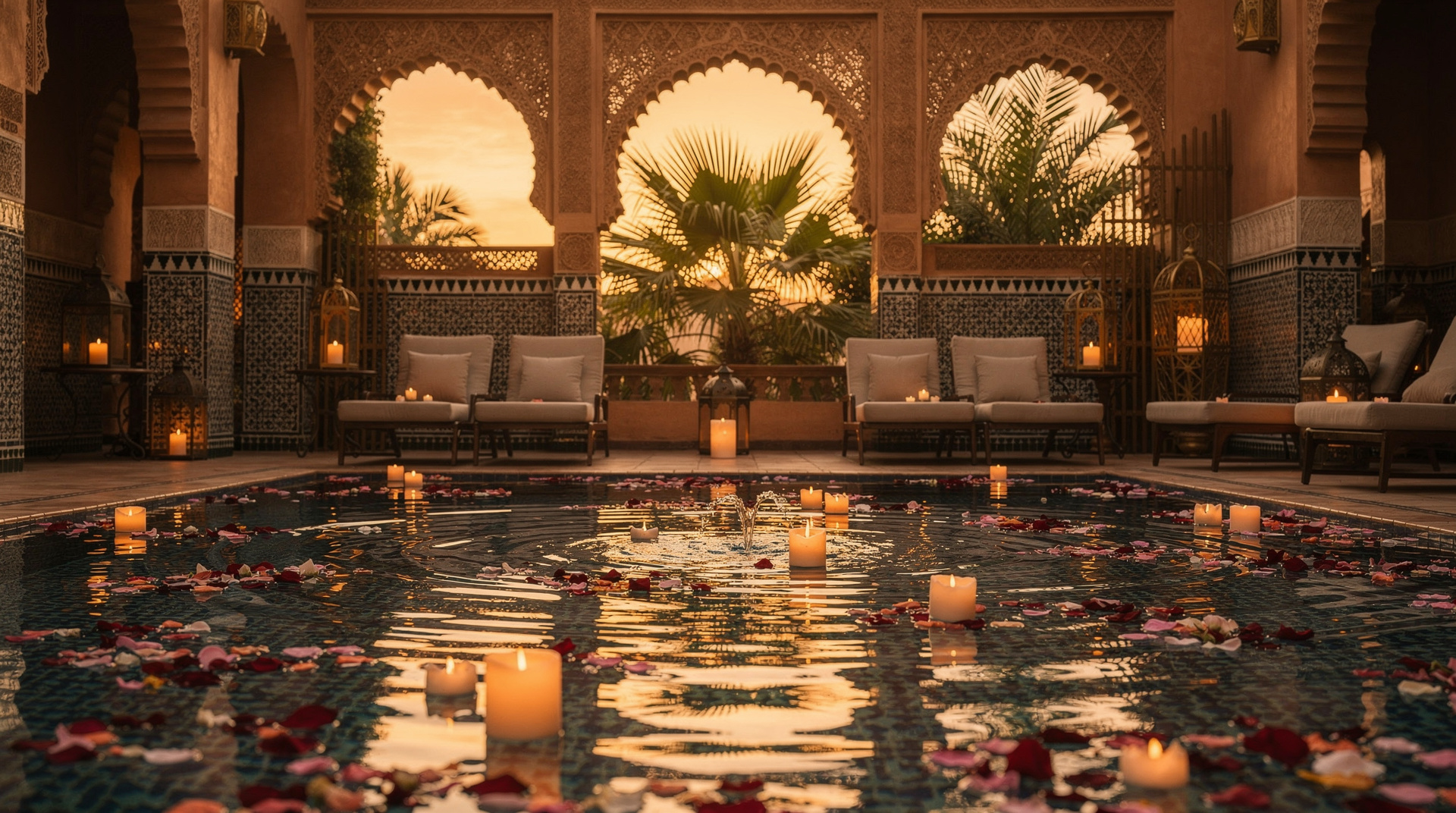
Many luxury riads offer private candlelit dinners in the courtyard or on the rooftop. At Riad Farnatchi or similar properties, a chef prepares a four-course Moroccan meal while you have the space entirely to yourselves. Budget €80–120 per couple. Ask for rose petals and Moroccan oil lamps when booking — they will understand exactly what you need.
Where to stay: Riad Farnatchi (€350–550/night), Riad El Fenn (€280–400/night), or La Mamounia (€600+)
Budget estimate today: €150–300 including transfer, meals, activities
Day 2: Marrakech — palaces, Majorelle, and a private hammam
Morning: Bahia Palace and Saadian Tombs
Start at 09:00 when the Bahia Palace (entry €2) is still quiet. The 19th-century palace was built by a grand vizier for his four wives — the decorated ceilings in each wife’s apartment reflect her status. The courtyard’s central fountain is one of the most photographed spots in Morocco, and for good reason.
The Saadian Tombs next door contain the marble tombs of the 16th-century Saadian sultans, sealed for three centuries and rediscovered from the air in 1917. The Chamber of the Twelve Columns is extraordinary.
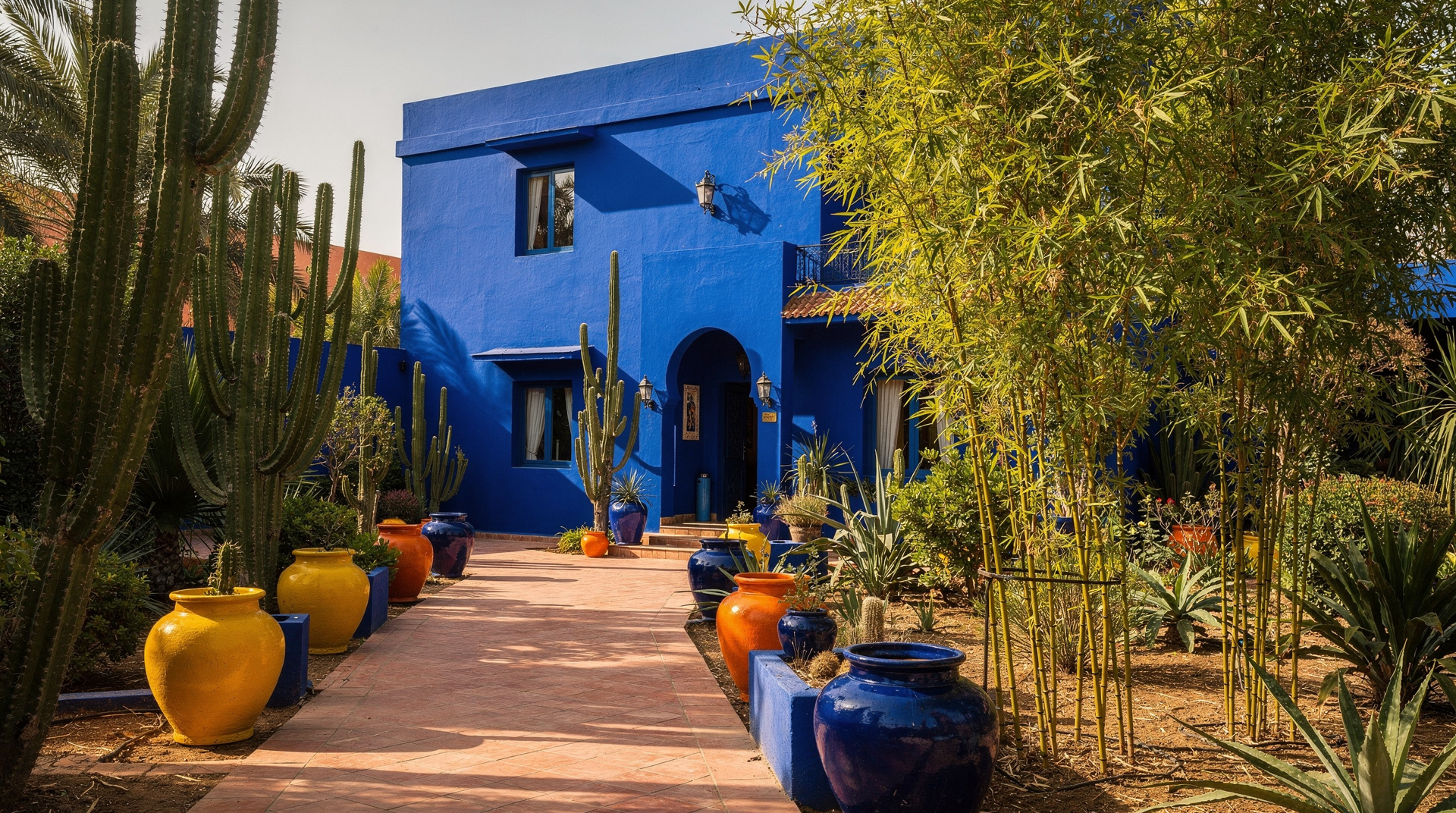
Book your Majorelle Garden entry with Berber Museum for 11:00. The cobalt-blue buildings designed by Jacques Majorelle and later owned by Yves Saint-Laurent are best photographed in morning shade. The adjacent YSL Museum (€12/person extra) is worth the hour if fashion and design interest you.
Afternoon: private hammam for two
A private hammam session for couples is one of Morocco’s great intimate rituals. The traditional sequence — hot room, black soap (savon beldi) scrub, kessa mitt exfoliation, ghassoul clay mask, rose water rinse — takes 90 minutes and leaves both of you entirely reset. Les Bains de Marrakech offers a private hammam room for couples (€80–120 per session including oil massage add-on). Book 24 hours ahead.
Evening: rooftop dinner
Nomad restaurant in the heart of the medina has a wonderful rooftop terrace with Djemaa el-Fna views and creative Moroccan cuisine. Alternatively, Dar Moha on Rue Dar el Bacha offers an exceptional €50–65 set menu in a 1930s riad garden.
Where to stay: Same riad as Day 1
Budget estimate today: €120–220 including entry fees, hammam, and dinner
Day 3: Marrakech + Agafay desert sunset dinner
Morning: cooking class together
A couples cooking class is a perfect Marrakech morning. The La Maison Arabe cooking workshop runs 09:00–13:00 and teaches tagine, couscous, and pastilla in the hotel’s garden kitchen. You eat what you cook; the recipes come home with you. €65–85 per person.
Afternoon: rest and Majorelle gardens revisit
The afternoon is genuinely best spent doing very little. Most riads have a shaded courtyard or rooftop pool; use it. If energy allows, revisit Majorelle at 16:00 when the afternoon light is gold rather than overhead.
Evening: Agafay desert sunset dinner
The Agafay Desert — a rocky hammada plateau 30 km south of Marrakech — is one of the most romantic dinner settings in Morocco. Several luxury camps operate here, offering sunset camel rides across the stone desert followed by Berber-tent dining under the stars. Book the Agafay Desert dinner with sunset camel ride for a spectacular evening — return to Marrakech by midnight. €80–130 per person including dinner and entertainment.
Where to stay: Same riad as Day 1
Budget estimate today: €200–350 as a couple including cooking class and Agafay evening
Day 4: The drive south — Tizi n’Tichka and Aït Benhaddou
07:00 pickup for the 3-day Sahara journey
Your private driver picks you up at the riad. For a honeymoon, choose a private tour rather than a shared group (the price difference is €100–200 more per couple but you have your own vehicle, your own pace, and no strangers). Budget €350–500 per person for a fully private 3-day experience including accommodation.
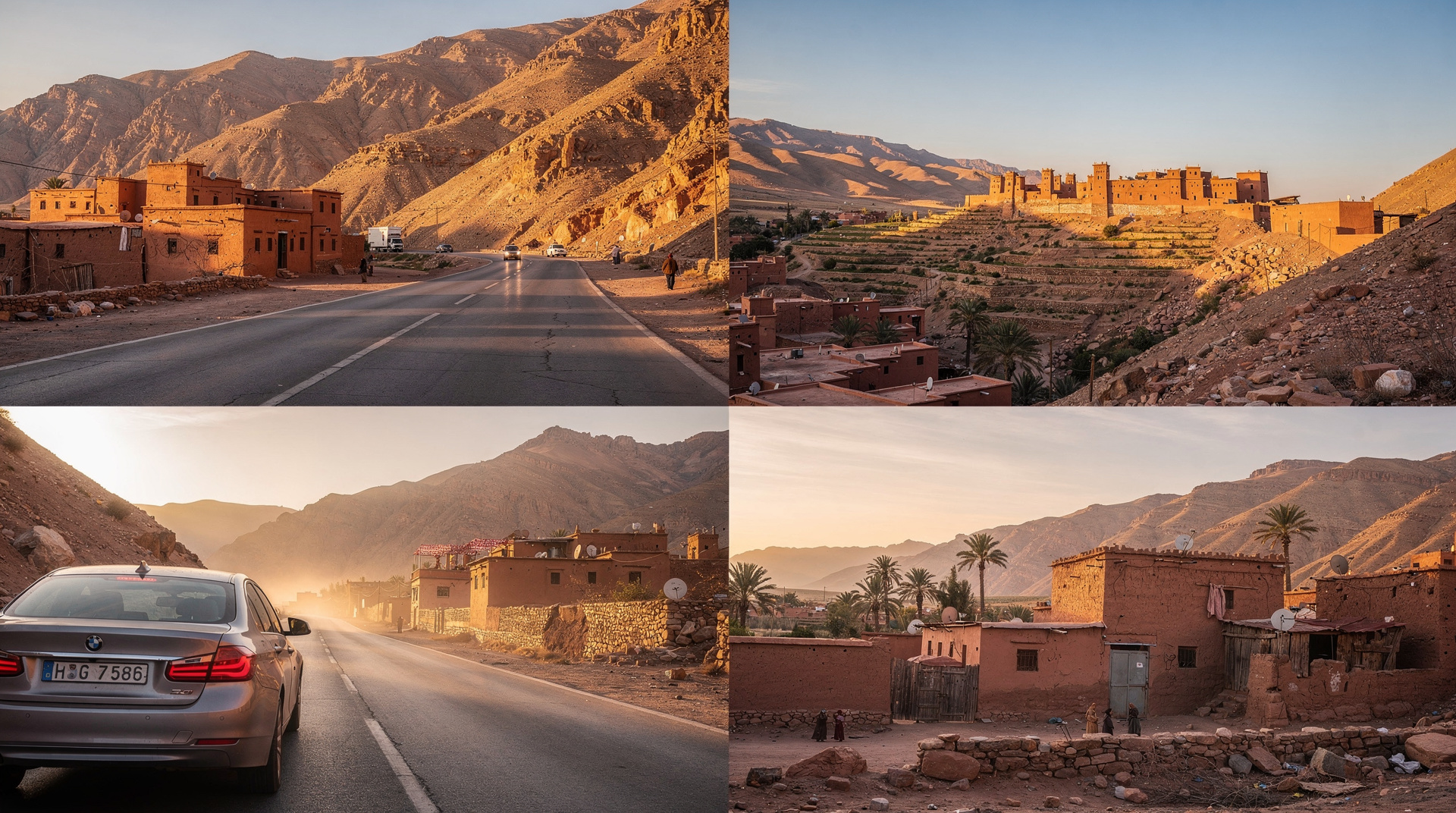
The road south climbs quickly through the High Atlas foothills. The Tizi n’Tichka pass at 2,260 metres is Morocco’s highest main road — hairpin after hairpin with views that justify the mild vertigo. The landscape on the south side turns red and ochre.
Midday: Aït Benhaddou
The UNESCO ksar is best understood as a living museum — a fortified city of earthen towers and labyrinthine passages that has been continuously inhabited (in small numbers) for four centuries. Cross the seasonal river on stepping stones and walk up through the four main kasbahs to the old granary at the top for views over the Ouarzazate Valley. Entry €3.
Lunch at a riverside restaurant below the ksar. The seven-salad plate (khobz with roasted peppers, olives, carrot cumin, potato chermoula) arrives as an automatic first course and is one of the small pleasures of Moroccan travel.
Afternoon: Ouarzazate
Your driver will stop at the Kasbah Taourirt in Ouarzazate (entry to the decorated interior €3) before continuing east through the Dades Valley’s long green ribbon of palmeries and rose fields.
Where to stay: A riad or guesthouse in Boumalne Dades or Tinghir area (included in tour if pre-booked)
Budget estimate today: Included in tour package
Day 5: Todra Gorge at dawn + Merzouga arrival
Dawn: Todra Gorge
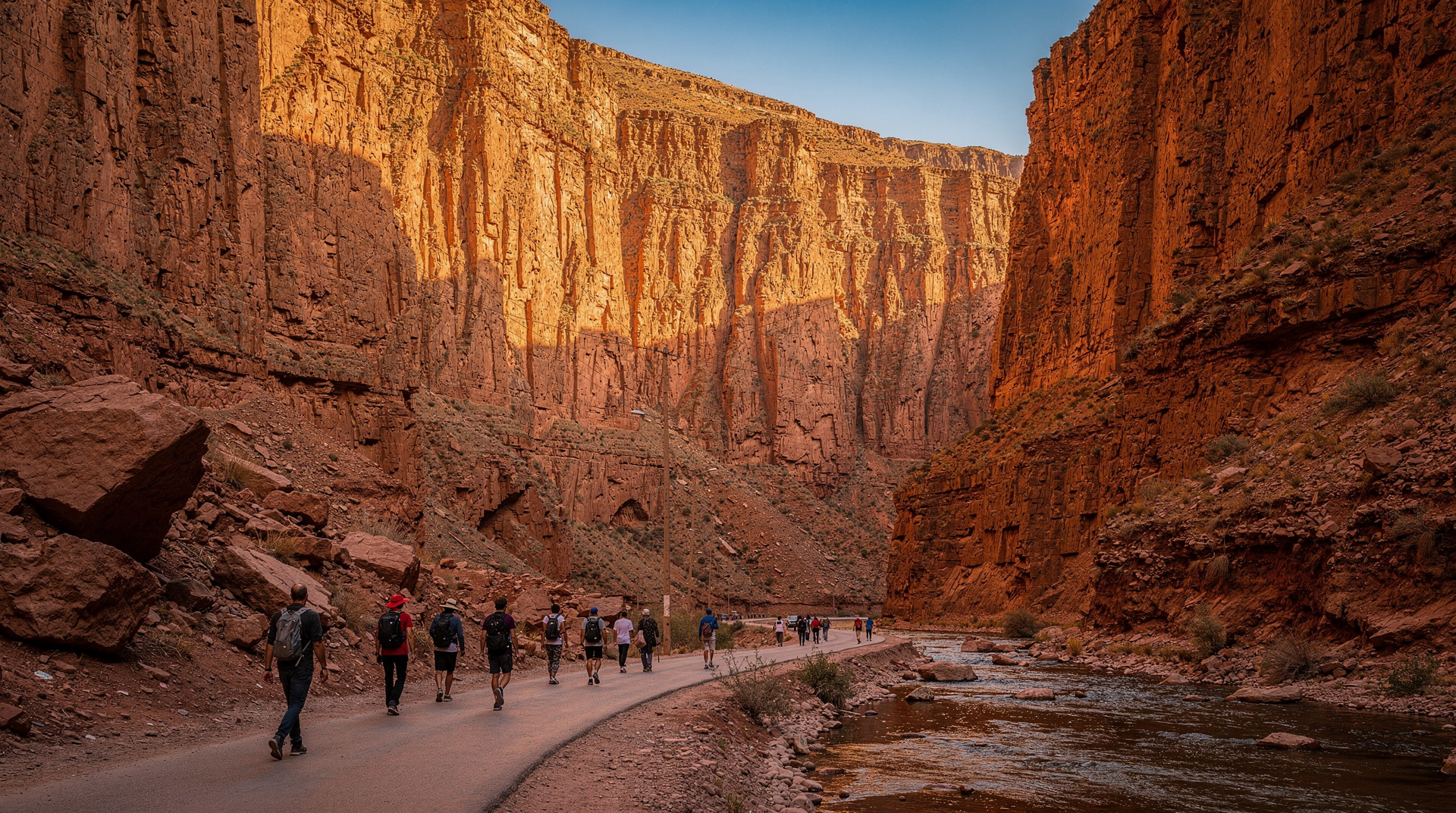
Be in the gorge by 07:30. The 300-metre granite walls glow pink at sunrise before narrowing to cast everything below into cool blue shadow. A shallow river runs through year-round. Walk the dramatic 600-metre slot section, then walk back. It takes 30 minutes and stays with you permanently.
Drive to Merzouga (4 hours)
Through Erfoud’s fossil market and Rissani’s Monday and Thursday souq, and then the flat black hammada stretches to every horizon. The Erg Chebbi dune sea appears like an apparition — 150 metres of orange sand rising without warning from the flat desert floor.
Late afternoon: settle into your luxury camp
For a honeymoon, book a luxury camp rather than a standard Berber camp. The difference: a private tent with a real bed (not a mat), en-suite solar-powered bathroom, private terrace, and a separate dining tent away from the group area. Merzouga Luxury Desert Camp and Azalay Desert Camp both offer exceptional honeymoon setups. Prices: €150–280 per night per couple including dinner, breakfast, and the sunset camel ride.
Evening: sunset camel ride + private dinner
Book the Merzouga luxury desert camp with camel ride and dinner if you have not arranged this through your private tour operator. The sunset camel ride leads to the dune crest where the light turns from gold to copper. After dinner under stars visible with a clarity impossible in any European city, the desert silence at 23:00 is extraordinary.
Where to stay: Merzouga Luxury Desert Camp or Azalay Desert Camp (€150–280/night per couple)
Budget estimate today: Included in tour; drinks extras €20–30
Day 6: Sahara sunrise + second dune day
05:30: climb to the dune crest
The sunrise hike from camp to the nearest high crest takes 25–30 minutes. You will be breathing hard in the soft sand; you will not care. At the summit, the sun rises over Algeria and the shadow of the dune sweeps west across the plain in real time. The Sahara at 06:00 is entirely silent. This is, for many couples, the moment of the trip.
Morning: at leisure in the dunes
Spend the morning at your own pace. The serious dune photographers will be out before 08:00; by 09:00 the heat discourages hiking. Sandboarding on the smaller slopes near camp is possible and entirely ridiculous in the best way. Or simply sit outside your tent and read. The dunes will not get boring.
Afternoon: return drive via Skoura palm oasis
The drive back begins after lunch. Route via Skoura — a hidden gem palm oasis with a scattering of kasbahs among 300,000 date palms. Dar Ahlam, one of Morocco’s most celebrated boutique hotels, is here (€700+/night; worth knowing for a future trip). The oasis walk takes 90 minutes on foot.
Where to stay: Riad in Ouarzazate or continue toward Marrakech (guesthouse in Aït Benhaddou area)
Budget estimate today: Included in tour; Skoura entry or guide optional €5–15
Day 7: Aït Benhaddou — second angle + return to Marrakech
Morning: Aït Benhaddou at golden hour
A second visit hits differently — you know the layout, you can climb higher, you can photograph the morning light on the towers without the crowds of midday. Ask your driver to arrive by 08:00.
Afternoon: return over the Atlas
The northward drive over Tizi n’Tichka is equally spectacular in the opposite direction. On clear days, Atlas peaks above 4,000 metres are visible from the pass. Arrive back in Marrakech by 18:00.
Evening: quiet night at the riad
The hammam tonight or the rooftop dinner — either option, but lean toward the hammam. The Sahara does extraordinary things to skin and the kessa scrub will remove the last of the desert.
Where to stay: Return to your original riad, or switch to a new one — Riad Star, owned by the late Josephine Baker’s son, is a romantic off-the-mainstream choice in the northern medina.
Budget estimate today: Included in tour; dinner €30–60
Day 8: Marrakech — hot air balloon and final medina
Dawn: hot air balloon over the Atlas
The most romantic thing you can do in Marrakech takes 45 minutes in the air. Book the hot air balloon ride with transfers and Berber breakfast — the flight lifts from a field outside the city at sunrise, drifts over palm groves, pise villages, and argan trees, and lands with a champagne-style mint tea celebration and a flight certificate. €180–220 per person. Absolutely worth it.
Afternoon: souks without rush
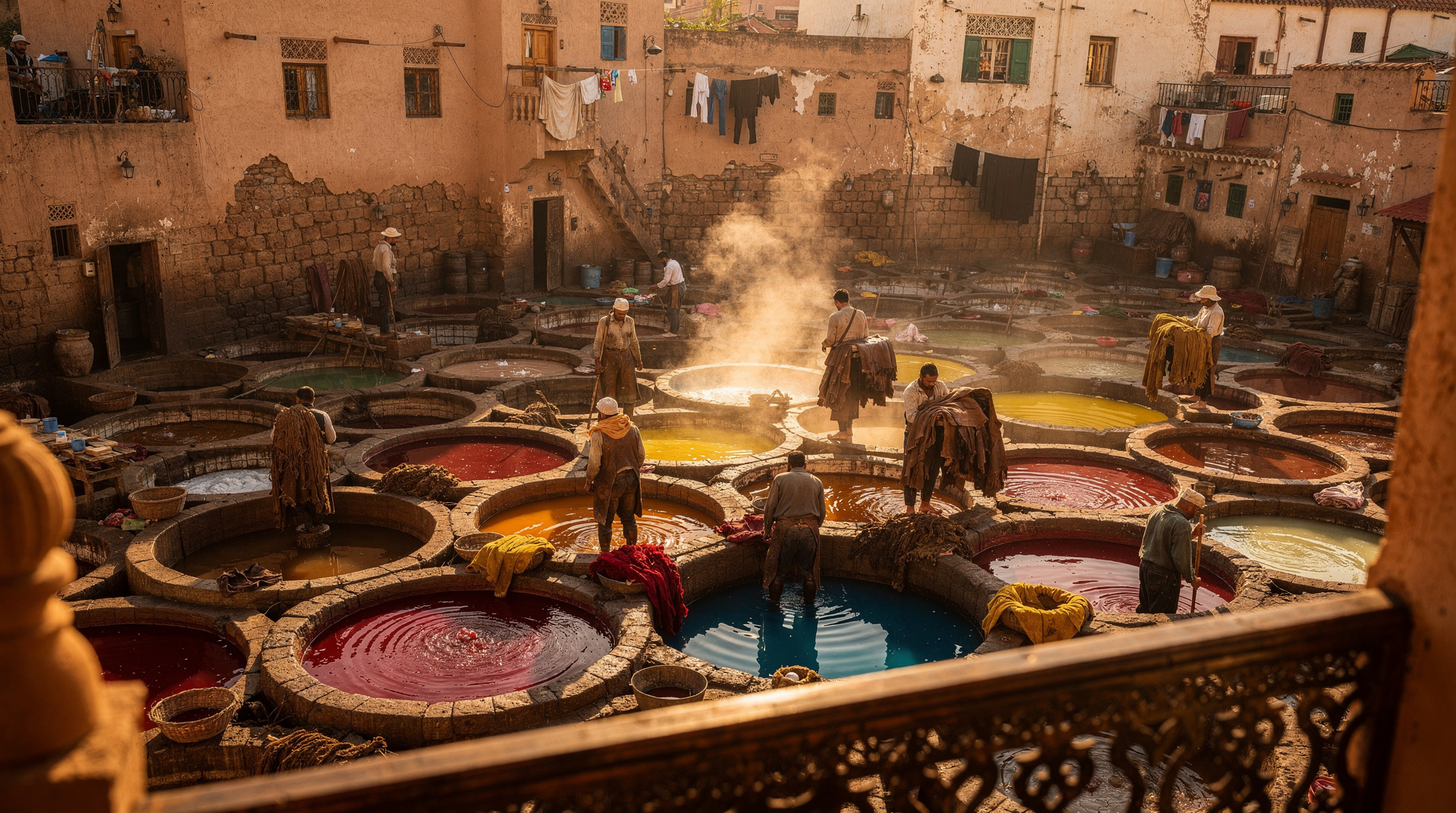
You now have three days of experience and a much clearer head for the medina. The carpet souk, the leather souk, the spice market at Mellah — all better on Day 8 than Day 1. Buy what you actually want.
Evening: farewell Marrakech dinner
The Dar Yacout restaurant, set in a 17th-century palace, is overpriced but extraordinary for a single special occasion. Alternatively, Le Tobsil does a four-course set dinner (€55/person, no menu — you eat what the chef cooks) in a riad courtyard that converts every first-timer.
Where to stay: Last night in your Marrakech riad
Budget estimate today: €400–550 per couple including balloon, souks, dinner
Day 9–10: Essaouira — the Atlantic finale
Day 9 morning: transfer to Essaouira (2h30)
The CTM bus runs Marrakech to Essaouira for €7 per person. For a honeymoon, take a private transfer (€50–70 one-way) and arrive directly at your riad door.
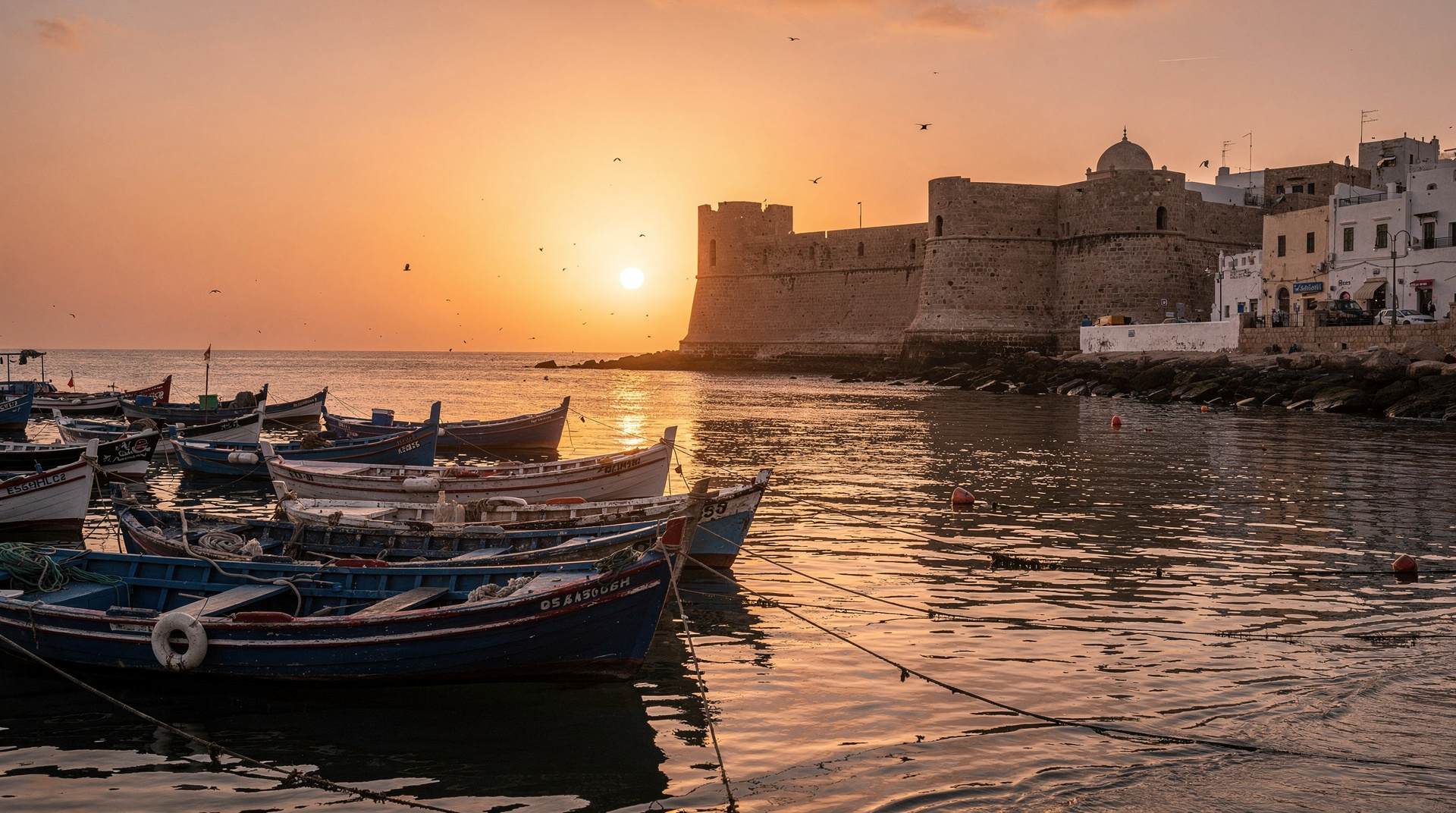
Essaouira’s pace is the antidote to Marrakech. The white-and-blue medina (UNESCO-listed) sits behind 18th-century Portuguese fortifications. The Atlantic wind blows constantly — in summer, kite surfers use it productively. In October–April, the wind gives the city a wild, cinematic quality.
For a romantic stay in Essaouira, Heure Bleue Palais (€150–250/night, pool, restaurant) is exceptional. L’Heure Bleue is a boutique hotel with real style. Or Riad Baladin for mid-range romance (€80–120/night).
Day 9 afternoon and evening:
Walk the Skala de la Ville ramparts at sunset — the sea-facing cannons, the breaking Atlantic swells, the disappearing sun: it is a location that would cost a film production team a fortune to recreate. The medina behind the ramparts is easily navigated — the main street (Rue Mohammed el Qory) runs straight through.
Dinner at Elizir (excellent fish tagine, open terrace, €20–30/person) or at the harbour fish stalls for the most honest grilled seafood in Morocco (€8–12/plate). Essaouira is more relaxed about wine than inland cities — outdoor tables, sea wind, a carafe of Moroccan rosé are entirely possible.
Day 10: final morning, return
The Essaouira beach runs 5 km south — walk it early before the wind builds. The weekly camel market on the edge of town (timings vary) is one of those accidental discoveries that become a favourite memory. Argan oil from Essaouira’s women’s cooperatives is the best value in Morocco — pay €30–50 for a genuine 100ml bottle and ignore the medina tourist prices.
Grand taxi or private transfer back to Marrakech (2h30) for your flight.
Where to stay: Heure Bleue Palais (€150–250/night) or Riad Baladin (€80–120/night)
Budget estimate (Days 9–10): €300–500 per couple including transfer, accommodation, and meals
Total trip cost estimate
| Item | Comfort (per couple) | Luxury (per couple) |
|---|---|---|
| Accommodation (10 nights) | €900 | €2,200 |
| Private Sahara 3-day tour | €800 | €1,200 |
| Hot air balloon (x2) | €360 | €440 |
| Agafay desert evening | €160 | €260 |
| Hammam sessions (x2) | €120 | €200 |
| Food and drink (10 days) | €400 | €800 |
| Transfers and local transport | €150 | €300 |
| Entry fees and activities | €100 | €180 |
| Total (flights excluded) | €2,990 | €5,580 |
What to skip or adjust
Skip if budget is tight: The hot air balloon (€360–440/couple) is magnificent but the Agafay dinner (€160–260/couple) is the better value per memory unit. The sunset camel ride at Merzouga is non-negotiable — that stays.
Add if you have a day spare: A night in Skoura at Dar Ahlam breaks up the desert return and adds extraordinary palm-oasis atmosphere. Or add a night in Ouarzazate and visit the Atlas Film Studios (€12/person) — surreal and genuinely interesting.
For ultra-luxury: La Mamounia in Marrakech, Amanjena (outside Marrakech), or the Scarabeo Camp in Agafay all represent the top end of Moroccan hospitality. Budget €500–1,000+/night for these; they are not for every budget but they are exceptional.
Key logistics for a Morocco honeymoon
Booking timeline: Book your luxury riads 2–3 months ahead for shoulder season (March–April, October–November). The best rooms in small riads (8–12 suites) sell fast to destination travel agents.
Private versus shared Sahara tours: For a honeymoon, always private. The cost difference is €150–250 extra per couple; the experience difference is total. Your own vehicle, your own pace, your own timeline — no strangers sharing the dune sunset.
Hammam protocols: Mixed hammams where couples bathe together exist but are rare in traditional settings. Most riads can book a private hammam room for couples — ask specifically. Les Bains de Marrakech and several luxury riad spas offer this explicitly.
Currency and tipping: All prices in MAD (Moroccan dirham; 1 EUR ≈ 10.8 MAD) and euros. Tip your private driver €10–15/day; your riad staff 30–50 MAD/night; your hammam attendant 20–30 MAD.
For essential planning, read our first-time visitors guide and riad versus hotel comparison. For the Sahara camp decision, see luxury desert camps guide. The Merzouga destination guide has detailed camp recommendations and Erg Chebbi logistics.
Also see our 10-day Morocco itinerary for the standard circuit and our luxury Morocco itinerary for the full high-end routing. For just the desert, the desert-focused itinerary covers every Sahara angle. If you’d rather compare honeymoon hotel picks directly, our honeymoon hotels in Morocco guide and best time for a couples honeymoon guide go deeper on timing and property choice, and the luxury desert camps guide compares the Merzouga camps by tier.
Choosing your honeymoon base in Marrakech
Not every couple wants the same riad style. If you want total privacy and a plunge pool of your own, a small 8–12 suite riad like Riad Farnatchi beats even La Mamounia for intimacy, because the entire property effectively becomes yours after dark. If you want grandeur, gardens, and a spa that could fill a week on its own, La Mamounia or Royal Mansour justify the premium. If budget matters more than either, Riad BE Marrakech gives a genuine rooftop-pool honeymoon feel for a third of the price of the flagship hotels — see our riad versus hotel comparison for the full trade-offs, and best riads in Marrakech for honeymoons for a shortlist by budget tier.
Making the Sahara nights feel special, not just scenic
The single biggest lever for a honeymoon-grade Sahara stop is booking two nights rather than one. The first night is spent adjusting — camel ride, dinner, an early exhausted sleep after a long drive day. The second night is when the desert actually settles into you: you know the camp, the silence stops feeling strange, and the sunrise climb on Day 6 is unhurried rather than rushed to catch a departure. Couples who only book one Merzouga night consistently say afterward they wish they’d added the second.
Frequently asked questions about Honeymoon Morocco itinerary
Is 10 days enough for a Morocco honeymoon, or should we do more?
Ten days covers Marrakech, the Sahara loop, and Essaouira comfortably at an unhurried pace. Cutting to 7 days means dropping either the coast or a Sahara night — doable, but the trip feels more like sightseeing than a honeymoon. If you have 14 days, add Chefchaouen or Fes rather than rushing this route.
Do we need a private guide for the whole trip, or just for parts?
Just for parts. The Marrakech medina, palaces tour benefits enormously from a private guide (context transforms the visit), but Essaouira and the desert camp days are naturally unhurried without one. Budget a guide for Day 2 in Marrakech and let the rest of the trip breathe on its own.