Quick facts
- Language
- Tachelhit, Darija
- Distance from Ouarzazate
- 42 km east (30–40 min)
- Distance from Boumalne Dades
- 90 km west (1h 15min)
- Best for
- Kasbahs, palmery walks, rose valley
The Oasis of a Thousand Kasbahs
The Draa-Tafilalet corridor — the great southern route that most travellers follow between Marrakech and the Sahara — contains some of Morocco’s most spectacular scenery, and most visitors rush through it en route to Erg Chebbi or Zagora. Skoura is one of the places they most often regret not stopping at.
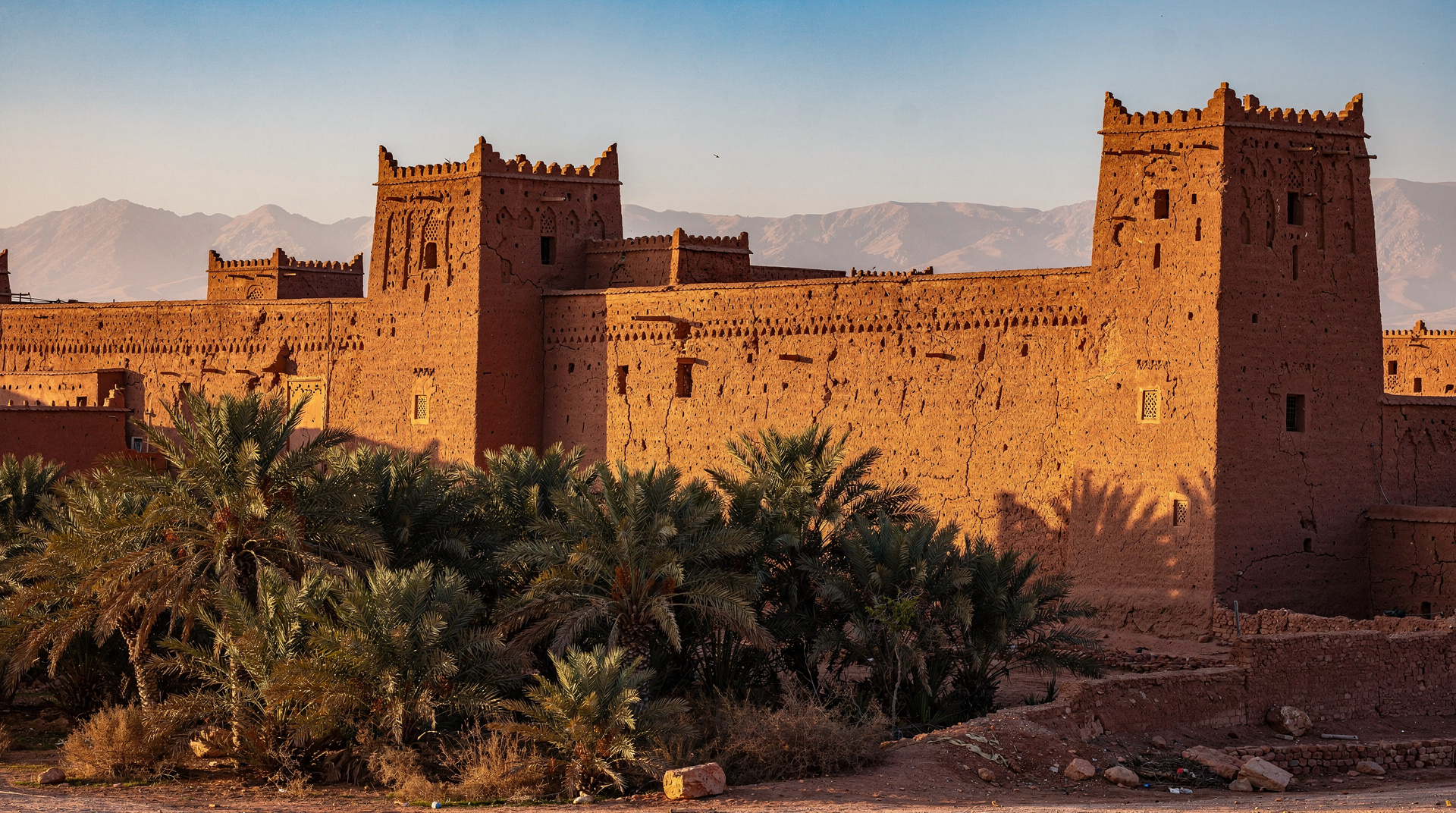
Skoura’s palmery extends across roughly 4,500 hectares of the Dades River floodplain, an extraordinary oasis that shelters hundreds of kasbahs — some crumbling, some restored, some still inhabited — in a dense garden of date palms, almond trees, roses, and irrigated vegetable plots. The density of mud-brick architecture in this single valley is remarkable: Skoura has more traditionally preserved kasbahs per square kilometre than almost anywhere in Morocco.
The most famous is the Kasbah Amridil, dating to the 17th century and once featured on the 50-dirham banknote. But the real pleasure of Skoura is not ticking off monuments — it is walking the shaded paths between the palms, crossing the Dades on stepping stones, pausing at a kasbah whose resident family has farmed these irrigated terraces for 15 generations, and seeing how productive and how beautiful a well-managed desert oasis can be.
Getting There
From Ouarzazate: Skoura sits 42 km east of Ouarzazate on the N10 highway. By car, the journey takes 30–40 minutes through flat scrubland. By shared grand taxi, the cost is around 25–35 MAD per seat.
From Marrakech: Cross the High Atlas via the Tizi n’Tichka pass (2,260 m) to Ouarzazate, then east on the N10. Allow 4.5–5 hours total, including a stop at Aït Benhaddou.
From the Dades Gorge: Boumalne Dades, the main access town for the gorge, lies 90 km east of Skoura (about 1 hour 15 minutes on the N10). Skoura is a natural stopping point on the journey between the gorge and Ouarzazate.
From Zagora: Approximately 4 hours west on smaller roads via Agdz — this routing is scenic and rarely used, passing through the Draa Valley.
By bus: CTM and Supratours coaches running the Marrakech-Ouarzazate-Boumalne route stop in Skoura. Check current timetables as schedules change seasonally.
Getting Around
Skoura’s palmery is best explored on foot or by bicycle. The network of irrigation channels (seguias) and mule paths that thread through the palms is not accessible by car, and much of the best scenery — hidden kasbahs glimpsed between palm fronds, the surprise of a rose garden beside a crumbling tower — is only visible at walking pace.
Bicycle rental is available from guesthouses in the village (50–80 MAD per half-day). A guided walk through the palmery with a local who knows the private kasbah owners takes around 2–3 hours and costs 150–250 MAD. Ask at your accommodation.
For the rose valley and further-flung kasbahs, a car or taxi is needed.
Top Things to Do
Kasbah Amridil
The jewel of Skoura’s kasbahs, Amridil dates to the 17th century and has been maintained by the same Berber family for generations. Its square towers, intricate geometric facades, and internal courtyard are some of the finest examples of southern Moroccan earthen architecture anywhere in the Draa-Tafilalet region. It was once reproduced on Morocco’s 50-dirham banknote, which says something about its status.
A family member leads visitors through the rooms, storage chambers, and prayer hall that give a genuine sense of how a kasbah functioned as a combined fortress, granary, and residence. Entry: around 30–40 MAD. Photograph the southern face in morning light for the definitive shot.
Walk the Palmery
The most rewarding activity in Skoura is simply walking the network of paths through the palmery without a fixed agenda. The irrigation system — a series of channels (seguias) fed from the Dades River via underground khettara aqueducts — keeps the oasis alive through the long desert summers. Walking beside these channels between rose hedges, almond groves, and date palms, with kasbahs emerging from the green at intervals, is the kind of experience that makes the effort of getting to this part of Morocco worthwhile.
Allocate a full morning for a serious palmery walk. Bring water, wear sun protection, and carry small change for the inevitable children who will ask for photos.
Visit the Rose Valley (El Kelaa des Mgouna)
Approximately 60 km east of Skoura on the N10, the town of El Kelaa des Mgouna is the centre of Morocco’s rose-growing industry. The valley along the N10 and the river below it is planted with hundreds of thousands of Damascus rose bushes — and in late April and early May, when the roses bloom, the roadside becomes a river of pink. The town’s rose water distilleries operate throughout the year, and the Rose Festival in May is one of the most colourful regional events in Morocco.
Skoura makes a good base for a visit to the rose valley — closer than Ouarzazate and more atmospheric than Boumalne.
Kasbah Ben Moro and Dar Ahlam
Two of Morocco’s most celebrated accommodation properties sit in the Skoura palmery. Kasbah Ben Moro is an atmospheric 17th-century fortified guesthouse; Dar Ahlam is a legendary luxury desert lodge with just 12 rooms, a creative kitchen, and a staff-to-guest ratio that makes it one of the finest properties in Africa. Even those not staying at either can arrange a lunch or guided tour at Ben Moro.
Dades Gorge Day Trip
The Dades Gorge — one of Morocco’s most dramatic natural features — begins about 90 km east of Skoura near Boumalne. The road into the gorge climbs between vertiginous pink-limestone walls before reaching the upper valley with its unusual “monkey fingers” rock formations. It makes a superb day trip or en-route stop. The drive alone — through the palm-filled gorge with kasbahs on the cliffsides — is worth the effort.
Aït Benhaddou
Morocco’s most famous ksar, Aït Benhaddou, lies 85 km west of Skoura via Ouarzazate. The UNESCO-listed fortified village — a film set for Gladiator, Lawrence of Arabia, and Game of Thrones — is best visited in morning light. It is an easy half-day from Skoura, or a natural stop on the drive in from the Tizi n’Tichka.
Where to Stay
Luxury (5,000–15,000 MAD / €500–1,500 per night)
Dar Ahlam is one of Morocco’s great hotel experiences — an intimate, discreet luxury lodge in the heart of the palmery with extraordinary meals (often eaten beside the irrigation channels or in the rose garden) and curated excursions led by the in-house team. Exceptional for special occasions.
Mid-range (500–1,500 MAD / €50–150 per night)
Kasbah Ben Moro is the best mid-range address — a genuinely old kasbah with atmospheric rooms, a good kitchen, and a terrace overlooking the palmery. Doubles from around 900 MAD including breakfast.
La Maison des Oliviers is a charming guesthouse set within the olive and almond groves at the edge of the palmery, with five rooms, excellent home cooking, and a garden that produces much of what ends up on the table.
Ecolodge Chez Momo caters to trekking groups and independent travellers with clean, simple rooms and helpful owners who organise palmery walks and Dades Gorge excursions.
Budget (under 300 MAD / €30 per night)
Several basic guesthouses and auberges in the Skoura village centre offer simple rooms for budget travellers. Quality varies; read recent reviews.
Where to Eat
Outside the guesthouses, Skoura’s dining options are limited. The village has a few local restaurants near the main road serving tagines, harira, and grilled meat at 60–120 MAD per person.
The most reliable strategy is to eat at your guesthouse — the cooking at both Kasbah Ben Moro and Dar Ahlam is among the finest in the region. Half-board is typically offered and makes logistical sense in an area with few independent restaurant options.
**The rose water: **Do not leave without buying a bottle of rose water — a distilled byproduct of the rose-growing industry sold in glass bottles throughout the oasis. It is used in Moroccan cooking, hammams, and as a daily skin tonic. Prices from the source are a fraction of what you pay in Marrakech’s tourist shops.
Day Trips from Skoura
Ouarzazate and the Film Studios: 40 minutes west, Ouarzazate is Morocco’s “Hollywood of the desert” — the Atlas Film Studios here have hosted productions from The Mummy to Game of Thrones, and guided tours of the sets are popular. The Taourirt Kasbah in town is architecturally impressive.
Aït Benhaddou: The UNESCO ksar sits 85 km west — an easy half-day drive combining Ouarzazate’s studios and the ksar.
Dades and Todra Gorges: Drive east on the N10 through the rose valley to the Dades Gorge (90 km) and the spectacular Todra Gorge (140 km). A full day allows both, with lunch in Tinerhir.
Practical Tips
Best time for roses: If you want to see the rose valley in full bloom, target the last week of April or first two weeks of May. The bloom period is short (2–3 weeks) and varies by year depending on winter rainfall.
Heat: Summer temperatures in the Dades corridor regularly exceed 38°C. The palmery shade makes walking comfortable in the morning, but midday in July–August is genuinely brutal. An afternoon rest is not laziness but common sense.
Driving conditions: The N10 between Ouarzazate and Boumalne is well-maintained. The road into the Dades Gorge narrows significantly above Aït Oudinar — a 2WD car with care is fine for the standard tourist viewpoints, but the upper gorge road beyond requires a 4WD.
Irrigation: The palmery’s seguia channels are narrow but fast-flowing. Watch your step near the edges — the irrigation channels appear without warning among the palm roots.
When to Visit
March to May is the optimum window — the roses are blooming, the almond trees are in flower earlier in March, temperatures are comfortable, and the golden light on the kasbahs at sunrise and sunset is exceptional.
September to November is the date harvest season. The palmery is at its most productive and beautiful, with workers climbing palms and drying dates on rooftop terraces.
December to February is cool and very quiet. Good for those who want the kasbahs to themselves; cold nights (below 5°C) require warm clothing.
How to Fit Skoura Into a Morocco Itinerary
Skoura is unavoidably on the route between Marrakech and the Sahara. Most travellers on the standard Morocco south loop pass through in 30 minutes and regret it later. Allowing a night — or even just a long morning walk in the palmery before continuing east — transforms the experience.
For a 10-day Marrakech-to-Sahara itinerary, the ideal routing is: Marrakech — Aït Benhaddou (overnight) — Skoura (overnight) — Dades and Todra Gorges — Merzouga. This adds one extra night over the rushed version but delivers a far richer experience of the southern Morocco oasis culture.
See also: the southern Morocco itinerary, our guide to Aït Benhaddou, and the Dades and Todra Gorges guide.