Quick facts
- Best for
- Kasbahs, gorges, palmeraies, Sahara approach
- Days needed
- 3-5 days
- Best time
- Mar–May, Sep–Nov
- Hub city
- Ouarzazate
Why visit eastern Morocco
Eastern Morocco — the region south and east of the High Atlas, running from Ouarzazate to the Algerian border — is one of the most cinematically dramatic landscapes in the world. Hollywood has known this for decades: Ouarzazate’s Atlas Film Studios have hosted productions from Lawrence of Arabia to Game of Thrones, Gladiator to The Mummy. The location scouts were not wrong. The palette here — terracotta kasbahs, copper-coloured gorge walls, silver-green palmeraies, violet mountains — is genuinely extraordinary, and it exists independently of any film set.
This is also the gateway to the Sahara. The road from Marrakech over the Tizi n’Tichka pass drops into the pre-Saharan plains at Ouarzazate, then continues east along the Dades valley — a river corridor lined with kasbahs — before the landscape dries further into the Tafilalt and the Erg Chebbi dunes at Merzouga. The journey is as much the point as any individual destination; this is road-trip country, and it rewards slow travel.
The Dades Gorge and Todra Gorge are the region’s two natural highlights. Dades is wider and more sinuous, with the famous “monkey fingers” rock formations and a cliff-hugging road into the upper gorge. Todra is more dramatic in the conventional sense — a 300m-high canyon narrowing to 10m at its most constricted point, one of the finest gorge walks in Africa. Both deserve more than a windshield tour.
| At a glance | |
|---|---|
| Where | South and east of the High Atlas, Ouarzazate to the Tafilalt |
| Cost | Around 500-1,200 MAD/night mid-range; hire car recommended over buses |
| Time needed | 3-5 days for the region alone, 7-10 days combined with the Sahara |
| Getting there | ~3.5 hr drive from Marrakech over the Tizi n’Tichka pass; small airport at Ouarzazate |
| Best time | March-May or September-November |
Getting there
From Marrakech, the main approach is the N9 over the Tizi n’Tichka pass (2,260m) — Morocco’s highest paved mountain road, spectacular and sometimes closed by snow in December and January. The drive from Marrakech to Ouarzazate is approximately 3.5 hours. CTM buses cover this route (85 MAD, 4–5 hours). Shared grand taxis from Marrakech’s Bab er-Rob station also serve Ouarzazate (around 100 MAD/person).
From Fes, the approach is via Midelt and Errachidia — approximately 7 hours to Merzouga, making this the classic Fes–Sahara route. This passes through the Middle Atlas, the Ziz Gorge, and the Tafilalt palmeraie — all worth slowing down for.
Within the region, a hire car is by far the best approach. The distance from Ouarzazate to the Dades Gorge is 100km (1.5 hours); Dades to Todra is 55km (1 hour); Todra to Merzouga via Tinejdad is 150km (2.5 hours). Grand taxis connect the main towns but require negotiation and changes at each hub.
Ouarzazate has a small airport (OZZ) with seasonal direct flights from Paris and occasional charters from other European cities — worth checking if you want to fly in and road-trip east toward Merzouga.
Main destinations within the region
Ouarzazate
Ouarzazate (pronounce it approximately “war-zah-zat”) is the region’s main service town and transport hub. Its own attractions are often underestimated. The Taourirt Kasbah, on the eastern edge of town, was the residence of the Glaoui family — the pasha-lords who controlled southern Morocco through the French protectorate period and whose story is fascinating, complicated, and largely untold in English. The kasbah is partially restored and open to visitors (20 MAD entry); the adjacent artisan cooperative sells quality goods at fair prices.
The Atlas Film Studios, 6km west of town on the Marrakech road, are the largest film studios in Africa and genuinely worth visiting. The open sets — Egyptian temples, Roman streets, medieval villages — are surreal in a landscape of red dust and date palms. The Atlas Film Studios guided tour covers the active and disused sets with context about which productions used which locations. Genuinely fun even if you’re not a film buff.
For accommodation, Ouarzazate has a good range from budget guesthouses (350–700 MAD) to established hotels. Berbère Palace is the traditional top-end choice (1,200–2,000 MAD). Several riads have opened in the old quarter in recent years offering a more intimate alternative.
Aït Benhaddou
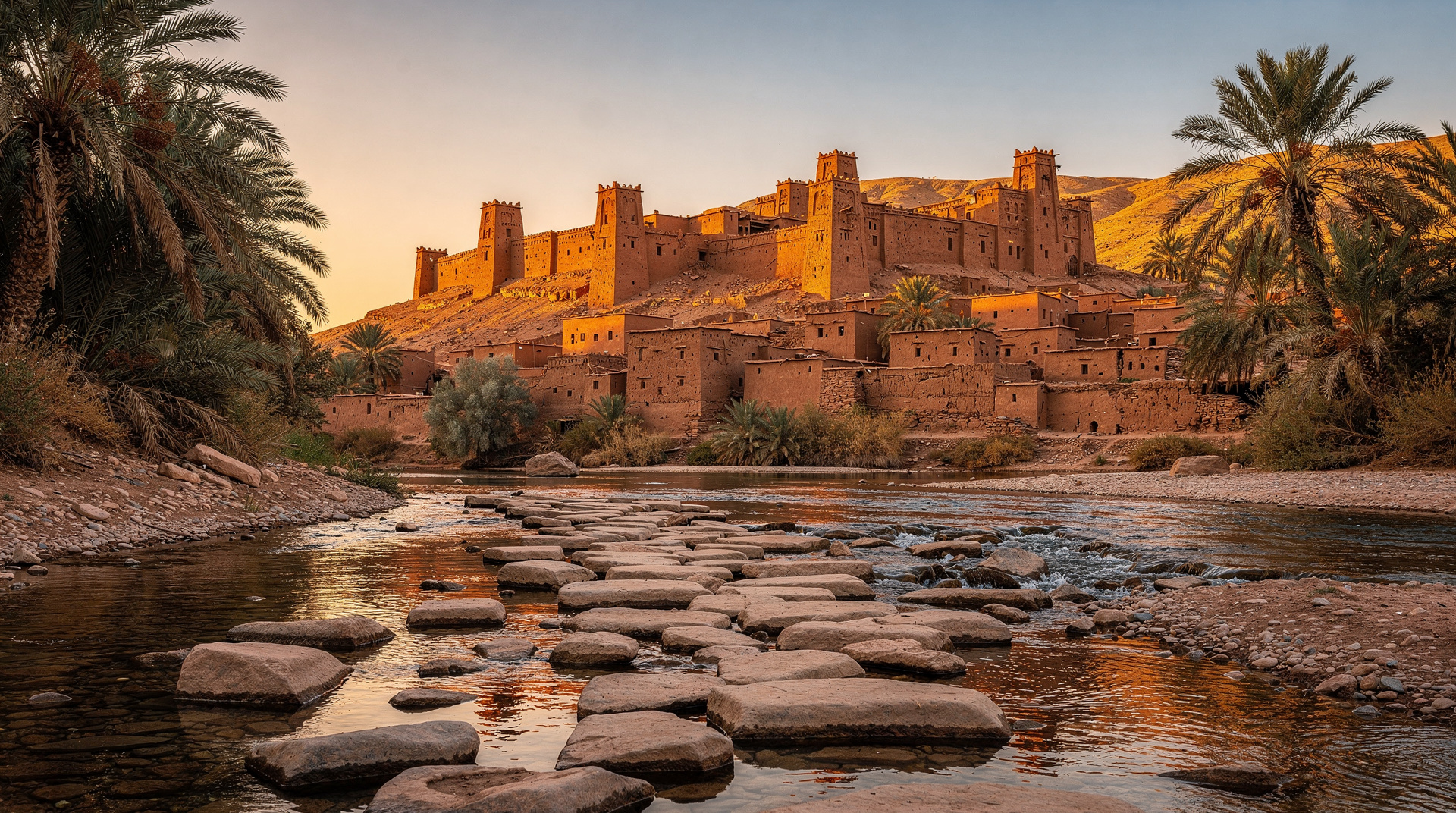
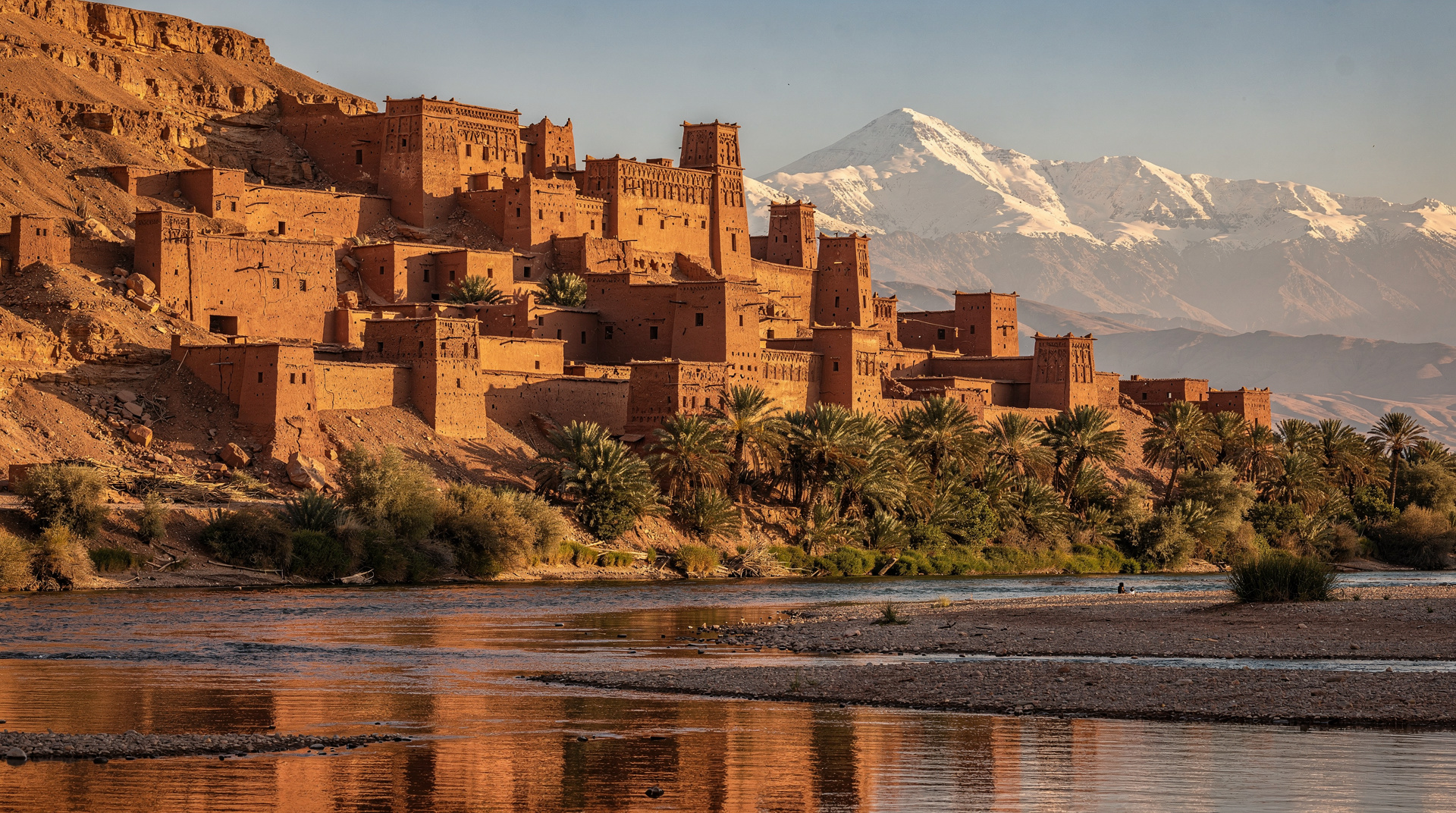
Aït Benhaddou is 30km northwest of Ouarzazate and is arguably the most photographed kasbah in Morocco — a UNESCO World Heritage Site and perennial film location (Gladiator, Game of Thrones’ Yunkai, Jesus of Nazareth). The ksar (fortified village) rises in tiers of mud-brick towers and defensive walls above the Ounila River, still partially inhabited.
The experience is honest about what it is: a preserved, partially restored film-location kasbah with a tourist village of restaurants, craft stalls, and guesthouses at its base. Most visitors cross the river (stepping stones or a small boat depending on season) and climb to the top for the panoramic view — allow 1.5–2 hours. The light at dawn and dusk is extraordinary; overnight visitors who walk up before the day-trip groups arrive from Ouarzazate have the site almost to themselves.
The Ouarzazate and Aït Benhaddou half-day tour efficiently combines the Film Studios and the kasbah in a single excursion — the standard approach for visitors based in Ouarzazate.
If you’re coming from Marrakech and don’t plan to overnight in the region, the day trip from Marrakech to Ouarzazate and Aït Benhaddou makes the round trip in a full day, though it’s a long drive (7 hours total) leaving limited time at each site.
Aït Benhaddou itself has several guesthouses right at the ksar foot — Dar Maktoub and Riad Caravane are reliable options (600–1,100 MAD). Staying the night is strongly recommended.
Skoura and the palmeraie
Skoura, 45km east of Ouarzazate, is a large palmeraie (date-palm oasis) containing some of the best-preserved kasbahs on the southern circuit. The Amridil Kasbah — still inhabited by the same family for 300 years — is open to visitors and considered the finest example of the southern Moroccan kasbah tradition. Walking paths between the kasbahs cross irrigation channels through the palm groves, past rose fields (Skoura is a centre of Moroccan rose water production) and almond orchards.
Dar Ahlam is Skoura’s landmark hotel — a converted kasbah with 11 suites and a design-forward aesthetic that has made it one of the most celebrated small hotels in Africa. Rates from 5,000 MAD/night. For more earthly budgets, Kasbah Ait Ben Moro (700–1,200 MAD) and several smaller guesthouses provide excellent bases.
The Vallée des Roses (Rose Valley), around Kelaat M’Gouna 50km east of Skoura, holds its annual rose festival (moussem) in May, when the rose harvest is processed into rose water and essential oil. The festival includes music, dance, and a procession — worth timing your visit around.
Dades Gorge
The Dades Gorge begins east of Boumalne Dades and runs 25km into the Atlas, narrowing progressively as the road climbs. The lower gorge passes through kasbah villages and palmeries. At around 15km, the “monkey fingers” rock formations — erosion pillars of extraordinary organic shapes — appear on the canyon walls. At 25km, the road begins a series of extreme hairpin bends cut into the cliff face — one of Morocco’s most photographed road sections.
The upper gorge, beyond the hairpins at around 1,700m, opens into a wide valley with a distinctly alpine feel — greener, cooler, and populated by Berber farming villages that rarely see tourists. Hiking trails from the upper gorge cross into the M’Goun massif — serious multi-day trekking country.
Stay in the gorge rather than using it as a transit stop. Kasbah Tizarouine and Auberge Tissadrine are comfortable mid-range options at the gorge entrance (700–1,200 MAD); several simpler guesthouses further up the gorge charge 300–500 MAD.
Todra Gorge
The Todra Gorge, 15km north of Tinghir, is among the most dramatic geological spectacles in North Africa. The Todra River has carved a 300m-high slot canyon through the limestone massif; at its narrowest point the walls are 10m apart and the sky is a thin strip of blue above. The light at mid-morning, when the sun penetrates the gorge floor, is remarkable.
Rock climbing at Todra is excellent and well-documented — sport routes up to 7b on excellent limestone, with local guides and gear hire available from several companies in Tinghir. The gorge also sees serious trad climbing and multi-pitch routes on the upper walls.
Hiking beyond the narrows leads north into the upper Todra valley — increasingly remote, with Berber villages and a trail system that eventually connects with the M’Goun massif. Day hikes of 3–5 hours are well within reach from the gorge floor.
A word of caution on timing: the gorge fills with day-trip vehicles from 10am to 4pm in peak season. Arrive before 9am or after 5pm for a different experience.
When to visit
Spring (March to May) is optimal. Temperatures are warm but not hot (20–30°C), the rose harvest is in progress in Kelaat M’Gouna, and wildflowers appear in the gorge walls. October and November are nearly as good. Summer is hot in the valleys (40°C at Boumalne Dades in July) but the gorge interiors stay shaded and somewhat cooler. The Tizi n’Tichka pass can close in January and February after snow.
How many days
Ouarzazate and Aït Benhaddou: 1–2 days. Skoura palmeraie: half a day to 1 day. Dades Gorge: 1 night in the gorge. Todra Gorge: 1 night in the gorge. Merzouga (Sahara): adds another 2 days minimum. Total for the southern circuit from Marrakech to Fes via the Sahara: 7–10 days.
Where to stay
Ouarzazate: Riad Dar Ayour (900–1,500 MAD), Berbère Palace (1,200–2,000 MAD).
Aït Benhaddou: Dar Maktoub, Riad Caravane (600–1,100 MAD).
Skoura: Dar Ahlam (luxury, from 5,000 MAD), Kasbah Ait Ben Moro (700–1,200 MAD).
Dades Gorge: Kasbah Tizarouine, Auberge Tissadrine (700–1,200 MAD).
Todra Gorge: La Vallée, Chez Pierre (basic but perfectly positioned, 350–700 MAD).
Sample itinerary — 5 days
Day 1: Marrakech over the Tizi n’Tichka pass to Aït Benhaddou (3.5 hours driving, stop for views). Afternoon at the kasbah. Overnight at Aït Benhaddou.
Day 2: Morning Ouarzazate — Taourirt Kasbah and Atlas Film Studios. Afternoon drive east to Skoura — Amridil Kasbah walk through the palmeraie. Overnight Skoura.
Day 3: Skoura to Dades Gorge via Kelaat M’Gouna (Rose Valley). Afternoon gorge drive to the hairpins and upper section. Overnight in the gorge.
Day 4: Dades to Todra Gorge (55km, 1 hour). Morning walk through the narrows. Afternoon rock climbing or upper valley hike. Overnight at gorge.
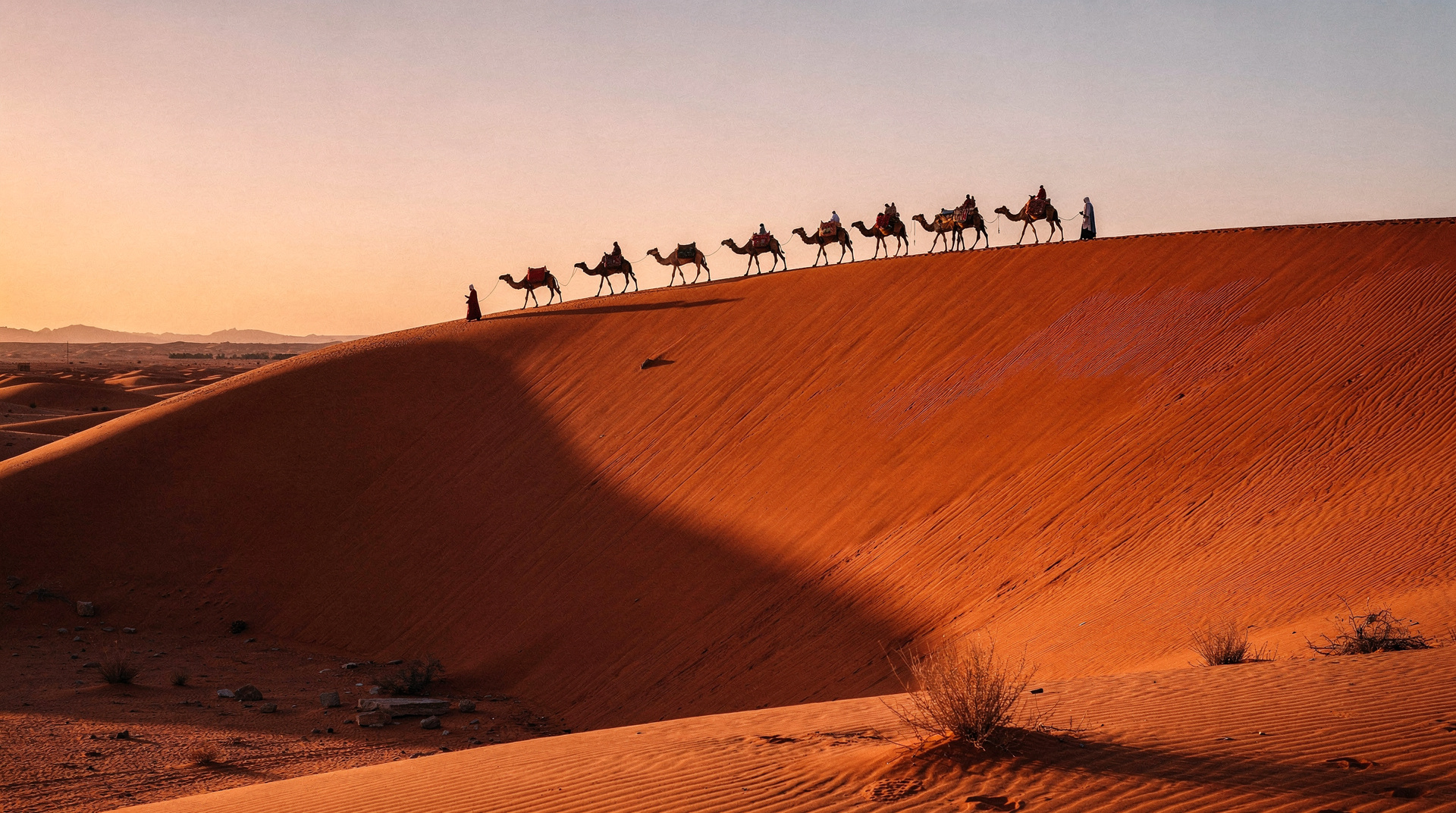
Day 5: Todra to Merzouga via Tinejdad (150km, 2.5 hours). Afternoon at Erg Chebbi dunes. Sunset camel ride to camp — linking into Sahara Desert.
Kasbahs: what you’re actually looking at
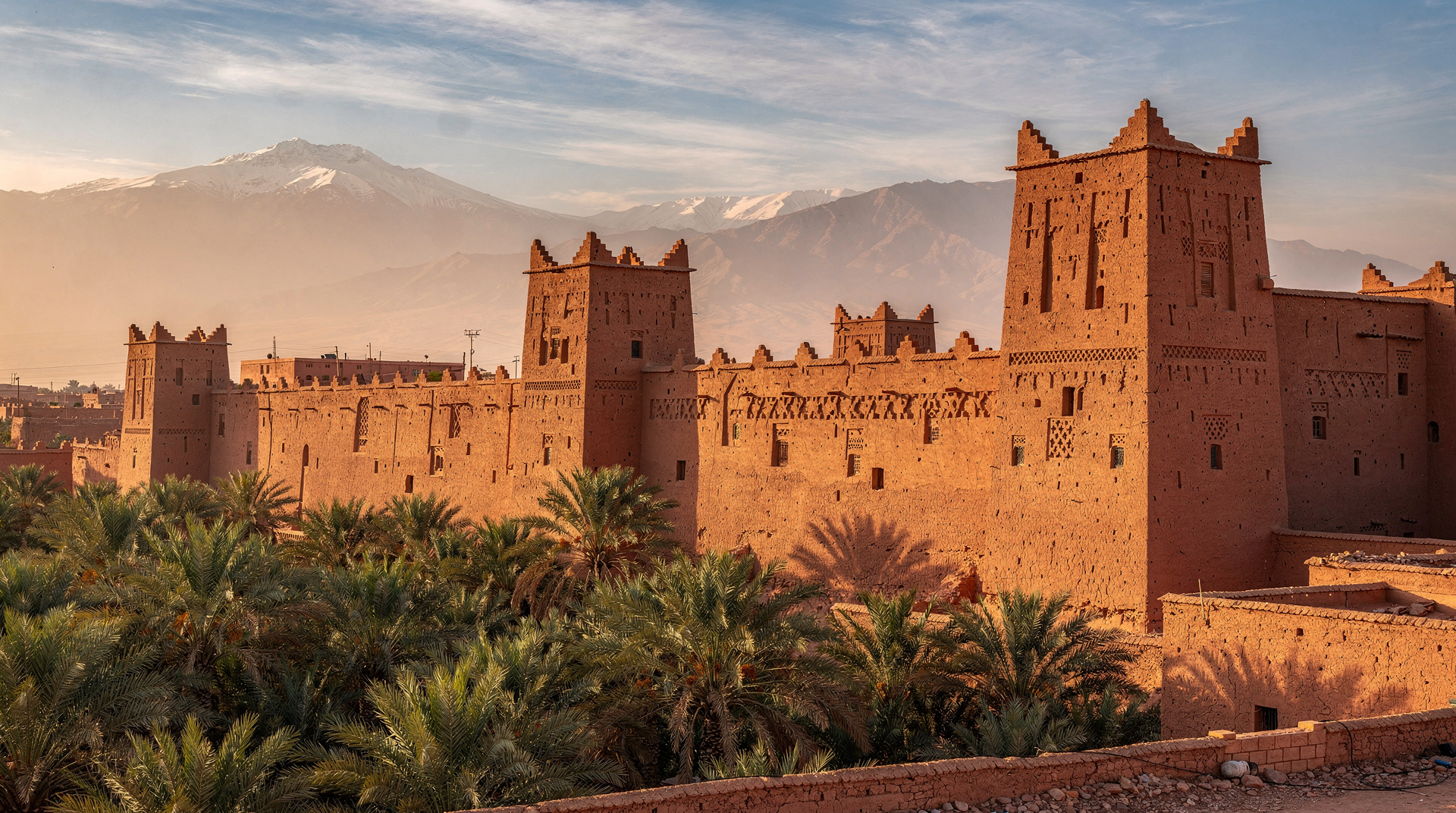
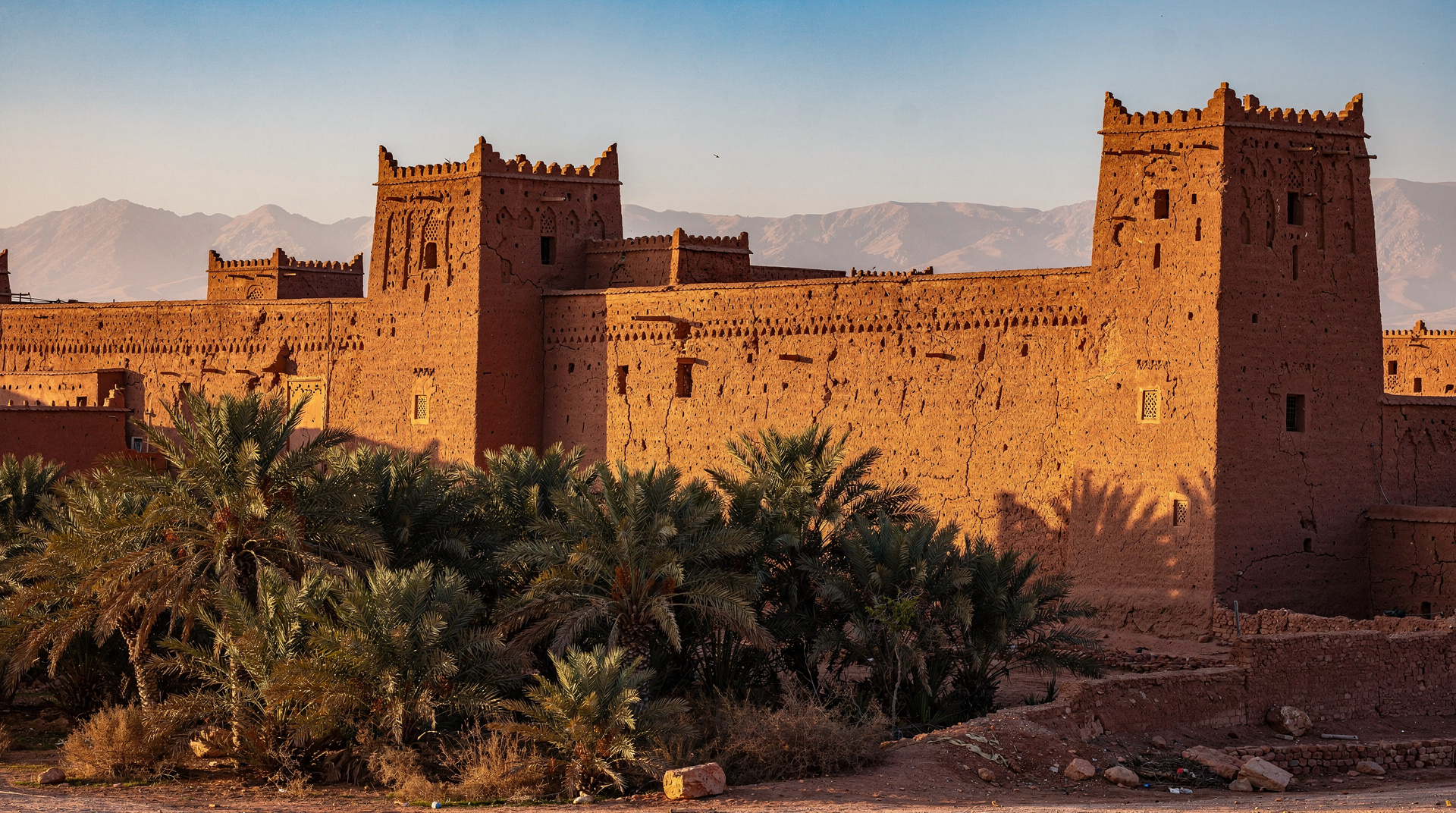
The word “kasbah” is used loosely in Morocco and often confusingly. Technically, a kasbah is a fortified residence or governor’s quarter within a city — distinct from a ksar (fortified village) or a tighremt (a smaller Amazigh tower house). In common usage, particularly in southern Morocco, all three are called kasbahs. What they share is a construction method: tabia or pisé (rammed earth mixed with straw and sometimes lime), which creates walls of remarkable thermal mass — cool inside in summer, warm in winter — and a distinctly organic quality as they erode at the edges.
The kasbahs of the Draa and Dades valleys were built primarily between the 16th and 19th centuries as defensive residences for powerful families — the Glaoui, the Ait Atta, and others. Many were abandoned after independence (1956) as the social structures that sustained them collapsed. Some were partially restored in the tourism development of the 1980s–2000s, often imperfectly. The best-preserved examples — Amridil in Skoura, the ksar at Aït Benhaddou, the Taourirt Kasbah in Ouarzazate — give a sense of how dense and elaborately organised these complexes once were.
The crafts traditions embedded in this landscape are worth understanding before you buy. Ouarzazate and the surrounding region produce Morocco’s finest Berber carpets — geometric, primary-coloured, woven on vertical looms from local wool. They are significantly cheaper here than in Marrakech (a decent medium rug is 800–1,500 MAD in Ouarzazate; the same rug sells for 2,000–3,500 MAD in Marrakech). The silver jewellery of the Draa valley — heavy torques, fibulas, Fatima hands — is also worth seeking at source. Fixed-price artisan cooperatives in Ouarzazate offer fair-trade pricing.
Choosing where to base yourself
Eastern Morocco rewards moving through it rather than picking one base, but if time is limited, the choice of overnight stops matters.
| Ouarzazate | Aït Benhaddou | Dades Valley | |
|---|---|---|---|
| Best for | Logistics hub, Film Studios | Iconic kasbah photography, quiet mornings | Gorge scenery, roses, slower pace |
| Overnight worth it? | Useful but not essential | Strongly recommended for dawn light | Yes — the gorge road rewards a full day |
| Distance from Marrakech | ~3.5 hr | ~4 hr (via the pass) | ~5.5-6 hr |
Most itineraries treat Ouarzazate as a service stop, overnight at Aït Benhaddou or Skoura for atmosphere, then push on to the Dades and Todra gorges before continuing to Merzouga.
Film Locations Beyond the Studios
The region’s cinematic reputation extends well past the Atlas Film Studios themselves. Aït Benhaddou’s ksar has stood in for locations from ancient Egypt to fictional Essos, and several kasbahs along the Dades and Draa valleys have hosted smaller productions without the same fame. Guides at the Film Studios and at Aït Benhaddou can usually point out which specific walls and courtyards appear in which productions — worth asking even if you’re not a dedicated film buff, since it adds context to what would otherwise be a generic ruin.
Going deeper on each stop
Each main stop has its own page if you want more detail before you commit to a route. The Ouarzazate page covers the hub town, Aït Benhaddou the ksar and its surroundings, and Skoura the palmeraie walks. For the two gorges, see Todra Gorge alongside the Dades Valley page linked above.
If the dunes are the end point of your trip, the Merzouga page picks up where the Todra leg ends, and the Merzouga vs Zagora comparison helps you decide which desert base suits you.
Rock Climbing and Trekking Beyond the Gorges
Todra Gorge’s climbing scene, mentioned above, extends into a broader network of routes and multi-day trekking options that link the gorge to the M’Goun massif and Atlas Mountains trekking country to the north. Climbers based in Tinghir for a few days typically combine gorge-floor sport routes with at least one full rest day exploring the upper Todra valley on foot — a good way to see Berber village life that the day-trip crowds never reach.
Frequently asked questions about Eastern Morocco
Can I visit eastern Morocco without a rental car?
Yes, but it requires more patience. CTM and Supratours buses and shared grand taxis connect the main towns (Ouarzazate, Boumalne Dades, Tinghir), but reaching specific sites like Aït Benhaddou or the upper gorges without a car means relying on organised day tours or negotiating local taxis at each stop. A hire car remains the most efficient way to see the region at its own pace.
Is eastern Morocco safe to drive yourself?
Yes. The N9 over the Tizi n’Tichka and the N10 along the Dades valley are well-maintained, well-signed roads. The main hazards are winter snow at the pass (occasionally closed in January-February) and fatigue on long driving days — plan realistic distances rather than trying to cover too much ground in one day.
Planning the wider trip
Eastern Morocco slots naturally into longer routes. The grand south road trip and the desert-focused itinerary both run through this region, and the how to book a Sahara tour guide explains what to arrange before you reach the dunes. For choosing the season, the best time to visit overview gives the national picture.
Related
- Sahara Desert — Merzouga is the natural continuation east of Todra
- Atlas Mountains — The M’Goun massif and Ait Bougmez Valley lie north of the Dades gorge
- Marrakech Region — The Tizi n’Tichka pass connects Marrakech to this region in 3.5 hours