Riad vs Hotel in Morocco: Which Accommodation Type?
Should I stay in a riad or a hotel in Morocco?
Riad for the authentic Moroccan experience — courtyard architecture, medina location, intimate service, and character that mass-market hotels can't replicate. Hotel for more amenities (pool, restaurant, gym), easier access by car, and a more predictable international standard. For a first Morocco trip, at least one riad night is essential — it's a fundamental part of understanding what Morocco's urban culture is built around.
Understanding Morocco’s distinctive accommodation landscape
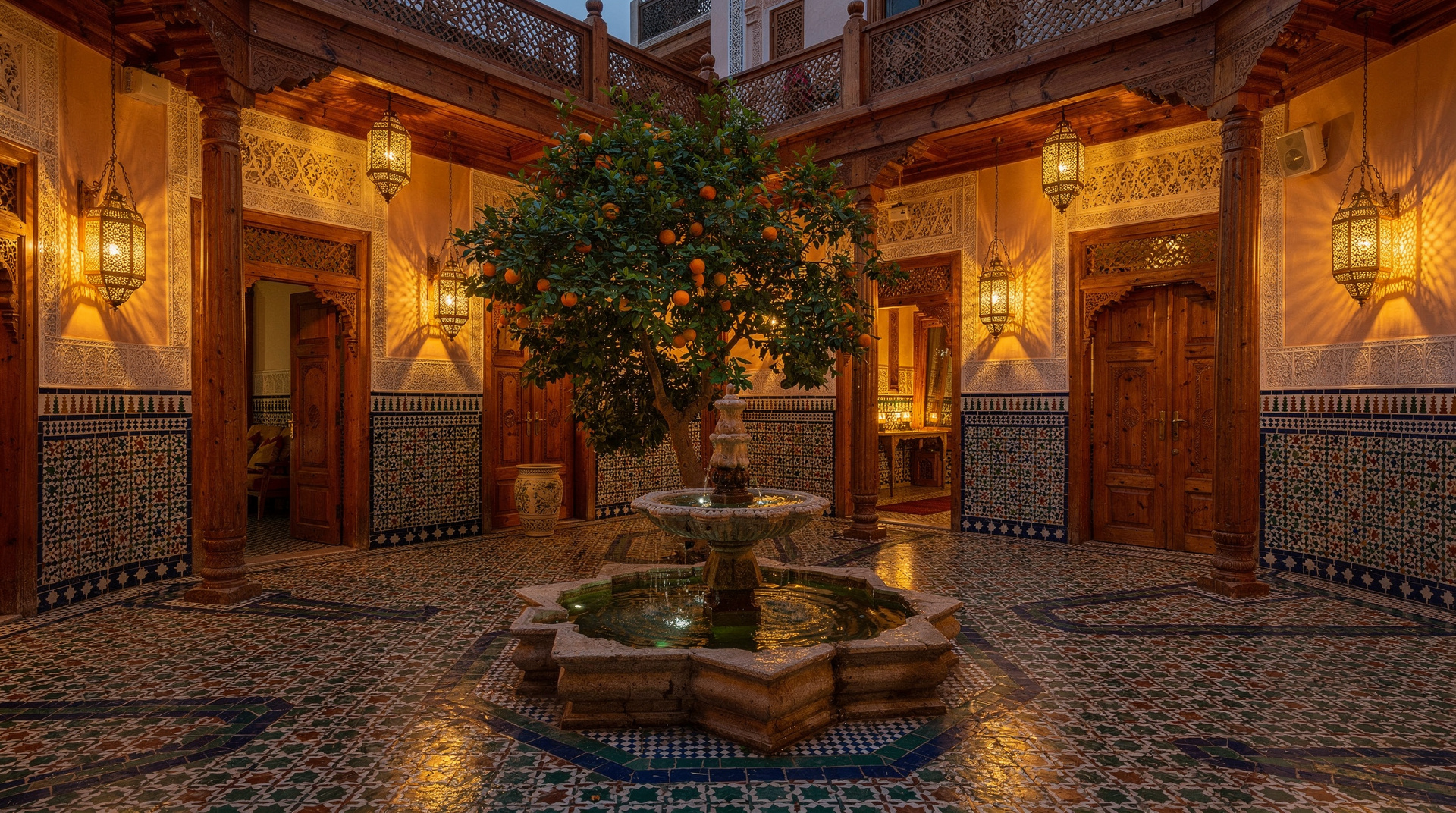
Morocco’s riad phenomenon is not a marketing invention. A riad (from the Arabic word for garden) is a traditional house built around a central courtyard — typically with a fountain, citrus or banana trees, and tiled walls — that faces inward rather than outward. The street-facing wall is often a plain, heavy door with no windows. The beauty is entirely internal.
Converting these historic medina houses into boutique accommodation has been going on since the 1990s, and the result is a category of accommodation that doesn’t exist anywhere else in quite the same form. But riads are not the right choice for every traveller or every part of a Morocco trip.
The quick comparison table
| Factor | Riad | Hotel |
|---|---|---|
| Location | Typically inside the medina (historic quarter) | Usually outside the medina or city outskirts |
| Architecture | Historic — often 16th-19th century | Modern or restored colonial |
| Atmosphere | Intimate, characterful, authentic | Predictable, professional |
| Size | 5-25 rooms typically | 20 to 500+ rooms |
| Courtyard / outdoor space | Central courtyard (usually no ground-level garden) | Often pool, garden, terrace |
| Swimming pool | Rare at low-mid range, more common at luxury end | Common at mid-range and above |
| Restaurant | Breakfast always; dinner at many; often requires advance booking | Full service as standard |
| Car access | Usually impossible — medina streets are pedestrian | Yes, with parking |
| Luggage to room | Carried by staff through medina streets | Trolleyed from car park |
| English-speaking staff | Variable | More reliable at international chains |
| Price range | 40 EUR (basic) to 500+ EUR/night (luxury) | 30 EUR (budget) to 400+ EUR/night |
| Noise | Medina noise (calls to prayer, street sounds) | Typically quieter at night |
| Privacy | High — internal layout means windows face courtyard | Standard hotel-level privacy |
| WiFi | Usually available, variable quality | Usually reliable |
| Check-in experience | Personal, sometimes complex to find | Standard |
The case for staying in a riad
The riad experience is genuinely distinctive. Walking through an unmarked medina door into a courtyard with tiled fountain, orange trees overhead, and a rooftop terrace that overlooks the ancient city — this is not something a Sheraton can replicate regardless of budget.
Why riads work well:
- Immersive location. Being inside the medina means you’re living in the historic city rather than visiting it as a day tripper. Morning call to prayer from a nearby minaret, the smell of bread from the neighbourhood oven, the sound of the souk waking up — these are authentic experiences that enrich the trip
- The courtyard architecture is beautiful. Zellige tile work, carved plaster, cedar wood ceilings — the decorative craft of Morocco’s historic buildings is on display in quality riads in ways that museum visits can’t match
- Service quality at the best riads is genuinely personal — a 12-room property can give every guest attention that a 200-room hotel can’t
- Breakfast in a riad courtyard — fresh msemen flatbread, khobz, amlou (argan oil and almond paste), honey, fresh-squeezed orange juice, mint tea — is one of Morocco’s great daily pleasures
- The price-to-character ratio at riads is often extraordinary. A 100-150 EUR/night riad in Marrakech or Fes frequently delivers more personality and comfort than a 300 EUR/night business hotel chain room
The honest complications:
- Getting to your riad is often an adventure. Medina streets are unlabelled, GPS doesn’t work well inside the walls, and navigation at night with luggage is stressful. Most riads provide detailed arrival instructions and offer to send someone to the main gate to meet you — use this service
- Riads vary enormously in quality. The category spans from genuinely exceptional boutique hotels to dusty, poorly maintained buildings being marketed above their quality. Read reviews carefully and check recent photos, not just the atmospheric shots from 2018
- Parking is not possible — you’ll walk the last 200m to 1km through narrow medina streets with your luggage
- If you need specific amenities — a large pool, a gym, accessible bathrooms, reliable elevators — the riad model typically doesn’t deliver at the mid-range price point
The case for hotels in Morocco
International standard hotels exist across Morocco, from budget chains to five-star resorts, and serve genuine needs that riads can’t always meet.
Why hotels work:
- Predictable standard. At a Marriott, Sofitel, or even a mid-range ibis, you know what you’re getting. For travellers who find uncertainty stressful or who need specific accessibility features, this predictability has real value
- Pool access is much more reliable at hotels than riads, particularly at the mid-range level. In Morocco’s summer heat, a pool matters
- Car access is straightforward — drive to the car park, unload, check in. For families with significant luggage or older travellers, this practical advantage is significant
- Larger hotels offer full restaurant service without advance booking, reliable room service, concierge who speak multiple languages, and staff who are used to managing international guest needs
- The Gueliz neighbourhood in Marrakech (the French-era new city) has good hotel options — modern buildings, restaurants within walking distance, less medina chaos — that work well for travellers who want to use Marrakech as a base without being immersed in the medina
The honest limitations:
- You lose the Morocco experience. A night in a generic international hotel in Marrakech could be a night in any hotel in any city. The point of Morocco is often precisely the things that riads deliver — the architecture, the sound, the courtyard, the authentic urban setting
- Price-to-character ratio is often poor. A 150 EUR/night chain hotel in Marrakech delivers a standard room and pool access. The same money at a quality riad delivers extraordinary architecture and personal service
By traveller type
First-time Morocco visitors: One riad minimum — it’s integral to understanding what Morocco’s urban culture is built around.
Families with young children: Hotels offer more practical amenities (pool, restaurant, parking). Some riads have excellent family rooms; check the specific property.
Business travellers: Hotels. The Casablanca business hotel scene offers the professional infrastructure (meeting rooms, reliable WiFi, airport transfers) that riads don’t.
Couples: Riads are significantly more romantic — rooftop dinners, courtyard fountains, intimate service.
Budget travellers: Both have budget options. Budget riads (40-70 EUR/night) in Fes and Marrakech can outperform budget hotels at the same price on character, while not always matching on amenities.
Luxury seekers: Both categories have exceptional options. The Royal Mansour and La Mamounia (riads at palace scale) in Marrakech are among the world’s most extraordinary hotels. Five-star resort hotels are also available in Agadir and along the coast.
Verdict by scenario
2-3 nights in Marrakech medina: Riad. The location and architecture justify the complexity of arrival.
Desert camp stay: Neither — you’re in a desert camp, which has its own accommodation model.
Agadir beach holiday: Hotel. Riads don’t exist in Agadir’s post-earthquake rebuilt city; the resort hotels match what you’re there for.
Fes medina: Riad strongly recommended. The city’s architectural heritage is best experienced from inside the medina, and Fes riads are often exceptional value.
Long-term base (7+ nights in one city): Consider a riad for the character but check amenities carefully — a week without a reliable pool or easily accessible food options can become limiting.
Finding a good riad
The quality range is wide. Use these filters:
- Look for recent reviews (last 6 months) rather than relying on older ratings — quality changes with management
- Photos of the actual rooms, not just the courtyard — the courtyard is beautiful; the question is whether the rooms match
- Read negative reviews specifically for the complaints that matter to you (noise, navigation difficulty, inconsistent service)
- “Maison d’hôtes” is the French equivalent term — the category is the same
- Luxury riads above 200 EUR/night often include private roof terrace access, superior linens, and higher-quality food — the jump from mid-range is usually visible
For Marrakech and Fes accommodation recommendations including specific riad and hotel options, see the Marrakech destination guide and the Fes destination guide. The Morocco accommodation planning guide covers the full spectrum including desert camps and coastal options.
Frequently asked questions
What is a riad exactly?
A riad is a traditional North African or Andalusian house built around a central courtyard, typically containing a fountain and sometimes a garden (the word riad derives from the Arabic for garden). In Morocco, the term has come to refer specifically to the boutique accommodation category created by converting these historic medina houses. A “riad” in the tourism sense is essentially a boutique hotel in a historic courtyard building.
Are riads noisy?
It depends on location within the medina. Riads near the main souk or the Djemaa el-Fna in Marrakech will hear the city more. Riads in the quieter residential quarters away from the souk core are significantly quieter. The call to prayer from nearby mosques (five times daily, starting around 5am) will be audible from most riads in the medina — this is part of the authentic experience, but can be a sleep issue for light sleepers.
Do riads have air conditioning?
The good ones do. In Morocco’s summer heat (Marrakech can reach 40°C in July), air conditioning is essential. Check that your specific riad room has air conditioning, not just a fan — descriptions can be vague.
Can I find riads outside medinas?
Occasionally — some Gueliz (new city) properties have been built in a riad-inspired style, and some are genuinely characterful. But the authentic riad experience is tied to medina architecture and location. A “riad” outside the medina is usually a new-build with a courtyard rather than a historic conversion.
How far in advance should I book a riad?
March-May and October-November are peak seasons — quality properties in Fes and Marrakech book out 4-8 weeks ahead. For travel in these windows, book as soon as you have confirmed dates. Summer and January-February have more availability at shorter notice.