Desert-focused Morocco itinerary: 7 days, Sahara-centric
When the Sahara is the point
Most Morocco itineraries treat the desert as one item on a checklist: day three of a tour, one night in a camp, camel at sunset. This itinerary inverts that logic. The desert is the destination. Three nights in Merzouga. Time to watch the light change across the same dunes at dawn, noon, and dusk. Time to walk out alone after dinner, beyond the camp lights, into genuine darkness and silence.
The route there — Marrakech to Merzouga via Aït Benhaddou, the Draa Valley, and the Dades and Todra gorges — is one of the great road journeys in Africa. The architecture is earthen and elaborate, the colours shift from ochre to rose to deep red as you move south and east, and the transition from green mountains to stone desert to sand is gradual, then suddenly total.
This itinerary uses a private driver. Seven days is not long enough to waste time on shared tour schedules and rushed stops. A private driver stops when you want, adjusts the day’s pace if you are ahead or behind, and adds local knowledge that no bus tour can replicate.
Route at a glance: Marrakech (1 night) → Aït Benhaddou (1 night) → Dades Valley / Skoura (stop) → Todra Gorge (1 night) → Merzouga (3 nights) → Fes (1 night or fly from Errachidia)
Total estimated cost (per person, sharing, flights excluded): €900–1600
At a glance
| Day | Route | Overnight |
|---|---|---|
| 1 | Arrive Marrakech | Marrakech |
| 2 | Drive: Marrakech → Tizi n’Tichka → Aït Benhaddou | Aït Benhaddou / Ouarzazate |
| 3 | Drive: Draa Valley → Skoura → Dades Gorge | Dades Gorge |
| 4 | Drive: Todra Gorge dawn → Merzouga | Merzouga |
| 5 | Merzouga: dunes, camel, camp | Merzouga / camp |
| 6 | Merzouga: sunrise, dunes, rest, optional excursion | Merzouga |
| 7 | Morning dunes → drive north to Fes | Fes |
Day 1: Arrive Marrakech — one night, early departure
Arrive Marrakech and check into your riad. This is a transit night: Marrakech is the staging point, not the destination on this itinerary. If you have not been before and want to see the medina properly, arrive a day early and build in a full Marrakech day. For repeat visitors, one focused evening in the medina and an early sleep is the correct approach.
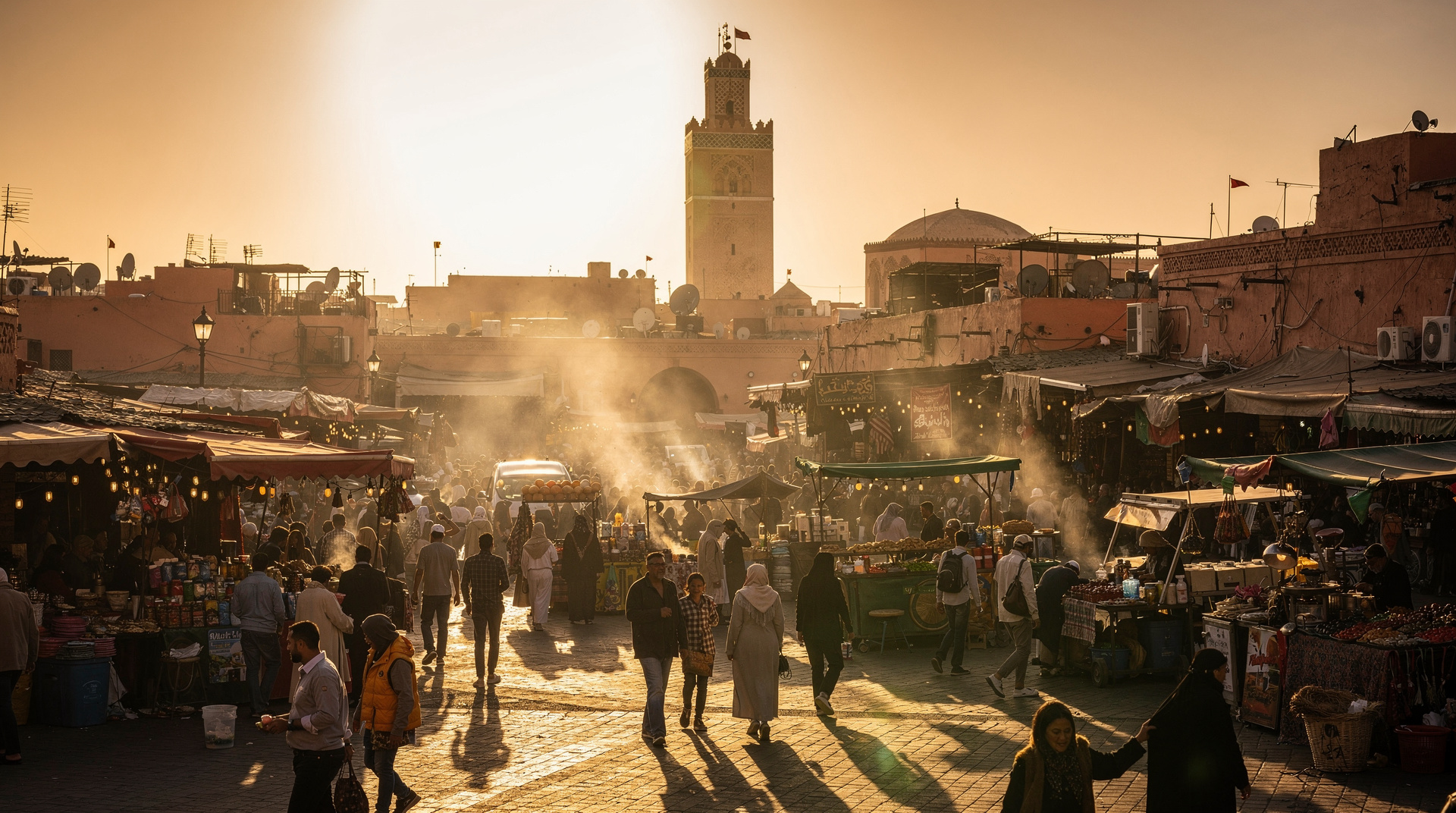
Djemaa el-Fna square at sunset: the daily transformation from afternoon market to evening spectacle is worth experiencing even as a quick 30-minute stop before dinner. A medina restaurant dinner (€12–25 per person at a proper riad restaurant, or €5–8 at the square stalls), then early to bed.
Your private driver collects you at 07:00 tomorrow.
Where to stay: Riad Jardin Secret (mid: €80–130); Riad BE Marrakech (mid: €90–140)
Tomorrow’s logistics: Confirm your private driver pick-up time and vehicle type. For this route, a comfortable 4x4 or premium minivan is ideal — the road through the Tizi n’Tichka pass is well-paved but mountain driving, and the Dades Valley road has some rougher sections.
Day 2: The great drive south — Tizi n’Tichka, Aït Benhaddou, Ouarzazate
07:00 departure
The road south from Marrakech climbs immediately into the Atlas foothills. Within 30 minutes you are in mountain terrain; within 90 minutes you are above 2000m on the approach to the Tizi n’Tichka pass. At 2260m, the pass viewpoint offers a 360-degree panorama of the High Atlas range — stop here, not because the driver suggests it, but because it is genuinely extraordinary.
The descent south is into a different Morocco. The vegetation changes abruptly at the watershed: lush on the north face, sparse and dry on the south. The rock colours shift from grey limestone to red and ochre schist. The first mud-brick villages appear on ridgelines, then more of them, then the road opens into the wide Ouarzazate Valley.
Midday: Aït Benhaddou (allow 2 hours)
The UNESCO ksar of Aït Benhaddou is a fortified earthen city that appears to have grown organically from the desert floor — which is essentially true, as it was built from local clay and straw in a tradition that stretches back several centuries. It has been a film location for 50 years: Gladiator, Game of Thrones, Kingdom of Heaven, Lawrence of Arabia, The Last Temptation of Christ. But the ksar predates all of them and will outlast them.
Cross the river (stepping stones or small wooden bridge) and climb through the towers and residential structures to the granary at the top. The view south over the Draa Valley from the summit is worth the climb. A private local guide adds genuine architectural and social context: €20–25 for 90 minutes.
Book the Aït Benhaddou guided tour through GetYourGuide if you prefer a vetted local guide rather than arranging independently at the site.
Lunch at a riverside restaurant below the ksar — the classic view, the standard menu (Moroccan salads, tagine, mint tea), and prices that are honest by tourist-area standards (€10–18 per person).
Afternoon: Ouarzazate and the road east
Ouarzazate is primarily a transit point but has its own interest for film enthusiasts. The Atlas Film Studios (open for guided tours, €6) has hosted more international productions than almost any facility in Africa; the permanent outdoor sets for Middle Eastern and North African scenes are strange and photogenic.
The road east from Ouarzazate enters the Draa Valley — one of the longest oasis valleys in Morocco, with palm groves and earthen kasbahs stretching for 200 km along the Draa river. The road through the Rose Valley around Kelaa M’Gouna is extraordinary in May (the Rose Festival), but the landscape is beautiful year-round.
Where to stay: Aït Benhaddou area: Ksar Ighnda boutique kasbah (€150–300); Dar Mouna (€100–180). Or push to Dades Gorge guesthouse (see Day 3).
Day 3: Skoura oasis + Dades Gorge
Morning: Skoura
The Skoura oasis, 30 km east of Ouarzazate, is a 1000-hectare palm grove pierced by a network of earthen paths that wind between ancient kasbahs. Many of the kasbahs are in various states of renovation or ruin — it is a genuine landscape of heritage rather than a managed monument. Walk the circuit around Kasbah Amerhidil (the largest surviving fortified kasbah in the Draa Valley) in the morning cool.
Midday: Roses Valley (Kelaa M’Gouna)
The town is famous across Morocco for rose water, rose jam, and rose oil. Whether or not it is Rose Festival season, the cooperative shops sell genuine local products at factory prices: 100ml rose water for €2–4, a jar of rose jam for €3–5. The valley smells differently in May when the damask roses are in bloom, but the mountains and villages are worth seeing year-round.
Afternoon: Dades Gorge
The Dades Gorge begins 30 km northeast of Boumalne Dades on a road that winds up an increasingly dramatic canyon. The famous “Monkey Fingers” rock formations — eroded pillars of sedimentary rock that resemble hands reaching from the cliff — appear about 25 km up the gorge. The light on these formations at late afternoon is extraordinary photography.
The road continues past the Monkey Fingers through an increasingly narrow canyon until it becomes a 4x4 track and eventually a hiking path — your private driver knows the point where a standard vehicle can safely turn around.
Guesthouses in the gorge cluster around the 24–28 km mark from Boumalne: simple but clean, with home-cooked Berber dinners and spectacular gorge views from the breakfast terrace. Chez Pierre and Auberge Tifawine are established options (€30–60/night half board).
Day 4: Todra Gorge at dawn → Merzouga
Dawn: Todra Gorge (allow 2 hours)
Be at Todra Gorge before 08:30. The gorge walls rise 300 metres above a river corridor 20 metres wide, and the light enters the canyon at angles that change completely through the day. In winter, the sun barely reaches the floor; in spring and autumn, a shaft of morning light illuminates the pink-orange rock face above the river. Both are extraordinary.
The main dramatic section of the gorge is 600 metres long and takes 20–30 minutes to walk each way. Climbers work the walls above on fixed routes — Todra is an established sport climbing destination with hundreds of routes up to 8c. Rock climbers should contact local guides for route information.
The Marrakech to Merzouga tour with luxury camp covers a similar route for those who prefer an organised experience over a private driver arrangement.
The drive to Merzouga (4 hours from Todra)
Through Tinghir, east through the Ziz Valley date-palm oases, through Erfoud (the fossil city — ammonite fossils extracted from local marble and sold in every roadside stall), and through Rissani (historically important as the ancient caravan terminus and seat of the Alaoui dynasty). Then the hammada — flat black gravel desert that extends to the horizon.
And then: the dunes. The Erg Chebbi sand sea appears from the flat plain without warning — 150 metres of orange-gold sand rising directly from the gravel. The colour changes every hour: pale gold at midday, deep orange in the afternoon, rose-pink at sunset.
Arrive Merzouga by early afternoon. Check into your accommodation and rest before the evening dune experience.
Where to stay: Merzouga village guesthouses (€25–60/night including breakfast); luxury tented camps in the dunes (€150–400 for the full experience including dinner and camel ride).
Day 5: First full day in the Sahara
Wake for sunrise if you have the energy after Day 4’s drive. The dune crest nearest the camp takes 20–30 minutes to climb in soft sand and rewards with the Sahara’s most spectacular light sequence.
After breakfast: rest. Seriously. This is the point of three nights in Merzouga — you are not in a hurry. Have tea, read, watch the dunes change colour through the day. The desert light is a reward in itself.
Afternoon options:
The camel trek at 17:00 is the classic approach to the dunes. A guided sunset camel ride to a traditional Berber camp takes 45–60 minutes each way and includes dinner, music, and the night in the dunes (stars, temperature dropping, the smell of woodsmoke). Budget €30–50 per person including overnight and breakfast.
Book a Merzouga overnight camp with camel ride in advance, especially in October–April peak season.
Alternatively: quad biking in the dunes (€50–80 for 2 hours). The large dunes around Merzouga are ideal quad terrain — steep, empty, scenic. Your accommodation can arrange quad hire and a local guide for the first run.
Sandboarding is free if you have a board (hirable at the dune base for €5–10). Climbing a 150m dune and sliding down takes 30 minutes and requires 3 minutes of effort and 30 seconds of speed.
Day 6: Second sunrise + excursion day
The second Sahara sunrise has a different quality from the first: you know what to expect, you are less adrenaline-charged, and you can simply stand and look. Bring binoculars — the detail in the dune formations visible from the crest is extraordinary.
Morning excursion: Nomad village or fossil sites
Your private driver and local guides can arrange a morning excursion to the nomadic communities living at the edge of the Erg Chebbi, or to the fossil and mineral extraction sites around Erfoud (the ammonite fossils are genuine and millions of years old — buying directly from the quarry workers is the most authentic purchase you will make in Morocco).
Afternoon: free desert time
The mid-afternoon light in the Sahara is harsh and bleached — this is the time for rest, shade, and tea. The guesthouse or camp will have a shaded courtyard or a tent with a rug and cushions. Use it.
At 16:00 the light begins to shift. Walk out onto the dunes without a guide — the village is visible from the dunes and you cannot get lost within a 1 km radius — and watch the colour of the sand change from pale gold to deep orange to amber as the sun descends.
Evening in Merzouga village:
The village has a few restaurants and a market that operates daily. Dinner at your guesthouse (Berber tajine, fresh bread, Moroccan soup) is typically excellent — the guesthouse cooking in this region uses genuinely fresh local ingredients and produces some of the best home-cooking in Morocco.
Day 7: Dawn finale + long drive to Fes
05:00: final Sahara sunrise
You have seen it twice. This is the third, and it is the one you will describe to people for years. Climb the dune, watch the light arrive, come back for breakfast, pack your bags, and say goodbye to the desert.
The drive from Merzouga to Fes (8–9 hours)
Your private driver takes the northern route via Midelt and the Ziz Gorge — a different landscape from the approach: cedar forests in the Middle Atlas, the spectacular Ziz river gorge cutting through limestone canyons, the market town of Midelt where apple orchards line the road.
Arrive Fes in the early evening. A single night in Fes is not enough for the city, but it allows you to experience the medina at first light before departure or to fly home from Fes Airport (FEZ) the following morning. The airport has connections to Paris, Brussels, and several other European cities.
Alternatively: if you are flying from Marrakech or Casablanca, a shared taxi or CTM bus from Fes covers the distance overnight. Or fly domestically Fes to Marrakech (45 minutes, €40–80) for same-day international connections.
Where to stay Fes: Riad Fes (upscale: €150–250); Dar Bensouda (mid: €80–130); Equity Point Fes (budget: €12–18 dorm)
Private driver logistics and costs
A private driver for this route (Marrakech → Aït Benhaddou → Dades → Todra → Merzouga → Fes) typically costs €150–250 per day for the vehicle plus driver, or a total package of €700–1200 for the full 5 driving days. This is per vehicle, not per person — sharing with 2–3 others makes it competitive with premium tour packages.
Book through your hotel in Marrakech or Fes, or through established agencies like Marrakech Private Tours or Atlas Voyage. The driver is not a tour guide — they drive and handle navigation; for cultural and historical context at sites, hire a licensed local guide at each location.
What to negotiate in advance:
- Total price including all fuel, driver accommodation, and tips
- Flexibility to adjust the route based on weather or personal preference
- The ability to stop for photography without a time limit
Budget estimate (7 days)
| Item | Per person (couple sharing) |
|---|---|
| Accommodation (7 nights, mix) | €300–600 |
| Private driver (5 driving days) | €350–600 |
| Desert camp with camel (1 night) | €40–80 |
| Food (7 days) | €100–180 |
| Entry fees + local guides | €50–100 |
| Total (flights excluded) | €840–1560 |
What to pack for a desert-focused Morocco trip
- Sunscreen SPF 50+ — the desert UV is severe and the reflective sand amplifies it
- Scarf or keffiyeh — for wind, sand, and sun protection on camel treks
- Lightweight long sleeves and trousers — cooler in the sun than shorts, essential at night
- Headlamp for dawn dune walks and camp nights
- Camera with extra batteries — the cold desert nights reduce battery life
- Small cash reserve in dirham — ATMs do not exist in the dunes
Best time of year for desert travel
October–November: The best months. Warm days (25–32°C), cool nights (8–15°C), clear skies, and the most dramatic dune light of the year. The Sahara’s colours are deepest in autumn.
March–April: Also excellent. Wildflowers briefly in the surrounding hammada after winter rains. Comfortable temperatures.
December–February: Cold nights (0–5°C in the dunes), possible rain, but extraordinarily few tourists. The winter Sahara has a stark beauty that summer visitors never see.
July–August: Daytime temperatures exceed 45°C. Not recommended. The camel riders rest; the camps are quiet; the experience is memorable but not in a pleasant way.
Common mistakes on desert-focused trips
One night in the dunes is not enough. The point of this itinerary is three nights. The first night you are too excited to sleep well. The second night you begin to understand the desert’s rhythms. The third night you do not want to leave.
Rushing the drive south. The Dades Gorge and Todra Gorge are not mere transit points. Allow full afternoons for both. The “Monkey Fingers” rock formations in the Dades at sunset are as photogenic as anything you will see in Morocco.
Over-scheduling Merzouga. There is a temptation, after driving 10 hours to reach the Sahara, to fill every moment with activities. Don’t. The desert rewards stillness as much as movement.
How to extend or shorten
Shorten to 5 days: Combine the Dades and Todra gorges into one long driving day (possible but rushed). Reduce Merzouga to 2 nights. This gives you the essential desert experience with less time in transit.
Extend to 10 days: Add Zagora (2 nights) as a second desert stop on the way south — a different dune system (Chigaga or Tinfou), a different character, and the experience of two separate Sahara landscapes. Then add a proper 2 nights in Fes on arrival.
For comparison, the 7-day Morocco itinerary provides the same desert section as part of a more general first-timer circuit. For a private driver deep-dive, read our private driver Morocco itinerary.