Quick facts
- Language
- Tachelhit, Darija
- Distance from Sidi Ifni
- 10 km north (15 min by car)
- Distance from Mirleft
- 25 km south (30 min by car)
- Best for
- Rock arches, photography, sunset, wild beach
The Red Arches of the Atlantic
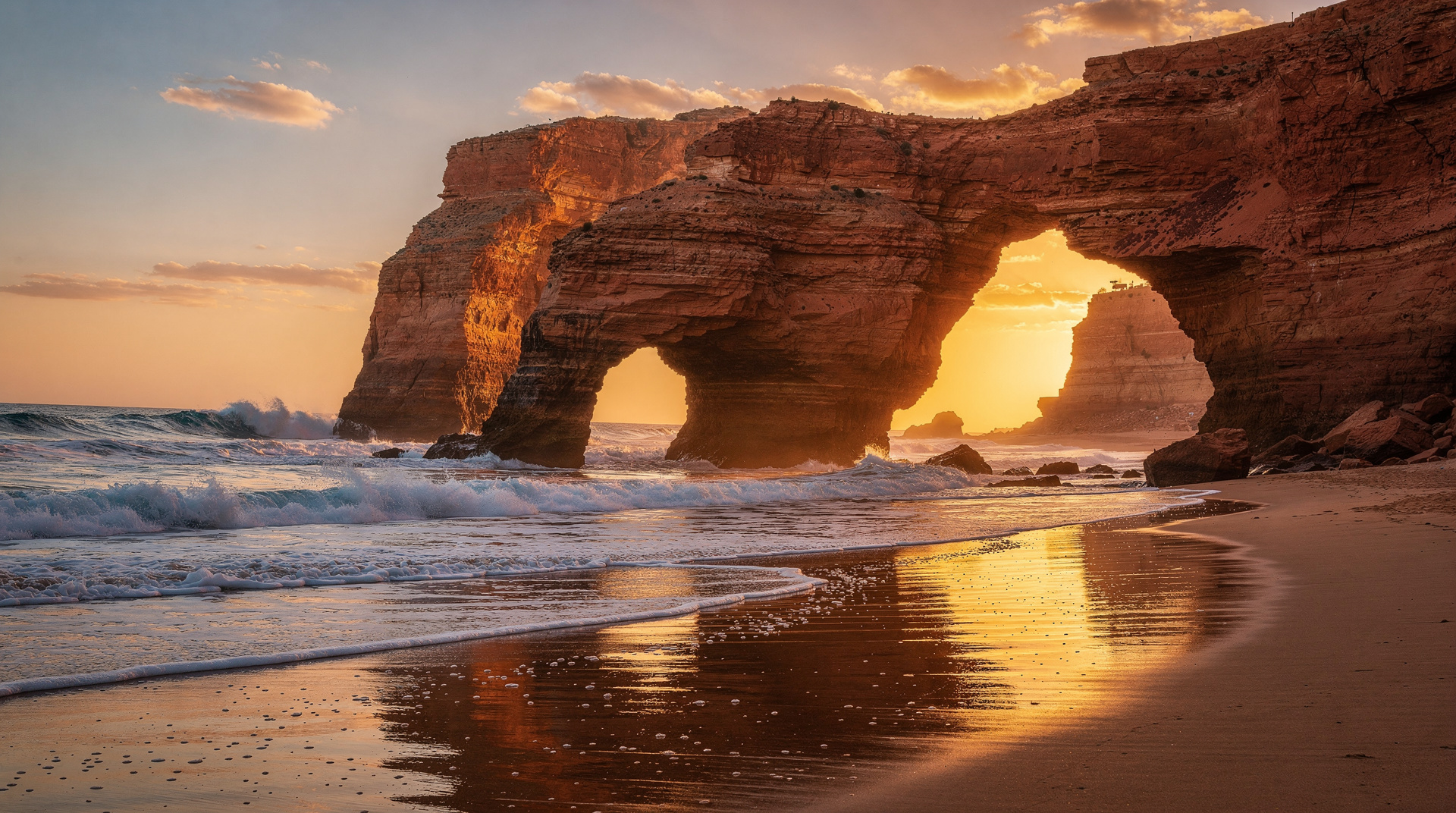
Until September 2016, Legzira Beach was famous for two massive natural stone arches — red sandstone bridges carved by millennia of Atlantic erosion that stood like cathedral doorways over the tide line. One collapsed that year, taking with it a portion of the cliff face and the most photographed arch in southern Morocco. The remaining arch — older, lower, and arguably more beautiful — still stands, and the beach it frames has lost none of its drama.
Legzira is located on a wild stretch of the Atlantic coast that most travellers skip entirely — the 100 kilometres between Agadir and the Mauritanian frontier that the tourist literature tends to ignore. This particular section, between Sidi Ifni and Mirleft, is the most visually striking: red iron-oxide cliffs drop to a beach of dark sand, the Atlantic swell arrives unimpeded from the north-west, and the remaining arch frames the horizon in a way that photographers have been trying to do justice to ever since.
The beach itself extends 3 km in either direction from the arch. At low tide, broad flat sand emerges and the walk around the base of the arch is straightforward. At high tide, the sea reaches the cliff base and passage is not possible. The surf is powerful and the rip currents are real — this is not a family swimming beach so much as a beach for looking at, walking along, and eating at one of the small restaurants that have established themselves on the clifftop.
| At a glance | |
|---|---|
| Where | Souss-Anti-Atlas coast, between Sidi Ifni and Mirleft |
| Cost | Free to visit; clifftop café meal around 60–120 MAD per person |
| Time needed | Half a day; longer if you plan around sunset or low tide |
| Getting there | Private car or negotiated taxi only — no public transport runs directly to the beach |
| Best time | Late afternoon for the light, and 1–2 hours either side of low tide for arch access |
Getting There
From Sidi Ifni: Legzira is 10 km north of Sidi Ifni on the coastal road (P1701). By car, the drive takes 15 minutes. A grand taxi from Sidi Ifni costs around 60–80 MAD negotiated. Sidi Ifni itself is 2 hours 30 minutes from Agadir on the N1 and regional roads.
From Mirleft: 25 km north of Mirleft, about 30 minutes by car. Grand taxis run between Mirleft and Sidi Ifni and can drop at the Legzira turn-off.
From Agadir: Take the N1 south to Tiznit (1 hour 15 minutes), then south on the R105 toward Sidi Ifni. Legzira is signposted off this road about 10 km before Sidi Ifni. Total: approximately 2 hours 15 minutes from Agadir. If you are based in Agadir and prefer a guided day out to this stretch of coast, the guided day trip from Agadir to Paradise Valley covers the wider Souss coast and gives the same type of Atlantic scenery experience with logistics handled.
From Tafraoute: About 2 hours west via Tiznit on regional roads. A logical stop on the Anti-Atlas coastal circuit.
Practical note: No public transport serves Legzira directly. A private car or negotiated taxi is necessary. The turn-off from the main road leads down a short piste (suitable for standard 2WD in dry conditions) to the beach parking area.
Getting Around
Legzira is a beach and a clifftop — walking is the only navigation required. The walk from the parking area down to the beach takes 5–10 minutes on a sandy path. From the beach, the arch is visible immediately to the north. At low tide, you can walk the full length of the beach; at high tide, the route is truncated by the sea against the cliffs.
For wider exploration — Sidi Ifni to the south, Mirleft to the north — you need a car or a taxi. The coastal road between the two towns, with the Atlantic on one side and the red cliffs on the other, is worth driving slowly.
Top Things to Do
Walk to the Arch
The remaining arch at Legzira stands perhaps 25 metres high and 20 metres wide — a genuine natural monument in deep red sandstone, its base sculpted by the sea into smooth, flowing forms. Walking beneath it at low tide, with the Atlantic horizon framed in the opening and the sound of the sea amplified under the rock, is one of those experiences that photographs do not quite capture.
The timing of your visit around the tide is important. Check tide tables before setting out: high tide makes passage to the arch impossible from the main beach area, though the arch remains visible and impressive from a distance. Low tide (particularly 1–2 hours below the low water mark) gives the most access and the cleanest photography angles.
Photography
Legzira is, without exaggeration, one of the most photogenic beaches in Morocco. The colour of the sandstone (a deep brick-red from iron oxide), the black-grey sand, the blue-green Atlantic, and the scale of the arch create compositions that work at almost any time of day. The best light falls in the final 90 minutes before sunset, when the low sun turns the sandstone almost orange and the shadows in the arch deepen dramatically. Sunrise is similarly compelling but requires an overnight nearby.
The collapsed arch’s absence has actually created an interesting additional feature: the rubble pile at the base of the cliff where the second arch fell has been rearranged by wave action into a dramatic rocky platform that is increasingly photogenic in its own right.
Swim and Surf
The surf at Legzira is consistent and powerful — it receives exposed Atlantic swell with no offshore protection. Beginners looking to learn before attempting this coast should consider a surf lesson in Essaouira, where conditions are more instructional and proper tuition is established.
The wave breaks both over the sand and against the cliff base. Experienced surfers find it worthwhile on the right swell; beginners should stay out of the water. There are no flags, no lifeguards, and rip currents run alongside the cliffs. The water is cold year-round (16–20°C).
Watch the Sunset
Legzira faces almost due west, which means the setting sun drops directly behind the arch on clear evenings in late autumn and winter. The combination of the arch silhouette against an orange Atlantic sky, with the cliffs glowing beside it, is one of the great sunset spectacles on the Moroccan coast. Several visitors time their entire visit to the region specifically around this.
Clifftop Café
Several small café-restaurants have established themselves at the top of the cliff path, with terraces looking directly down to the beach and the arch. The view from these terrace chairs — watching the tide come and go around the arch over a pot of mint tea or a plate of fresh fish — is one of the most pleasantly undramatic things you can do in this part of Morocco.
Where to Stay
Legzira has limited accommodation directly at the beach.
Camping Legzira: A basic campsite at the clifftop, with tent pitches, cold showers, and a simple kitchen. The main appeal is the location — waking at sunrise above the arch. Around 80–120 MAD per person.
Auberge Chez Alain: A small guesthouse with simple rooms above the beach, good home cooking, and an owner who has been here since before the arch collapse. Around 300–400 MAD per night.
For more comfortable accommodation, stay in Sidi Ifni (10 km south) or Mirleft (25 km north), both of which offer better choices and use Legzira as a day trip destination.
Sidi Ifni accommodation
Hotel Suerte Loca in Sidi Ifni is a converted Spanish colonial building with a rooftop bar and the best views in town. Around 400–600 MAD per night. A perfect base for Legzira visits.
Dar Nomad in Sidi Ifni offers well-designed rooms in a traditional house with a good kitchen and helpful owners who know the local beaches. Around 500–700 MAD.
Mirleft accommodation
Kerdous Eco-Lodge sits on the clifftops above Mirleft with panoramic Atlantic views and a pool. Mid-to-upper range.
Auberge Tissint is a reliable mid-range guesthouse in Mirleft village with easy access to the beaches and the coastal road to Legzira.
Where to Eat
At Legzira itself, the clifftop cafés serve mint tea, tagines, and fresh fish at reasonable prices (60–120 MAD per person). The quality varies but the setting compensates for any culinary shortcomings.
For a proper restaurant, Sidi Ifni has the best options:
Restaurant El Basha is the most recommended address in Sidi Ifni — fresh Atlantic fish, good tagines, and a pleasant terrace. Lunch for two: 150–250 MAD.
Café-Restaurant Nomad serves solid Moroccan basics with sea views from the clifftop. Good for a simple lunch before or after Legzira.
The catch of the day in this part of the coast tends to be excellent: gilt-head bream, sea bass, sardines, and sometimes langouste are brought in from small artisanal fishing boats. Ask what is fresh.
Day Trips from Legzira
Sidi Ifni: 10 km south, Sidi Ifni is a former Spanish enclave surrendered to Morocco in 1969. The town retains extraordinary Art Deco colonial architecture — a Baroque church converted to a courthouse, the old Spanish consulate, and the coastal parador — which gives it an atmosphere unlike anywhere else in Morocco. The beach south of town is broad and wild. Allow half a day.
Mirleft: 25 km north, Mirleft is a small, increasingly popular coastal town with a surf scene and several good guesthouses. Its beaches are more protected than Legzira and better for swimming. A growing yoga and wellness tourism industry has established itself here.
Tafraoute: 2 hours inland, Tafraoute in the Anti-Atlas offers a complete landscape change from the coast — pink granite boulders, Berber villages, and almond groves. Worth an overnight if you have the time.
Tiznit: 1 hour 30 minutes north, Tiznit is a traditional market town famous for its silverwork. The Wednesday souk is excellent for traditional Berber jewellery at genuine prices.
Practical Tips
Tide timing is essential: Check tide tables before visiting. Low tide extends the beach significantly and allows walking to the arch. High tide confines you to the clifftop. The beach is most beautiful 2 hours either side of low water.
The collapsed arch: The second arch fell in September 2016 after being undercut by storm erosion. The remaining arch shows no immediate signs of instability but it is a natural structure subject to ongoing erosion. Local authorities periodically assess its condition.
Swimming: The warning cannot be overstated — the rip currents at Legzira are strong and the surf is powerful. Do not swim here unless you are a confident ocean swimmer who understands rip current behaviour. Children should not enter the water.
Sunsets: The best sunset positions are from the clifftop, not the beach — you need height to see the arch silhouette against the sky. The café terraces provide this angle better than being on the sand.
Weather: This stretch of Atlantic coast is exposed to prevailing north-west winds. Wind is almost constant; bring a windproof layer even on warm days.
When to Visit
March to May is excellent: mild temperatures, clear Atlantic light, and the wildflowers on the clifftops are in full colour.
September to November: The autumn swell is at its peak — best for dramatic wave photography and for surfers. The light is extraordinary.
December to February: The wildest season. Powerful swell, cold wind, occasional rain, and the beach almost entirely empty. The arch in winter storm light is magnificent for those who find desolate beauty appealing.
June to August: Hot inland, but the coastal breeze keeps Legzira comfortable. Busiest with Moroccan domestic tourists.
| Season | Weather | Crowds | Best for |
|---|---|---|---|
| Mar–May | Mild, clear light | Low–moderate | Photography, wildflower cliffs |
| Jun–Aug | Warm, breezy coast | Highest (domestic tourism) | Escaping inland heat |
| Sep–Nov | Warm days, big swell | Low | Surf photography, dramatic waves |
| Dec–Feb | Cold wind, occasional rain | Very low | Solitude, storm-light photography |
Beyond the arch: the wider Legzira coastline
Most visitors treat Legzira as a single stop, but the stretch of coast either side rewards a little more time. South toward Sidi Ifni, smaller unnamed coves and tidal pools appear at low tide — worth a slow walk if you have an extra hour. North toward Mirleft, the coastline turns into a string of surf beaches (Aftas, Imi Ouaddar) that see far fewer visitors than the well-known Taghazout scene further north; see our surfing in Morocco guide for how this coast compares.
Travellers building a longer loop often combine Legzira with the Souss-Anti-Atlas region overview and the best beaches in Morocco guide to decide how much time this corner of the coast deserves against Essaouira or Taghazout further north.
How to Fit Legzira Into a Morocco Itinerary
Legzira makes sense as part of a southern Atlantic coast circuit that most travellers on standard itineraries miss entirely. The logical route from Agadir: Agadir — Tiznit — Sidi Ifni (overnight) — Legzira (afternoon visit) — Mirleft (overnight) — back to Agadir or south via the coastal road.
For the ambitious traveller on a two-week Morocco itinerary, incorporating Legzira alongside Tafraoute and Paradise Valley creates an extraordinary Anti-Atlas and Atlantic coast extension that covers some of Morocco’s most dramatic and least-visited scenery.
See also: Sidi Ifni guide, Mirleft guide, the Souss-Anti-Atlas region overview, and our grand south road trip itinerary.
Frequently asked questions about Legzira Beach Travel Guide
Is Legzira Beach safe to swim at? Not recommended for casual swimming. The rip currents are strong and there are no lifeguards or flags. Confident ocean swimmers who understand rip currents can judge conditions for themselves; families with children should stick to admiring the arch from the sand or clifftop.
How long do you need at Legzira Beach? A half-day is enough to walk to the arch, take photographs, and have a meal at a clifftop café. Staying for sunset extends that to a full afternoon, and it’s the best version of the visit if your schedule allows it.