Quick facts
- Language
- Tachelhit, Darija
- Altitude
- 1,000 m
- Distance from Agadir
- 4h by car (163 km)
- Best for
- Rock scenery, almond blossom, hiking, isolation
The Pink Granite Town at the End of the Anti-Atlas
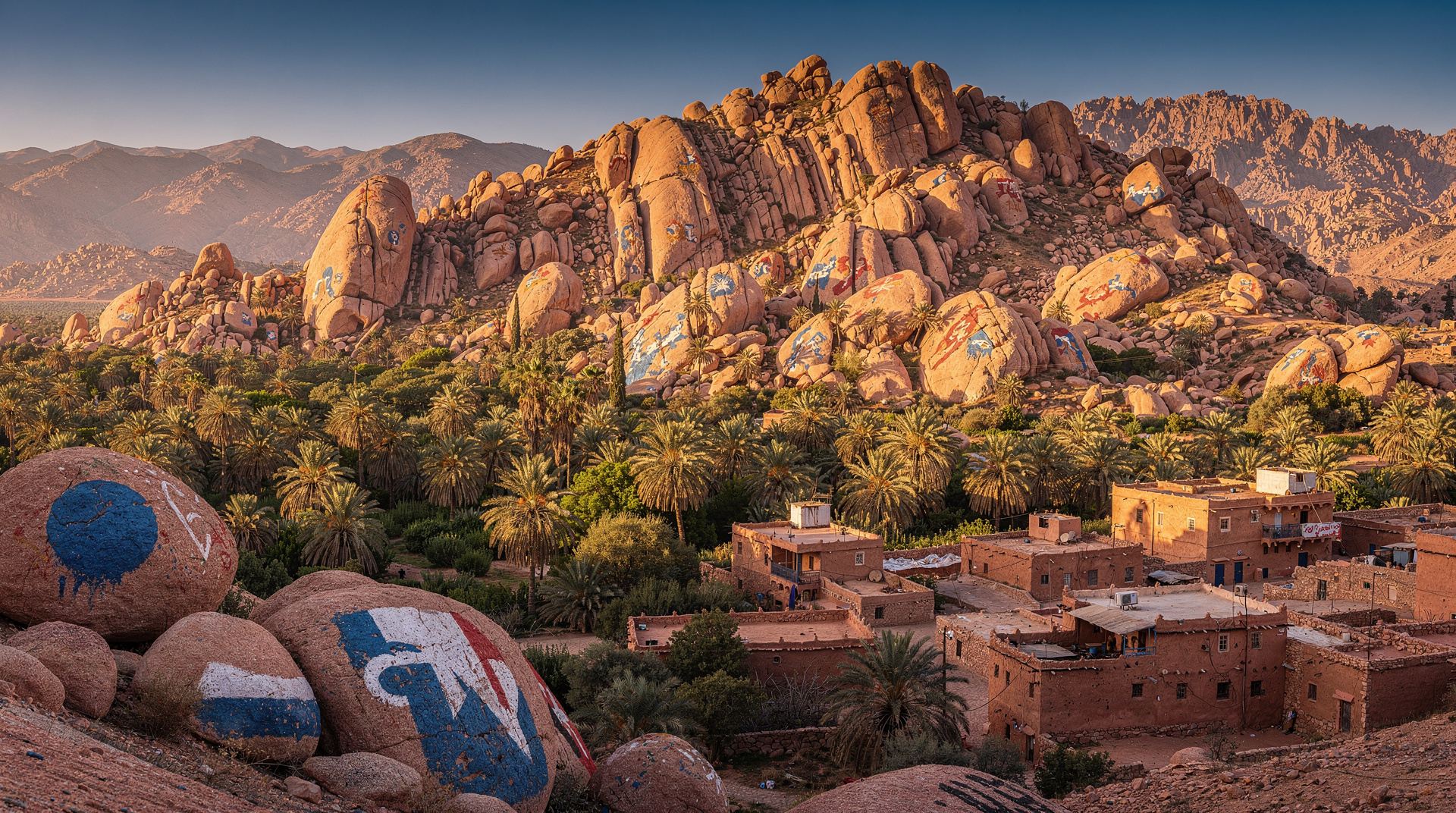
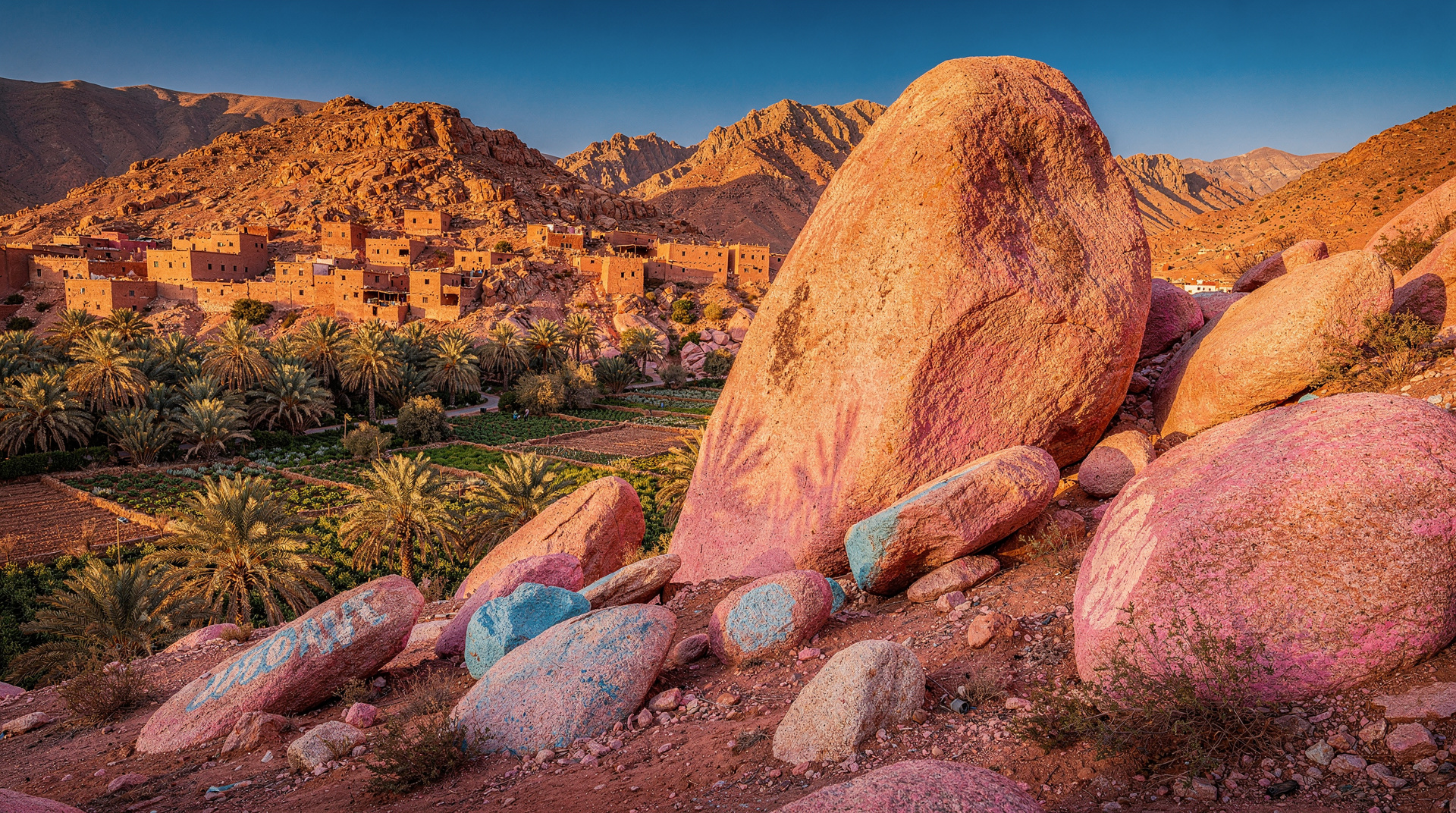
There is a moment on the road into Tafraoute — from any direction, but particularly from the Tiznit approach — when the landscape becomes genuinely surreal. The mountains, which have been the usual Morocco brown, abruptly shift to a deep rose-pink: enormous rounded granite boulders, sculpted by millennia of wind erosion into shapes that suggest animals, faces, and impossible stacks, glowing almost orange in the late afternoon sun. Tafraoute itself then appears in the middle of this geological fantasia, a compact Berber town of flat-roofed houses in matching rose-tinted stone, and the whole composition looks like something from a different planet.
This is the southern Anti-Atlas, a mountain range that most visitors to Morocco never reach. At 163 km from Agadir (4 hours by road, and that road includes some genuinely alpine switchbacks), Tafraoute is sufficiently inconvenient to remain wonderfully free of the tourist infrastructure that has transformed Marrakech and even Chefchaouen into photogenic queuing systems. There is one main square, a handful of guesthouses, a Wednesday souk, and several days’ worth of hiking among granite formations and ancient rock carvings.
The Ameln Valley, which Tafraoute anchors at its eastern end, is one of the most beautiful Berber-inhabited valleys in Morocco: 26 villages of silvery-grey stone perched on terraces above almond and argan orchards, with the granite peaks rising behind them. In February, when the almond trees bloom, the valley turns white and pink in a display that rivals any spring blossom display in Europe.
| At a glance | |
|---|---|
| Where | Anti-Atlas mountains, 163 km / around 4 hours by road from Agadir |
| Cost | Budget to mid-range — guesthouses from around 250–700 MAD, meals 60–150 MAD |
| Time needed | 2–3 days minimum for the Ameln Valley and painted rocks |
| Getting there | Grand taxi or hire car via Tiznit; no direct bus from Agadir |
| Best time | February for almond blossom, March–May and October–November for hiking |
Getting There
From Agadir: The most common approach. Take the N1 south to Tiznit, then east on the R105 to Tafraoute. The road through the Anti-Atlas passes some of Morocco’s most dramatic mountain scenery. Allow 4 full hours — the road is winding and the switchbacks require care. A grand taxi from Tiznit to Tafraoute costs around 60–80 MAD per seat (1.5–2 hours). From Agadir, no direct public transport serves Tafraoute; you need to change in Tiznit.
From Tiznit: 75 km east on the R105. The road climbs through the Jbel Lkst range in a long series of hairpin bends before descending into the Ameln Valley. Allow 1.5–2 hours.
From Marrakech: Possible but long — take the A7 south to Agadir (3 hr) and then the Agadir–Tiznit–Tafraoute route. Total: 7–8 hours. Best broken with a night in Agadir or Tiznit.
By car: The only truly practical way to explore the Tafraoute area. The painted rocks, the rock art sites, and the Ameln Valley villages are all spread over tens of kilometres and not served by public transport.
Getting Around
Tafraoute town is small enough to walk everywhere. The surrounding area — the Ameln Valley villages, the painted rocks, the rock art at Oum el-Aleg, the Aït Mansour gorge — requires either a car or a hired mountain bike.
Mountain bike rental: Several guesthouses in Tafraoute rent basic mountain bikes for 80–120 MAD per day. The valley floor is cyclable; the routes to higher villages involve significant climbing.
Local guides: For the rock art sites and more remote valleys, a local guide adds considerable value. Ask at guesthouses or at the syndicat d’initiative on the main square. Rates: 200–400 MAD per day.
Top Things to Do
See the Painted Rocks
In 1984, Belgian artist Jean Vérame obtained permission from the Moroccan government to paint the massive boulders south of Tafraoute in vivid blues, purples, reds, and yellows. The result was controversial and initially jarring in this landscape of natural rose granite — but the paint has faded over 40 years into softer, more harmonious tones, and the rocks have become an established piece of land art in the Anti-Atlas. They sit about 4 km south of town by dirt track — accessible by car or a 45-minute walk.
Whether you find them a fascinating artistic intervention or an unnecessary defacement of natural beauty is a matter of personal taste. Most visitors find the combination of the painted stones and the surrounding granite scenery unexpectedly compelling.
Walk the Ameln Valley
The 26 villages of the Ameln Valley are connected by a trail that runs along the base of the mountains for about 20 km. Each village — Oumesnat, Tazekka, Aït Ahmed — has its own agadir (fortified communal granary) on the ridge above, and the views from the trail across the valley to the granite peaks are exceptional.
Visitors coming from Agadir who want the region orientation before reaching Tafraoute can join the Souk el-Had market tour in Agadir — the Souss Berber culture on display there is the same root as the Ameln Valley villages, making it a useful primer.
A full day’s walk covers 5–6 villages at a comfortable pace. The path is unmarked in places — a local guide or a good GPS track (downloadable from WikilLoc or AllTrails) is recommended. Carry all water as the villages have limited supplies for visitors.
Visit Oumesnat Agadir
The collective granary (agadir) above the village of Oumesnat is one of the best-preserved in the Anti-Atlas — a multi-storey stone structure with hundreds of locked wooden chambers where each family stored grain, olive oil, and valuables. The caretaker lives nearby and opens the agadir to visitors (small donation expected). The views from the agadir terrace down the Ameln Valley are among the finest in the Anti-Atlas.
Prehistoric Rock Carvings at Oum el-Aleg
The Tafraoute area contains one of Morocco’s highest concentrations of Neolithic rock carvings — petroglyphs of cattle, ibex, hunters, and abstract geometric patterns carved into the granite several thousand years ago. The main accessible site is at Oum el-Aleg, about 7 km south of Tafraoute. A local guide will lead you directly to the most significant panels; finding them independently is possible but unreliable.
Almond Blossom Season (February)
The Ameln Valley is one of Morocco’s primary almond-producing areas, and in late January and February the valley’s hundreds of thousands of almond trees burst into white and pale pink flower simultaneously. The timing is rarely precise (it varies by up to two weeks depending on the winter) but the spectacle, combined with the rose-granite backdrop and the clear Anti-Atlas winter light, is extraordinary. February is Tafraoute’s busiest and most atmospheric month.
Aït Mansour Gorge
About 35 km south of Tafraoute on a piste road, the Aït Mansour Gorge is a narrow canyon cut through the granite by the Aït Mansour River. The road through the gorge passes between walls of pink rock and through palm groves before opening into a series of Tachelhit-speaking villages that see very few foreign visitors. A half-day drive and walk from Tafraoute.
Where to Stay
Mid-range (400–1,000 MAD / €40–100 per night)
Hotel Les Amandiers occupies the hillside above Tafraoute with sweeping Ameln Valley views and a pool — the finest property in town. The building has 1960s charm that has mellowed into character. Doubles from around 700 MAD. The terrace restaurant at sunset is the social hub of Tafraoute.
Auberge Toubkal is a reliable, mid-range guesthouse in the town with comfortable rooms and excellent Berber cooking. A good base for walkers.
Dar Infiane is a small, charming guesthouse in the traditional stone architecture of the valley, with warm hospitality and home-cooked meals. Around 500 MAD per person half-board.
Budget (under 250 MAD / €25 per night)
Several simple auberges operate in the main square area. Standards are basic but adequate. The best budget option is usually the guesthouse attached to whichever local guide you hire — they typically offer rooms at fair prices.
Where to Eat
Tafraoute’s restaurant scene is limited but genuine.
Hotel Les Amandiers restaurant is the most reliable option — a full Moroccan menu served on the terrace with valley views. Dinner for two: 250–400 MAD.
Restaurants on the main square serve tagines, harira, and omelettes at local prices (60–100 MAD per person). Look for the unlabelled places where taxi drivers stop — reliable indicators of authenticity.
Argan oil and amlou: The Souss valley surrounds produce both argan oil and amlou (argan paste with honey and almonds) of exceptional quality. Buy from the women’s cooperatives rather than shops — the price is regulated and the quality is verified. Amlou at breakfast with fresh bread is the defining Tafraoute morning.
Day Trips from Tafraoute
Tiznit: 75 km west, Tiznit is a silversmithing town with one of Morocco’s better-preserved old medinas and a functioning jewellery souk where Tachelhit-speaking Berber silversmiths produce traditional work. A half-day from Tafraoute.
Sidi Ifni: 110 km west and then south from Tiznit, Sidi Ifni was a Spanish enclave until 1969 and retains extraordinary Art Deco colonial architecture at the edge of the Atlantic. Worth a full day.
Tafraout Plateau and Jbel el-Kest: The massif immediately north of Tafraoute offers a demanding full-day hike to the summit with panoramic views over the Anti-Atlas to the Saharan plains. Best with a local guide.
Practical Tips
The road: The anti-Atlas approaches to Tafraoute are genuinely mountain roads. Take curves carefully and allow much more time than the map distance suggests. The Tiznit approach involves long sections of 15–20 km/h switchback driving.
Best light for photography: The pink granite glows most intensely in the hour before sunset and for the first hour after sunrise. The painted rocks in late afternoon are particularly vivid.
Wednesday souk: Tafraoute’s weekly market is one of the most authentic in the region — farmers from the surrounding valleys bring agricultural products, and artisans sell silver jewellery and woven goods. Avoid tourist-targeted carpet shops and focus on the produce and crafts section.
Language: Tachelhit (Tachilhiyt), the Berber language of the Souss, is the primary tongue. Darija is understood; French less so than in northern Morocco. Pointing and numbers work fine for market transactions.
Water: Carry adequate water for any hike — the Anti-Atlas heat in summer is dry and intense. Spring and autumn are the practical walking seasons.
When to Visit
February is the peak for almond blossom and the most atmospheric month. Temperatures are mild (15–20°C by day) and the valley is genuinely beautiful.
March to May offers warm days and wildflowers on the hillsides.
October to November is excellent for hiking — clear air, comfortable temperatures, golden light.
June to September: Hot (regularly above 35°C in the valley). Doable in the early morning and late afternoon with appropriate preparation, but the heat is serious.
December to January: Cool and often very quiet. The almond trees are bare but the granite scenery is dramatic in winter light.
How to Fit Tafraoute Into a Morocco Itinerary
Tafraoute is a genuine detour — you do not pass through it on the way to anywhere else. This is both its appeal and its limitation. The minimum sensible visit is two nights, which allows one full day for the Ameln Valley and one for the rock art and painted rocks.
For a two-week Morocco itinerary that wants to include the deep south, Tafraoute slots naturally into a loop: Agadir — Tafraoute (2 nights) — Tiznit — Mirleft or Sidi Ifni — back to Agadir. This Anti-Atlas circuit covers some of Morocco’s most striking and least-visited scenery.
For those on the southern Morocco itinerary centred on the Sahara, Tafraoute requires a separate excursion from Agadir and does not connect efficiently to the Ouarzazate-Merzouga route. That Sahara circuit is best covered on a dedicated tour — the 3-day Sahara tour from Marrakech to Merzouga is the standard framework for that route, freeing you to treat Tafraoute as a separate Anti-Atlas excursion from Agadir. Plan it as its own thing.
See also: Souss and Anti-Atlas region guide, Tafraoute day trip from Agadir, and our Anti-Atlas trek guide.
Frequently asked questions about Tafraoute Travel Guide
Is Tafraoute worth the detour from Agadir?
Yes, if you have at least 2–3 spare days and want pink-granite scenery, rock climbing, or the February almond blossom that few travellers ever see. It is a genuine detour, not a stop on the way to anywhere else — pair it with Sidi Ifni or Taghazout for a fuller Anti-Atlas loop.
Can I visit Tafraoute without a car?
Partly. Grand taxis cover Agadir–Tiznit–Tafraoute reliably, but the Ameln Valley villages, the painted rocks, and the Aït Mansour Gorge are far easier with a rental car, a hired guide, or a mountain bike from a local guesthouse.