Quick facts
- Best for
- Surfing, seafood, coastal walks, windsurfing
- Days needed
- 3-7 days
- Best time
- Apr–Oct (surf: Sep–Mar)
- Hub city
- Agadir or Essaouira
Why visit the Atlantic coast
Morocco’s Atlantic coast is the country’s least-Instagrammed and most underappreciated asset. While visitors crowd the medinas of Marrakech and Fes, the 3,500km of Atlantic coastline — much of it wild, windswept, and barely developed — rewards those who veer off the imperial cities circuit.
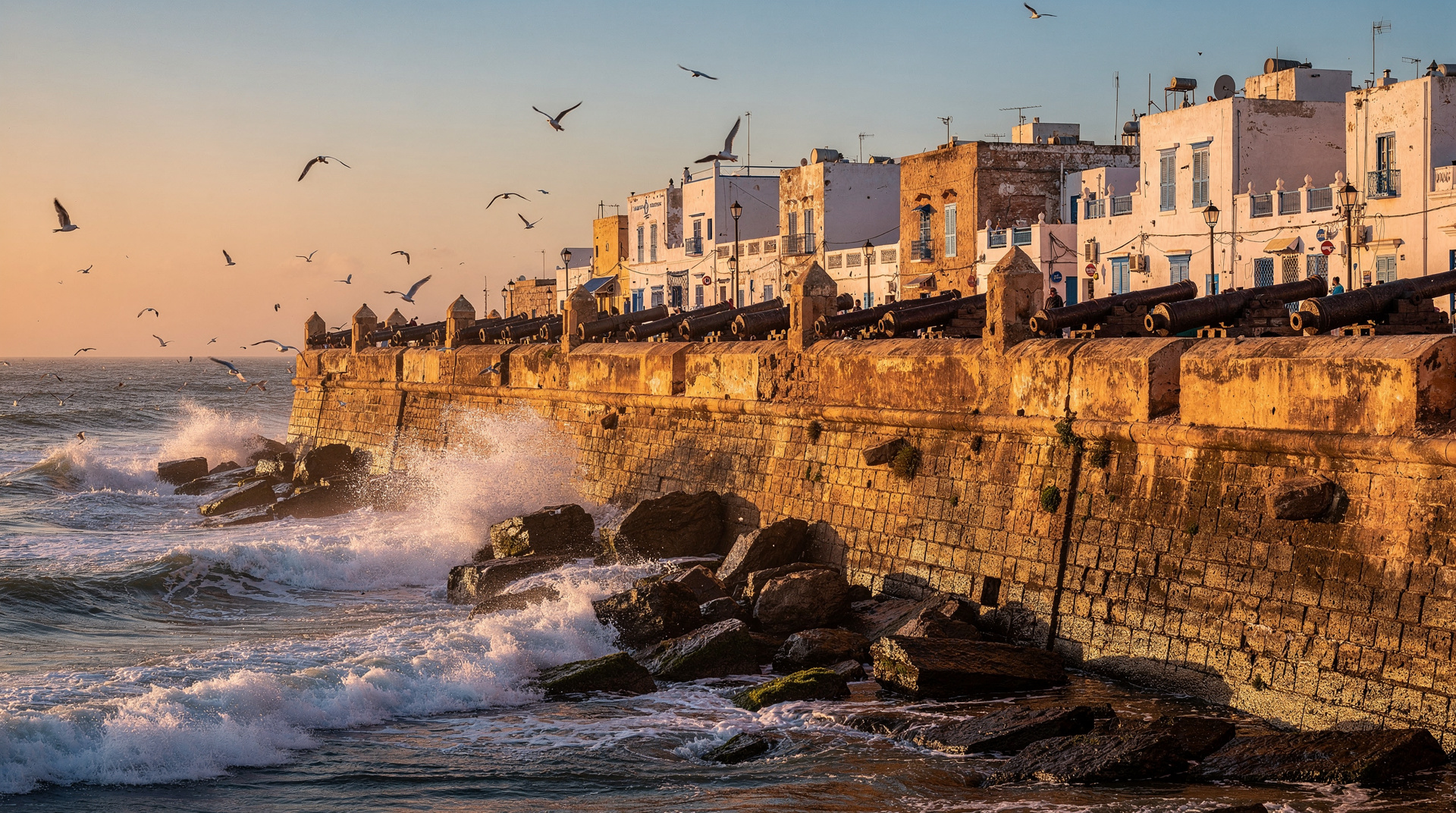
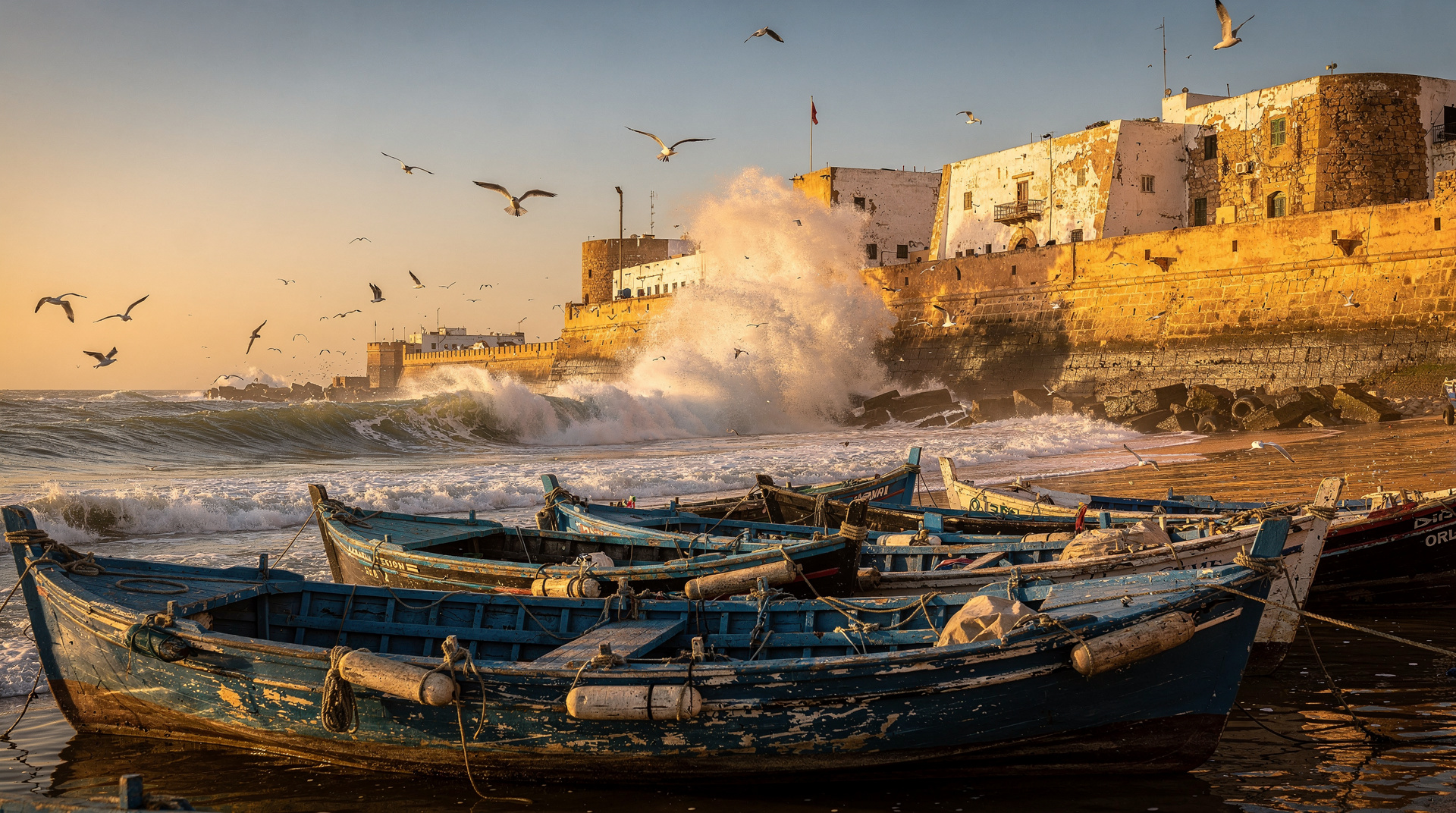
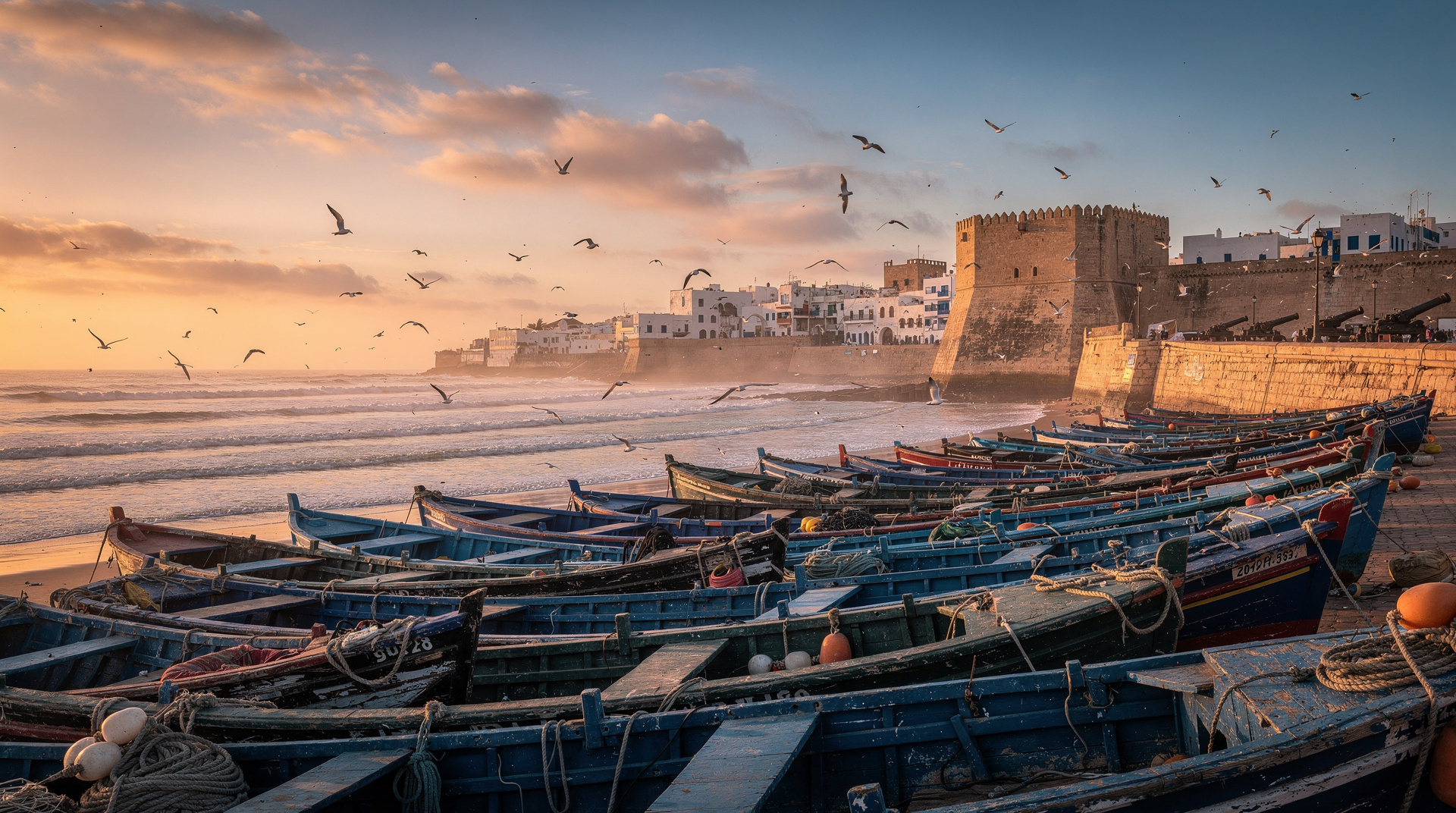
The coast offers a different pace. Essaouira is the jewel: a walled port city of blue-painted boats, wild wind, and a creative community that has attracted artists, musicians, and writers since the 1960s. Taghazout, 20km north of Agadir, is the surf capital — still scrappy enough to feel authentic despite growing numbers of Europeans in boardshorts. Oualidia, halfway between Casablanca and Agadir, is a lagoon town famous for its oysters and near-silence. Legzira, near Sidi Ifni, has rock arches at the sea edge that rival anything on the Normandy coast.
Agadir itself divides opinion. The original city was destroyed by an earthquake in 1960 and rebuilt as a package-holiday resort — wide beaches, international hotels, a tourist strip that feels more Spanish costa than Morocco. It’s not without purpose (good transport hub, excellent beach, pleasant climate), but it requires no more than a night. The surroundings, however, are extraordinary.
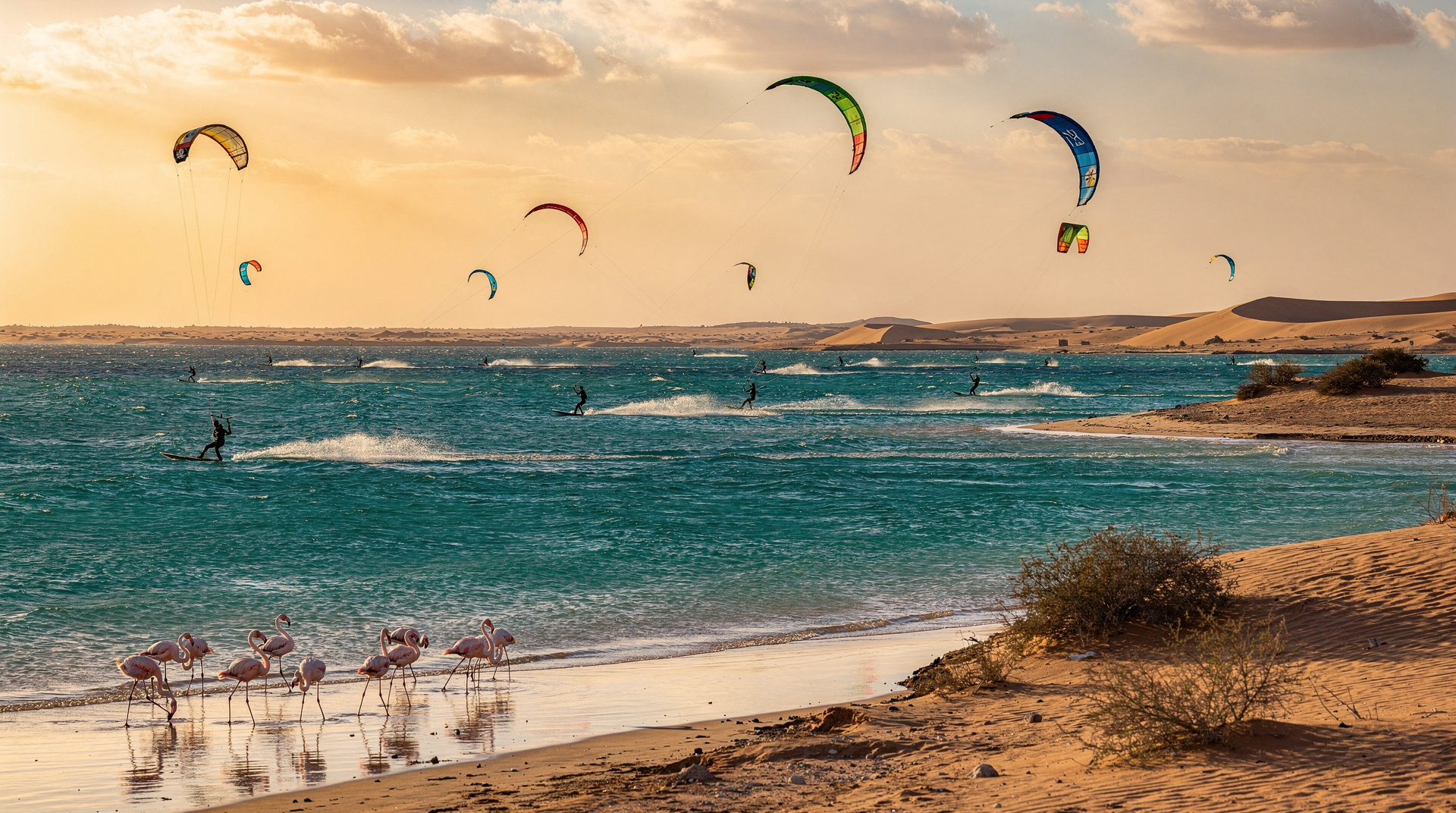
The Atlantic swell is consistent and powerful — Morocco is one of Europe’s best surf destinations, with breaks that work for beginners at Taghazout and advanced surfers at exposed points like Anchor Point and Killer Point. The wind at Essaouira (locally called the alizé) is legendary in the windsurfing world, making it a consistent destination for kitesurfers and windsurfers from spring through autumn. For a full rundown of breaks and skill levels, see the Morocco surfing guide.
| At a glance | |
|---|---|
| Where | Coastal strip from Oualidia to Sidi Ifni, hub cities Agadir and Essaouira |
| Cost | Guesthouse from around 250–400 MAD/night; surf camp packages from around 1,200 MAD/person/night with meals |
| Time needed | 3–7 days for one base; 7–10 days for a full coastal road trip |
| Getting there | Fly into Agadir (AGA) or bus/drive from Marrakech (around 3 hours) |
| Best time | April–October for beach weather; September–March for the best surf swell |
Getting there
Agadir Al Massira Airport (AGA) is the coast’s main hub, with direct flights from major European cities. Ryanair, easyJet, TUI, and Transavia all serve Agadir from multiple European airports. The airport is 20km east of the city — taxis cost around 150–200 MAD into town.
From Marrakech, Agadir is 3 hours by road (the N8 highway via Imi n’Tanout, or the faster A7 toll motorway). Supratours and CTM buses run frequently (100–130 MAD, 3 hours). Essaouira is 3 hours from Marrakech and 2.5 hours from Agadir by road; Supratours buses run both routes daily.
There is no train service south of Casablanca along the Atlantic coast. For coastal hopping, renting a car gives far more flexibility than relying on buses. A basic hire in Agadir costs 300–450 MAD/day from local agencies; international chains run higher.
From Agadir, Taghazout is 20 minutes north. Oualidia is 4 hours north toward Casablanca. Legzira is 1.5 hours south of Agadir, near Sidi Ifni.
Main destinations within the region
Essaouira
Essaouira was called Mogador by the Portuguese and the French before independence. Its medina — a UNESCO World Heritage Site — is compact, whitewashed, and blue-shuttered, designed by a French architect in the 18th century on behalf of Sultan Mohammed III. It has a geometry that other Moroccan medinas lack: straight-ish streets, ocean views from the ramparts, and wind that keeps the air clean and cool even in August.
The port is the best part of the city on a working day: returning boats unloading sardines, swordfish, and sole directly onto the dock, where fish grillers line the entrance to the harbour and serve lunch at plastic tables for 30–50 MAD. Avoid the restaurants along the main tourist square — prices are double for half the quality.
Essaouira’s creative legacy is real. Jimi Hendrix famously visited (the “Castle Made of Sand” myth is disputed, but his presence here was genuine). Orson Welles filmed Othello on the ramparts. The Gnawa World Music Festival in June brings musicians from across sub-Saharan Africa to play in the medina squares.
For walkers, the beach extends 10km south of the city walls with almost no development — dunes, wind-sculpted argan trees, and the occasional camper van. The Essaouira medina half-day guided walking tour covers the ramparts, the medina’s craftsman quarter, and the port with local context.
Stay in the medina if possible — it’s compact and quiet at night after the day-trippers leave. Villa Maroc was one of the first boutique riads in Morocco (late 1980s) and remains excellent. Madada Mogador and Heure Bleue are mid-to-upper range options with real character.
Taghazout and the surf coast
Taghazout is a fishing village turned surf hub 20km north of Agadir. A decade ago it was a genuine backpacker-and-shaper haven. Today it has surf camps, yoga retreats, and a small number of international coffee shops. It still functions as a working village with a daily fish catch and a mosque that calls at 5am, but the vibe has shifted.
The surf at Taghazout is genuinely excellent. Anchor Point is a long, fast right-hand point break that holds swell up to 8 feet and is best for intermediate to advanced surfers. Hash Point and Panorama Point handle smaller swell and are appropriate for beginners in the 1–4 foot range. The surf lessons on the Atlantic coast are available for all levels with qualified instructors.
Surf season runs September to April, with the biggest swells in December and January. Summer (June–August) sees flat or very small conditions at Taghazout; Essaouira’s windswell works year-round for windsurfers.
Accommodation in Taghazout ranges from simple guesthouses above the village (250–500 MAD/night) to fully-serviced surf camps with meals (1,500–2,500 MAD/person/night). Surf camps typically include equipment, instruction, and transfers to the beach. Booking in advance for October–March is advisable.
Agadir
Agadir’s beach is one of the best in Morocco — 9km of sand, protected bay, lifeguards in season, and consistently warm sea temperatures (18–22°C year-round). The rebuilt city has no medina to speak of; the Ancienne Talborjt hillfort gives a view over the ruined pre-earthquake town and the bay. The Souk el Had, the big Sunday market on the edge of the new town, is a practical place to buy produce, ceramics, and argan products at non-tourist prices.
The Paradise Valley day trip from Agadir is the best single excursion from the city — a gorge of polished granite pools and palm trees in the foothills 45 minutes from Agadir, considerably more impressive than the name suggests. Bring a swimsuit.
Oualidia
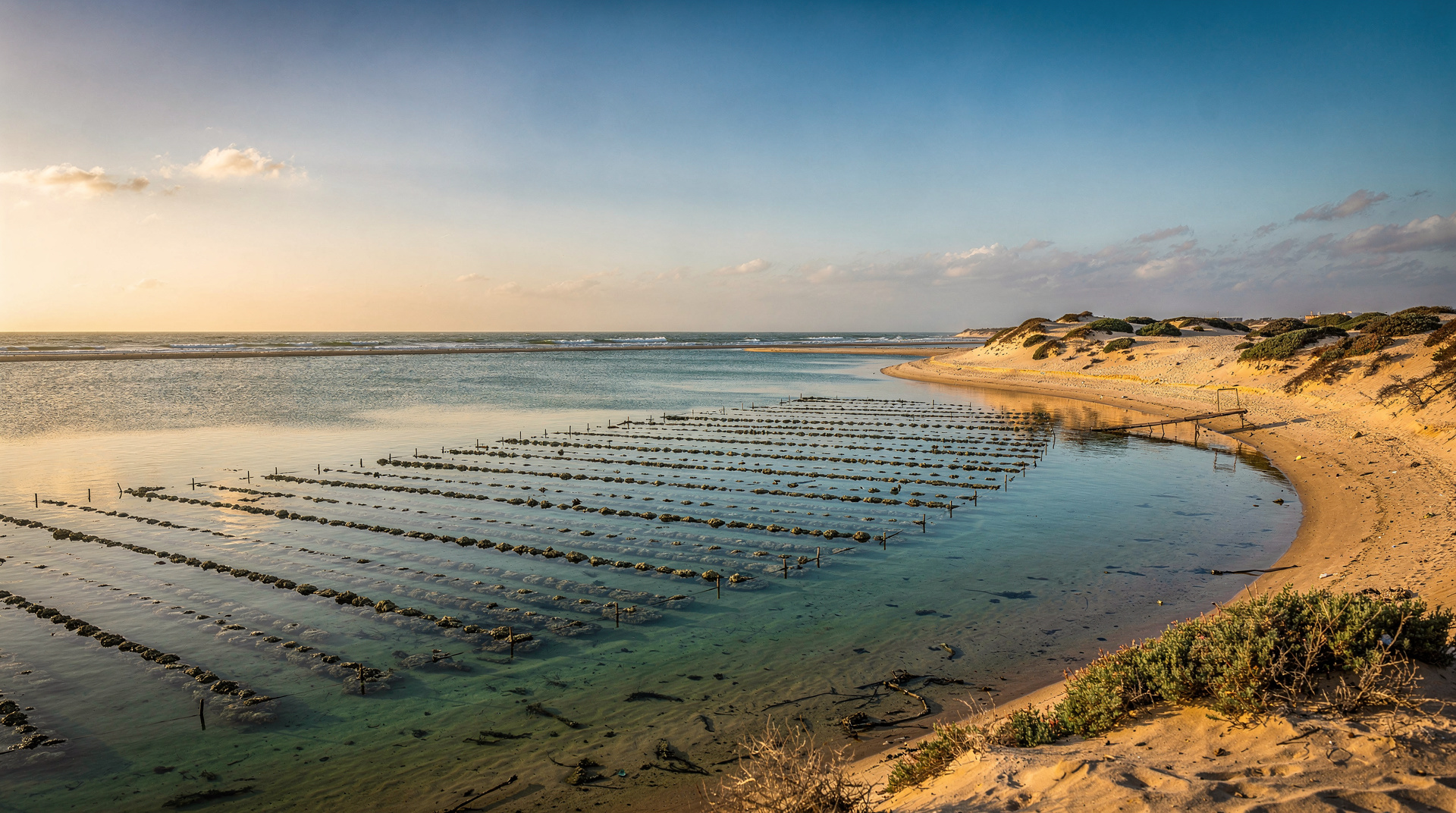
Oualidia deserves more visitors than it gets. The lagoon — separated from the Atlantic by a sandbar, calm enough for kayaking, rich enough in nutrients to produce Morocco’s finest oysters — is beautiful in a low-key, undramatic way. The village has a handful of good restaurants serving oysters fresh from the lagoon (75–100 MAD for a dozen), a few simple hotels, and the kind of silence that feels increasingly rare on the Moroccan tourist circuit.
L’Hippocampe restaurant, perched above the lagoon, has been serving oysters and grilled fish since the 1970s. Reserve for lunch.
Legzira
Legzira Beach, 10km north of Sidi Ifni, has red rock arches rising from the sea at the south end of the beach. One of the original arches collapsed in 2016, but the remaining formations are still striking. The beach is long, clean, and quiet — a handful of cliff-side guesthouses is the extent of the infrastructure. It is 1.5 hours south of Agadir on a mostly good road; the final stretch to the beach is a steep track.
When to visit
Essaouira: April to October for warmth and beach weather; the wind makes it bearable in summer when Marrakech is unbearable. The Gnawa Festival (June) is one of Morocco’s best.
Taghazout/surf coast: September to April for the surf. Summer is flat and hot inland though cool on the coast.
Agadir and Oualidia: Year-round beach destination; winter temperatures rarely fall below 18°C.
How many days
Essaouira alone: 2–3 days. Taghazout for a surf trip: 5–7 days minimum. Agadir as a base for day trips: 3–4 days. A full coastal road trip Agadir–Essaouira–Oualidia–Casablanca: 7–10 days with stops.
Where to stay
Essaouira: Villa Maroc (boutique, 1,200–2,000 MAD), Madada Mogador (mid-upper, 1,500–2,500 MAD), Riad al Medina (mid, 900–1,400 MAD).
Taghazout: Surf camps from 1,200 MAD/person/night (meals included); village guesthouses from 300 MAD.
Agadir: International chain hotels along the beach from 800 MAD/night. For character, Riad Villa Blanche (900–1,500 MAD) or Dar Tafoukt.
Oualidia: La Sultana Oualidia (luxury, 3,000–5,000 MAD), L’Hippocampe (simple, 600–900 MAD).
Coastal driving and road conditions
The Atlantic coast is well-served by Morocco’s national road network, though the quality varies significantly by route. The N1 between Agadir and Tiznit (south) is dual carriageway and fast. The road between Agadir and Essaouira (the coastal N1 via Taghazout) has been upgraded in sections and is generally good; allow 2.5 hours including a fuel stop. Between Essaouira and El Jadida (north toward Casablanca), the road passes through Safi and Oualidia — scenic but slower, with trucks sharing the single carriageway; allow 4–5 hours for this section.
Petrol stations are plentiful between Agadir and Essaouira. South of Agadir toward Sidi Ifni and Guelmim, fill up at every opportunity — stations thin out below Tiznit.
Argan oil: what’s real, what isn’t
The argan tree (Argania spinosa) grows almost exclusively in the Souss basin between Agadir, Essaouira, and the Atlas foothills — a UNESCO-protected biosphere. Morocco produces the world’s entire supply of culinary and cosmetic argan oil. Every roadside stall between Marrakech and Agadir sells it; most are affiliated with the cooperatives of women producers who represent a genuine social enterprise model.
Pure culinary argan oil costs around 150–200 MAD per 100ml from a legitimate cooperative. Cosmetic argan oil (cold-pressed, unroasted) runs 200–300 MAD per 100ml. Prices significantly below this indicate either poor quality or adulteration. The UCFA and AMAPPE cooperatives (recognisable by their signage and fixed pricing) are reliable sources. Buying directly from cooperatives along the Essaouira road rather than from medina tourist shops ensures more of the money reaches the women producers.
Water sports beyond surfing
Essaouira’s consistent wind makes it one of the best kitesurfing destinations in Africa. The beach south of the medina walls provides a long, open launch zone; wind speeds average 25–35 knots from April through October. Several kitesurfing schools operate on the beach (lessons from 500 MAD, equipment hire from 400 MAD/day). The IKO (International Kiteboarding Organisation) certification is available from licensed instructors.
Agadir’s sheltered bay is ideal for paddleboarding and kayaking — conditions are calm by Atlantic standards, and several operators along the beach offer hourly rentals (80–120 MAD). Boat trips from Agadir harbour to see dolphins (bottlenose dolphins are resident in the bay year-round) run daily from 9am, approximately 200–250 MAD per person for a 2-hour trip.
Sample itinerary — 6 days (Essaouira to Agadir)
Day 1–2: Essaouira — medina walk, port fish lunch, rampart sunset, morning beach walk south of the walls.
Day 3: Drive Essaouira to Agadir (2.5 hours), stop at Cap Rhir point for views, overnight Agadir.
Day 4: Paradise Valley excursion from Agadir — gorge swimming, lunch, return to Agadir.
Day 5: Drive north to Taghazout — surf lesson or watch the break, beach afternoon, overnight in village.
Day 6: Morning surf, drive south to Agadir for flight or onward to Anti-Atlas.
Which Atlantic base suits you
| Base | Best for | Vibe | Days needed |
|---|---|---|---|
| Essaouira | First-timers, culture, food, wind sports | Walkable medina, artsy, breezy | 2–3 days |
| Taghazout | Dedicated surf trips | Scrappy surf village, camps | 5–7 days |
| Agadir | Transit hub, day trips, families | Resort strip, wide beach | 1–3 days |
| Oualidia | Quiet, seafood, lagoon calm | Sleepy, undeveloped | 1–2 days |
| Legzira | Photography, remote beach time | Isolated, minimal infrastructure | 1 day |
For a deeper side-by-side, see the Essaouira vs Asilah vs Taghazout comparison. If your priority is purely surf logistics, the surfing Taghazout guide and surf camps guide go deeper than this overview can.
Frequently asked questions about Atlantic Coast
Is the Atlantic coast better than the Mediterranean north for a beach trip?
For most travellers, yes. The Atlantic coast has more developed infrastructure for surf and watersports, better seafood, and a wider choice of bases (Essaouira, Taghazout, Oualidia). The Mediterranean north (around Tangier and Asilah) is calmer and less touristed but has fewer beach towns of comparable quality.
Can you swim comfortably on the Atlantic coast?
Yes, but the water is cooler than the Mediterranean and currents can be strong, especially around Taghazout’s surf breaks and Legzira. Agadir’s bay is the most swim-friendly — sheltered, lifeguarded in season, and consistently 18–22°C. Essaouira’s wind makes it better for windsurfing than casual swimming.
Related
- Souss and Anti-Atlas — The region immediately inland and south of Agadir
- Marrakech Region — Marrakech is 3 hours from Essaouira, 3 hours from Agadir
- Northern Morocco — Continue north up the coast toward Casablanca and Asilah