Tangier first impressions: what nobody told me about Morocco's gateway city
The train from Casablanca changed everything before I even arrived
At a glance
| Where | Northern Morocco, on the Strait of Gibraltar |
| Getting there | Al Boraq high-speed train from Casablanca (around 2h10); ferry from Tarifa, Spain (around 35 minutes) |
| Time needed | 2-3 days for the city; add a day for Chefchaouen |
| Getting around | Medina on foot; petit taxis (metered) for the Ville Nouvelle |
| Best time | Spring or autumn for mild weather and fewer crowds |
I had been building a picture of Tangier for months before I went. The picture was constructed from Paul Bowles’s fiction, from William S. Burroughs’s paranoid dispatches, from a handful of noir photographs of the International Zone in the 1950s — men in pale suits at café tables, the hazy mouth of the Strait, a city suspended between continents and accountable to no single one of them. Tangier in my imagination was decadent, dangerous, and seductive in a specifically mid-century literary way.
What I was not expecting — what the Bowles mythology tends to obscure — is how ordinary Tangier feels when you arrive.
Not ordinary as in disappointing. Ordinary as in: you step off the train at Tanger-Ville station and walk into a city that smells of diesel and pastries, where the taxi drivers are negotiating in French, where the street signs are trilingual, and where the café on the corner is playing French radio. It feels, immediately and disconcertingly, like the south of Spain crossed with a Moroccan medina. Which is, I eventually understood, exactly what it is.
What the guidebooks bury in footnotes
Tangier was, from 1923 to 1956, an International Zone — administered jointly by France, Spain, and later Britain, with its own currency, its own tax system, its own postal service, and famously its own anything-goes permissiveness that attracted writers, artists, smugglers, spies, and people who needed to be somewhere that was technically in no one’s jurisdiction. The legacy is not just literary. It is architectural, culinary, and — I found — deeply embedded in how the city relates to itself.
The Spanish influence is visible in the street grid, the tiled café interiors, and the pintxos-ish bar food available in the ville nouvelle. The French influence is in the language (most Tangier merchants and taxi drivers default to French with foreigners, not Arabic), the café culture, and the boulevard urbanism of the Avenue Mohammed VI. The Moroccan Islamic city is in the medina — compact, atmospheric, much more navigable than Fes or even Marrakech — and in the call to prayer that interrupts the French radio at regular intervals.
Nobody had told me to expect this. I had read about Tangier’s Moroccan character. Nobody had told me that walking around the Ville Nouvelle felt more like Malaga than like Marrakech.
The Paul Bowles pilgrimage
I will confess to a certain Paul Bowles obsession. The Sheltering Sky is, in my view, one of the best novels about travel ever written — specifically about the gap between what a traveller imagines a place will do to them and what a place actually does. Reading it in Tangier felt appropriately recursive.
Bowles lived in Tangier for most of his adult life, dying there in 1999. His apartment in the Immeuble Itesa in the Ville Nouvelle has become a modest pilgrimage site — a building that looks like a 1950s insurance company office block from the outside and contains, on one of its upper floors, the preserved rooms where Bowles wrote, received Burroughs and Ginsberg and Capote, and translated Moroccan oral folklore into English. The apartment is technically accessible through the Bowles estate and local cultural organisations, though arrangements require some advance effort.
What I found more affecting than the apartment was the Gran Café de Paris, on the Place de France. It has been there since 1927. Bowles used it. The older men playing chess at the marble tables look like they might have been playing chess there when Bowles was still alive. The coffee is excellent. The croissants are North African rather than French — flatter, denser, better suited to dunking. I sat for an hour and read The Sheltering Sky and felt, for the first time since arriving, the particular atmosphere that draws people to Tangier: the layered improbability of its history, the sense of being somewhere that has seen too much to be impressed by any of it.
Ibn Battuta’s city
What the Bowles mythology tends to crowd out is that Tangier’s more important son predates Burroughs by six centuries. Ibn Battuta was born in Tangier in 1304. He left for Mecca at 21 for what was supposed to be a one-time pilgrimage and spent the next 29 years travelling across the Islamic world — to China, to Mali, to the Maldives, to Constantinople — covering approximately 120,000 kilometres, more than any traveller before him and most after him until the 19th century. His account, the Rihla, is one of the foundational texts of travel writing and one of the most important primary sources on the medieval Islamic world.
There is a small square named for him in the medina and, outside the city, the Ibn Battuta Mall (a shopping centre, which is somehow appropriate for a man who documented commerce across three continents). His house no longer stands in identifiable form. What remains is his name, his book, and the awareness that this city — this specific corner of Africa where the continent nearly touches Europe — has been producing travellers who felt the continent was too small for their ambitions for at least 700 years.
I found the Ibn Battuta connection more moving than the Bowles one. Bowles came to Tangier from elsewhere. Battuta came from Tangier to everywhere.
The medina: manageable in ways Marrakech is not
After two days in the Ville Nouvelle absorbing the Franco-Spanish strangeness, I walked into the medina and felt Morocco return.
Tangier’s medina is compact compared to Marrakech or Fes. You can orient yourself within a morning without a guide — the Petit Socco (the small square at the medina’s social centre) and the Grand Socco (the larger square at the medina’s northern gate) serve as useful anchor points. The uphill kasbah quarter above the medina has extraordinary views over the Strait of Gibraltar and, if visibility allows, the coast of Spain.
From the terrace outside the Kasbah Museum, I watched a cargo ship crossing from Spain to Morocco — the crossing takes roughly 35 minutes — and thought about how many people have stood on this headland looking north. Ibn Battuta among them. The Strait at this point is 14 kilometres across. On a clear day, Europe is visible. On the day I was there, it was not clear, and the far shore was an idea rather than a fact.
I hired a guide for the kasbah half-day — the neighbourhood requires context that self-guided wandering does not provide. For a structured introduction to the key sites, a Tangier medina and kasbah guided tour covers both the medina’s historical layers and the Kasbah quarter efficiently — more useful here than in Marrakech, where you can blunder around productively, because Tangier’s sites need explanation.
The American Legation — the only historic American public building outside the United States, dating from 1821 — is in the medina and is the most surprising museum visit in Morocco. The United States recognised Moroccan sovereignty in 1777, making Morocco the first country to recognise American independence. The legation is a monument to that diplomatic history and houses Paul Bowles’s typewriter, some of his manuscripts, and a permanent art collection focused on Morocco’s international artists period.
The food: better than expected, different than expected
I had low expectations for Tangier food based on no particular evidence. The expectation was wrong.
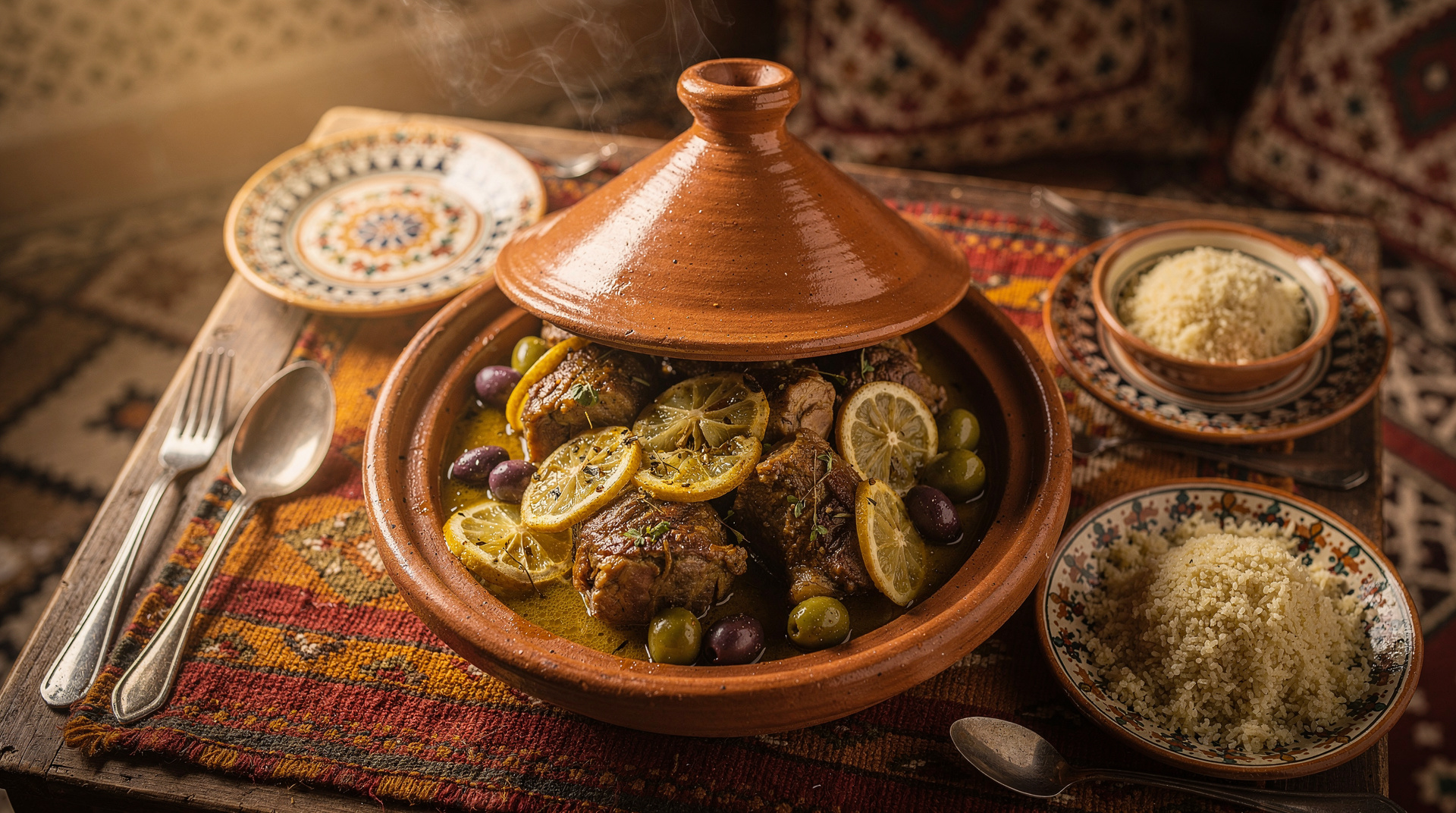
The fish market near the port is where Tangier shows what it can do. Red mullet, dorade, fresh sardines, sole — the quality is exceptional and the prices are Moroccan rather than European. Several small restaurants around the port area will cook your market purchase to order. The meal I had on my second evening — sea bass with chermoula, bread, olives, Moroccan salads — was the best fish meal of the entire Morocco trip, and the trip covered Essaouira.
The café culture in the Ville Nouvelle is also genuinely excellent. Patisseries with French-Moroccan hybrid pastries (cornets filled with almond paste, croissants with orange blossom rather than butter), strong coffee at the marble café tables — you can do worse for breakfast anywhere in the Mediterranean world.
The honest verdict after three days
Tangier is not Marrakech. It is not Fes. It is a city where Africa meets Europe in a way that feels neither dramatic nor obvious — just historically inevitable. The medina is accessible without being tame. The Ville Nouvelle is genuinely interesting rather than just a utility zone for transit tourists. The literary history is real, though Paul Bowles’s Tangier and Ibn Battuta’s Tangier are more interesting than the Burroughs mythology that tends to dominate English-language discourse.
What surprised me most: the European-ness is not a loss. Tangier’s character comes precisely from its position — a city that has always been between worlds, that has been administered by multiple foreign powers and belongs entirely to none of them. You feel the Strait in every part of the city. You feel the weight of all that transit — of the centuries of travellers who came through here heading somewhere else and left pieces of themselves in the architecture and the cooking and the language.
For northern Morocco trip planning, Tangier connects naturally with Chefchaouen (3–4h southeast) and Rabat (6h south). A circuit of Tangier, Chefchaouen, Fes, and Meknes is one of the most historically satisfying itinerary structures in Morocco — complementary to the Marrakech-Sahara-Essaouira circuit that dominates most trip planning. The 14-day Morocco itinerary shows how to combine both circuits.
The ferry connection from Tarifa in Spain takes 35 minutes. The crossing is cheap, smooth in good weather, and one of the great threshold experiences in international travel — a city of Spanish tile and Arabic calls to prayer, visible in the distance, then growing, then suddenly surrounding you. Three days in Tangier felt like a very good beginning to understanding it. I suspect a month would feel like the same.
Practical notes
- Getting there: Tanger-Ville train station is 3 km from the Ville Nouvelle; trains from Casablanca via Kenitra run in about 5h30. The high-speed Al Boraq from Casa-Voyageurs takes 2h10.
- Getting around: The medina is walkable. Petit taxis handle Ville Nouvelle distances (metered, MAD 10–15). Grand taxis for longer routes.
- Staying: Budget options concentrate around the Petit Socco. Better guesthouses and boutique riads are in the kasbah area. The El Minzah hotel (the grande dame of Tangier hotels, Churchill and various Bond-era spies, now somewhat faded but atmospheric) is on the Rue de la Liberté.
- Day trips: Chefchaouen (3–4h by CTM or shared taxi) or the Hercules Caves and Cap Spartel coastline west of the city (30 minutes). If you would rather not arrange transport yourself, a city tour taking in Cap Spartel and the Hercules Caves is an option, and for the Chefchaouen side trip a guided day trip to Chefchaouen from Tangier saves you the bus logistics.
Tangier against the rest of northern Morocco
Tangier is easy to underrate as “just the ferry city,” but it earns more time than most first-timers give it. Compared to Chefchaouen, Tangier is a real working city rather than a photogenic mountain town — better food, more layered history, less obviously beautiful. Compared to Asilah, a small whitewashed coastal town an hour south, Tangier is louder and more complex but has far more to actually do. If your northern Morocco time is limited, Tangier plus one of Chefchaouen or Asilah as a day trip covers the region’s range without overreaching.
For onward planning, our getting around Morocco guide lays out the rail and bus network that makes Tangier a genuinely convenient base rather than just an arrival point.
Frequently asked questions about Tangier first impressions
Is Tangier worth visiting or just a transit point to Chefchaouen? It is worth visiting on its own terms — the medina, the kasbah, the American Legation, and the café culture of the Ville Nouvelle are a legitimate two-to-three-day destination, not just a ferry terminal.
How does Tangier compare to Casablanca for a short stop? Tangier has far more historic and atmospheric texture for the time invested; Casablanca is a larger, more modern working city whose main draw (the Hassan II Mosque) can be seen in half a day.