Marrakech vs Casablanca: Which City Should You Base In?
Should I base in Marrakech or Casablanca?
Marrakech is the better choice for almost all tourists — it has the historic medina, the souks, the day trips, and the atmosphere that most people come to Morocco for. Casablanca is Morocco's economic capital and best experienced as a one-day stop rather than a base. The exception: if you're doing northern Morocco (Rabat, Fes, Chefchaouen) and connecting through the main international airport, Casa makes sense as an arrival/departure city.
At a glance
| Where | Marrakech (inland, south-central Morocco) vs Casablanca (Atlantic coast, main hub) |
| Cost | Marrakech riads run 50-300 EUR/night; Casablanca hotels run around 50-250 EUR/night |
| Time needed | Marrakech: 3-4 nights minimum; Casablanca: 1 day/night is usually enough |
| Getting there | Direct train Casablanca-Marrakech, around 3 hours, roughly 250 MAD first class |
| Best time | March-April and September-November for comfortable temperatures in both cities |
The choice most Morocco planners face early
If you’re flying into Morocco, Casablanca Mohammed V (CMN) is the country’s main international hub — and many travellers wonder whether to stay there rather than taking the connecting train or bus to Marrakech. Others want to include Casablanca as a destination in its own right and need to know how much time to allocate.
The honest answer: Marrakech and Casablanca are not equivalent options. They serve very different purposes in a Morocco trip.
The quick comparison table
| Factor | Marrakech | Casablanca |
|---|---|---|
| Historic medina | Yes — large, navigable | Yes — small, rarely visited |
| Main reason to visit | Culture, souks, day trips, Sahara gateway | Hassan II Mosque, art deco architecture, business |
| International airport | Yes (RAK — smaller) | Yes (CMN — main hub) |
| Tourist infrastructure | Extensive | Moderate |
| Riad accommodation | Hundreds of options | Very limited |
| Modern city appeal | Gueliz new town | Extensive — Morocco’s most modern city |
| Art deco architecture | Some | Outstanding — best in Africa |
| Day trips | Atlas, Agafay, Essaouira, Ouarzazate | Rabat, Casablanca beaches, El Jadida |
| Sahara access | Direct (7-10h south) | Not practical base for desert |
| Nightlife | Good in Gueliz | Better — Morocco’s most active scene |
| Average riad cost | 60-250 EUR/night | Not applicable (riads mostly don’t exist) |
| Average hotel cost | 50-300 EUR/night | 50-250 EUR/night |
| Food scene | Excellent traditional and modern | Excellent — strongest seafood in Morocco |
The case for Marrakech
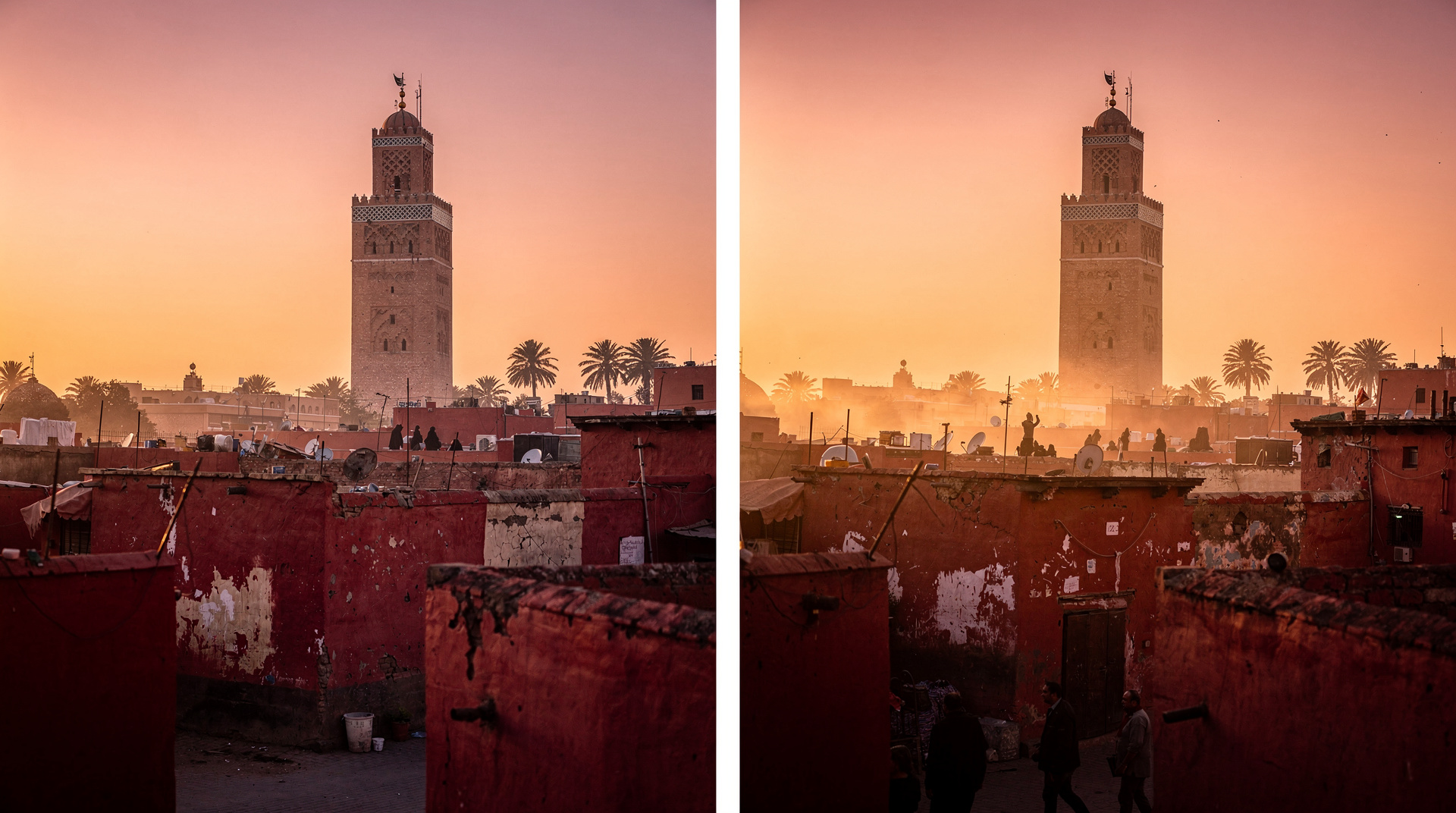
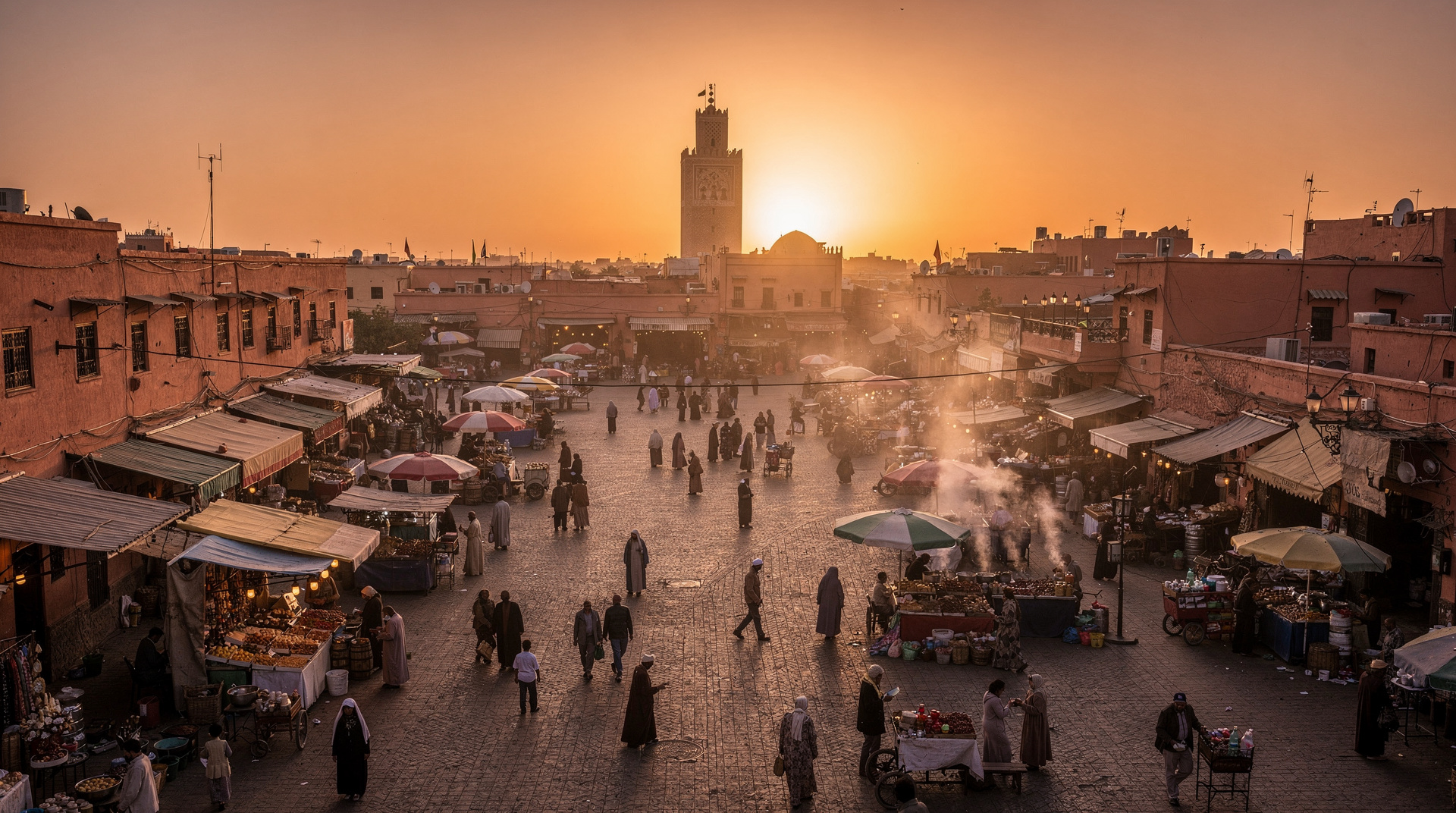
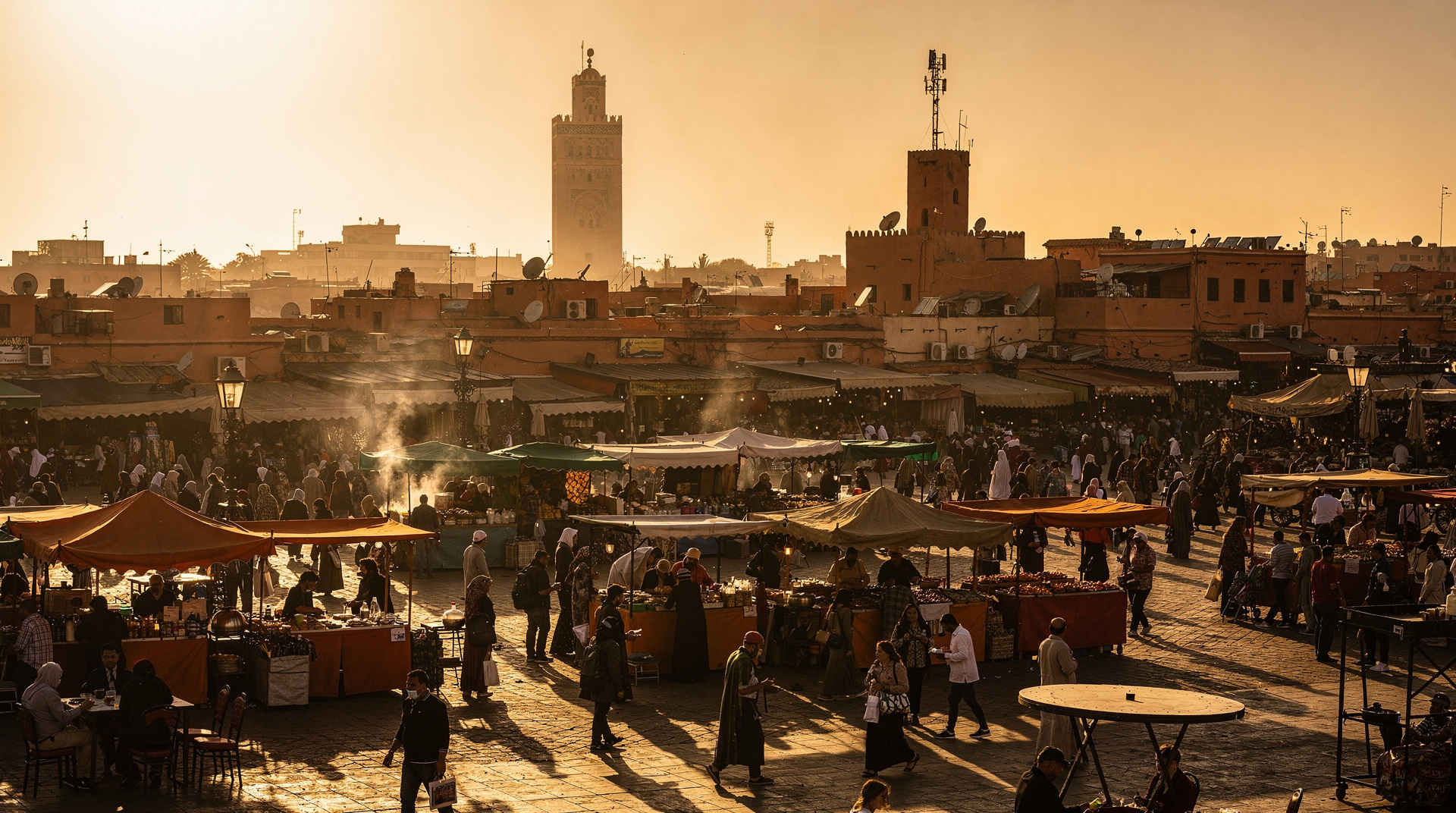
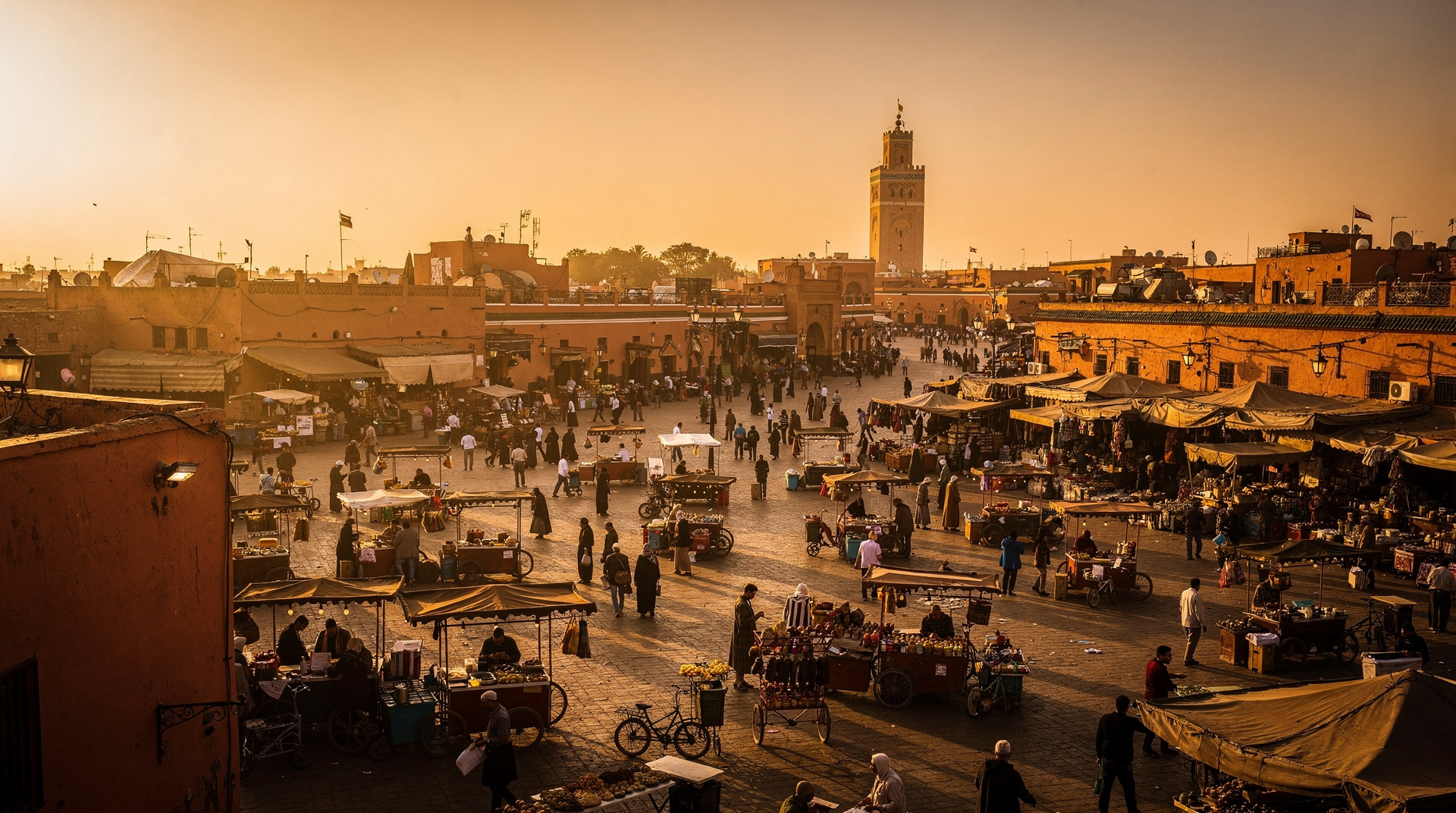
Marrakech is the reason most tourists come to Morocco. The medina — a UNESCO World Heritage Site — contains one of the world’s most intense market environments, dozens of historic monuments, an extraordinary riad scene, and the Djemaa el-Fna square, which functions as the social, cultural, and gastronomic centre of the city every evening. Beyond the medina, the Gueliz new city has a genuinely good restaurant and bar scene.
What Marrakech does exceptionally well:
- The medina experience is unmatched — souks, palaces, shrines, and riads all within walking distance
- Riad accommodation is a unique product that doesn’t meaningfully exist elsewhere in Morocco
- Day trip network is the best of any Moroccan city: Atlas foothills (2h), Essaouira (3h), Agafay desert (45min), Ouarzazate and Aït Benhaddou (2.5h)
- Sahara tours depart from Marrakech on the most scenic route through the south
- The food scene spans from cheap medina hole-in-the-wall to ambitious Moroccan-French restaurants
- Menara airport (RAK) handles flights direct from major European cities — you don’t need to transit CMN
The honest friction points:
- Tourist pressure in the medina core is real and constant. The Djemaa el-Fna has dozens of scams directed at visitors. It’s manageable but tiring
- Marrakech is expensive relative to other Moroccan cities — good riads start at 80-100 EUR/night
- The city is not representative of Morocco as a whole — it’s heavily oriented toward the tourist economy
For a first-time visitor, a private Marrakech medina tour covering the palaces and tombs provides context that transforms the monuments from beautiful ruins into comprehensible history.
The case for Casablanca
Casablanca is a working city of 4 million people that functions as the economic engine of Morocco. It is not primarily a tourist destination, and that’s part of its appeal — you’ll find genuine Moroccan urban life here in a way that the heavily tourism-oriented cities don’t offer.
What Casablanca does well:
- The Hassan II Mosque is one of the world’s great religious buildings. Built partly over the Atlantic Ocean, it holds 105,000 people and its minaret (210m) is the tallest in the world. It’s genuinely worth visiting even if you’re not religious
- Art deco architecture from the French Protectorate period (1912-1956) is concentrated in the Quartier des Habous and the Maarif/Anfa neighbourhoods — the most impressive surviving colonial-era architecture in North Africa
- Morocco’s best seafood restaurants are in Casablanca, particularly around the corniche
- The nightlife is genuinely active — bars, clubs, and live music venues operate at a level not found elsewhere in Morocco
- Morocco’s best train connections run through Casa — to Rabat (45min), Fes (3h30), Tangier (4h45), Marrakech (3h)
- The city feels authentically Moroccan rather than tourist-facing
The honest limitations:
- The old medina is small, somewhat rough, and not on the same level as Fes, Marrakech, or Meknes
- There’s a limited range of characterful accommodation — mostly international business hotels
- The city doesn’t function well as a day-trip base for most of Morocco’s highlights
- The corniche beach area is popular with locals but not particularly impressive as a beach destination
A guided Casablanca city tour with Hassan II Mosque entry covers the main sights efficiently in half a day — the right format for most visitors, who will then move on.
By traveller type
First-time Morocco visitors: Marrakech. No contest — the medina, the souks, the Sahara gateway, and the riad experience are what Morocco’s tourist appeal is built on.
Business travellers: Casablanca. The major companies and government ministries are here, along with Morocco’s best business hotel infrastructure.
Architecture enthusiasts: Casablanca deserves a full day for the art deco quarter, then Marrakech for the medina. Allocate time to both.
Families: Marrakech, with caveats. The medina can be overwhelming with small children, but the day trip options (Agafay desert, Atlas, Ourika Valley) are excellent family experiences.
Nightlife seekers: Casablanca wins on volume of options. Marrakech has a good scene in Gueliz but doesn’t match Casa’s scale.
Food-focused travellers: Casablanca for seafood and contemporary Moroccan cooking. Marrakech for traditional Moroccan and the widest range of cuisines.
Verdict by scenario
Arriving at CMN, short trip (5-7 days): Take the train to Marrakech (3h, about 250 MAD / 25 EUR first class). Don’t spend a night in Casa unless you specifically want to see the Hassan II Mosque.
Arriving at CMN, longer trip (10+ days): Consider stopping one night in Casa for the mosque and food scene, then moving on.
Doing northern Morocco: Casablanca makes sense as an arrival point with a half-day in the city before taking the train to Rabat (45min) or Fes (3h30).
Flying out of CMN after Marrakech: Take the night train from Marrakech (8h, arrives early morning) if your flight is morning. Or take the day train and spend your final night in Casa.
The Hassan II Mosque question
This comes up in every Marrakech-vs-Casablanca debate. The Hassan II Mosque is genuinely one of the world’s architectural wonders and visiting it — including an interior tour when access is available — is worth the detour. But it doesn’t anchor a multi-night stay on its own.
The efficient approach for a Marrakech-based itinerary: take the train from Marrakech to Casablanca (3h), do the mosque tour and lunch at a seafood restaurant on the corniche, and take the train back. Day trip done. See the day trips from Marrakech guide for how to structure this.
Skip-the-line Hassan II Mosque tour with hotel pickup handles the logistics without queueing — worth it in peak season.
Can you combine both?
Yes, and easily. Casablanca and Marrakech are connected by direct train (3h, roughly 250 MAD first class, departures throughout the day). The typical approach:
- Arrive CMN, one night in Casablanca for the mosque and seafood dinner
- Train to Marrakech next morning — 3-4 nights exploring medina and day trips
- Continue south or east for the rest of your Morocco circuit
Or reverse: Marrakech as base, Casablanca as a single-day excursion. Both approaches are common and both work well.
For a full itinerary structure, the Morocco 7-day itinerary shows how to sequence the two cities within a standard trip length. The Morocco 10-day itinerary adds room for Casablanca as a proper overnight stop.
Frequently asked questions about Marrakech vs Casablanca
Is Casablanca worth visiting as a tourist?
Yes, for one day. The Hassan II Mosque alone justifies a detour, and the art deco quarter, the corniche, and the food scene add enough for a full day. Spending multiple nights in Casablanca as a tourist base is hard to justify unless you have specific reasons.
Which city is safer?
Both are generally safe by North African standards. Casablanca’s size means petty crime rates are proportionally higher, but tourist areas are generally fine with normal urban precautions. Marrakech has more concentrated tourist scam activity (particularly around the Djemaa el-Fna) but is safe for walking.
Is the train between Marrakech and Casablanca comfortable?
Yes. ONCF first-class seats are comfortable, air-conditioned, and reasonably priced at around 250 MAD (25 EUR) one-way. The journey is 3 hours with multiple daily departures. Book at the station or via the ONCF app.
What neighbourhood should I stay in for Casablanca?
For tourists: Quartier des Habous for the art deco and medina area, or the corniche for seafood and beach access. Avoid staying near Casa Port station, which is a busy commercial area without much tourist appeal.
Does Casablanca have a medina worth visiting?
The old medina exists but is small and not maintained for tourism the way Marrakech or Fes medinas are. It’s worth a 2-hour wander for the authentic street-level feel, but don’t come expecting souk magic on the scale of the imperial cities.
How much does a taxi cost between Casablanca airport and the city?
A petit taxi or Careem/inDrive ride from Mohammed V Airport (CMN) into central Casablanca costs roughly 150-250 MAD, taking 30-45 minutes depending on traffic. The airport also has an ONCF train connection direct to Casa Voyageurs station, which is often faster and cheaper than a taxi if you’re travelling light.
Is it worth stopping in Rabat between Casablanca and Marrakech?
Not on the direct route — Rabat is north of Casablanca, so it’s a detour rather than a stop on the way to Marrakech, which sits south. If northern Morocco (Rabat, Fes, Chefchaouen) is part of your trip, Rabat makes sense as a separate leg from Casablanca; keep the Casa-Marrakech train for a direct southbound journey.
Which base saves you more time overall
Time is often the deciding factor once budget and interest are similar. Marrakech wins decisively here: its day trip network (Atlas, Agafay, Essaouira, Ouarzazate) means every extra night produces a genuinely different experience, while Casablanca’s practical sightseeing — the mosque, the art deco quarter, the corniche — is realistically exhausted in a single day. Travellers who add a second or third night in Casablanca hoping for more to do are usually disappointed; that time is better spent in Marrakech itself or on a day trip such as those covered in the day trips from Marrakech guide.