10 Days in Morocco
Overview of this 10-day Morocco itinerary
Ten days is the threshold where Morocco stops feeling rushed. You can do the Sahara, do Fes, see the imperial cities, and still have a recovery morning where you sit on a riad rooftop and do nothing. This is the itinerary that covers the country’s iconic highlights without the punishing pace of a 7-day trip.
The logic of this loop: start in Marrakech, push south to the Sahara via the classic mountain and valley route, then drive north through the Ziz Valley to Fes, spend two nights in the medieval medina, detour to Meknes and Volubilis, and return south to Marrakech via Rabat or directly by bus. This is essentially a one-way loop rather than a back-and-forth, which is far more satisfying.
The routing works because there is a 3-day guided tour from Marrakech to Fes via the Merzouga desert that handles Days 3–5, covering transport, accommodation, Aït Benhaddou, the desert, Todra Gorge, and the Ziz Valley. This is the backbone of the trip.
Route at a glance: Marrakech (2 nights) → Aït Benhaddou → Todra Gorge → Merzouga dunes (1 night) → Fes (2 nights) → Meknes + Volubilis (day trip) → Rabat (1 night) → Marrakech
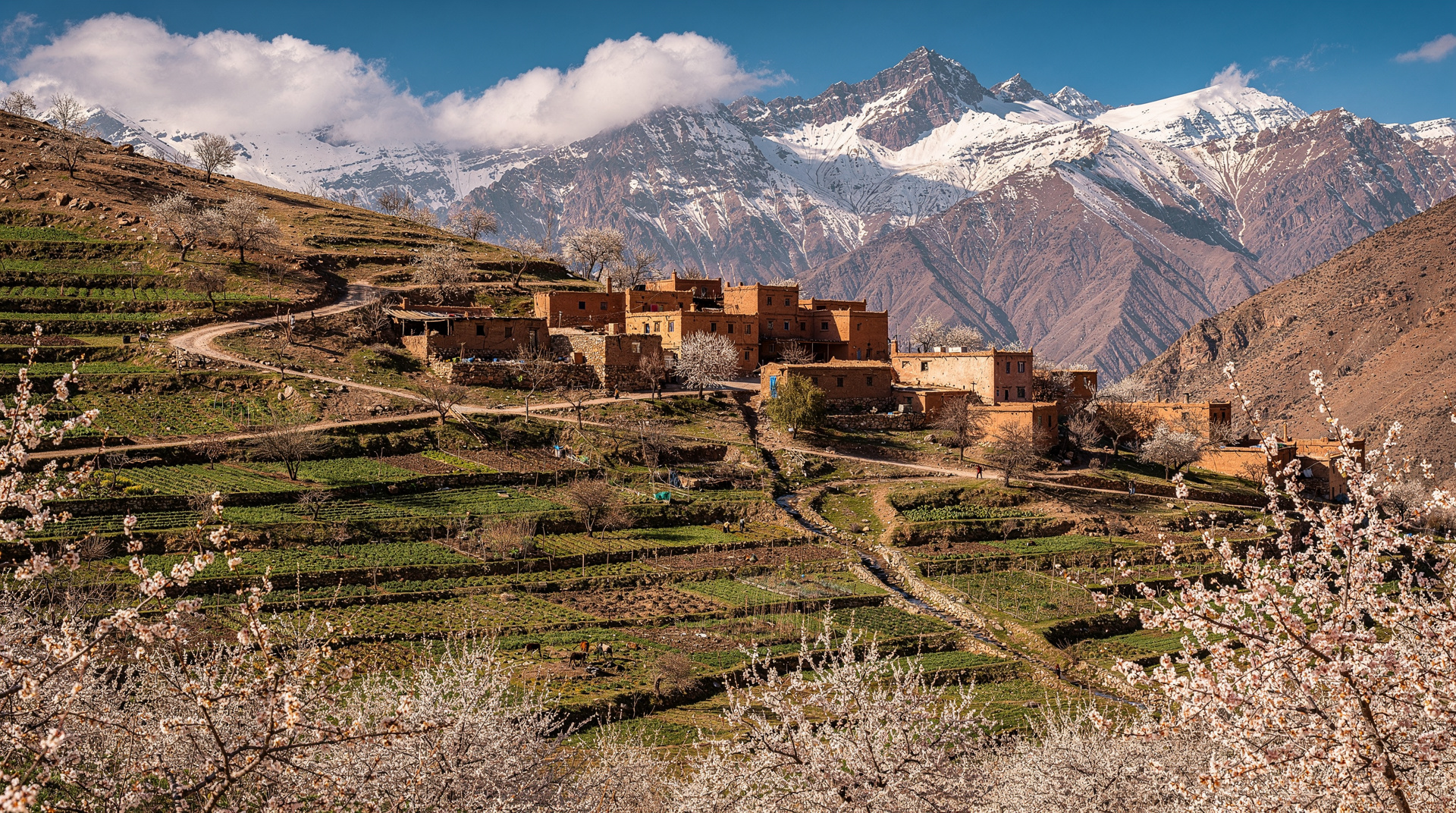
Best season: October–April. Fes in summer (July–August) is as hot as Marrakech — 38°C in the medina — and the tanneries in heat are an acquired experience. Spring is exceptional: the Ziz Valley palms are green and the Atlas still has snow.
Total estimated cost (per person, mid-range, flights excluded): €1100–1600
Trip snapshot
| Route | Marrakech → Aït Benhaddou → Todra Gorge → Merzouga → Fes → Meknes/Volubilis → Rabat → Marrakech |
| Cost (pp, flights excluded) | around €770–1610 for 10 days |
| Getting there | fly into Marrakech Menara; the loop returns you there for departure |
| Transport style | guided 3-day desert tour + ONCF trains + CTM/Supratours buses — no car needed |
| Best time | October–April; Fes and Marrakech get very hot June–August |
| Book well ahead | the 3-day Marrakech-to-Fes desert tour, especially October–November |
Day 1: Marrakech — arrival and medina
Morning: arrival
Petit taxi from Menara Airport to the medina: €4–6. Your riad will send GPS coordinates. The northern medina riads near Djemaa el-Fna (Riad Yasmine, Riad BE Marrakech) are the most convenient base for the square and souks.
Afternoon: Djemaa el-Fna + souks
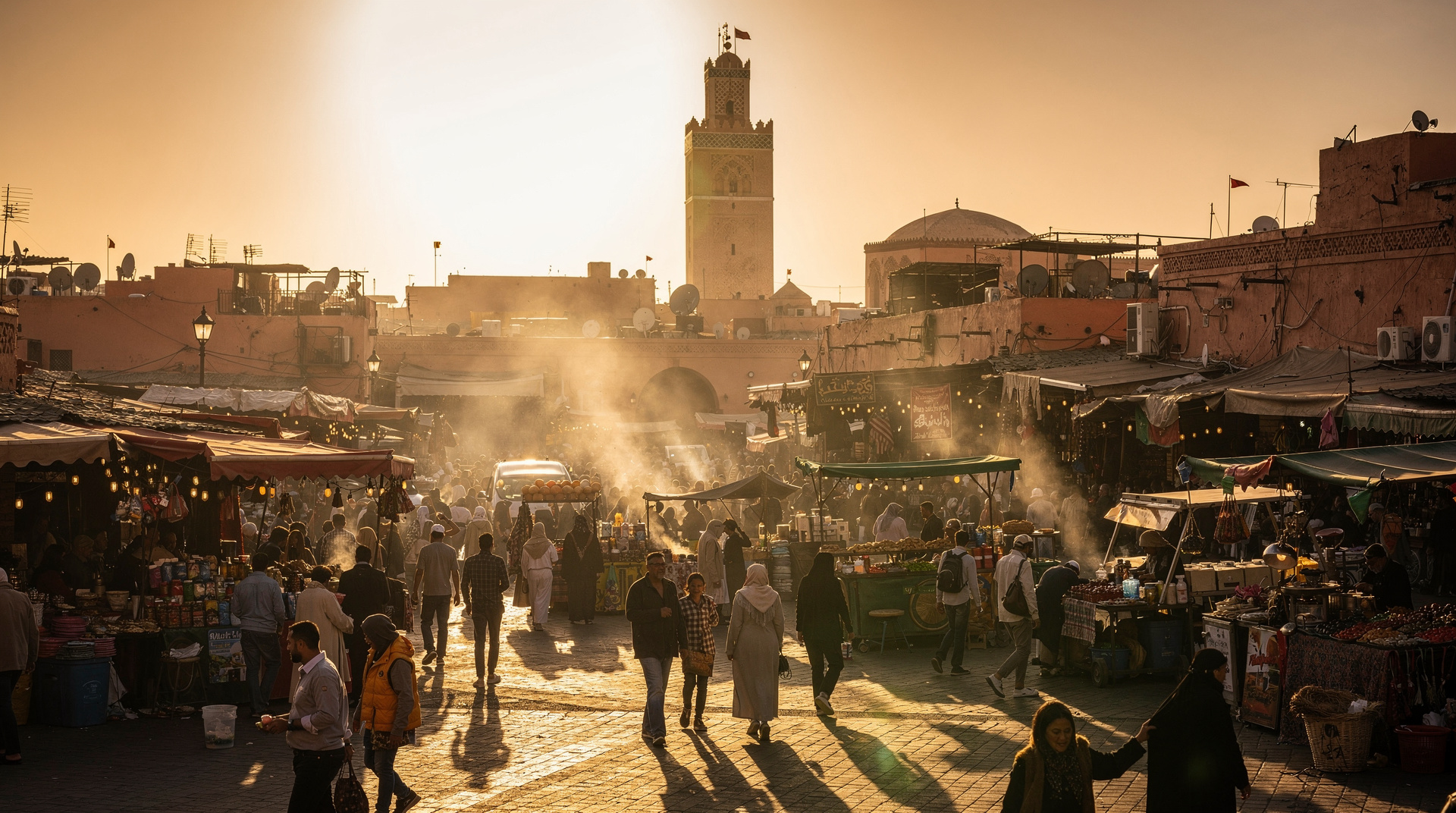
The Djemaa el-Fna square in the afternoon: orange juice (€0.50), henna artists (be gentle in your refusals), the low percussion of Gnawa musicians, and the first smell of cumin and charred lamb that you will associate with Morocco forever. Walk north into the souks. The deeper you go, the more local the goods and the lower the prices.
Evening
Return to the square after dark. Eat at the grill stalls — merguez sausage, brochettes, calamari, harira soup. Alternatively, ask your riad host to recommend a neighbourhood restaurant without tourist prices.
Where to stay: Riad Yasmine or Riad Jardin Secret (mid: €80–130); La Sultana Marrakech (boutique luxury: €300+)
Budget estimate today: €70–140
Book in advance: Riad; Marrakech-to-Fes desert tour (critical — book weeks in advance)
Day 2: Marrakech — palaces, gardens, hammam
Morning: Bahia Palace + Saadian Tombs
Open at 09:00. Bahia Palace is the most photogenic interior in Marrakech: painted cedar ceilings, vast reception rooms, and intimate courtyard gardens all built for a man with 4 wives and 24 concubines in the 1890s. Entry: €2. The Saadian Tombs (5-minute walk) are a bricked-up necropolis from the 16th century, only rediscovered from aerial photography in 1917.
For context that transforms these sites from pretty rooms to meaningful history, book the private Marrakech medina and palaces tour.
Afternoon: Majorelle Garden
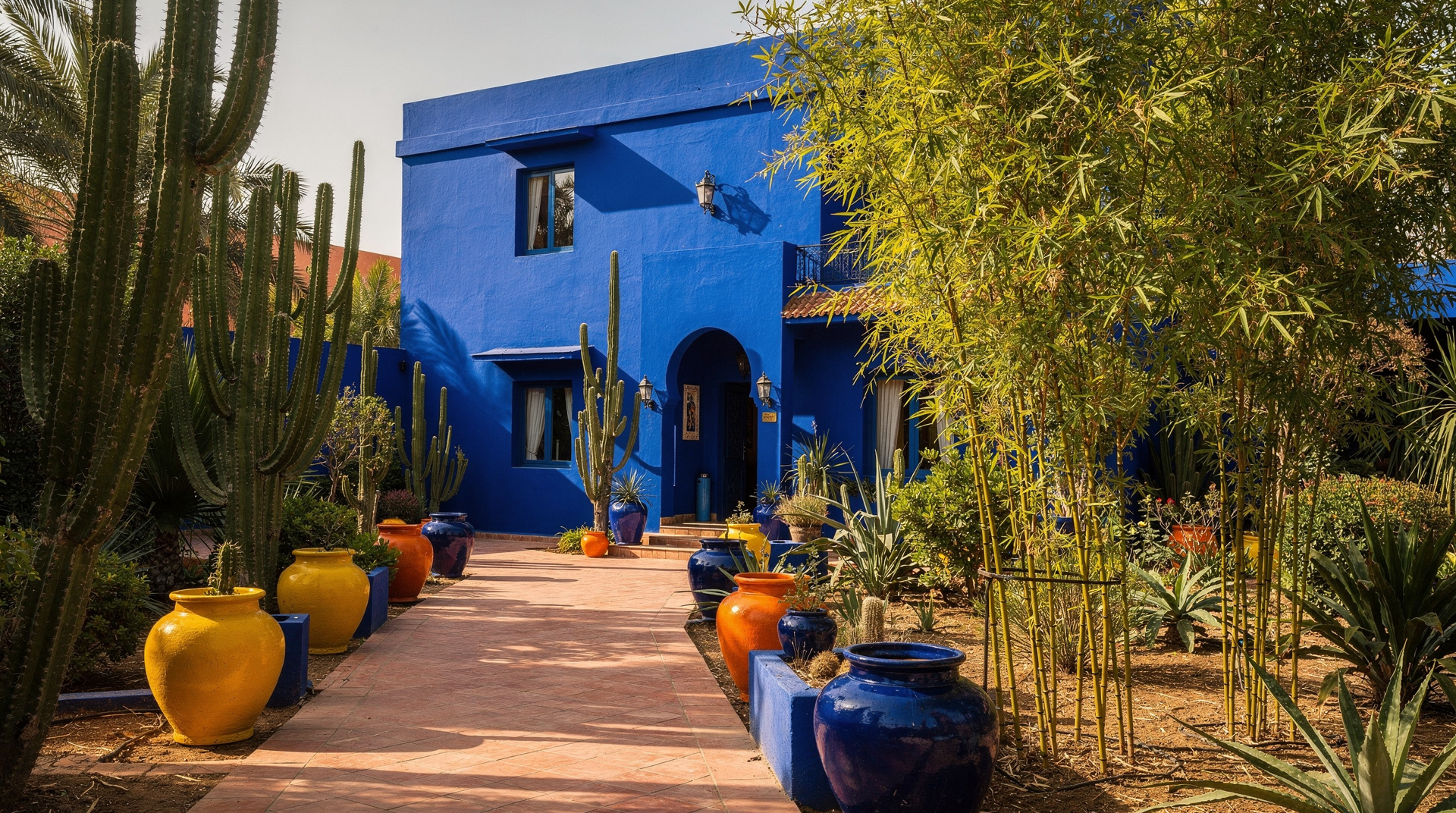
A €3 petit taxi to the Ville Nouvelle for the Majorelle Garden and Berber Museum — book ahead to skip the walk-in queue. After the garden, the Gueliz neighbourhood has proper coffee shops and a good supermarket if you need snacks for the desert drive tomorrow.
Evening: hammam
Les Bains de Marrakech does a 90-minute package for €45–55. Non-negotiable before 3 days in a tour vehicle.
Where to stay: Same riad
Budget estimate today: €100–180
Day 3: South — Tizi n’Tichka, Aït Benhaddou, Dades Valley
07:00 pickup
Your Marrakech-to-Fes desert tour vehicle collects you at the riad door. The first and longest day of the trip: 12–13 hours of driving and stops. South through the Atlas mountains over the Tizi n’Tichka pass (2260m), then the descent to the pre-Saharan plateau.
Tizi n’Tichka pass
At 2260 metres this is the highest paved road pass in North Africa. Snow closes it occasionally in January and February. In spring and autumn: clear road, extraordinary views. Stop at the summit, take in the scale of the Atlas from above, buy a trilobite fossil if the mood strikes.
Midday: Aït Benhaddou
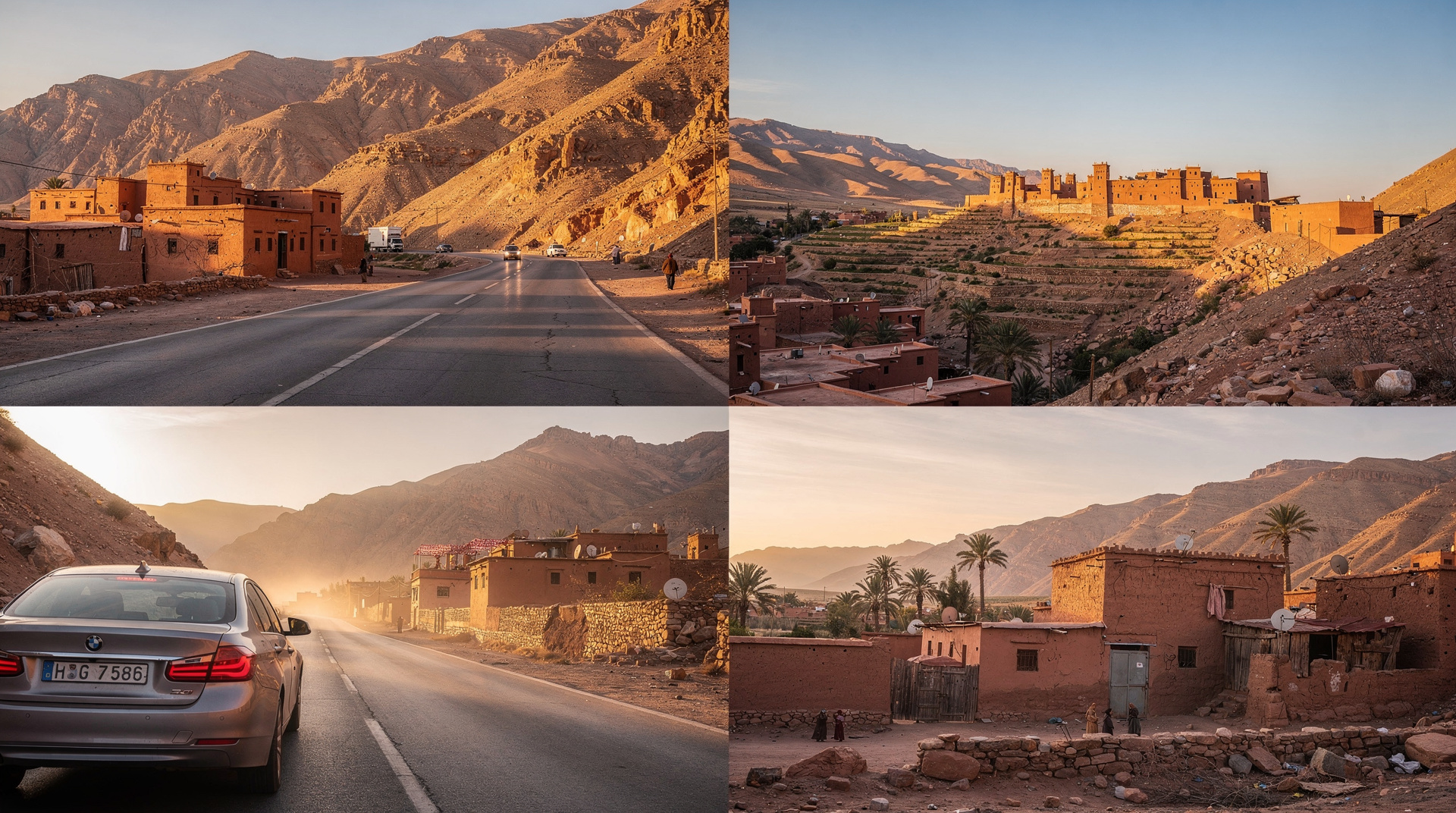
The UNESCO ksar is 30 km north of Ouarzazate on a red dirt road. Cross the river on foot or by small wooden boat. Walk through the towers — this fortified village of earthen construction has been a film set for 50 years (Gladiator’s slave market was filmed here). The kasbahs are inhabited at their base and increasingly empty as you climb. The view from the highest tower looks across the Draa River to the Anti-Atlas beyond.
Afternoon: east through the Dades Valley
Ouarzazate, then east. The Dades Valley is one of Morocco’s most beautiful drives: 100 km of palm oases, earthen villages, and kasbah ruins against a backdrop of increasingly dramatic rock formations. The Roses Valley around Kelaa M’Gouna produces the rose water and rose jam that appears in every tourist shop in the country. Stop and buy some from a roadside farm — the quality is genuine.
The Dades Gorge (a side canyon north of the main valley) is spectacular if your tour includes it. Arrive in the Tinghir/Todra area for the night.
Where to stay: Guesthouse at the Todra Gorge (included in tour package)
Budget estimate today: Included in tour
Day 4: Todra Gorge + drive to Merzouga dunes
Dawn in the gorge
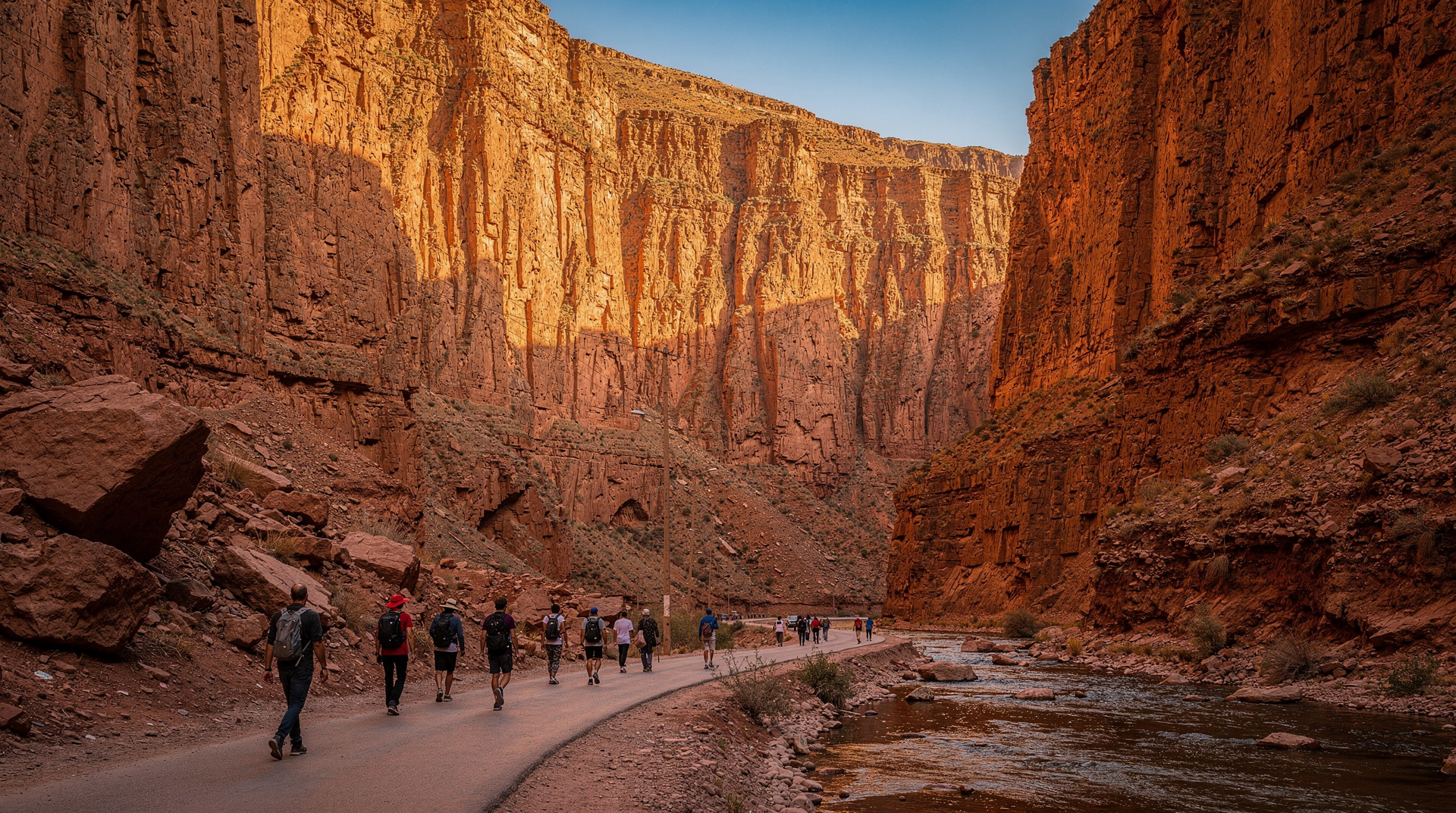
Be in the gorge before 08:00. The canyon walls rise 300 metres on both sides with a gap of 10 metres at the narrowest point. The light enters differently depending on season. Walk the 600-metre dramatic section early, before tour groups arrive from further afield. The cold river water is startling in the morning — splash your face.
Drive to Merzouga (4 hours through the Ziz Valley)
East through Erfoud (known for its fossil marble — the hotel lobbies here have entire fossils embedded in the floor slabs) and Rissani. Then the dunes appear without warning: the Erg Chebbi sand sea at 150 metres is Morocco’s largest dune field, and the first sighting from the road is viscerally disorienting.
Late afternoon: camel ride and camp
The camel ride into the dunes leaves at 17:00. The camp inside the dunes serves dinner in a main Berber tent — tagine, flatbread, mint tea, a musician with a guembri. After dinner: stars. The Milky Way is visible with the naked eye on moonless nights from October to April.
Where to stay: Sahara Luxury Camp (premium, included in high-end tours); Chez Julia or Hotel Kasbah Mohayut (budget alternative near dune edge)
Budget estimate today: Included in tour
Day 5: Desert sunrise + drive north to Fes
05:30: sunrise on the dunes
Climb the main dune before dawn. The walk up takes 25 minutes through soft sand. At the summit: the sun rises in the east over the Algeria border, the shadow of the dune sweeps across the plain below. Wind. Silence. Worth every ounce of effort.
The long drive north (9–10 hours)
From Merzouga to Fes is roughly 500 km via the Ziz Valley and the Middle Atlas. This is a full day’s driving. The Ziz Valley gorges and its date-palm oases are beautiful early in the journey. The Middle Atlas plateau is cooler — sometimes dramatically cooler — with cedar forests and the occasional Barbary macaque roadside sighting. Ifrane, a colonial-era ski resort town that looks genuinely Swiss, appears incongruously around hour 7.
Arrive in Fes in the evening. Your tour will drop you at your riad or a specified meeting point.
Where to stay: Riad Fes (upscale: €150–250); Dar Bensouda (mid: €80–130); Palais Amani (boutique luxury: €200–400)
Budget estimate today: Included in tour
Day 6: Fes el-Bali — the medieval medina
Fes is not like Marrakech
The Fes medina (Fes el-Bali) is larger, older, more complex, and — initially — more disorienting. Over 9000 streets and lanes in a city of 150,000 medina residents. It is a working medieval city, not a tourist stage. This is a genuine difference: the butcher is selling meat for local families, the water carrier is delivering water to hammams, the leather tanneries are producing leather for the global market.
Morning: Chouara Tanneries
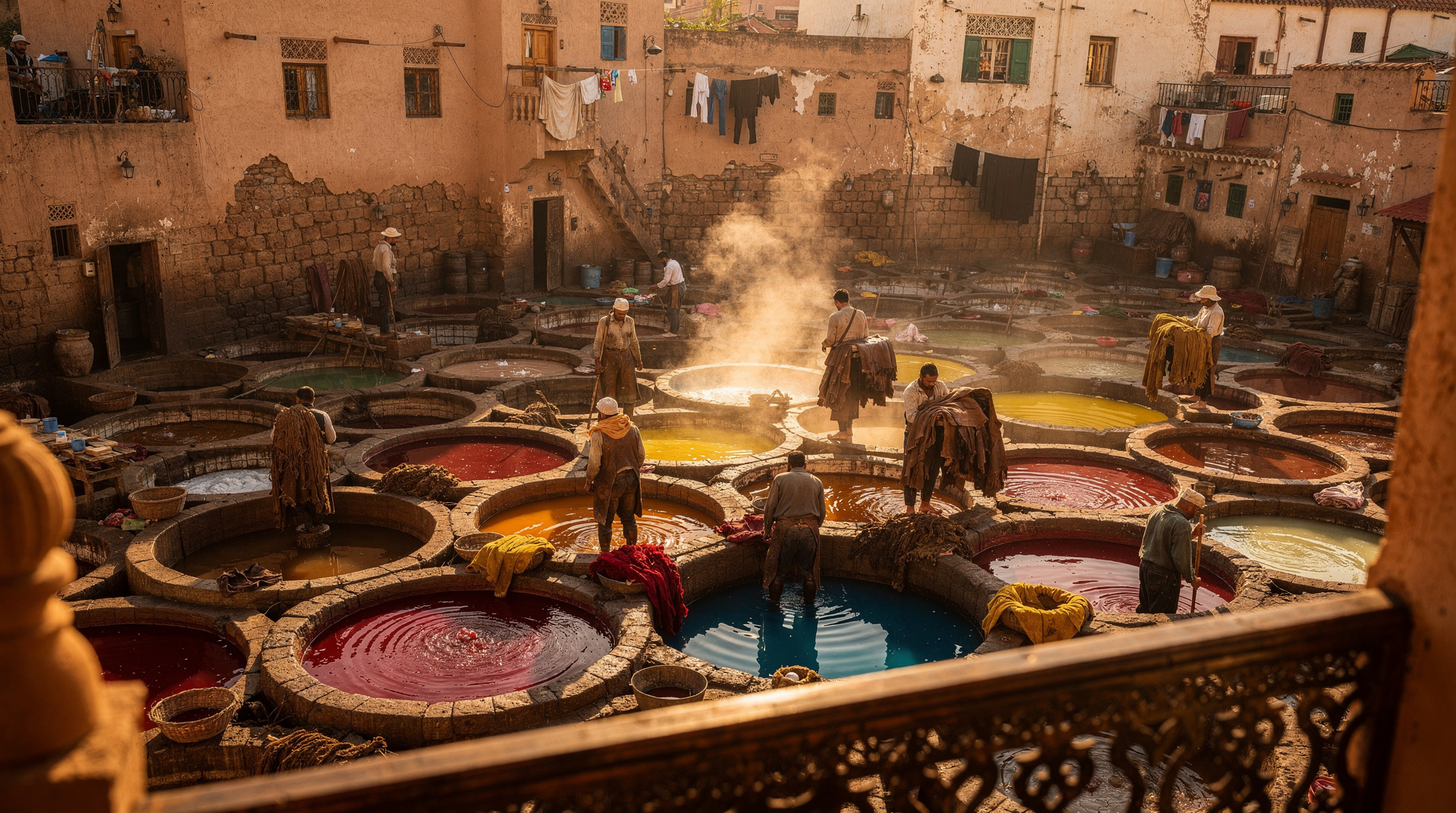
The Chouara Tanneries are Fes’s most iconic sight — stone vats of coloured dye (saffron yellow, kermit green, poppy red) where workers tan hides using methods unchanged since the 10th century. View from the terraces of surrounding leather shops (they will let you up if you agree to browse; you are not obligated to buy). The smell is intense; merchants hand you mint to hold under your nose.
Afternoon: Bou Inania Medersa + Attarine Medersa + Funduq
The Bou Inania Medersa is a 14th-century Islamic theological college open to non-Muslims — the most ornate building in Fes with layered carved stucco, cedar wood screens, and a minaret that still calls to prayer. Entry: €3. The Al Attarine Medersa nearby is smaller and quieter.
Walk the main artery, Talaa Kebira, from the Bab Bou Jeloud gate south through the medina. Follow it without turning and you will see the full cross-section of medina life. The carpenter’s souk (Ain Azliten area) and the copper hammering souk (near the Nejjarine fountain) are among the most atmospheric.
Book the Fes full-day cultural tour — Fes rewards having a guide who knows it. The medina is genuinely disorientating and a local guide adds significant depth.
Evening: dinner in the medina
Riad restaurants in Fes are generally excellent. La Maison Bleue (high-end, €60pp) does a full Fassi feast. Neighbourhood restaurants near Bab R’cif serve full tagine meals for €6–8.
Where to stay: Riad Fes or Dar Bensouda (as above)
Budget estimate today: €80–160 including meals, entry fees, tour
Day 7: Meknes + Volubilis — Roman Morocco
Day trip from Fes (45-minute drive each way)
Meknes is an imperial city that gets overlooked because it sits between Fes and Rabat. It should not be overlooked. The Bab Mansour gate is arguably the finest ornamental gateway in the Maghreb — 20 metres of carved marble and mosaic framing an entrance to the royal city built by Sultan Moulay Ismail in the late 17th century. The Heri es-Souani granaries (vast underground storage chambers for the sultan’s horses and armies) give a sense of the imperial scale that Meknes once had.
Volubilis is 33 km further north: a remarkably well-preserved Roman city occupied from the 1st century AD to the 11th century. The mosaic floors are still in situ — Bacchus, Diana, Hercules — and the triumphal arch of Caracalla still stands. Entry: €7.
Book the Meknes and Volubilis day trip from Fes — the guide context is especially valuable at Volubilis where interpreting the mosaics without explanation is difficult.
Evening: back in Fes
Optional: if you want to add the blue city of Chefchaouen, you could swap Day 7 for a Chefchaouen day trip (4-hour drive from Fes each way — very long for a day trip, but popular). The Chefchaouen day trip from Fes is doable but genuinely exhausting — consider it only if the blue city is specifically on your list.
Budget estimate today: €60–120 including day trip, meals
Day 8: Fes to Rabat — the Atlantic capital
Morning: final Fes wander
One last early morning walk in the medina before the crowds arrive. The Zouiat Moulay Idriss II mausoleum complex (can be viewed from outside, non-Muslims cannot enter) is Morocco’s most important pilgrimage site — the architecture of the surrounding lanes is exceptional.
Midday: train to Rabat (2h30)
ONCF trains run Fes to Rabat directly. Journey: 2 hours 30 minutes. First class is comfortable and affordable at €8. The train station in Rabat is Rabat Agdal or Rabat Ville — both are central.
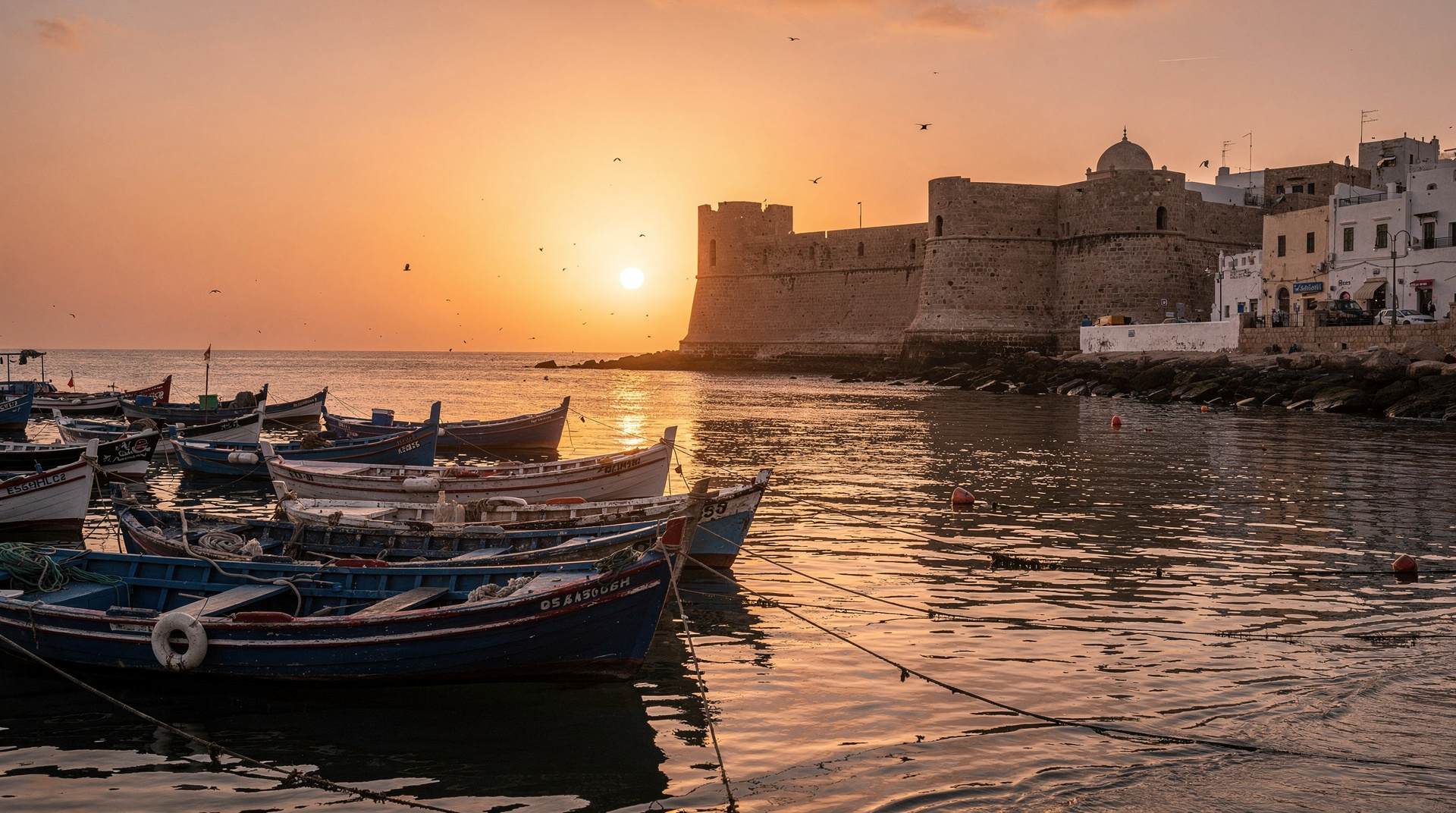
Rabat is Morocco’s administrative capital and one of its most liveable cities. The medina is compact, the traffic manageable, and the pace noticeably calmer than Fes or Marrakech. The Kasbah of the Udayas above the Bou Regreg river is one of the most beautiful fortified quarters in Morocco.
Afternoon: Kasbah of the Udayas + Hassan Tower
The Kasbah’s interior is a whitewashed Andalusian garden — brought by Moorish exiles from Spain in the 17th century. It overlooks the Atlantic ocean and the river simultaneously. Five minutes away: the Hassan Tower, an incomplete 12th-century minaret intended to be the largest mosque in the world. The Mausoleum of Mohammed V next to it is a masterwork of modern Moroccan craftsmanship.
Evening: dinner in Rabat
Rabat has a better restaurant scene than its reputation suggests. The Agdal and Océan neighbourhoods have modern Moroccan and Mediterranean restaurants. Budget €20–40 per person for dinner.
Where to stay: Hotel Terminus Rabat (mid: €70–100); Dar El Batoul (boutique riad: €100–160)
Budget estimate today: €80–140 including train, meals, accommodation
Day 9: Rabat + return to Marrakech
Morning: Chellah
The Chellah is the ancient necropolis at the edge of Rabat — a walled Roman and medieval city now inhabited by storks. Entry: €3. The ruins are atmospheric and seldom crowded. White storks nest on every available turret from January to July.
Midday: Casablanca option
Rabat to Casablanca by Al Boraq high-speed train takes 45 minutes (€8). Casablanca is not a tourist city in any conventional sense — it is a financial and commercial hub — but the Hassan II Mosque is one of the most extraordinary pieces of religious architecture built in the 20th century. It sits directly over the Atlantic ocean on a promontory, and the interior (open for non-Muslims on guided tours) seats 25,000 people. The minaret at 210 metres is the tallest in the world.
Return to Marrakech
Train from Casablanca Voyageurs to Marrakech: 2h30 by Al Boraq high-speed train (€18–25 first class; book in advance — this sells out on weekends). Or take a CTM bus from Rabat directly (5h, €12). Arrive Marrakech in the evening.
Where to stay: Marrakech riad for the final night
Budget estimate today: €60–120
Day 10: Final Marrakech morning + departure
Morning: whatever you missed
The Mellah (Jewish quarter), Rahba Kedima spice square, or a morning hammam. The Marrakech medina in the morning light of your last day is a different city from Day 1. You know now which lanes go where. The shopkeepers have seen your face. The square makes sense.
Pick up last-minute gifts from the spice souk (argan oil, saffron, ras el hanout spice mix). All are genuine from named shops; agree prices in advance.
Airport (Menara)
Allow 2 hours from medina to airport including the taxi and check-in. Petit taxi: €4–6.
Total trip cost estimate
| Item | Budget (pp) | Mid-range (pp) |
|---|---|---|
| Accommodation (10 nights) | €280 | €700 |
| Marrakech-Fes desert tour (3 days) | €180 | €320 |
| Train fares (Fes–Rabat, Casa–Marrakech) | €30 | €50 |
| Food and drink (10 days) | €160 | €320 |
| Entry fees, day trips, activities | €80 | €160 |
| Local transport | €40 | €60 |
| Total (flights excluded) | €770 | €1610 |
What to skip if you only have 8 days
Remove the Rabat overnight and do Meknes and Volubilis as a day trip from Fes, then take the direct train to Marrakech from Fes (6 hours, €12). You lose the Atlantic capital experience but save a night’s accommodation and a lot of transit time. Alternatively, skip Chefchaouen — it requires a full day commitment from Fes and compresses everything else.
Route map description
Starting at Marrakech airport, the route goes south over the Atlas mountains via Tizi n’Tichka (2260m) and Ouarzazate, east through the Draa and Dades valleys to the Todra Gorge, then southeast to Merzouga. From the Sahara the route heads north through the Ziz Valley and the Middle Atlas cedar forests to Fes. Day trips from Fes cover Meknes and Volubilis (northwest). The final leg goes west by train: Fes to Rabat (2h30), optional stop in Casablanca, then south to Marrakech (2h30).
Key logistics
The Marrakech-Fes desert loop: This is the backbone of the trip. Book a 3-day private or shared tour well in advance. Shared tours cost €150–200 per person; fully private tours with your own guide and vehicle run €350–500 per person.
Trains: Morocco’s ONCF rail network is reliable and comfortable. Book online at ONCF.ma at least 48 hours ahead for the Al Boraq high-speed services (Casablanca–Marrakech, Casablanca–Tangier). Standard trains (Fes–Rabat, Rabat–Casablanca) rarely sell out.
Fes vs. Marrakech: Both cities deserve time, but they are very different. Marrakech is more accessible for first visits; Fes is more demanding and more rewarding. Do not try to understand Fes in one day.
Explore our destination guides for Marrakech, Fes, Merzouga, and Rabat for deeper planning on each stop. For a longer trip with proper breathing room, see our 14-day Morocco itinerary.
Choosing between the guided desert tour and self-driving
This itinerary is built around a shared 3-day guided tour for the Marrakech-to-Fes desert crossing (Days 3–5), and that is deliberate at 10 days: driving the Tizi n’Tichka pass, the Dades Valley, and the long Merzouga–Fes leg yourself eats into the time you have for Fes and Rabat. Our private tour vs. self-drive guide walks through the trade-offs in more depth, and if you do want to compare, the self-drive Morocco itinerary shows how the same regions look with your own car.
If you would rather have a private driver and vehicle for the whole loop instead of a shared tour, see our with driver Morocco itinerary — it costs more per person but removes the fixed schedule of a shared group tour.
Solo travellers: joining the shared 3-day desert tour is one of the easiest ways to meet other travellers on a short Morocco trip, and it is genuinely more sociable than a private car. Our solo female Morocco itinerary has route-specific safety notes if that is your situation.
Frequently asked questions about 10 Days in Morocco
Is 10 days enough time to see Morocco properly? Enough to see its essentials well — Marrakech, the Sahara, and Fes — but not the whole country. It is the sweet spot between a rushed 7-day trip and a slower 14-day itinerary that adds the Atlantic coast.
Do I need a 4x4 for the desert section of this itinerary? No — the shared tour vehicles are standard minivans or SUVs and the roads to Aït Benhaddou, the Dades Valley, and Merzouga are paved. A 4x4 only matters if you want to go further off-road once at the dunes (dune-bashing excursions), which are booked locally and separately.