Best riads in Essaouira: medina stays and Atlantic character
Which riads in Essaouira are worth booking?
Riad Mimouna and Villa Maroc lead on design and Atlantic character. For mid-range, Riad Chbanate and Dar Loulema are solid picks in the €80-150/night range. Essaouira riads have a specific aesthetic — more coastal, more wind-exposed, and more design-forward than Marrakech equivalents.
What makes Essaouira riads different
Essaouira’s medina was built by French architect Théodore Cornut in the 18th century under Sultan Mohammed III — which gives it a more planned, grid-like character than the organic medina of Fes or the layered complexity of Marrakech. The streets are wider, the ramparts are proper fortifications (now a UNESCO World Heritage site), and the whole city sits directly on the Atlantic coast.
This context shapes the riad scene. Essaouira properties tend to be:
- More design-forward than Marrakech riads — the city attracted artists, bohemian travellers, and creative residents from the 1960s onward, and that influence persists in the aesthetic of even traditional properties
- More exposed to wind — the alizée (trade wind) that makes Essaouira famous for kitesurfing also means any roof terrace requires wind-breaking design to be usable; the best properties have thought about this
- More varied in architectural origin — Portuguese, Berber, and French colonial influences create a hybrid aesthetic that the best Essaouira properties lean into
- Smaller on average than Marrakech equivalents — the medina is compact and plot sizes reflect that
At a glance
| Where | Inside the UNESCO medina, ideally within 5-10 minutes of the ramparts |
| Cost | Roughly €35-75/night budget, €75-150 mid-range, €150-300 premium |
| Time needed | 2-3 nights fits most itineraries; see the day-by-day structure below |
| Getting there | Supratours bus or taxi from Marrakech (around 3-4 hours) |
| Best time | Spring and autumn, when the alizée wind moderates and the beach is more usable |
Premium tier (€150–300/night)
Villa Maroc The original design riad of Essaouira and still one of the best. A collection of interconnected traditional houses near the ramparts, Villa Maroc established the template for creative, design-led accommodation in the city in the 1990s. 21 rooms and suites across multiple buildings, each decorated differently with vintage textiles, local artisan work, and Atlantic-facing terraces. The rooftop terrace above the ramparts has sea views; on a clear day you can see the Île de Mogador.
Standout: Pioneer of the genre, sea-facing terraces, design quality Limitation: Some rooms are dark due to the interconnected building layout; confirm room type
Riad Mimouna A newer property (opened 2018) that has become one of Essaouira’s most respected upmarket riads. 8 suites, each differently configured. The design references Atlantic Moroccan aesthetics — indigo-dyed textiles, whitewashed walls, hand-hammered copper. The breakfast terrace is protected from the alizée by a natural windbreak created by the building’s configuration. Impeccable linen and mattresses at this price point.
Standout: Design, breakfast terrace, linen quality Limitation: Small scale (8 suites) means it books quickly; reserve 6-8 weeks ahead in season
Dar L’Oussia A 5-suite property positioned near the Mellah (Jewish quarter) of Essaouira. The smallest property in this tier and the most intimate. The owner curates the guest experience personally — suggesting restaurants, arranging surf lessons, and managing reservations. The breakfast here is consistently cited in reviews as one of the best in the city.
Standout: Personal management, intimate scale, breakfast quality Limitation: 5 suites only — frequently fully booked; early reservation essential
What sets premium Essaouira properties apart
The distinguishing factors at this price point are: wind-management design (terraces that are actually usable rather than windy and unpleasant), quality of mattresses and bedding (critical in a coastal damp climate where cheaper properties struggle), and food quality. The Atlantic coast makes fresh fish available in a way inland Morocco can’t match — properties that leverage this (fresh grilled fish at breakfast, local sardine preparations) are doing something genuinely useful at the premium price.
Mid-range tier (€75–150/night)
Riad Chbanate One of the most popular mid-range riads in Essaouira. 12 rooms, a central courtyard with orange trees, and a rooftop terrace with partial sea views. The management is well-organised and the reviews for helpfulness are consistently strong. Location in the northern medina is 5 minutes walk from the beach ramparts.
Standout: Location, rooftop, service Limitation: Popular — can feel busy during peak months
Dar Loulema A small property (9 rooms) with a focus on sustainable sourcing and local craft. The owner is active in the Essaouira artisan community and the decor reflects this — genuine local work rather than generic Moroccan hotel furnishing. The breakfast is particularly good, sourcing argan products from the nearby Souss cooperative.
Standout: Authenticity of craft, breakfast sourcing, management knowledge Limitation: No rooftop (replaced by a courtyard terrace on the upper floor)
Riad Watier A long-established property in the medina, 14 rooms across two buildings. The in-house restaurant is worth noting — the fish tagine is one of the better hotel restaurant versions in the city. Popular with French and Spanish travellers who appreciate the food-first approach.
Standout: Restaurant quality, fish dishes, reliability Limitation: Older property — not as design-forward as newer competitors
Ocean Vagabond Technically a surf camp and activity centre as much as a riad, Ocean Vagabond is one of the best-located properties in Essaouira — right near the beach. 14 rooms, surf lessons bookable on-site, windsurf and kitesurf equipment rental. The beach proximity is the main draw; interior design is functional rather than spectacular.
Standout: Location, surf facilities, beach access Limitation: More hostel/surf camp in atmosphere than traditional riad; not ideal if you’re not interested in surf activities
Mid-range booking notes
At this tier, the key questions to confirm before booking: Does the terrace have wind protection? What time is breakfast served (several properties stop serving at 9am — early for travellers wanting a slow start)? Is the room on an upper floor with natural light, or a ground-floor room with limited windows?
Budget tier (€35–75/night)
Casa Lila A reliable budget property in the southern medina. 8 rooms, shared terrace, good location. Breakfast is basic but clean and included. The management team is small but responsive — expect quick replies to booking questions.
Dar Al Bahar A basic guesthouse with one strong differentiator: its location directly on the ramparts, with sea views from upper-floor rooms that other properties charge significantly more to access. The rooms are modest but the location justifies the price.
Riad Layalina Budget to mid-range depending on room choice. 10 rooms, central medina location near the Spice Market, rooftop terrace. One of the better budget properties that has received consistent recent reviews.
Price comparison table
| Property | Tier | Price/night | Sea views | Rooftop | Surf/beach focus |
|---|---|---|---|---|---|
| Villa Maroc | Premium | €175–300 | Yes (some rooms) | Yes | Minimal |
| Riad Mimouna | Premium | €160–280 | No | Yes | No |
| Dar L’Oussia | Premium | €150–250 | No | No | No |
| Riad Chbanate | Mid-range | €90–150 | Partial | Yes | No |
| Dar Loulema | Mid-range | €80–140 | No | No (upper terrace) | No |
| Ocean Vagabond | Mid-range | €75–130 | Yes | Yes | Yes |
| Casa Lila | Budget | €40–65 | No | Shared | No |
| Dar Al Bahar | Budget | €35–70 | Yes (upper) | Yes | No |
The alizée wind: how it affects your stay
The trade wind that blows consistently from the north from April through September is the defining Essaouira weather condition. It keeps summer temperatures pleasant (24-27°C versus Marrakech’s 38°C) but can make unprotected terraces uncomfortable. Key points:
Terraces matter. A south-facing or sheltered terrace makes the difference between a wind-battered experience and a genuinely comfortable outdoor breakfast. The best properties in this guide — Villa Maroc, Riad Mimouna — have this figured out. Budget properties sometimes don’t.
Timing. The wind is typically strongest from midday to sunset, with calmer mornings. If you want to use outdoor spaces comfortably, morning is your window. Evening often calms down again.
The beach experience changes. Essaouira’s beach is wide and beautiful but windswept in summer — sand in the eyes, kite-fighting winds. The beach is best in spring (March-May) and autumn (September-November) when the alizée moderates. This affects accommodation choice: a sea-view terrace in April is wonderful; in July it may be too windy to use.
Essaouira activities from your riad base
For activities bookable from Essaouira, surf lessons for all levels are available at the beach — instruction in Essaouira’s consistent Atlantic waves is good for beginners. The consistent wind also makes it one of Morocco’s best kitesurfing locations, with certified schools along the beach.
The medina itself is compact enough to explore independently — the Essaouira destination guide covers all the key sights. For context on Essaouira as a surf destination, the surfing Morocco guide and Taghazout surfing guide provide comparison across the Atlantic coast.
Booking tips for Essaouira
Festival timing: The Gnaoua World Music Festival (usually June) brings significant accommodation pressure — the medina fills completely for this 3-4 day event. Book months in advance if you want to attend, or avoid the weekend if you’re not interested.
Shoulder season value: Essaouira is genuinely underpriced in February and March compared to its summer peak. The wind is less intense, the medina is quieter, and several properties offer 15-20% discounts on rack rates. The city’s arts and music scene continues year-round.
Direct booking advantage: Essaouira’s riad owners are generally accessible via WhatsApp (numbers on their websites). For small properties like Dar L’Oussia and Riad Mimouna, a direct booking message often gets you a slightly better room allocation and more personal attention on arrival.
For connections to Marrakech (3-hour drive or 4-hour bus), the Marrakech day trip to Essaouira section covers transport options and timing. The Agadir destination guide has context if you’re continuing north or south along the Atlantic coast. For broader accommodation comparison across Morocco, the riad vs hotel Morocco guide covers the genuine differences in what each type of property delivers.
Essaouira connects naturally to a coastal Morocco circuit. The 14-day Morocco itinerary includes Essaouira as a 2-night stop after Marrakech, which is the standard pairing. For those doing the Atlantic coast from north to south, the surf Morocco itinerary covers Taghazout and Essaouira as a coastal surf trip.
What to do in Essaouira: context for your riad stay
Your riad in Essaouira is the base for a city that rewards slow exploration. The key areas and what they offer:
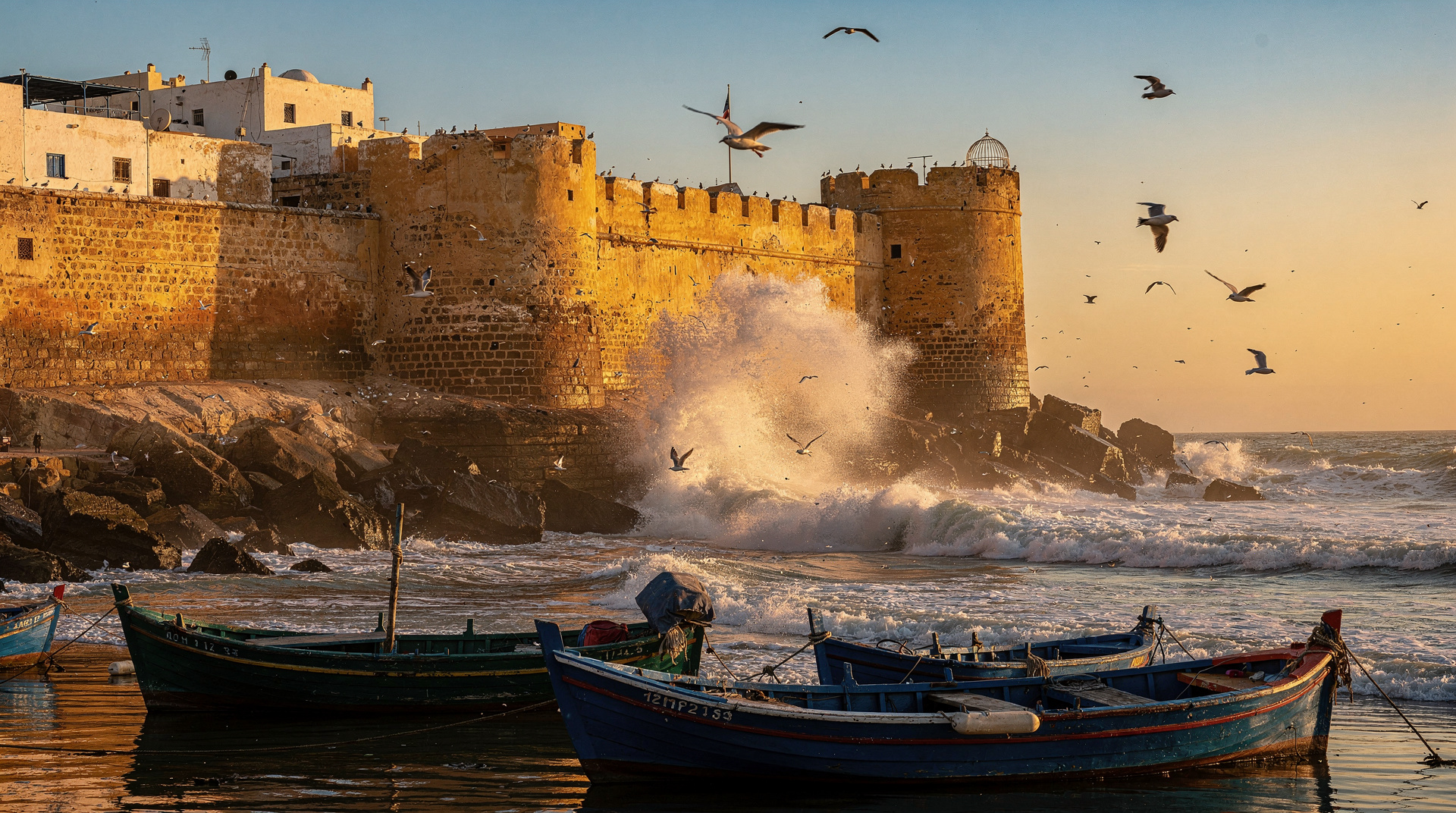
The ramparts: The Skala du Port (sea ramparts) and the Skala de la Ville (land-side ramparts) are Essaouira’s architectural signatures. The sea ramparts have antique Portuguese cannons along their length and views over the fishing harbour and Île de Mogador. Walk them at 7am before the tourist foot traffic begins — the light is best and you often have them to yourself.
The harbour: Essaouira’s working fishing harbour is one of the most photogenic in Morocco. Blue and white wooden fishing boats, fish auction activity in the early morning, and seagull populations that make the whole thing more visually chaotic and alive. The fish restaurants at the harbour entrance serve grilled fresh fish at genuinely good prices: a full mixed grill of sardines, sea bass, and calamari for 80-120 MAD (€8-12).
The beach: Essaouira’s beach runs 10km south of the medina — wide, flat, and windswept. The northern section (near the ramparts) is where the wind is strongest, which makes it popular with kitesurfers but uncomfortable for sunbathing in summer. The further south you walk, the less wind-exposed the beach becomes. Early morning and late afternoon are the best windows for comfortable beach time.
The souqs: Essaouira’s market area specialises in thuya wood products — thuya is a root burl found only in this region of Morocco, with a distinctive marbled appearance. The furniture, small boxes, and decorative objects made from thuya are Essaouira’s distinctive artisan product. Prices are more fixed here than in Marrakech; haggling is less aggressive.
Gnaoua music: Essaouira is one of the primary centres of Gnaoua music — a Sufi-influenced tradition brought by sub-Saharan African communities. The annual Gnaoua and World Music Festival (usually June) is the most concentrated opportunity, but music sessions happen in restaurants and cultural spaces throughout the year.
Essaouira food: what’s worth eating near your riad
Fish at the harbour: Non-negotiable. The fish restaurants immediately outside the fishing port (turn right leaving the medina through the main port gate) serve the freshest fish in Essaouira at the lowest prices. Pick your fish from the display, agree a price, eat it grilled. Morning is better — the afternoon catch is older.
Argana and Côte Plage: Two reliable medina restaurants that do good-quality Moroccan food in a tourist-friendly setting. Not cutting-edge, but consistent — useful when you want a reliable tagine without navigating to the harbour.
Zaouia cafe: Good coffee and pastries in the medina — the croissants here are better than the standard Moroccan café offering, reflecting the French influence on Essaouira.
Getting to Essaouira: connections to plan
From Marrakech: Supratours bus (4 hours, 90 MAD / €9 one-way, departs 4-5 times daily) or private taxi (3 hours, approximately 600-800 MAD / €60-80 for the full car). The bus is the standard budget option; the taxi is worth it for 3-4 people splitting the cost.
From Agadir: 2.5-hour drive north along the coastal N1 road. Shared grand taxis run this route. Rental car makes the coastal drive enjoyable — the N1 passes several unmarked beach access points worth stopping at.
From Casablanca: 5-6 hours by car, or take the train to Marrakech and the Supratours bus onward. No direct train connection.
The Essaouira destination guide covers these transport connections in full detail, including schedules and current prices. The best riads in Marrakech guide is the natural companion for the Marrakech portion of this itinerary pairing.
What 2-3 days in Essaouira actually looks like
Essaouira rewards a slower pace than Marrakech. The medina is compact enough to cover on foot in a single morning; the second and third days are for re-walking what you found the first time, going further on the beach, and sitting in cafes with good coffee.
Day 1: Arrive in the afternoon. Drop luggage at the riad and walk the ramparts before sunset (45-minute loop). Dinner at the harbour fish restaurants — point at the fish you want, agree the price (usually 60-100 MAD for a full mixed grill), eat it grilled within 20 minutes. Return to the riad for the medina evening.
Day 2: Morning: souq and medina exploration — thuya wood shops, spice market, artisan cooperatives. The Sidi Mohammed Ben Abdallah Museum (housed in a historic building near the medina centre) is worth an hour for the musical instruments and historical context. Afternoon: beach walk south, as far as you want to go (the beach runs 10km). Sunset on the ramparts. Dinner at a rooftop restaurant.
Day 3: A surf lesson (if inclined) in the morning, or a day trip to the Sidi Kaouki beach 25km south (accessible by grand taxi, a quieter beach with a small surf scene). Afternoon: slow medina exploration, more thuya shopping.
Essaouira’s artistic and musical heritage
Essaouira has been a creative community since the 1960s, when it attracted musicians and artists from Europe and North America (Jimi Hendrix visited in 1969, a fact the city markets enthusiastically though his visit was brief). The legacy is real: Essaouira has a disproportionately active visual arts scene for a city of its size.
The Galerie Damgaard: The most established art gallery in Essaouira, on Avenue Oqba Ibn Nafia. Frédéric Damgaard has been championing local Gnaoua-influenced artists since the 1980s. The work here — intense colour, symbolic figures — is genuinely distinctive and different from the craft objects in the souq.
Gnaoua music: Gnaoua is a form of Sufi music brought to Morocco by sub-Saharan African communities. Its trance-inducing rhythm, call-and-response vocals, and distinctive guembri (bass lute) are heard in various venues in Essaouira year-round. The Festival Gnaoua et Musiques du Monde (June) is the main event, but informal sessions happen in restaurants and cultural spaces throughout the year. Ask your riad manager where to find live music during your stay.
Essaouira for different travel styles
For couples and honeymooners: Essaouira’s scale and atmosphere is ideal for romantic stays — the ramparts at sunset, fish dinners at the harbour, riad courtyards with candles. The honeymoon hotels Morocco guide covers the premium options. For the mid-range honeymoon, Riad Mimouna and Villa Maroc both deliver without requiring the full luxury hotel spend.
For surfers: Ocean Vagabond and the beach surf schools mean Essaouira can function as a surf base as well as a cultural destination. The consistent Atlantic wind makes it better for kitesurfing than for traditional surfing, though beginners can learn at Panoramas-equivalent beach breaks. The surfing Morocco guide compares Essaouira and Taghazout honestly.
For solo travellers: Essaouira’s compact scale and relatively low-pressure tourist environment makes it one of Morocco’s most comfortable solo travel destinations. The medina is small enough to navigate confidently within a day. The arts and music scene creates organic social opportunities without the aggressive hustle of Marrakech’s Jemaa el-Fna. The solo female travel Morocco guide covers Essaouira specifically as one of the easier bases.
For those weighing Essaouira against Morocco’s other coastal towns, the coastal Morocco comparison and the Essaouira vs Agadir guide go through the trade-offs in more depth.
Frequently asked questions about Best riads in Essaouira
Is 2 nights enough in Essaouira?
Two nights covers the ramparts, the harbour, and a first pass through the souqs. Three nights, as in the structure above, adds time for the beach and a surf lesson or a day trip to Sidi Kaouki. If you’re combining Essaouira with Marrakech on a 14-day itinerary, 2-3 nights is the standard allocation.
Do Essaouira riads have air conditioning?
Not always — the Atlantic coast is significantly cooler than inland Morocco (24-27°C versus Marrakech’s 38°C in summer), so many properties rely on natural ventilation and thick walls rather than AC. If you’re visiting in July or August and want guaranteed cooling, confirm with the property directly rather than assuming.