Imperial Cities of Morocco
Overview of this imperial cities Morocco itinerary
Morocco has four imperial cities — capitals of successive dynasties that shaped the country’s culture, architecture, and identity over 1200 years. Marrakech in the south, Fes in the centre-north, Meknes between Fes and Rabat, and Rabat on the Atlantic. Each is a UNESCO World Heritage Site. Each feels completely different from the others. Together they form the most culturally concentrated circuit in North Africa.
This itinerary skips the Sahara entirely — which is the right call if culture and history are your primary interest. The desert is magnificent, but Moroccan architecture and Islamic urban design are equally extraordinary in their own way, and they rarely get the undivided attention they deserve. This is a trip for people who want to understand what they are looking at rather than simply photograph it.
The itinerary runs 8 days but can be compressed to 6 (cut one night in Marrakech and one in Fes) or extended to 10 by adding Chefchaouen or Volubilis as an overnight rather than a day trip. The routing is logical: start in Marrakech (the most dramatic entry point), head north to Meknes, then east to Fes, and finish on the Atlantic coast in Rabat.
Route at a glance: Marrakech (2 nights) → Meknes (1 night) → Fes (3 nights) → Rabat (1 night) → Casablanca (depart)
Transport: Mostly by train, which is comfortable, cheap, and more reliable than the bus. The ONCF rail network connects all four imperial cities.
Best season: October–April. The imperial cities in summer exceed 40°C. Stone walls absorb and radiate heat; the medina alleys trap it. Visit in spring or autumn.
Total estimated cost (per person, mid-range, flights excluded): €900–1400
At a glance
| Where | Marrakech, Meknes, Volubilis, Fes, Rabat, Casablanca |
| Duration | 8 days / 7 nights |
| Cost per person | around €540–1150 (flights excluded) |
| Getting there | fly into Marrakech Menara (RAK), depart Casablanca (CMN) |
| Getting around | ONCF trains between all cities, taxis for Volubilis/Moulay Idriss |
| Best time | October–April |
Day-by-day summary
| Day | Route | Overnight |
|---|---|---|
| 1–2 | Marrakech: medina, palaces, Majorelle | Marrakech riad |
| 3 | Train to Meknes | Meknes riad |
| 4 | Volubilis + Moulay Idriss → Fes | Fes riad |
| 5 | Fes el-Bali: tanneries, medersa, Qarawiyyin | Fes riad |
| 6 | Fes: Andalusian quarter, Merenid Tombs | Fes riad |
| 7 | Train to Rabat: Kasbah des Oudayas, Hassan Tower | Rabat riad |
| 8 | Casablanca: Hassan II Mosque → departure | — |
Day 1: Marrakech — the southern capital
Arrival
Marrakech Menara Airport (RAK) is the entry point for most European routes. A petit taxi to the medina: €4–6, agree the fare before departing. The Marrakech medina was the imperial capital of the Almoravid, Almohad, and Saadian dynasties — over a thousand years of power concentrated in a few square kilometres of ochre earthen walls.
Afternoon: first medina immersion
Walk from your riad to the Djemaa el-Fna square in the late afternoon. The square was a place of public execution, royal proclamation, entertainment, and market for 900 years. It still serves most of those functions in modified forms: musicians where the executioners stood, storytellers where proclamations were read, 50 grill stalls where the market was.
Walk north into the souks. The Souk Semmarine is the main artery — it has been a trading street since the 11th century and looks approximately as it did then, except for the fluorescent lighting and the tourist-priced carpets.
Evening: Djemaa el-Fna at night
Return to the square at 19:00 when the transformation is complete. Smoke, music, competing calls from stall holders, the orange glow of a hundred grills. Eat here on your first night: merguez, kefta, harira, brochettes. €6–10 all in.
Where to stay: Riad Yasmine or Riad BE Marrakech (mid: €80–130); La Mamounia (historic luxury: €500+)
Budget estimate today: €70–140
Book in advance: Riad; tomorrow’s palace and medina tour
Day 2: Marrakech — palaces, tombs, and the Almoravid city
Morning: the palace quarter
Start at 09:00 at Bahia Palace — built in the 1890s by Si Moussa and his son Ba Ahmed, grand viziers of the Alaoui dynasty. The palace complex contains over 150 rooms arranged around courtyards of zellij tilework, carved stucco, and painted cedar ceilings. The women’s quarters — a multi-room suite surrounding a private garden — give a sense of harem life that is specific and human rather than generalized.
Walk 10 minutes south to the Saadian Tombs: a dynastic mausoleum built by Ahmed el-Mansour in the late 16th century, sealed by a subsequent sultan who preferred to erase his predecessor’s memory, and undiscovered again until 1917 when French aerial photography revealed the roof. The main burial chamber contains 60 carved marble columns and a ceiling of honeycomb muqarnas plasterwork.
For the full narrative arc — Almoravid founders, Almohad empire, Saadian prosperity, Alaoui dynasty — book the private Marrakech medina, palaces, and tombs tour. This is the best single investment for cultural depth on a first visit.
Midday: El Badi Palace ruins
El Badi Palace was built by Ahmed el-Mansour in the 1590s using ransom money from the Portuguese — he traded sugar, which Morocco had, for marble and gold, which Portugal needed. The palace reportedly had 360 rooms, onyx columns, gold-leaf ceilings, and a pool 90 metres long. A later sultan stripped it entirely in the 1690s to furnish Meknes. What remains is the enormous sunken courtyard, four pavilion sites, and nesting storks. Entry: €2.
Afternoon: Majorelle Garden + Berber Museum
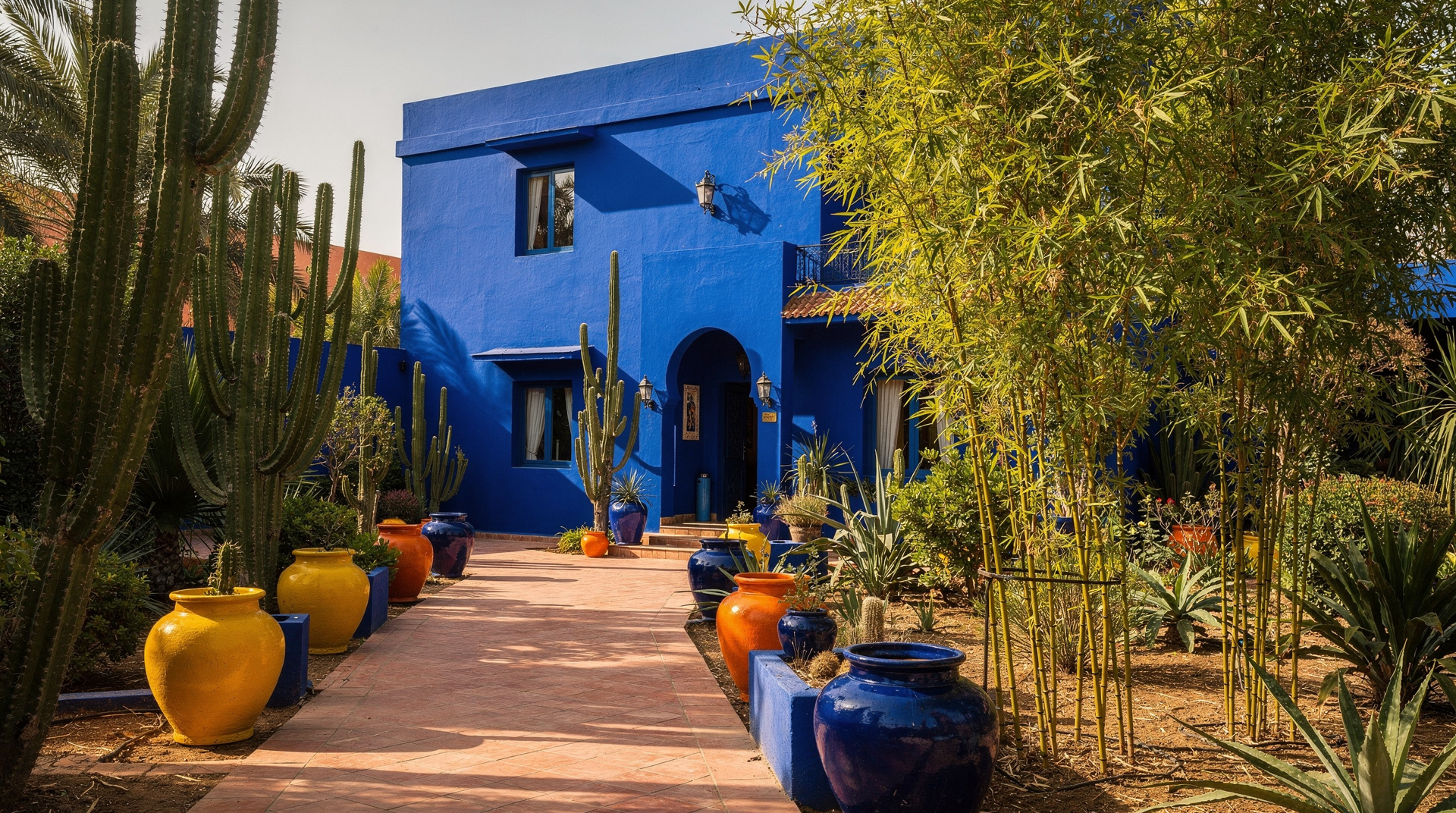
A petit taxi (€3) to the Ville Nouvelle for the Majorelle Garden. The botanical garden’s cobalt blue pavilions, palm groves, cacti, and reflecting pools were designed by the French painter Jacques Majorelle in the 1920s, saved from property developers by Yves Saint Laurent and Pierre Bergé in 1980, and bequeathed to a foundation on YSL’s death. The adjacent Berber Museum — housed in the cobalt blue studio building — contains a remarkable collection of Amazigh jewelry, textiles, and tools from across Morocco and the wider Maghreb.
Book Majorelle Garden and Berber Museum entry in advance — the walk-in queue is long on busy days.
Evening: hammam
Before the travel days ahead, a hammam tonight is essential maintenance. Les Bains de Marrakech (90 minutes, €45–55) or a traditional neighbourhood hammam for €5 if you prefer the authentic experience over comfort.
Where to stay: Same riad
Budget estimate today: €100–180
Day 3: Train to Meknes — the forgotten imperial city
Morning: Marrakech to Meknes by train (4–5 hours)
The ONCF train from Marrakech runs north to Casablanca (2h30) and connects to Meknes via Kénitra or Rabat (total 5–6 hours, one or two changes). Alternatively, take the direct bus from Marrakech’s Supratours terminal (6 hours, €12). Arrive in Meknes in the early afternoon.
Meknes is the least-visited and perhaps the most underrated of the four imperial cities. Sultan Moulay Ismail chose it as his capital in 1672 and spent 50 years building it into one of the most ambitious urban projects in Moroccan history — 40 km of defensive walls, 20 city gates, 50 palaces, and stables for 12,000 horses. Most of this is now ruin or inaccessible. What remains is still extraordinary.
Afternoon: Bab Mansour + the imperial quarter
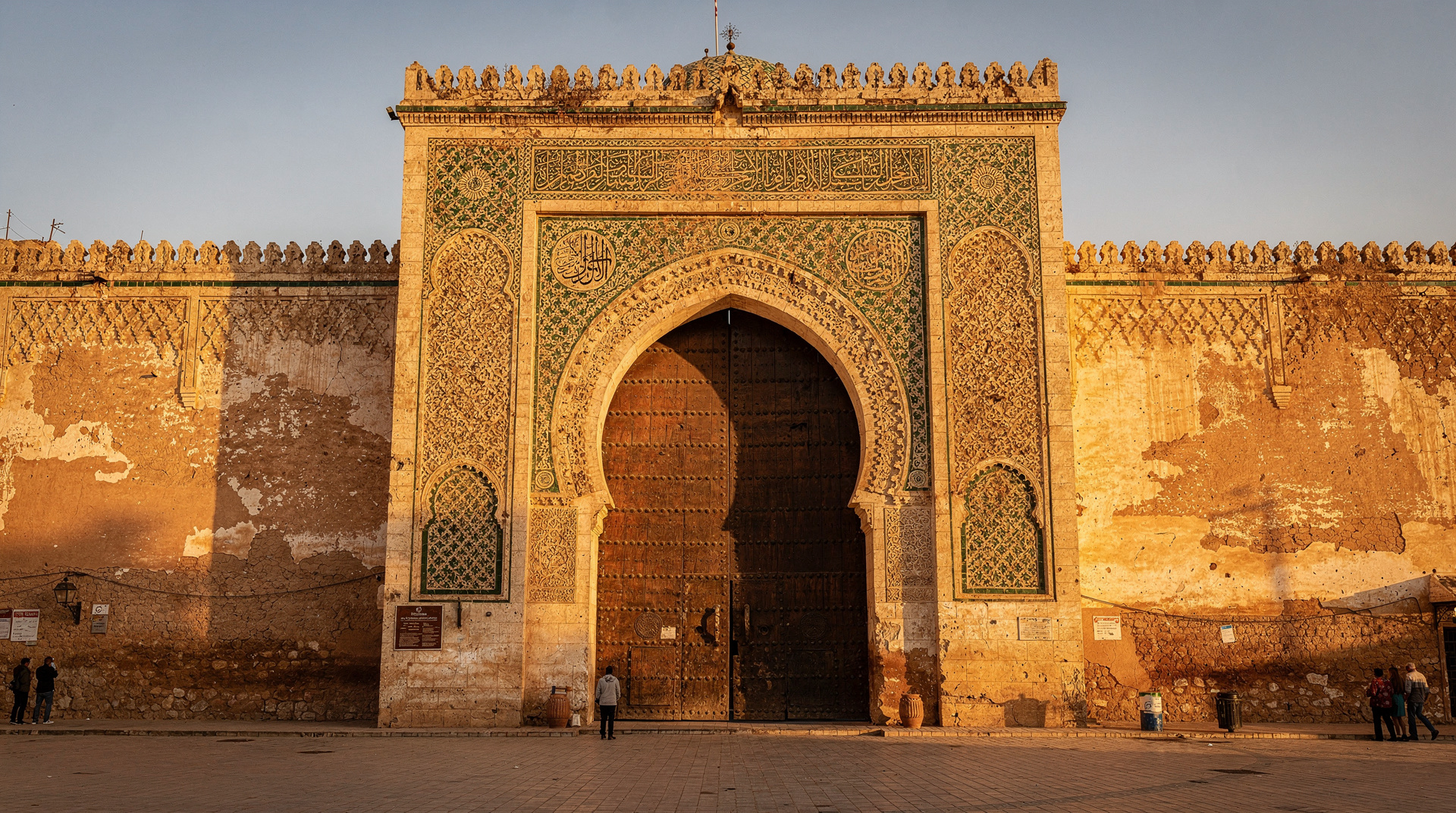
Bab Mansour is the main ceremonial gate of Moulay Ismail’s imperial city. Built in 1732, it is 20 metres high and elaborately decorated with zellij panels and marble columns taken from the Roman ruins at Volubilis. It is the finest ornamental gate in Morocco — and somehow less famous than it deserves to be.
Beyond Bab Mansour: the Mausoleum of Moulay Ismail (open to non-Muslims, unusually for a royal tomb in Morocco) — a calm series of courtyards leading to the marble tomb chamber. The Heri es-Souani, a 10-minute walk from the gate, is a system of underground granaries and stables of monumental scale: vaulted chambers designed to store grain and house 12,000 horses in a pre-air-conditioning climate using a sophisticated underground water system.
Evening: Meknes medina
The Meknes medina is compact compared to Fes — 30 minutes end-to-end — and notably quieter. The main square, Place el-Hedim, opposite Bab Mansour is a smaller version of Marrakech’s Djemaa el-Fna. Dinner at a medina restaurant: tagine and harira for €8–12.
Where to stay: Riad Bahia Meknes (mid: €60–90); there are fewer riad options here than in Fes — book ahead
Budget estimate today: €80–140 including train, meals, entry fees
Day 4: Volubilis + onward to Fes
Morning: Volubilis (Roman Morocco)
Volubilis is 33 km north of Meknes on a well-paved road. A taxi from Meknes costs €15–20 one-way; agree the round trip fare (waiting time included) before departing: €40–50.
The Roman city of Volubilis was occupied from the 1st century BC to the 11th century AD — a remarkably long habitation that left extraordinary archaeological layers. The city served as the administrative capital of the Roman province of Mauretania Tingitana and reached its peak under the Severan dynasty in the 2nd–3rd centuries AD. The in-situ mosaics from this period are among the best-preserved in Africa: Bacchus riding a panther, the labours of Hercules, Diana bathing, the chariot race of Amphitrite. The triumphal arch of Caracalla (dedicated 217 AD) still stands in the main street. Entry: €7.
If you prefer, book the Meknes and Volubilis day trip from Fes and visit these sites from Fes rather than from Meknes — the route works either way.
Midday: Moulay Idriss
Between Volubilis and the road back to Meknes: Moulay Idriss Zerhoun, Morocco’s holiest city and the burial place of Idris I, founder of the first Islamic dynasty in Morocco. Non-Muslims cannot enter the sanctuary, but the white-washed town clinging to twin hills above the surrounding farmland is worth a 30-minute stop and a climb to the viewpoint.
Afternoon: train to Fes (45 minutes)
From Meknes train station to Fes by ONCF: 45 minutes, €3. The most convenient short rail journey in Morocco. Arrive Fes in the early afternoon and check in to your riad in Fes el-Bali before dark — navigating to a riad for the first time in the Fes medina after dark is inadvisable even with GPS.
Where to stay: Riad Fes (upscale: €150–250); Palais Amani (boutique: €200–400); Dar Bensouda (mid: €80–130)
Budget estimate today: €80–140
Day 5: Fes el-Bali — the living medieval city
Fes is a different category of city
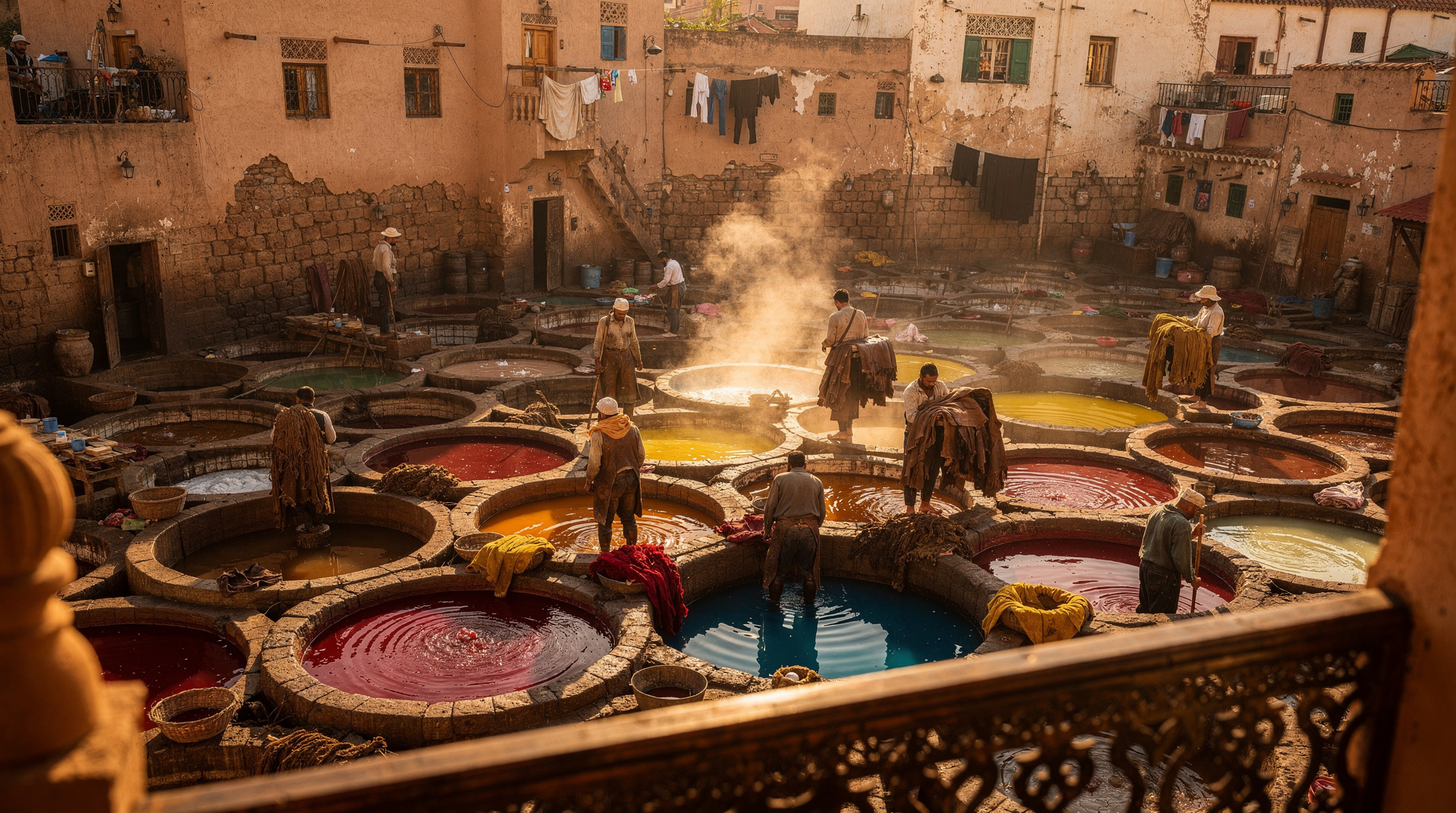
The Fes el-Bali medina is the largest preserved medieval city in the world, inhabited by 150,000 people living in conditions little changed since the 9th century. It is not a heritage museum — it is a working city where leather goods are made in stone vats of pigeon dung, where theology students study the Quran in medersas built in 1351, and where donkeys are still the primary freight transport because the lanes are too narrow for anything with a motor.
Book the Fes full-day cultural tour for today. A knowledgeable guide transforms Fes from a bewildering maze into a readable city. The difference between having a guide and not having one in Fes is larger than at any other site in Morocco.
Morning: the tanneries and the souks
The Chouara Tanneries are the oldest still-operating tanneries in the world. Stone honeycomb vats filled with dye — saffron yellow from safflower, green from mint, red from poppy, brown from henna — and a smell that announces itself from 200 metres. Workers tread hides in the vats in a process unchanged since the 10th century. View from the terraces of the surrounding leather shops; they let you up if you browse, and you are not obligated to buy.
The surrounding souk alleys specialize by trade: tailors, brass workers, candle makers, basket weavers. The Attarine Spice Market near the Qarawiyyin mosque sells spices, essential oils, and kohl in the same shop stalls that have been here for centuries.
Afternoon: Bou Inania Medersa + Qarawiyyin
The Bou Inania Medersa (built 1351) is the finest example of Marinid architecture in Morocco: three layers of ornament stacked vertically — zellij tilework at the base, carved plaster in the middle, and carved cedar at the top — in proportions so balanced they feel inevitable. Entry: €3. Open to non-Muslims; the students are long gone, the architecture eternal.
The Qarawiyyin mosque and university (founded 859 AD — the oldest continuously operating university in the world) is closed to non-Muslims. You can see the entrance from the main alley and hear the call to prayer from within its minaret. The fountain in the alley outside the Qarawiyyin entrance is where students have washed before prayer for 1100 years.
Evening: Fes el-Bali by night
The medina at 21:00 belongs to locals. The tourist shops are shuttered but the bakeries are open, the tea houses are busy, and the lanes are lit by the glow of mobile phones and the occasional bare bulb. Walk from Bab Bou Jeloud toward the Andalusian quarter (Fes el-Andalus, across the river) for dinner at a neighbourhood restaurant — full Fassi meal for €8–12.
Budget estimate today: €80–140 including tour, meals, entry fees
Day 6: Fes — Andalusian quarter + Merinid tombs
Morning: Fes el-Andalus
The river divides Fes el-Bali into two ancient quarters: the Arab quarter (larger, more visited) and the Andalusian quarter, settled by Moorish refugees from Cordoba in the 9th century. The Andalusian mosque (closed to non-Muslims) has one of the finest carved stone doorways in Morocco. The quarter’s souks are quieter, the lanes wider, and the pace noticeably more local.
Late morning: Merenid Tombs viewpoint
A 20-minute walk up the hill north of the medina leads to the ruined Merenid Tombs — 14th-century dynastic mausoleum now stripped and structurally precarious. The tombs themselves are secondary to the reason to come up here: the panoramic view over Fes el-Bali. From this vantage you can see the full extent of the medina, the Andalusian quarter across the river, the medersa rooflines, and the minarets marking each neighbourhood’s mosque. This is the view that makes the scale of the city comprehensible. Go at 09:00 before the haze builds.
Afternoon: Dar Batha Museum
The Dar Batha palace museum houses Morocco’s finest collection of Fassi applied arts: Quranic manuscripts, Fassi embroidery, Merenid bronzes, and an extraordinary collection of Fes blue and white pottery (the distinctive blue-on-white geometric style that is the visual signature of the city). Entry: €3. Often quiet; you may have some rooms to yourself.
Evening: cooking class
A Fes cooking class in a riad kitchen is the best food experience in Morocco if this is your interest. Agencies like Plan-it Fez and individual riads offer 3-hour sessions (€40–60 per person) covering preserved lemon, ras el hanout, bastila (the remarkable pigeon pie with sugar and almonds), and tagine. The meal you eat at the end of your own class is disproportionately satisfying.
Budget estimate today: €70–130
Day 7: Train to Rabat — the Atlantic capital
Morning: last Fes walk
One final morning in the medina before 08:00: the souks before the sellers arrive, the lanes before the donkey-carts begin their rounds. Have coffee at a traditional cafe near Bab Bou Jeloud: a glass of black coffee and a pastry for €1.
Midday: ONCF train to Rabat (2h30)
First class from Fes to Rabat: €8. Comfortable, reliable, scenic through the Gharb plain wheat fields. Arrive Rabat Agdal or Rabat Ville station in the early afternoon.
Rabat is the administrative capital and the most European-feeling of the imperial cities: wide boulevards, functional government buildings, a reasonable metro system. The medina is compact — 30 minutes corner to corner — and the pace is the most relaxed of the four cities.
Afternoon: Kasbah of the Udayas
The Kasbah of the Udayas sits on a promontory above the Bou Regreg river, facing the Atlantic ocean and the sister city of Salé across the water. The 12th-century Almohad gate (Bab Oudaia) is the most beautiful monumental doorway in Morocco: horseshoe arch, carved geometric and floral decoration, and proportions that feel simultaneously massive and delicate. Inside the kasbah walls: a Moorish garden of orange trees and bougainvillea, surrounded by whitewashed houses with blue painted doors. Artists and academics have lived here since the French protectorate period in the early 20th century.
Walk down through the kasbah to the Atlantic cliff edge. The view north over the ocean and south over the river estuary to the old Portuguese-era lighthouse is one of the best in Rabat.
Late afternoon: Hassan Tower + Mausoleum of Mohammed V
The Hassan Tower was intended to be the minaret of the world’s largest mosque, begun by Sultan Yacoub el-Mansour in 1195 and left unfinished on his death in 1199. The mosque was never completed; an earthquake in 1755 destroyed most of what existed. The tower — 44 metres of the intended 80 — stands alone in a field of 200 broken columns, the ghosts of the mosque’s pillars. The scale of what was intended is readable from the stump column lines.
Adjacent: the Mausoleum of Mohammed V, built 1961–71 for the king who led Morocco to independence. The white onyx tomb and green tiled roof surrounded by traditional Moroccan craftsmanship represent the post-independence generation’s statement about national identity and artistic continuity.
Evening: Rabat seafood
The Atlantic coast means excellent fish. The Océan neighbourhood restaurants near the corniche serve the daily catch — St. Peter’s fish, sea bass, shrimp — grilled simply with chermoula. Budget €20–35 per person with wine or Moroccan beer.
Where to stay: Dar El Batoul (boutique riad: €100–160); Hotel Balima (historic Art Deco option on Mohammed V Avenue: €70–100)
Budget estimate today: €90–160
Day 8: Casablanca — Hassan II Mosque + departure
Morning train to Casablanca (45 minutes by Al Boraq)
Book the Al Boraq high-speed train from Rabat Agdal to Casablanca Voyageurs in advance (€8, fills up on weekday mornings). Casablanca Mohammed V International Airport (CMN) serves most European and North American long-haul routes. If your flight is in the morning, relocate to Casablanca the evening of Day 7 (train from Rabat: 45 minutes; airport shuttle from Casablanca Voyageurs: 35 minutes).
The Hassan II Mosque
Morocco’s most ambitious piece of modern architecture. Built between 1987 and 1993 under Hassan II — who decreed that the mosque should be visible from the sea, that it should be built on water, and that it should be the tallest minaret in the world. All three ambitions were fulfilled. The mosque sits on a promontory directly above the Atlantic ocean on a glass floor over the sea. The minaret at 210 metres is the world’s tallest religious tower. The retractable roof, designed by Michel Pinseau, opens in good weather to bring the Atlantic sky into the prayer hall.
Non-Muslims can enter on guided tours (approximately every 30 minutes in English, French, and Arabic). Entry: €14 for the guided tour. The interior seats 25,000 worshippers under a cedar-wood ceiling inlaid with gold and Islamic geometric patterns.
Airport
The ONCF train runs directly to Mohammed V Airport from Casablanca Port and Casa Voyageurs stations: 30–40 minutes, €5. Allow 2.5 hours before your flight for the journey and check-in.
Budget estimate today: €50–90
Total trip cost estimate
| Item | Budget (pp) | Mid-range (pp) |
|---|---|---|
| Accommodation (8 nights) | €240 | €600 |
| Train fares (all legs) | €40 | €40 |
| Food and drink (8 days) | €120 | €250 |
| Tours, entry fees, activities | €100 | €200 |
| Local transport | €40 | €60 |
| Total (flights excluded) | €540 | €1150 |
What to skip if you only have 6 days
Remove one night in Marrakech (arrive, do Day 2, depart) and convert Meknes to a day trip from Fes rather than an overnight. This makes Fes your base for Days 3–5 and removes the need to navigate two different medinas with luggage in a short window. You lose the atmospheric Meknes overnight but keep all the key sites.
Why the imperial cities without the Sahara?
The Sahara is magnificent. But it takes 4–5 days minimum to reach Merzouga and return to Marrakech, and adding the desert to this itinerary would require 13–14 days. The imperial cities circuit is complete in itself — it covers a more concentrated form of Moroccan cultural depth than the desert-and-coast combination. Many repeat visitors to Morocco deliberately skip the Sahara on a second trip to focus on the north.
For a trip that combines the imperial cities with a Sahara loop, see our 10-day Morocco itinerary. For the full combined experience with proper breathing room, see our 14-day Morocco itinerary.
Route map description
Starting at Marrakech airport, the route goes north by train: Marrakech to Casablanca (2h30), connecting to Meknes (additional 1h30). From Meknes a day trip by taxi covers Volubilis (33 km north) and Moulay Idriss. Then east by train to Fes (45 minutes). Three nights in Fes with day trips in the surrounding region. Northwest by train to Rabat (2h30). Final leg west to Casablanca (45 minutes) for the international departure.
Practical notes for the imperial cities circuit
Medina navigation: All four imperial city medinas have GPS dead zones and streets too narrow and curved for satellite view to be accurate. Download the offline Google Maps tile before you arrive, but accept that you will need to ask for directions at least once per day. Every local knows where the main landmarks are.
Dress codes: The imperial cities have more conservative dress expectations than coastal Essaouira. Shoulders and knees covered in medinas. Women travelling solo should carry a scarf for medersas and mosque adjacents. Men in shorts are uncommon in the traditional quarters and attract occasional stares.
Photography: Mosques are closed to non-Muslims and photography from outside is fine. Inside medersas, photography is generally permitted. Tannery viewing platforms: photography yes; workers: ask first and tip if they agree (€1–2 is appropriate).
Guides: Hire official guides from ONMT-licensed agencies rather than from individuals who approach you on the street. The licensed guides carry a badge; they are significantly more knowledgeable and their prices are regulated.
Explore our detailed destination guides for Marrakech, Fes, Meknes, Volubilis, and Rabat for deeper planning on each stop. For accommodation choices along the way, see best riads in Fes and best riads in Marrakech, and for the palace history that anchors this circuit, our imperial palaces of Morocco guide is a useful companion read.
Why train travel suits this circuit especially well
Unlike a desert loop, where a private driver is genuinely worth the cost, the imperial cities circuit runs almost entirely along Morocco’s best rail corridor. Marrakech–Casablanca–Rabat–Meknes–Fes are all connected by ONCF trains that are punctual, air-conditioned, and cheaper than a private car for a solo traveller or couple. The only leg that benefits from a taxi is the Meknes–Volubilis–Moulay Idriss day trip, since there is no direct rail line there. If you’d rather do the whole circuit by rail without a single taxi day, our Morocco by train itinerary covers exactly that routing, including the Al Boraq high-speed leg to Casablanca.
Comparing the four imperial cities
| City | Character | Best for | Time needed |
|---|---|---|---|
| Marrakech | Dense, theatrical, tourist-ready | First impressions, palaces, souks | 2 nights |
| Meknes | Quiet, monumental, underrated | Scale without crowds | 1 night |
| Fes | The largest living medieval city | Deep culture, guided exploration | 2–3 nights |
| Rabat | Calm, administrative, coastal | An easy final stop, Atlantic views | 1 night |
Frequently asked questions about Imperial Cities of Morocco
Which imperial city should we prioritize if we only have 4 days?
Marrakech and Fes carry the most cultural weight — between them they cover the Almoravid/Saadian south and the medieval Islamic north. If time is genuinely tight, fly into Marrakech, spend 2 nights there, take the overnight train to Fes (or a shorter Casablanca connection), and spend 2 nights in Fes before flying home from Fes airport directly rather than looping back through Rabat and Casablanca.
Is it worth adding Chefchaouen to this circuit?
Chefchaouen is not technically an imperial city, but many travellers add it as a detour from Fes (roughly 4 hours each way) or as an overnight extension via Tangier. It fits better on a northern-Morocco-focused trip than bolted onto this one — see our northern Morocco itinerary if the blue city is a priority.