Tangier vs Casablanca: Gateway Cities Compared
Should I enter Morocco via Tangier or Casablanca?
Casablanca (CMN) is the main international air hub — most transatlantic and many European flights arrive here. Tangier is better approached from Europe by ferry (from Spain) or if you're specifically doing northern Morocco. They serve different entry scenarios, not competing purposes.
Two cities that function as Morocco’s entry points
Tangier and Casablanca are both gateway cities — but they serve travellers arriving from different directions with different plans. Casablanca Mohammed V is Morocco’s main international airport, the logical entry point for transatlantic flights and most European connections. Tangier is where Europe meets Africa across the 14km Strait of Gibraltar — the natural arrival point if you’re crossing from Spain by ferry or doing a Europe-to-Morocco overland trip.
If you’re choosing between them as destinations — rather than entry points — the comparison is very different.
| At a glance | Tangier | Casablanca |
|---|---|---|
| Where | Strait of Gibraltar, northern tip | Atlantic coast, Morocco’s commercial hub |
| Getting there | Ferry from Spain (35-60min), TNG airport, Al Boraq train | CMN international airport, national rail hub |
| Time needed | 1-2 nights | 1 day, or a night if exploring food/nightlife |
| Cost level | Moderate; thinner tourist infrastructure | Moderate to high in business hotel category |
| Best time | Year-round; spring/autumn mildest | Year-round; avoid peak summer humidity |
The quick comparison table
| Factor | Tangier | Casablanca |
|---|---|---|
| Population | ~1 million | ~4 million |
| Main arrival type | Ferry from Spain, some flights | Major international airport (CMN) |
| Train connections | Al Boraq to Casa (2h15), Fes (4h45) | National hub — all major cities connected |
| Historic character | Strong — Kasbah, medina, colonial café culture | Limited — rebuilt 20th century |
| Tourist sights | Kasbah, Cap Spartel, Hercules Caves, strait views | Hassan II Mosque (world-class) |
| Artistic / literary history | International Zone era, Matisse, William Burroughs | Less significant |
| Medina | Characterful, compact | Small, not impressive |
| Seafood | Excellent (strait fish) | Excellent (Atlantic) |
| Art deco architecture | Some | Outstanding — best in Africa |
| Day trips | Chefchaouen (2.5h), Asilah (45min), Tetouan (1h) | Rabat (45min), Essaouira (4h), El Jadida |
| Distance from Europe | Closest African city to Europe | Further |
| Al Boraq (high speed) | Yes — both directions | Yes — hub |
The case for Tangier
Tangier has a fascinating layered identity. For centuries it functioned as the International Zone — governed jointly by multiple European powers from 1923 to 1956, and before that as the seat of foreign legations. This created a cosmopolitan, morally ambiguous atmosphere that attracted writers, artists, and exiles: Matisse painted here, Paul Bowles lived here for decades, William Burroughs wrote Naked Lunch in the medina, and the Rolling Stones spent significant time in the city. That literary and artistic mythology is still present in the city’s DNA.
What works well at Tangier:
- The Kasbah and medina retain genuine character, much improved from the rough reputation of the 1990s
- The view across the Strait of Gibraltar to Spain from Cap Spartel is one of Morocco’s most striking geographical perspectives
- The Hercules Caves — sea caves at the Atlantic/Mediterranean junction, with a cave opening shaped like Africa — are one of northern Morocco’s more unusual sights
- Asilah, 45km south, is a pristine whitewashed coastal town with an arts festival (August) and excellent seafood — one of Morocco’s most underrated destinations as a day trip
- The café culture around the Grand Socco and into the medina has a genuine literary-history overlay — Café de France, Café Tingis — that gives the city a distinct identity
- The Al Boraq high-speed train now connects Tangier to Casablanca in 2h15 and to Fes in 4h45 — the city is no longer the awkward detour it once was
The honest limitations:
- Tangier’s tourist infrastructure is thinner than Marrakech or Casablanca — fewer high-quality hotels and restaurants in the medina
- The city has a history of aggressive tourist hassle, though this has improved significantly since the medina renovation programs of the 2010s
- As a day trip destination from Europe (ferry from Tarifa: 35 minutes), Tangier receives large numbers of cruise and day-tripper visitors who overwhelm parts of the medina for a few hours daily
A Tangier city tour covering the Hercules Caves and Cap Spartel handles the geographical highlights efficiently if you’re arriving by ferry.
The case for Casablanca
Casablanca is Morocco’s economic and logistical capital — not primarily a tourist city, but one with genuine appeal for travellers who know what to look for. The Hassan II Mosque alone justifies the detour. The art deco quarter is the best-preserved example of French colonial modernist architecture in Africa. The seafood restaurants on the corniche are Morocco’s finest.
What works well as a Casablanca visit:
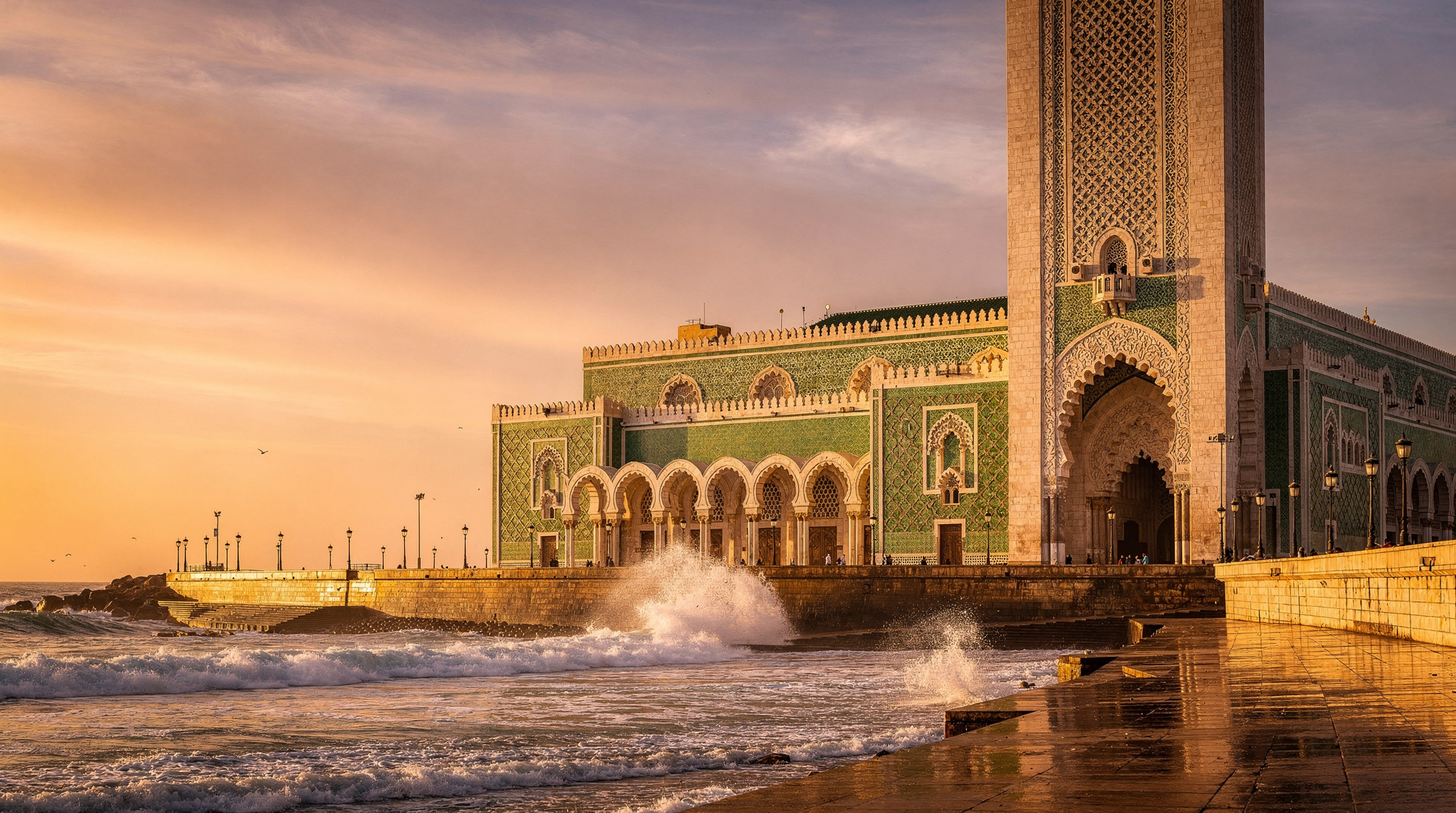
- The Hassan II Mosque (built 1993, capacity 105,000, minaret 210m — tallest in the world) is an architectural wonder in any context. Built partly over the Atlantic, it’s genuinely stunning both exterior and interior
- The art deco district around Boulevard Mohammed V and the Quartier des Habous is a beautiful surprise for travellers who associate Morocco exclusively with medina architecture
- Morocco’s best train connections run through Casa — Rabat (45min), Fes (3h30), Tangier (2h15 by Al Boraq), Marrakech (3h)
- The food scene is excellent — Casablanca’s corniche has Morocco’s finest seafood restaurants, and the city has the most developed contemporary dining scene in the country
- The nightlife is Morocco’s most active — wine bars, clubs, and live music operate with fewer restrictions than in more conservative cities
The honest limitations:
- The medina is small and not impressive compared to Fes or Marrakech — don’t come for the old city
- The city is oriented toward business rather than tourism — hotel options are strong in the business hotel category, less interesting for those wanting boutique character
- Without the Hassan II Mosque, there’s limited reason for tourists to visit for more than a transit day
A half-day Casablanca city tour with mosque visit covers the essentials in 4-5 hours — the right format for most transit visitors.
By traveller type
Arriving from Europe by plane: Casablanca (CMN) — it’s the hub. Take the train on from there.
Arriving from Spain by ferry: Tangier — it’s the crossing point. The Tarifa-Tangier crossing takes 35 minutes.
Doing northern Morocco circuit: Start in Tangier (or arrive at CMN and take the Al Boraq to Tangier), then proceed south via Chefchaouen and Fes.
Architecture enthusiasts: Casablanca for art deco, Tangier for Kasbah architecture and colonial-era buildings.
Literary travellers: Tangier — the Bowles/Burroughs/Matisse connection gives it a specific cultural overlay that Casablanca lacks.
First-time Morocco visitors: Don’t base in either — use them as arrival/departure points and spend your actual trip time in Marrakech, Fes, and the south.
Verdict by scenario
Fly-in, Morocco circuit, fly-out same airport: Arrive CMN, train to Marrakech (3h) or Fes (3h30). Return to CMN from wherever your circuit ends.
Doing a Europe-Morocco road trip or ferry crossing: Enter via Tangier, proceed south through Chefchaouen, Fes, and the imperial cities.
Adding a cultural day to a transit through CMN: Half-day in Casablanca — mosque, art deco, lunch at Rick’s Café (the Casablanca film reproduction is genuinely good). Then train to your actual destination.
Spain-Morocco short trip: Algeciras or Tarifa → ferry to Tangier → Chefchaouen (2.5h) → Fes (4h from Chefchaouen) → return via Al Boraq to Tangier.
Can you combine both?
Very easily — the Al Boraq high-speed train connects them in 2h15. Most longer Morocco itineraries that involve northern Morocco will pass through both:
- Arrive CMN → train to Tangier (2h15) → Chefchaouen (2.5h bus) → Fes (bus, 3-4h) → Marrakech circuit → depart CMN
Or the reverse. Both cities work as transit nodes rather than week-long bases. Build your trip around the destinations between them — see the northern Morocco itinerary for a detailed sequence. The Tangier destination guide covers the city’s neighbourhood detail and the Kasbah in depth.
Frequently asked questions about Tangier vs Casablanca
Should I arrive at Tangier airport or take the ferry from Spain?
Tangier has an international airport (TNG) with some European connections. But most travellers from Europe arrive at Casablanca CMN and take the train north, or cross by ferry from Tarifa or Algeciras via the crossing that takes 35-60 minutes. The ferry is a genuinely enjoyable experience — particularly the short Tarifa-Tangier crossing on the FRS or other operators.
Is Tangier safe for tourists now?
Yes. Tangier’s reputation for harassment and scams — deserved in the 1980s and 1990s — has significantly improved following major investment in the city’s infrastructure and medina renovation. Normal precautions apply; the city is no more problematic than other Moroccan cities.
How long should I spend in Tangier?
1-2 nights is right for most travellers. The main sights — Kasbah, Cap Spartel, Hercules Caves, Asilah day trip — fill 2 full days. The city rewards slower exploration for those interested in its specific literary and international history, but doesn’t have enough to justify a week.
Is Casablanca worth a night or just a transit day?
For most travellers, a single day is sufficient. Arrive morning, do the Hassan II Mosque (2h with guided entry), lunch at a corniche seafood restaurant, art deco walking tour in the afternoon, train to your next destination. If you want to explore the food and nightlife scene, a night is worthwhile.
What’s the Al Boraq train like?
Morocco’s high-speed line between Tangier and Casablanca is genuinely impressive — TGV-type rolling stock, 320km/h max speed, the journey covers 350km in 2h15. First class seats are comfortable and priced at 250-300 MAD (25-30 EUR) one-way. Advance booking via ONCF’s app or website is recommended in peak season.
Is Rabat worth visiting instead of, or alongside, these two?
Rabat sits between them geographically and logistically — 45 minutes from Casablanca by train, and on the route north toward Tangier. It’s Morocco’s political capital, calmer and more orderly than either gateway city, with a genuinely good kasbah and medina. Most travellers treat it as a half-day add-on from Casablanca rather than a standalone base; the Rabat day trip from Casablanca guide covers the logistics.
Which city has better food?
Casablanca, by a clear margin, for restaurant variety and quality — the corniche seafood scene and contemporary dining options outclass Tangier’s more limited restaurant infrastructure. Tangier’s strait-caught seafood is excellent when you find it, but the overall dining density is lower.
Extending north or south from each gateway
Neither city is really a base — they’re points you pass through. From Tangier, the natural extension is north-to-south through Chefchaouen and into Tetouan or coastal Asilah. From Casablanca, most travellers head straight to the imperial cities circuit or south toward Marrakech; day trips to El Jadida work well if you have an extra day near Casa. The day trips from Tangier guide and day trips from Casablanca guide both lay out fuller options if you’re building a longer stay around either gateway.