Taghazout vs Essaouira: Which Atlantic Surf Town?
Should I go to Taghazout or Essaouira for surfing in Morocco?
Taghazout for serious surfers chasing Morocco's best point breaks — Hash Point and Anchor Point are world-class. Essaouira for multi-activity beach trips where surfing is one element alongside medina culture, Gnawa music, and Atlantic scenery. Intermediate surfers get more from Taghazout; cultural travellers who also surf get more from Essaouira.
Two surf towns, two very different propositions
Morocco’s Atlantic coast produces consistent surf year-round, and the country has two genuine surf destinations: Taghazout, a former fishing village north of Agadir that evolved into a dedicated surf town, and Essaouira, a UNESCO-listed walled port 170km north with a wide beach break and a cultural scene that extends well beyond watersports.
For dedicated surfers, the comparison is relatively clear. For travellers who surf but also want cultural content, the choice requires more thought.
| At a glance | Taghazout | Essaouira |
|---|---|---|
| Where | Former fishing village 20min north of Agadir | Walled Atlantic port, ~2.5-3h from Marrakech |
| Typical cost (surf camp/week) | Around 250-450 EUR incl. lessons + board | Similar range for lesson packages; riad stays add up |
| Time needed | 4-7 nights for a proper surf block | 2-4 nights combined with medina time |
| Getting there | Fly to Agadir, or bus/taxi from Marrakech via Agadir | Direct bus/grand taxi from Marrakech (~3h) |
| Best time | October-April for wave quality | September-May; windier midsummer |
The quick comparison table
| Factor | Taghazout | Essaouira |
|---|---|---|
| Main surf break type | Point break (world-class) | Beach break (consistent) |
| Best waves | Hash Point, Anchor Point, Killers | Essaouira beach, Sidi Kaouki (15km south) |
| Surfing level | All levels, but best for intermediate-advanced | All levels |
| Wind conditions | Offshore in winter, thermal in summer | Onshore trade winds — affects surf quality |
| Best surf season | October to May | September to May |
| Town character | Purpose-built surf camp village | UNESCO heritage medina city |
| Cultural content | Minimal | Rich — medina, Gnawa music, arts scene |
| Accommodation | Surf camps, guesthouses, some Airbnbs | Riads, guesthouses, small hotels |
| Kitesurfing | Limited | Excellent — world-class kite conditions |
| Windsurfing | Moderate | Outstanding |
| Distance from Marrakech | 3h | 3h |
| Distance from Agadir | 20km (20min) | 170km (2.5h) |
| Food scene | Surf camp catering, local cafés | Good seafood, medina restaurants |
| Non-surf activities | Yoga, hammam, Agadir day trip | Medina, ramparts, horse riding, quad biking |
The case for Taghazout
Taghazout built its reputation on Morocco’s best point breaks. Hash Point (directly in front of the village) and Anchor Point (1km north) produce long, peeling right-handers that work on virtually any swell. On a good day in October or November, Anchor Point generates rides of 200-300m — one of the longest point break waves in Africa. Killers break, a few kilometres north, handles larger swells and suits experienced surfers.
What works well at Taghazout:
- The wave quality at the point breaks is genuinely excellent. If you’re an intermediate or advanced surfer, the consistency and length of the waves are hard to match anywhere in accessible North Africa
- The surf camp infrastructure has matured — dozens of operators from budget bivouacs to comfortable boutique camps now run week-long surf packages (accommodation + lessons + guiding)
- Water temperature year-round ranges from 16-22°C — cold but manageable with a 3/2mm wetsuit, avoiding the need for the heavy winter rubber required in northern Europe
- The town’s small scale means everything is walkable — surf shop, café, sunset yoga class, hammam — within 10 minutes
- Agadir is 20 minutes by taxi, providing backup for any equipment needs, ATMs, and dining options beyond the camp kitchen
- October through April is the prime window: offshore winds, consistent swells from Atlantic storms, and clear skies
The honest limitations:
- Taghazout the town is entirely oriented around surf. If you’re not surfing, there’s limited to do
- The “authentic village” reputation is fading — heavy development of surf camps and boutique accommodation has changed the character significantly in the last decade
- Onshore winds (thermal) in summer reduce wave quality — the best months are October to March
- Getting to Taghazout from Marrakech or Essaouira requires going through Agadir, which adds transit complexity
Beginner surf lessons at Taghazout provide instructor guidance on the gentler beachbreaks in the bay, away from the more advanced point breaks — the right introduction for those new to surfing.
The case for Essaouira
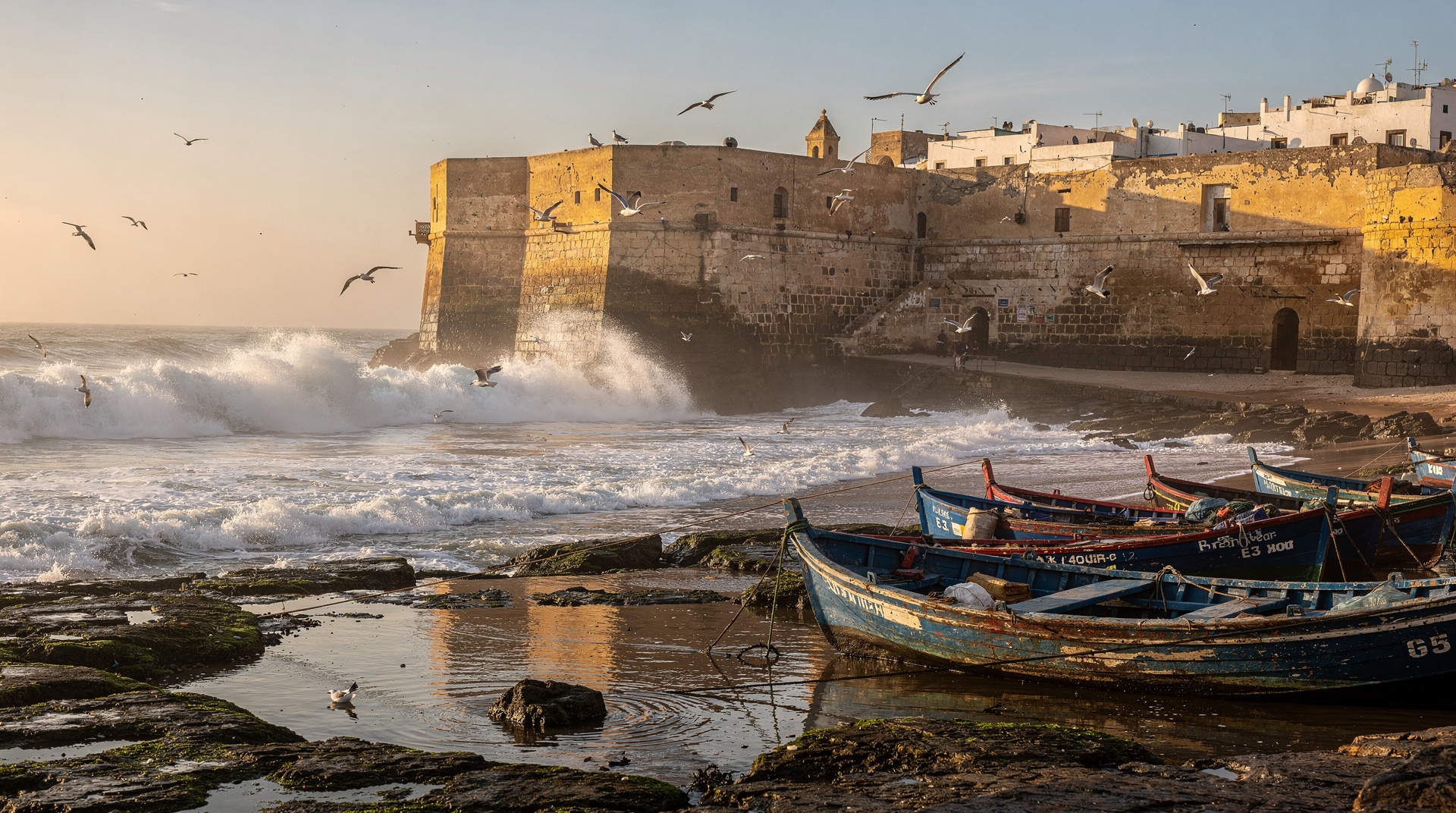
Essaouira’s surf offer is embedded in a much broader destination experience. The wide beach south of the medina produces consistent beach break — not as technically impressive as Taghazout’s points, but rideable for beginners and intermediates on most swells. Sidi Kaouki, 15km south along a coastal track, offers a more powerful beach break and one of Morocco’s better kite spots.
What works well at Essaouira:
- You can surf in the morning and explore the medina in the afternoon — the cultural content of Essaouira adds depth that Taghazout can’t match
- The Alizé trade winds that make beach swimming uncomfortable create world-class conditions for kitesurfing and windsurfing — Essaouira hosts international competitions
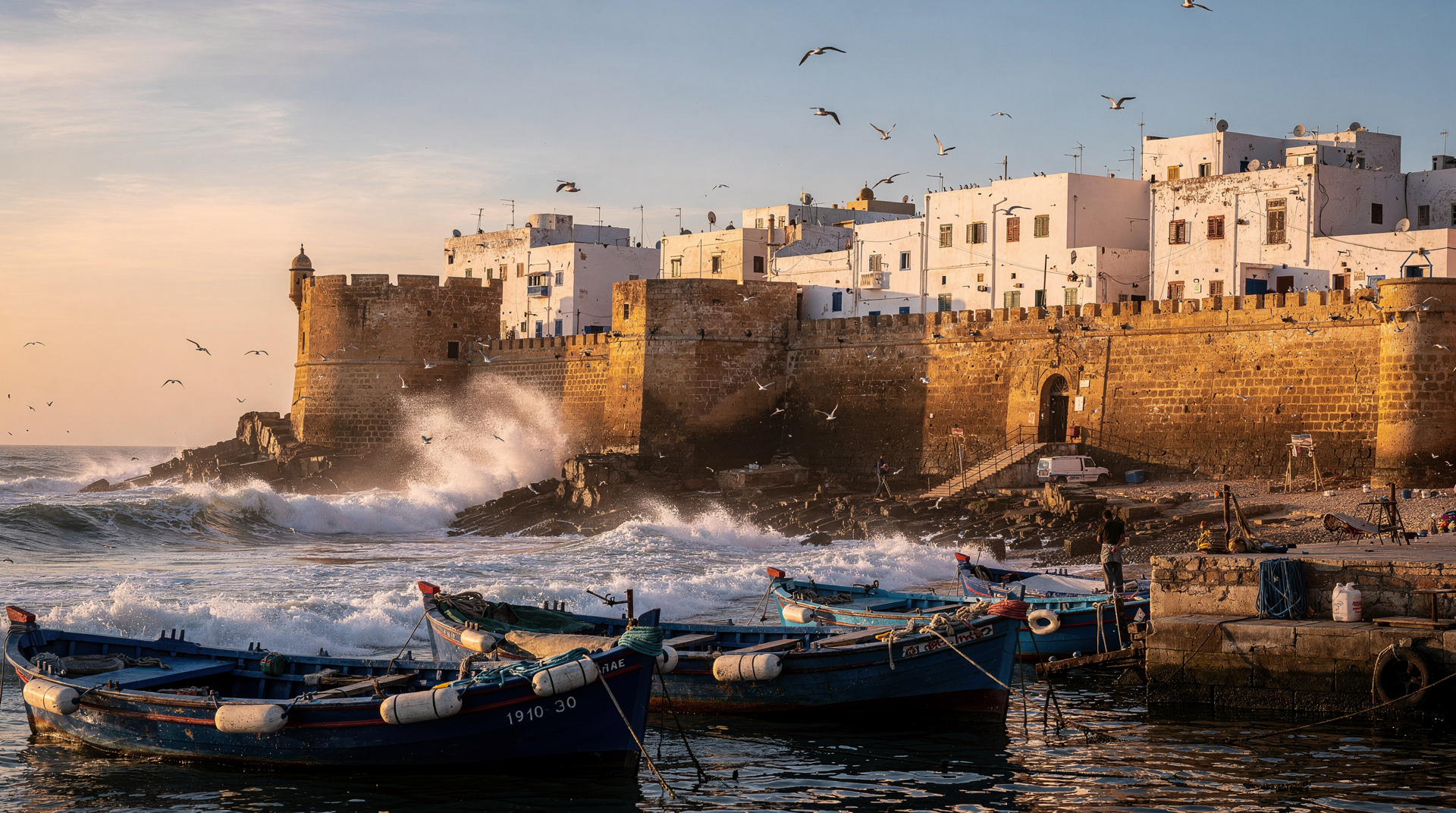
- The medina experience — Portuguese ramparts, fishing harbour, Gnawa music, artisan workshops — is genuinely excellent and completely absent from Taghazout
- Accommodation in Essaouira offers genuine character — riads with courtyards, terrace views over the ramparts, genuine hospitality environments
- The beach itself is visually dramatic — wide, wild, with the medina walls and the islands (Îles Purpuraires) as backdrop
- Sidi Kaouki, the wilder beach break 15km south, is developing its own surf and kite camp scene while retaining genuine remoteness
The honest limitations:
- The wind that creates kite and windsurf conditions makes surfing harder — onshore wind chops the surf, reducing quality for wave surfing
- The beach break at Essaouira is less powerful and shorter than Taghazout’s point breaks — advanced surfers will find it less satisfying
- Winter can be genuinely cold and grey, with storm wind making the city uncomfortable for multiple days at a stretch
Surf lessons at Essaouira for all levels use the sheltered beach sections where the wind impact is reduced — viable for beginners even on windy days.
By traveller type
Dedicated surfers (intermediate-advanced): Taghazout wins. The point breaks are a different category of surfing experience from Essaouira’s beach break.
Beginners learning to surf: Both work. Essaouira’s beach break is slightly gentler; Taghazout’s camp infrastructure is more developed for lessons.
Kitesurfers and windsurfers: Essaouira (and Sidi Kaouki) are the better choice — the consistent Alizé winds produce world-class kite conditions.
Cultural travellers who also surf: Essaouira. The medina and cultural scene add a dimension that makes the trip worthwhile beyond the waves.
Couples: Essaouira — romantic riad accommodation, evening medina atmosphere, shared cultural experiences. Taghazout is more functional than romantic.
Week-long surf camps: Taghazout has the developed package infrastructure for a full surf-camp week — lessons, accommodation, guide, transfers sorted in one booking.
Verdict by scenario
5-day dedicated surf trip: Taghazout. Base at a surf camp, surf Anchor Point and Hash Point, day trip to Agadir.
10-day Morocco trip that includes surfing: Essaouira — stay 2-3 nights, surf mornings, medina afternoons. Less surf-intensive but more complete Morocco experience.
Learning to kitesurf: Essaouira is the clear answer — the consistent Alizé trade winds make it one of the world’s better beginner kite destinations.
Wanting to combine surf with Agadir beach: Taghazout is 20 minutes from Agadir — easy to mix point break surf sessions with Agadir beach afternoons.
Solo surf trip: Taghazout’s surf camp social scene is better for solo travellers — the camp format naturally creates a community.
Can you combine both?
Yes — they’re 170km apart (2.5-3h by road) and both on the Atlantic coast south of Marrakech. A workable itinerary:
- Marrakech → Essaouira (3h): 2-3 nights in the medina, surf the beach break, kite lesson at Sidi Kaouki
- Essaouira → Agadir (2.5h): one night in Agadir
- Agadir → Taghazout (20min): 2-3 nights at a surf camp, point break sessions
This Atlantic coast arc works well as a 7-8 day standalone circuit from Marrakech, or as part of a longer Morocco loop. The Atlantic coast guide covers the full route. The Marrakech base guide compares using either city as your overall Morocco base.
Going deeper on each town
If Taghazout is leaning ahead, the Taghazout destination page covers the village itself, while surfing in Taghazout goes break by break and surf camps in Taghazout helps you choose between the budget and boutique ends of the camp scene. For the bigger national picture, the Morocco surfing guide puts both towns alongside the country’s other spots.
If Essaouira appeals more, start with the Essaouira destination page, then look at riads in Essaouira for somewhere to sleep after a day in the water. The Essaouira food tours guide is a good way to spend a non-surf afternoon, and the Gnaoua festival guide is worth reading before you fix your dates. For the wilder beach break to the south, see Sidi Kaouki.
Building the surf into a wider route
Surfers who want more than one stop can fold either town into a longer trip. The surf Morocco itinerary and the Atlantic coast itinerary both lay out how to sequence the coast without rushing, and the best beaches in Morocco guide is useful for rest days when the swell goes flat.
What about Agadir as a base instead?
Some surfers skip both and base in Agadir, using it as a launchpad for day trips to Taghazout (20 minutes) without committing to the surf-camp lifestyle. This works if you want beach-resort infrastructure — more restaurant variety, bigger hotels, nightlife — alongside easy access to the point breaks. The Taghazout day trip from Agadir guide covers the logistics. It’s a reasonable compromise for travellers unsure whether they’ll surf every day, but it dilutes the immersive surf-camp experience that makes Taghazout worthwhile for dedicated surfers, and it puts real distance between you and Essaouira’s cultural content.
Comparing to a third option: Agadir itself
For travellers who want beach time without committing to either surf town’s specific character, Essaouira vs Agadir is worth reading before finalising the Taghazout-vs-Essaouira decision — Agadir’s resort infrastructure is a genuinely different proposition from both.
Frequently asked questions about Taghazout vs Essaouira
Is Morocco good for surfing year-round?
Both Taghazout and Essaouira have year-round surf, but season matters. October through April produces the best Atlantic swells (generated by North Atlantic storms) and offshore/neutral winds. Summer sees thermal winds that reduce surf quality, though the warmer air temperatures offset this somewhat.
Do I need my own surfboard in Morocco?
No — both destinations have surf schools and board rental. Quality ranges from battered beginners’ foam boards (cheap) to quality shortboards for hire. Week-long surf camps at Taghazout typically include board rental in their package prices.
What wetsuit thickness do I need?
A 3/2mm wetsuit handles Moroccan Atlantic water temperatures comfortably year-round. In December-February when sea temperatures drop to around 16°C, a 4/3mm adds comfort. Wetsuit rental is available at both destinations but bringing your own is worth it for a dedicated surf trip.
Is Sidi Kaouki worth visiting from Essaouira?
Yes. The wilder beach break is better than Essaouira’s main beach for wave surfing, and the landscape — emptier, more remote — is beautiful. It’s 15km south via a coastal track (4x4 or high-clearance vehicle) or reachable by taxi from Essaouira. Basic camp accommodation is available if you want to overnight there.
Are there surf lessons in English at both destinations?
Yes. Both Taghazout and Essaouira have international surf schools with English-speaking instructors. Taghazout has more camps oriented toward English-speaking markets (UK, Ireland, Netherlands). Essaouira schools are used to mixed European clientele.
Is Taghazout or Essaouira better for a first Morocco trip that isn’t primarily about surfing?
Essaouira. Its medina, ramparts, and Gnawa music scene give non-surfers plenty to do, and the why Essaouira over Marrakech for first-timers piece explains why it works well as a broader introduction to the country. Taghazout is worth it specifically for people prioritising the surf.