Photography Etiquette in Morocco: The Complete Guide
Can I freely take photos in Morocco?
Architecture, landscapes, and markets are generally fine to photograph. Always ask before photographing people — 'photo?' as a question works universally. Mosques are largely closed to non-Muslims, so external shots only in most cases. Drones require advance permits. Don't photograph royal palaces, police stations, or military sites.
Photography in Morocco: the principle that covers most situations
Morocco is extraordinarily photogenic — the blue streets of Chefchaouen, the tanneries of Fes, the Sahara dunes at sunset, the ornate tilework of medersas. It’s also a country where photography of people without consent creates real friction and where specific categories of subject matter are genuinely restricted.
The guiding principle that handles most situations: ask before photographing people, and accept the answer if it’s no. Beyond this, understanding a handful of specific rules about sensitive locations prevents the kinds of incidents that turn great travel days into uncomfortable ones.
Photographing people: the essential rule
Morocco is a conservative Muslim-majority country. Many Moroccans — particularly women in traditional dress, older generations, and people in market and working contexts — do not want to be photographed without permission. This is not unusual hostility toward tourists; it’s a cultural norm around dignity and consent.
The approach that works: Make eye contact, gesture toward your camera or phone, and say “photo?” with a questioning tone. This is universally understood. A smile and a nod means yes. A shake of the head, a hand gesture, or a “la” means no. Accept no gracefully and move on.
In the medinas: Souk vendors, women in traditional clothing, and people in the act of prayer or worship particularly appreciate being asked. Photographing someone in their workplace (a butcher’s stall, a spice seller, a traditional craftsman) is often fine with a respectful request. Photographing without asking — phone raised quickly, point-and-shoot — is noticed and generates hostility.
Street photography style: The “candid street” approach that’s common in European cities is much more fraught in Moroccan medinas. What reads as artistic documentary in Paris reads as invasive in Fes el-Bali. This doesn’t mean candid photography is impossible — it means the approach requires more patience and relationship-building.
After someone says yes: A small thank-you payment is appropriate in some contexts. Djemaa el-Fna performers expect payment if photographed (10-20 MAD). Artisans who let you photograph their work in their workshop may not expect payment but appreciate it. Use judgment.
Children: Photographing children requires parental consent. In practice, many Moroccan children love being photographed and will pose enthusiastically. When in doubt, ask nearby adults.
Djemaa el-Fna performers: a specific case
The performers at Marrakech’s main square — snake charmers, acrobats in traditional costume, gnawa musicians, monkey handlers — perform for tourism income. Photographing them without entering the fee context is a specific etiquette challenge.
If you’re close to them: You’re in the tip zone. Photograph from proximity and pay 10-20 MAD per performer photographed. This is their livelihood.
If you want photos without the interaction: The cafe and restaurant terraces surrounding Djemaa el-Fna provide elevated views of the square. With a phone zoom or a longer lens, you can photograph the square’s atmosphere from above without direct interaction. This is the standard approach for photographers who want documentary shots without confrontation.
Snake charmers specifically: Engagement with the snake — handling, posing — immediately creates a payment expectation. Simply watching from a respectful distance is different from touching the cobra for a photo.
Mosques and religious sites
The vast majority of Morocco’s mosques are not accessible to non-Muslims. This includes:
- The Koutoubia Mosque in Marrakech
- The Kairaouine Mosque in Fes
- The Tinmel Mosque in the Atlas
- Most zaouias (shrines)
Photographing the exterior of mosques is generally fine. Walking up to the entrance for a closer look is usually fine. Attempting to enter or pointing cameras inside through doorways is not appropriate.
The Hassan II Mosque in Casablanca is one of the only mosques in Morocco that officially admits non-Muslim visitors on guided tours. Photography inside is permitted during the tour (with some exceptions around prayer spaces). A Hassan II Mosque guided tour with entry is the standard way to access and photograph this extraordinary building’s interior.
Medersas and religious schools: Some historical medersas (such as the Bou Inania in Fes or the Ben Youssef Medersa in Marrakech) admit non-Muslim visitors with an entry ticket. Photography of the architecture — tilework, carved plaster, cedar ceilings — is allowed in most of these. Photographing people at prayer or in worship contexts is not.
Cemeteries: Moroccan cemeteries are Muslim spaces and photography is generally not appropriate. Some historical cemeteries at the edges of medinas are more tourist-accessible; use judgment and be genuinely discreet if you photograph anything.
The Fes tanneries: a specific photographic case
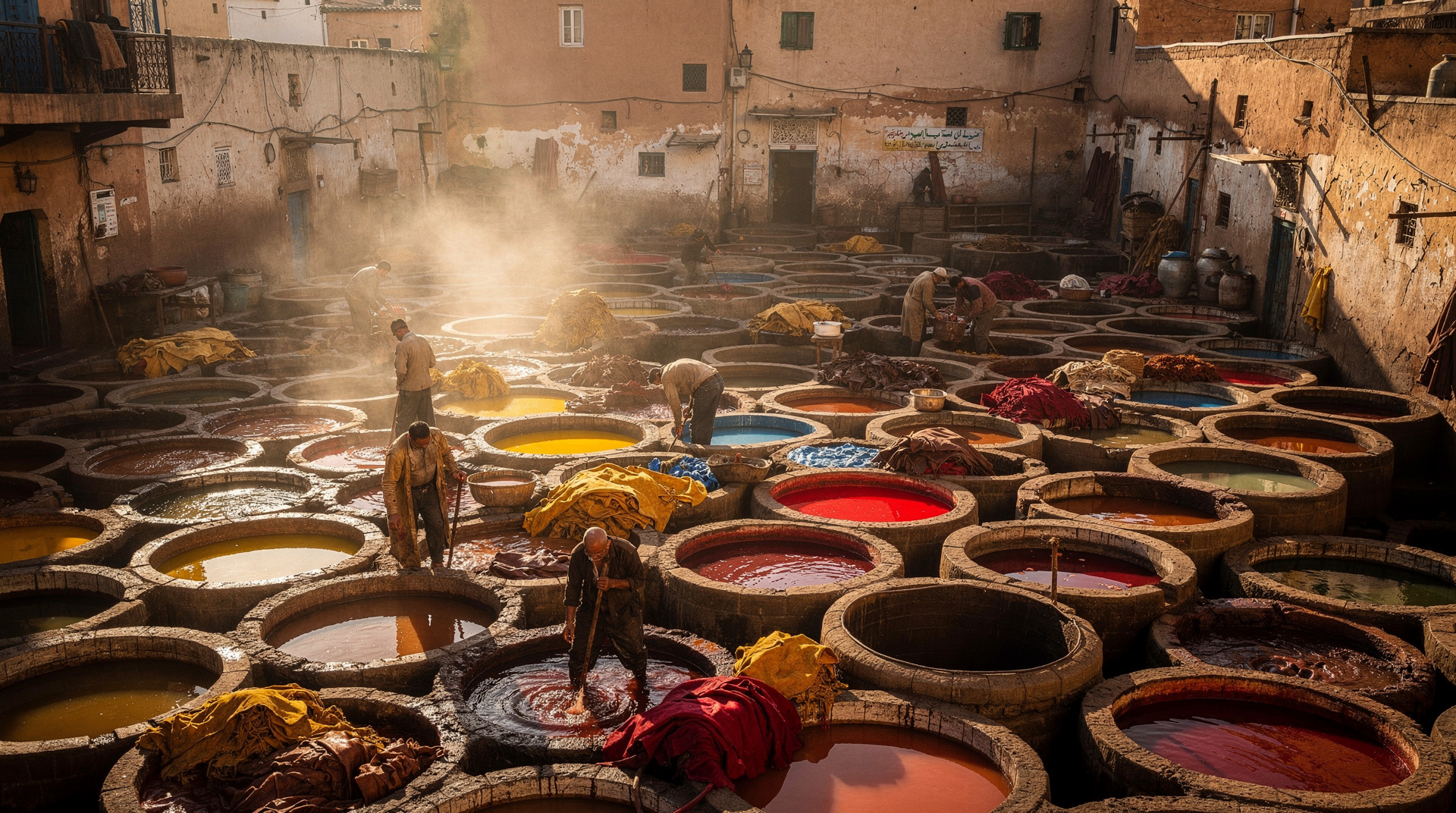
The Chouara Tanneries in Fes are one of Morocco’s most photographed sights — the circular dyeing vats, the workers, the vivid colours of dye and leather. Getting a photo here requires navigating a specific social setup.
The standard tourist access: Via the leather shop rooftops that border the tanneries. The shops offer a “free view” from their terrace in exchange for exposure to their leather goods. Photography from these terraces is permitted and excellent. The view from rooftop level looking down into the tannery vats is the classic shot.
Photographing the workers: The tannery workers are in a working environment and are not performers. Some don’t mind being photographed; others find it intrusive. A gesture toward your camera and a raised eyebrow works as a query. If you’re on a guided tour, your guide will advise on the etiquette specific to that day.
Licensed tannery entry: A formal tannery viewing arrangement exists through operators — an official Fes tour that includes the tannery handles the access logistics and gives you context for what you’re photographing.
Restricted photography: what not to photograph
Royal palaces
Morocco’s royal palaces — including the Royal Palace in Fes, the Royal Palace in Casablanca, and the grounds of any royal residence — are off-limits for photography. This is a legal restriction, not a guideline. The guards will intervene if you raise a camera. Photograph the outside of the decorative gates (a common and acceptable shot) but not the palace buildings or grounds beyond the gates.
Police stations and military installations
Photographing police stations, military checkpoints, army barracks, or any military infrastructure is illegal in Morocco. This is standard in many countries but enforced here. If you’re uncertain whether a building is a security installation, don’t photograph it.
Government buildings
Photographing certain government buildings (particularly in the political context of Rabat) is restricted. The Tour Hassan and Mausoleum of Mohammed V in Rabat are tourist attractions and fine to photograph; active government ministries and parliament buildings are not.
Prisons
Obvious but worth stating: don’t photograph any correctional facility.
Sensitive border and military zones
The Western Sahara region (Laayoune, Dakhla) has additional sensitivities around photography of infrastructure. If you’re visiting this area, be conservative about what you photograph in areas that might be considered strategic.
Drones in Morocco: the real rules
Recreational and professional drone use in Morocco requires advance permission. This is not a loose guideline — drones operated without permits have been confiscated and operators fined.
The legal framework: Drones in Morocco fall under the Direction Générale de l’Aéronautique Civile (DGAC). All drones above 250g require registration. Commercial drone operations require specific authorisation. Flying near airports, military installations, cities, and tourist sites generally requires specific permits that are non-trivial to obtain.
In practice: Many tourists fly small drones in Morocco without incident — particularly in remote desert and mountain areas away from urban zones. But flying over Marrakech medina, over beach areas with crowds, or near any restricted zone creates real risk of confiscation and a fine.
If you want drone footage: Research the specific area you plan to fly over. The Atlas Mountains and Sahara dune areas are lower-risk than urban medinas or coastal resort areas. Consult recent accounts from other photographers about what they encountered. Don’t fly near Menara Airport (Marrakech), Mohammed V Airport (Casablanca), or any military checkpoint.
Insurance: If you’re flying a drone professionally, ensure your liability insurance covers Morocco specifically.
Market and craft photography
Photographing craft products — ceramics, leatherwork, textiles, metalwork — in shops and souks is generally fine when asked. Many vendors are proud of their work and happy to have it photographed.
Photographing active craft processes (a ceramicist at the wheel, a leatherworker stitching, a weaver at a loom) is usually fine with a quick gesture of permission. These are working people in a workplace, and a moment of consultation before photographing is the respectful approach.
Photographing food markets (fresh produce, spice stalls, meat markets) is fine for atmosphere shots from a step back. Getting very close to vendors’ faces or food preparation without asking is less welcome.
Getting great ethical photos
Early morning: The medinas are dramatically quieter from 7-9am. Fewer tourists, better light, more relaxed vendors. The best architectural and street photography happens before the souk crowds arrive.
Telephoto from a distance: A phone zoom or a longer lens from across a lane captures human scenes without intrusion. The candid moment from 20 metres is more honest than a staged close-up.
Make a connection first: Even 30 seconds of genuine conversation before asking for a photo changes the whole interaction. Asking a craftsman about their work, genuinely listening, then asking for a photo — this produces a better photo and a better human exchange.
The architectural photography reward: Morocco’s buildings require no permission. Tilework, carved plaster, mashrabiya latticework, painted doors — all of this is freely photographic and extraordinarily detailed. Marrakech’s riads, the medersas of Fes, the kasbah architecture of the south, and the kasbahs of the Draa Valley are among the world’s most visually distinctive built environments.
Light in the Sahara: The 30 minutes after sunrise and before sunset in the Sahara are extraordinary for photography. The dunes of Erg Chebbi near Merzouga change colour through gold, orange, and rose. This is the shot that makes the 10-hour drive from Marrakech feel completely justified. A 3-day Sahara tour to Merzouga times the camel ride and camp arrival specifically for the golden hour at the dunes.
Photography and the scam ecosystem
One specific photography scam worth noting: in some contexts, someone will “offer” to photograph you in a scenic location, take your phone to do so, and then demand payment before returning it. This is rare but documented.
Prevention: If you want a photo of yourself in a scenic spot, ask a fellow tourist rather than an uninvited local volunteer. If a local offers to take your photo, don’t hand over your phone — use a camera with a strap instead, or decline.
For the full scam context, the scams guide covers the broader landscape.
Camera gear recommendations for Morocco
Dust: The Sahara and the desert south have very fine dust that gets into everything. A good camera bag that seals against dust and a supply of lens cleaning wipes are essential. Sensor dust is common after desert travel.
Heat: Extreme heat in summer can affect battery performance. Carry spare batteries.
Sand: Don’t change lenses in the open desert — sensor contamination from sand is a real risk. A sealed changing bag or doing lens changes inside a tent or vehicle is better.
Security: Expensive camera equipment in medinas attracts attention. A camera body around the neck with a strong wrist strap is more secure than a loose grip. Camera bags that look like camera bags are more visible targets than regular-looking bags.
Connecting to related guides
The solo female travel guide covers photography considerations specific to women travelling alone. The scams guide details the performer payment dynamics. For Fes specifically, the is Morocco safe guide addresses medina navigation and safety.