Solo Female Travel in Morocco: The Honest Guide
Is Morocco safe for solo female travellers?
Morocco is manageable for solo women with preparation. Violent crime is rare. Street harassment in tourist medinas is real and higher than Western Europe — but smaller cities, the coast, and the Atlas are notably calmer. Most solo women have good trips. Preparation matters more here than in many destinations.
What solo female travel in Morocco actually looks like
Every year, tens of thousands of women travel Morocco alone. Most have positive, enriching experiences. A meaningful minority find the medinas exhausting and the constant attention draining. Both outcomes are real, and the difference often comes down to preparation, destination choice, and knowing what to expect before you land.
This guide doesn’t paper over the friction. Morocco has a higher level of street harassment than Western Europe, and pretending otherwise does solo women a disservice. But it also doesn’t catastrophise — because Morocco is absolutely doable solo, and many travellers come back considering it among the best trips they’ve taken.
Here’s the honest picture.
The street harassment reality
Solo women in Morocco’s tourist medinas — particularly in Marrakech and Fes — face more unsolicited attention than in most European countries. This ranges from unwanted comments and staring to men following you for several minutes, asking where you’re from, whether you’re married, where you’re staying.
It is almost never physically threatening. It is often genuinely irritating.
The key word is “tourist medinas.” In the Gueliz neighbourhood of Marrakech (the new city), in Casablanca’s business districts, in Essaouira’s wide beachfront, in Chefchaouen’s tiny medina — the dynamic is completely different. The harassment is concentrated around the most tourist-dense zones where a specific hustling culture has evolved.
Understanding this geography helps you plan a trip that minimises friction without cutting yourself off from Morocco’s genuine highlights.
Where the experience is easiest for solo women
Essaouira — consistently the best starting point
Essaouira is almost universally cited by solo female travellers as the most relaxed Moroccan city. The combination of a strong surf culture, an artistic community, and a less intense medina environment creates a noticeably different atmosphere than the imperial cities. The medina is UNESCO-listed, genuinely beautiful, and almost entirely free from the professional hustling that characterises Marrakech. The persistent Atlantic wind seems to keep everyone moving forward rather than loitering for targets.
If you’re anxious about your first solo Morocco experience, starting in Essaouira is a sound strategic choice.
Chefchaouen — small, manageable, photogenic
The blue city of Chefchaouen is small enough to understand quickly. The medina takes 15-20 minutes end to end. Locals are accustomed to tourists but not dependent on tourist hustling for income in the way that Marrakech medina residents can be. Some hashish approaches happen (the Rif region produces significant amounts), but a flat “no” while walking works consistently.
Chefchaouen is not hassle-free — it’s Morocco — but it’s at the easier end of the spectrum.
The Atlas Mountains — genuine hospitality culture
Village hospitality in the High Atlas operates on different principles to medina tourism. Interaction is direct, genuine, and rarely commercial. Solo women trekking from Imlil toward Toubkal or through Berber villages report overwhelmingly positive interactions with locals. The main considerations here are physical safety (trail conditions, altitude) rather than social friction.
A guided Atlas Mountains day trip from Marrakech handles navigation and introductions for those not comfortable going independently.
Agadir — the beach resort exception
Agadir is Morocco’s beach resort city and operates on different social norms. The beachfront area, with its international hotels and tourist infrastructure, feels more like a Mediterranean resort than a Moroccan medina. Solo female travellers consistently find it easy. The trade-off: Agadir has less of what makes Morocco distinctive culturally. But as a decompression stop or a base for day trips, it works well.
Marrakech and Fes — navigable, requiring more energy
This guide won’t tell you to avoid Marrakech and Fes — they’re two of the most fascinating cities in Africa and deserve to be on any Morocco itinerary. But they require more energy and preparation for solo women than the alternatives listed above.
In Marrakech: the Djemaa el-Fna and the souk area north of it is where most harassment concentrates. The rest of the medina — the Mellah quarter, the area around Bab Doukala, the residential streets of Riad Laarouss — is noticeably calmer. Your first day should involve a guided orientation (your riad staff can provide this informally) before you head out solo.
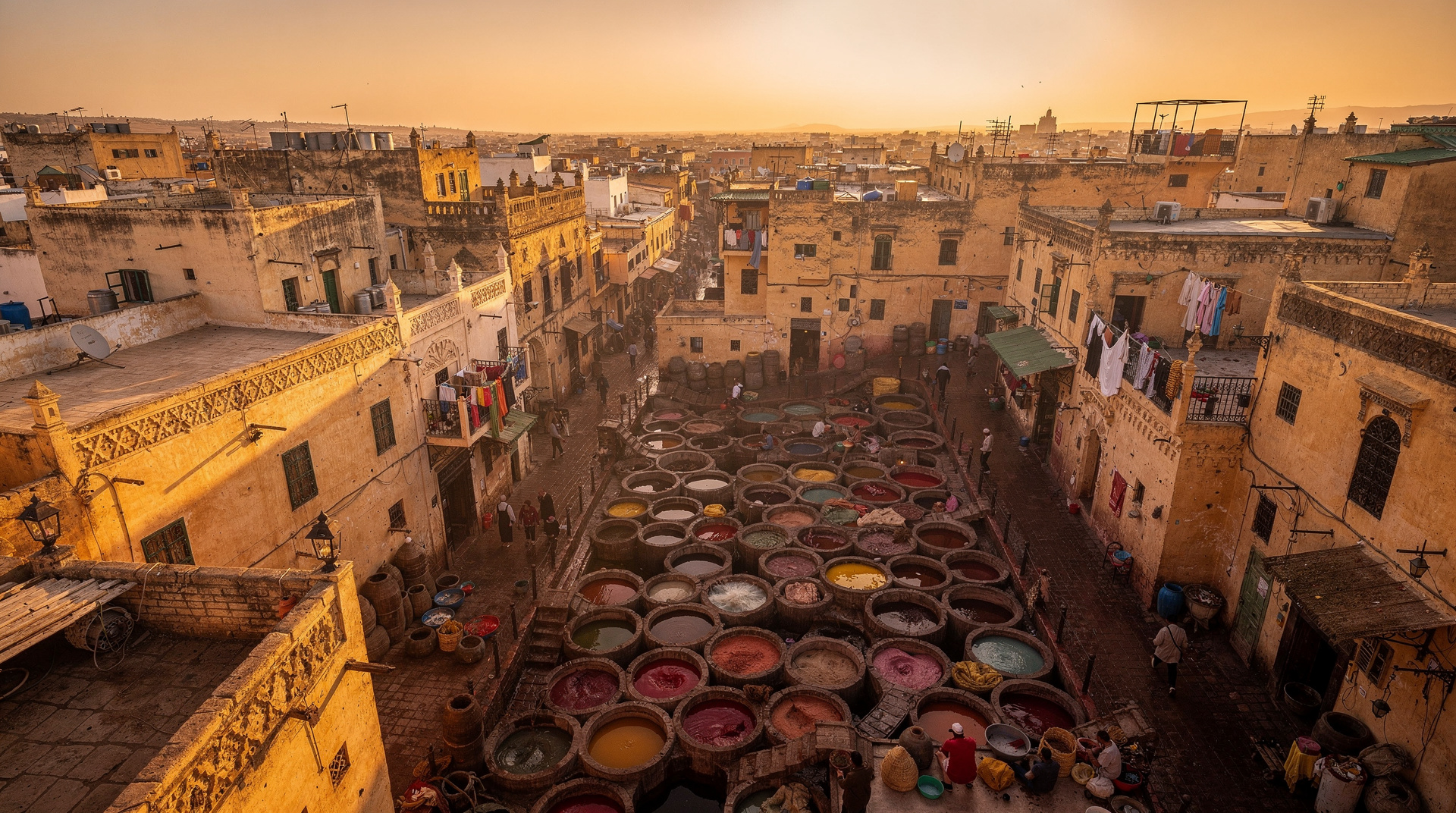
In Fes: the challenge is more navigation-based. The medina is genuinely maze-like in ways that make getting lost normal, and getting lost creates vulnerability. A licensed guide for your first day in Fes el-Bali is money genuinely well spent — it makes the medina navigable and interesting rather than stressful. A guided Fes medina tour gives you the orientation map in your head for independent exploration afterwards.
Dress guidelines for solo women
Dressing modestly reduces friction in Moroccan medinas. This doesn’t mean covering everything — tourists in Morocco are not expected to dress like Moroccan women, and nobody is going to confront you about your clothing. But the relationship between dress and the level of attention you receive is real.
Practical guidelines:
Shoulders and knees covered in medinas. This is the most effective single adjustment. A lightweight long-sleeved top and trousers or a midi-length skirt removes you from the most visible tourist category and reduces approach frequency noticeably.
Chest coverage matters more than you’d expect. Low necklines that would be completely normal in Madrid or Paris attract specific attention in Moroccan medinas. A scarf that you can deploy as needed is a useful flexible tool.
At the beach and in resort areas: Normal beach attire is fine at Agadir’s beach, Essaouira’s surf spots, and Taghazout. The resort beach context is understood.
In the Atlas and rural areas: Shoulders-and-knees coverage is more important than in cities, not less. Village interactions are respectful and positive, and dressing accordingly reinforces mutual respect.
Hammams: You’ll strip down to underwear (women’s hammams) or a bathing suit. This is the hammam context and is understood. Private hammam experiences at riads are an alternative if communal is uncomfortable.
What not to do: Shorts and a tank top in the Marrakech medina on a hot July day is your call to make, but it will increase the attention you receive from the tourist-hustling sector of the medina noticeably.
Handling hassle: what actually works
Ignoring doesn’t work as well as many travel guides suggest. In Morocco’s tourist medinas, ignoring someone often reads as an invitation to continue.
What works:
Walk with purpose. Hesitation, looking at your phone in the middle of a lane, studying a map while standing still — all of these read as opportunity. Navigate at home the night before, then walk like you know where you’re going.
A firm “la, shukran” (no, thank you) while maintaining forward motion. You don’t need to stop, engage, or explain. Say it once, keep walking.
“I’m not interested, thank you” in English works surprisingly well — many touts drop approaches when they realise the English response will be consistent and non-engaging.
Don’t engage with the preamble. “Where are you from? France? Germany? First time in Morocco?” is not small talk — it’s the opening of a sales interaction. You don’t need to answer.
The ring trick: Some solo women wear a simple ring and mention “my husband is meeting me later” when pressed. This is entirely your choice to make and works with some (not all) approaches.
Accept that some days the medina is exhausting. Even experienced solo female travellers have days where the cumulative attention in Marrakech’s medina is draining. Schedule “recovery” time in quieter areas, riads, or restaurant terraces. You don’t need to be in the medina at peak hours every day.
Accommodation choices matter
Where you stay affects your experience significantly.
Riads in the medina: The traditional choice — and a great one for atmosphere. Prioritise riads with an active reception and helpful staff over beautiful-but-remote options. A riad manager who can give you a 10-minute orientation on which routes to take, where to avoid at which times, and how to get back safely is worth more than a discount rate at an unattended guesthouse. Read reviews specifically for mentions of staff helpfulness to solo women.
Guesthouses and hostels with common areas: The social infrastructure of a hostel common area matters when you’re travelling alone. Casablanca and Marrakech both have decent hostel scenes with a mix of travellers. These are also good places to find travel companions for day trips if you prefer not to do everything solo.
Book the first two nights before you arrive. Arriving in a Moroccan city for the first time, negotiating accommodation with luggage and jet lag, is harder than it needs to be. Pre-book the first stop; adjust from there based on experience.
Night safety in Moroccan cities
In tourist medinas: The main squares and restaurant streets are busy until 10-11pm and remain relatively safe. Avoid poorly lit alleys in outer medina zones after dark. Your riad should be able to tell you the specific route to take back.
Taxis at night: Use petit taxis (licensed) rather than accepting rides from unofficial drivers who approach you. Your riad or restaurant can call a trusted taxi. In Marrakech, the Careem app (app-based rides) eliminates negotiation entirely.
Dining alone: This is straightforward in tourist restaurants, which are accustomed to solo travellers. Local restaurants are sometimes more awkward — not hostile, but you may be the only person eating alone in a room of family groups. Both experiences are valid.
Djemaa el-Fna at night: Busy, chaotic, and generally safe — but keep your bag secure and your phone in a pocket, not in your hand. The food stall area is more crowded than it looks from the edges.
Hammam experiences for solo women
The traditional Moroccan hammam is one of the genuine pleasures of travelling here and is entirely accessible to solo female travellers.
Local women’s hammams: Neighbourhood hammams have separate sections for women (or specific women-only times). Prices are astonishingly cheap — 10-20 MAD for the full experience. The attendant will scrub you down with a kessa (exfoliating glove) and apply black soap. No Darija required — the process is universal and the attendant knows what to do. Tip 10-20 MAD afterwards.
Riad and spa hammams: More expensive (200-500 MAD) and aimed at tourists, but also more comfortable for those who find the communal local hammam intimidating. Clean, calm, and with English-speaking staff. The experience is less authentic but perfectly enjoyable.
What to bring: Underwear or swimwear for the local hammam. A change of clothes for after. Your own shampoo if you prefer (soap is provided). Flip-flops.
A traditional hammam experience in Marrakech with a booking removes the uncertainty about finding the right place and knowing what to expect.
Photography safety
Pointing a camera at people without asking is the fastest way to create confrontation. Always ask first, especially in the medinas.
For photographing architecture, street scenes, and general atmosphere, you’re fine. For people — street workers, market vendors, children — ask first with a gesture or “photo?” and accept the answer if it’s no.
Women photographing in conservative dress and behaving respectfully are rarely confronted about photography. The issue arises when tourists are visibly intrusive.
Solo female safety by region summary
| Region | Harassment level | Physical safety | Solo-friendliness |
|---|---|---|---|
| Marrakech medina | High | Good | Manageable with prep |
| Marrakech Gueliz | Low | Very good | Easy |
| Fes medina | Medium-high | Good | Needs orientation |
| Chefchaouen | Low | Very good | Easy |
| Essaouira | Very low | Very good | Excellent |
| Agadir beach | Very low | Very good | Excellent |
| High Atlas | Very low | Good (hiking) | Excellent |
| Merzouga/Sahara | Low | Good | Good (tour context) |
Practical planning tips
Transport: Book train and bus tickets in advance for popular routes. The getting around Morocco guide covers all transport options. For the Sahara, a guided tour is more practical and safer than independent travel for solo women — you’re with a group and the logistics are managed. See how to book a Sahara tour for the detail.
Money: Read the Morocco currency guide for ATM tips and cash management. Solo travellers need slightly more cash buffer for taxis and small security expenditures.
What to pack: The Morocco packing list has gender-neutral recommendations; solo women should specifically prioritise a daypack that’s difficult to access from behind and a money belt for medina days.
Insurance: Travel insurance with medical coverage is non-negotiable for solo travellers anywhere. For Morocco specifically, choose a policy that covers emergency repatriation.
Itinerary suggestion: Arrive Essaouira or Agadir (gentle start), then Marrakech (now you have your bearings), then further destinations. Ending with the Sahara via a guided tour is a satisfying finale.
Frequently asked questions
Do I need to cover my hair in Morocco?
No. Tourists are not expected to cover their hair in Morocco. A headscarf is appropriate when visiting religious sites (Kairaouine mosque in Fes if non-Muslims were admitted, which they currently are not; some zaouias). For general travel, hair-covering is not expected.
Is Ramadan a particularly bad time to travel solo as a woman?
During Ramadan, Moroccan public space is noticeably different — quieter during the day, more animated after iftar (sunset meal). The harassment dynamic in tourist medinas doesn’t necessarily worsen during Ramadan. Some solo women find Ramadan evenings (iftar atmosphere, communal meals) among the most welcoming experiences of their trip.
Can I visit the Sahara safely as a solo woman?
Yes. Sahara tours run in groups, guides are professional, and the desert camp context is well-managed. It’s one of the safer solo female experiences in Morocco precisely because the tour structure provides company and guidance throughout. See the Ramadan travel guide and the best time to visit guide for seasonal context.
What’s the emergency number in Morocco?
General emergency: 19. Tourist police (Brigade Touristique) exists in major cities and is the right first contact for tourist-related incidents. Your accommodation can contact them on your behalf.
Should I use a fake wedding ring?
It’s a personal choice that some women find effective. It doesn’t work universally — some touts will persist regardless. The more reliable approach is confident body language and consistent non-engagement. But if wearing a ring makes you more comfortable, there’s no reason not to.