Gnaoua World Music Festival Essaouira: everything you need to know
Is the Gnaoua Festival in Essaouira free?
Most of it is free. The main outdoor stages on the ramparts, the beach, and throughout the medina are all free entry. Some special evening concerts in the Moulay Hassan square area may require tickets. The festival typically runs 4 days in late June — 2026 dates have not been officially announced but late June (25-28 June) is the historical pattern.
At a glance
| Where | Essaouira medina, ramparts, and beach |
| Cost | Free for most stages; some evening concerts may require tickets |
| Time needed | 2-4 days to experience the festival properly |
| Getting there | CTM bus or grand taxi from Marrakech, around 2.5 hours |
| Best time | Late June, historically 25-28 June-ish; confirm exact 2026 dates on gnaoua.net |
What the Gnaoua Festival is and why it matters
Every year in late June, Essaouira receives between 400,000 and 500,000 visitors for the Gnaoua World Music Festival — one of Africa’s largest music events and among the most culturally significant festivals in the Arab world. The free outdoor concerts, the Gnaoua trance ceremonies in riad courtyards, and the combination of ancient spiritual music with international jazz, blues, and reggae artists make it an event unlike anything else in the region.
But understanding what the festival is requires understanding Gnaoua music first — because this is not a generic world music festival that happened to be placed in a beautiful location. The Gnaoua tradition is what the festival exists to present, celebrate, and transmit.
Gnaoua music: a living tradition from West Africa
The word “Gnaoua” (also spelled Gnawa) refers to a community and a musical-spiritual tradition that originated with West African populations brought to Morocco as enslaved people over several centuries of trans-Saharan trade. The term itself likely derives from “Gnawa,” a Berber word referring to people from sub-Saharan Africa — Bambara, Hausa, and other Sahelian populations who were sold into Moroccan households and later emancipated.
The Gnaoua tradition is fundamentally a healing practice. At its core is the lila (night ceremony) — an all-night trance ritual performed by a maalem (master musician) and his troupe. The ceremony uses music, chanting, incense, and specific colour associations to invoke mluk (spiritual entities) and achieve states of possession that adherents believe can heal mental illness, spirit possession, and psychosomatic conditions.
The instruments:
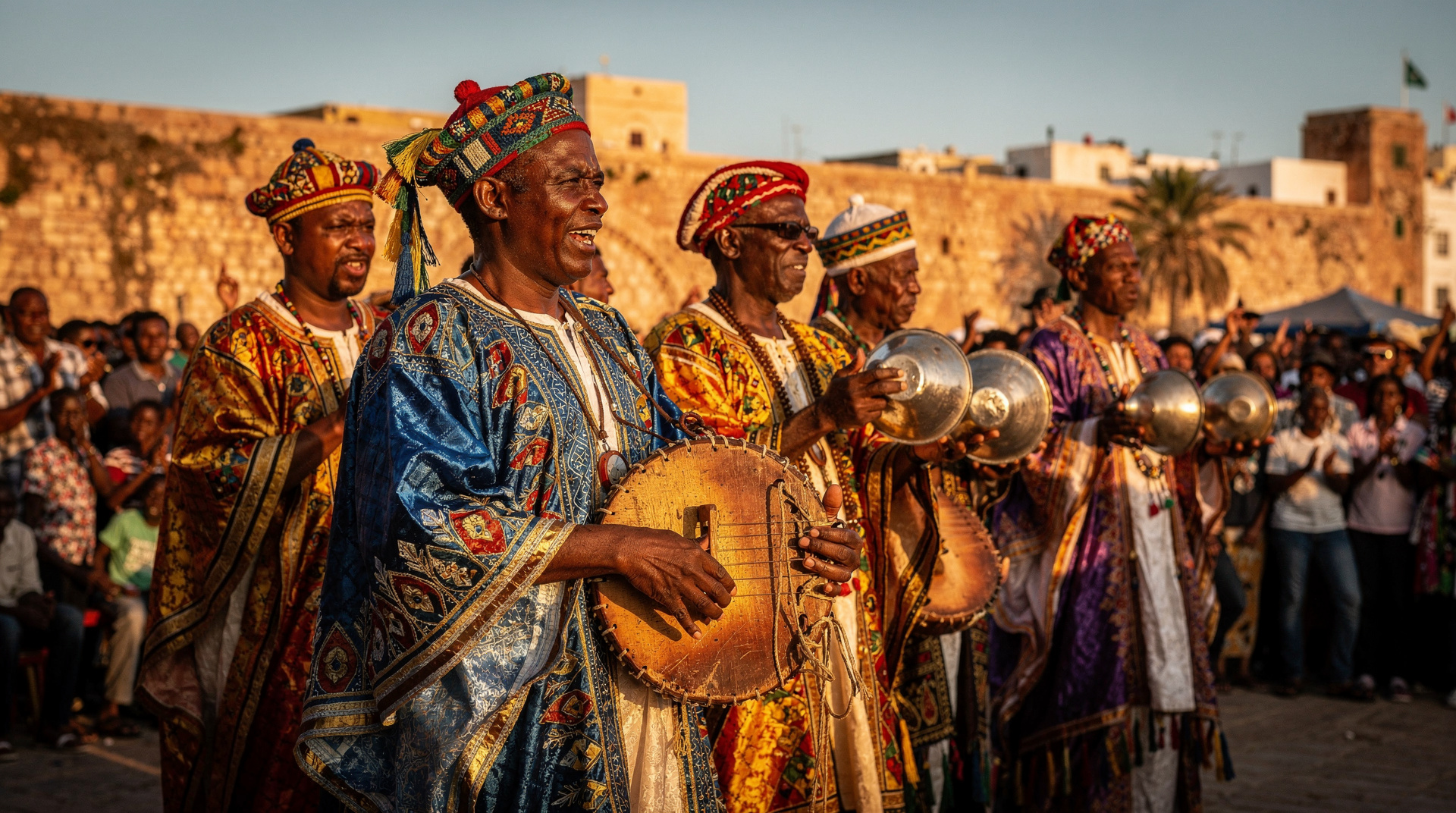
- Guembri (sintir): A three-stringed bass lute with a distinctive percussive thud, tuned in fourths. The guembri is the sacred instrument at the centre of any ceremony — played by the maalem, it carries the melodic and rhythmic foundation.
- Qraqeb: Large iron castanets, held in pairs by each hand and clapped in hypnotic interlocking patterns. The qraqeb sound is the iconic Gnaoua audio signature — clicking, metallic, insistent.
- Tbel: Large drums played with a hooked stick. Provide additional rhythmic drive in outdoor performances.
The repertoire: Each piece (tariq) in the Gnaoua canon is dedicated to a specific mluk entity and associated with particular colours, incense types, and offerings. The complete ceremonial repertoire takes many years to learn and is transmitted orally from maalem to apprentice. A skilled maalem knows hundreds of tariqs across all the colour chapters (seven main ones: black, red, blue, green, white, yellow, and mixed).
The festival’s history and evolution
The Gnaoua World Music Festival was founded in 1998 by a group of Moroccan cultural activists and the municipality of Essaouira, with support from the Ministry of Culture. The founding concept was dual: to bring global attention to the Gnaoua tradition before it was lost to generational change, and to pair Gnaoua masters with international musicians who could engage with the tradition without overwhelming it.
The early years featured collaborations between Essaouira’s Gnaoua masters and musicians including Randy Weston (American jazz), Carlos Santana (who has attended multiple times and has publicly discussed the festival’s influence on his music), and a range of African, European, and Middle Eastern artists.
Over 25+ years, the festival has evolved into the major cultural event it is today — but it has also been criticised for the commercialisation of Gnaoua music and the extraction of its ceremonial forms into a concert context that strips the spiritual framework. This tension is real and acknowledged by serious practitioners. The festival’s response has been to maintain space for traditional lila ceremonies (often in riad courtyards, not on main stages) alongside the international collaborations.
What the festival looks like from the inside
The main stages: The festival sets up large outdoor stages at several locations across the city. The Place Moulay Hassan (the main square near the medina entrance) has historically been the primary concert venue for international headliners. The esplanade de Bab Marrakech (near the ramparts) hosts major Gnaoua performances. The beach provides space for auxiliary stages.
The free outdoor concerts: Most performances happen on outdoor stages that are free to enter. The crowd is a mixture of Moroccan families, Moroccan young people from across the country, and international festival-goers — primarily French, Spanish, and other European visitors who have built the Gnaoua Festival into their annual calendar.
The intimacy of the medina performances: The festival’s most memorable moments often happen in small spaces — a maalem performing in a narrow alley with 50 people pressed around him, an impromptu collaboration in a riad courtyard, a group of qraqeb players warming up before a stage set in a doorway. Exploring the medina on foot during the festival uncovers these moments repeatedly.
The lila ceremonies: Traditional all-night ceremonies are held in private riads and community spaces throughout the festival period. Some are accessible to respectful non-Muslim visitors; many are not. Festival organisers sometimes arrange access for journalists and serious researchers. For general visitors, the street performances are sufficient to encounter the ceremonial tradition.
2026 festival dates: what we know
The Gnaoua World Music Festival has consistently occurred in late June since its founding. The specific dates shift slightly year to year based on Ramadan scheduling (the festival does not overlap with Ramadan) and the weekend pattern.
Based on historical patterns, the 2026 festival is likely to run approximately 25-28 June 2026 (Thursday through Sunday). Official dates are typically announced in March or April by the festival organisation. Check gnaoua.net for official confirmation as the date approaches.
Ramadan context for 2026: Ramadan in 2026 is projected to begin around 19 February, ending approximately 19 March — well before the festival period. This means the 2026 festival is unlikely to be affected by Ramadan scheduling.
Where to stay: the accommodation reality
Essaouira has approximately 100 riads and small hotels in the medina plus a range of options in the modern districts. During the Gnaoua Festival, the entire city fills — riads are booked months in advance and prices increase by 50-100% above standard rates.
Booking timeline: For festival weekend accommodation in Essaouira, book 3-6 months in advance. Seriously. Anything less and you’ll find nothing in the medina. The good riads (Riad al Madina, Dar Mimosas, Villa Maroc, Lalla Mira) often fill before the official festival dates are announced.
Alternative base: Safi (1.5 hours north) and Agadir (2.5 hours south) retain available accommodation during the festival and allow day trips. This sacrifices the festival atmosphere but solves the accommodation problem. Marrakech (2.5-3 hours) is also an option for those with reliable transport.
Camping: The beach south of Essaouira historically accommodates informal camping during the festival. Municipal facilities are basic. This is popular among younger Moroccan festival attendees.
Managing the crowds
At peak attendance (typically Saturday of the festival), the medina and main square become genuinely difficult to navigate — narrow medina alleys become bidirectional queues, the main stages are packed from late afternoon onward, and the city’s infrastructure (water, waste, transport) shows visible strain.
Practical crowd management:
- Arrive at main stages by 3-4 pm if you want a comfortable position for the evening headliners
- The beach stage is typically less crowded than Moulay Hassan — similar programme quality, much more space
- Explore the medina in the mornings when the crowds are thinner and the riad courtyard performances more accessible
- The festival’s first day (Thursday) is significantly less crowded than Saturday — start then if you have flexibility
- The day after the final concert (often Monday) is the quietest time to still find residual festival atmosphere
The music pairings: what to expect from collaborations
The festival’s curatorial premise is that Gnaoua music’s pentatonic scales and trance-rhythm structures share deep resonances with West African music, American blues, and certain Indian classical traditions. The collaborations test this hypothesis annually, with variable results.
Successful pairing types:
- Gnaoua maalems with West African kora players and percussionists: the most natural fit, sharing deep common roots
- Gnaoua with American blues and jazz artists: the guembri/blues guitar conversation works remarkably well; the qraqeb drives jazz rhythms in unexpected directions
- Gnaoua with Malian or Senegalese artists: particular resonance in the griot tradition context
Less successful pairings: Gnaoua with electronic producers or orchestral arrangements. The trance function of the music requires the specific interaction of guembri, qraqeb, and voice — isolating elements into a studio production strips the functional context.
What to eat and drink during the festival
Essaouira’s food culture shifts during the festival. Port stalls extend their hours; new pop-up vendors appear along the ramparts and beach; café terraces stay open until 2-3 am. See the food guide for Essaouira for the baseline food culture that underlies the festival eating.
Specific festival food tips:
- The port stalls for grilled fish remain the best value, but queue times extend during the main festival days
- Café de France on Moulay Hassan is a good vantage point for watching the square setup and drinking mint tea in relative comfort
- Alcohol is available in licensed venues (some restaurants and the Atlas Essaouira hotel bar) but the medina’s public spaces are alcohol-free by convention if not regulation
Getting to Essaouira for the festival
From Marrakech: CTM buses run regularly (2.5 hours, approximately 100-130 MAD). During the festival, additional services are added. Book your bus ticket in advance — regular services sell out on festival travel days. Shared grand taxis from Marrakech cost approximately 120-150 MAD per person.
Visitors who want transport and a guide for the day — particularly useful for the first morning of the festival when the medina layout is unfamiliar — can take the Essaouira day trip from Marrakech with activity options — transport, free time, and optional guided walks in the medina, from €25pp for the opening day before self-organising for the main festival nights.
From Casablanca: CTM bus or private vehicle via the coast road. Approximately 5-6 hours by road.
Arriving by car: Parking in and around Essaouira becomes difficult during peak festival days. The municipality sets up additional parking areas outside the medina. Walk in — the distances are manageable.
The Gnaoua community: respectful engagement
The Gnaoua community in Morocco is genuinely proud of its tradition and generally welcoming to interested outsiders. A few considerations:
Photographs during ceremonies: Ask before photographing — particularly in more intimate or private settings. During main stage performances, photography is standard. During lila ceremonies, ask the maalem or a community member first.
The music is sacred: Understanding that what you’re watching on the main stage is a public-facing version of a spiritual practice — not folk entertainment — changes how you receive it. Listening carefully rather than treating it as background festival noise is appropriate.
Learning about what you’re hearing: The festival produces materials (programme booklets, sometimes documentary content) explaining the tradition. Engaging with these adds significantly to the experience.
For visitors who discover Essaouira through the festival and want to return for a quieter exploration, the Essaouira half-day old town guided tour — 2.5 hours through the medina, ramparts, and port with a local guide is the best way to understand the city’s layered history outside festival season.
For the broader Essaouira context, the Essaouira destination guide covers the city’s year-round culture and character — the festival is an intensification of what Essaouira is, not an imposition on it.
Combining the festival with the rest of Morocco
Because the festival dates land in late June, many visitors build it into a wider loop rather than a standalone trip. The 10 days itinerary and 14 days itinerary both have room to add Essaouira onto a Marrakech-based trip without heavy restructuring, and the why I keep going back to Essaouira blog post is worth reading for a personal take on what draws people back outside festival season too. If you’re deciding whether to make Essaouira or Marrakech your base for the days around the festival, the Marrakech vs Essaouira base guide walks through the trade-offs.
Other Essaouira festivals and slower alternatives
If the scale of Gnaoua isn’t for you — or you can’t make the late-June window — Essaouira rewards a visit without any festival at all. The city’s Gnawa music heritage is present year-round in smaller ways: street musicians near the port, occasional evening performances in riad courtyards, and shops selling qraqeb and guembris in the medina. The Essaouira destination guide covers the calmer, everyday version of the city that the festival temporarily transforms.
Frequently asked questions about Gnaoua World Music Festival Essaouira
Do I need to book festival tickets in advance?
Most of the festival — the main outdoor stages on the ramparts, beach, and around the medina — is free and doesn’t require booking. What you do need to book well ahead is accommodation, since the city’s limited riad stock sells out months before the festival.
Is the Gnaoua Festival suitable for families with children?
Yes, with some planning. The daytime and early-evening programme is family-friendly and the free outdoor stages are open to everyone, but the medina gets genuinely crowded by Saturday evening. Families are better served basing themselves slightly outside the peak crush (a quieter riad, or a day-trip pattern from nearby Safi or Marrakech) and prioritising the earlier, calmer festival days.