Essaouira vs Agadir: Windswept History or Beach Resort?
Should I visit Essaouira or Agadir?
Essaouira for culture, character, and the authentic Moroccan experience. Agadir for sun, beach, and comfort. They're 3 hours apart and easy to combine. If forced to choose: Essaouira for most independent travellers, Agadir for families wanting beach holidays and resort infrastructure.
Two very different Atlantic cities
Morocco’s Atlantic coast contains two cities that represent opposite ends of what a coastal destination can be. Essaouira is a 16th-century walled port — a UNESCO World Heritage Site — with a working fishing harbour, a characterful medina, strong winds year-round, and an arts scene that attracted Jimi Hendrix and Orson Welles. Agadir is a modern beach resort rebuilt after a devastating 1960 earthquake, with a long sandy bay, resort hotels, a marina complex, and tourism infrastructure designed around maximum comfort.
They’re not competing for the same traveller. Knowing which you are tells you which to visit.
| At a glance | |
|---|---|
| Distance apart | Around 170 km / 2.5-3 hr by bus or car |
| From Marrakech | Both roughly 3 hr by bus or car |
| Cost to compare | Essaouira riads generally cheaper; Agadir resort hotels cost more but include more |
| Getting between them | Direct CTM/Supratours bus or car along the coastal road |
| Best time to visit either | Spring/autumn for Essaouira’s wind, June-September for Agadir’s beach season |
The quick comparison table
| Factor | Essaouira | Agadir |
|---|---|---|
| Old city character | Yes — UNESCO-listed Portuguese medina | No — rebuilt from scratch after 1960 |
| Beach | Windy, beautiful, excellent for watersports | Large, sheltered bay, excellent for sunbathing |
| Wind conditions | Very windy (Alizés trade winds) | Moderate — sheltered bay |
| Swimming in the sea | Possible but cold and wavy | Much more comfortable |
| Watersports | World-class windsurfing, kitesurfing, surfing | Good surfing nearby (Taghazout) |
| Medina | Yes — compact, navigable, good for wandering | Small reconstructed souk — not comparable |
| Architecture | Portuguese ramparts, medina, fishing port | Modern resort-style |
| Food scene | Excellent seafood, good traditional | Excellent seafood, good resort restaurants |
| Arts / music | Strong — Gnawa music festival, galleries | Limited |
| Day trips | Marrakech (3h), Agadir (2.5h), Sidi Ifni | Marrakech (3h), Paradise Valley, Tiznit |
| Distance from Marrakech | 3h drive | 3h drive |
| Accommodation range | Budget to mid-range riads | Budget to 5-star beach resorts |
| Average temperature | Cool to warm, windy year-round | Warm, sunny — 300+ days/year |
| Best for | Culture lovers, artists, surfers | Families, beach seekers, package tourists |
The case for Essaouira
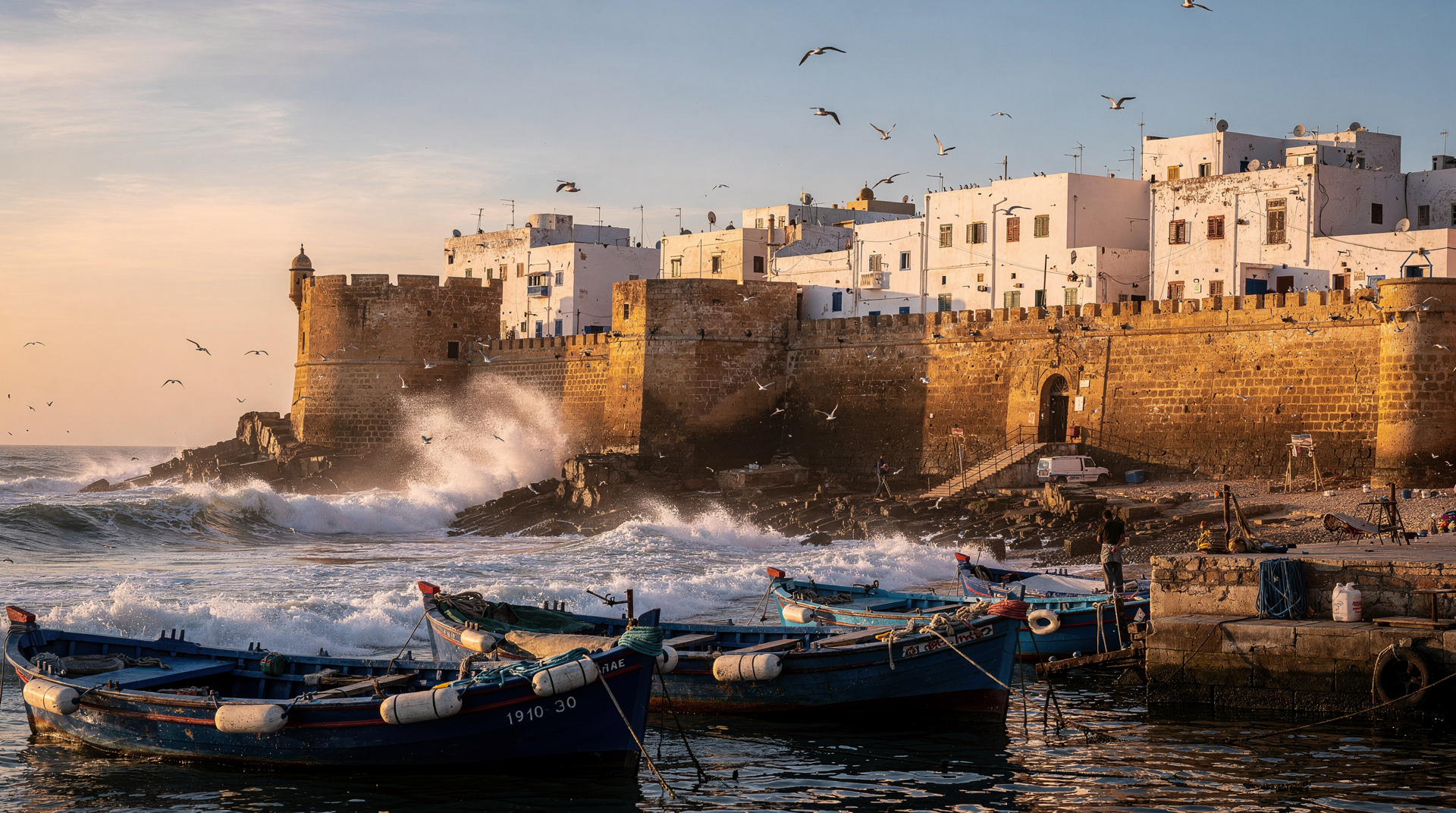
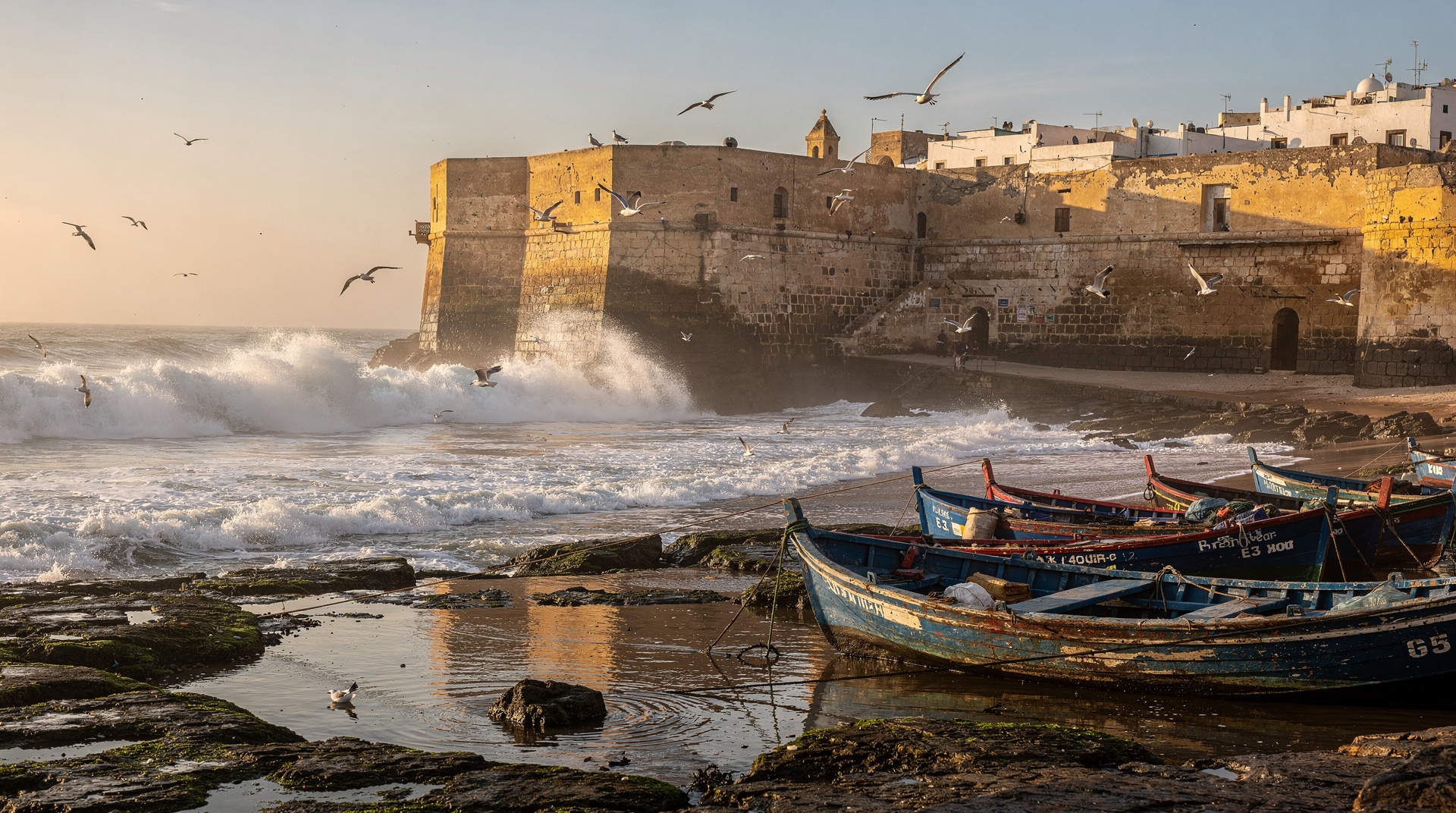
Essaouira’s character is built around a specific combination: salt air, stone ramparts, blue boats, and wind. The Portuguese fortifications (built 16th century, expanded 18th century under Mohammed III who hired a French engineer) define the city’s skyline and create the ramparts walk — one of Morocco’s best urban promenades, with views over the Atlantic crashing against the rocks below.
What works well at Essaouira:
- The medina is compact and navigable — a deliberate contrast to the labyrinth of Fes or Marrakech. Getting lost here is pleasant rather than stressful
- The fishing harbour is a working, smelly, chaotic, photogenic environment — blue boats stacked with nets, fish auction at dawn, seagulls everywhere
- Gnawa music (an ancient West African trance tradition brought to Morocco via the slave trade) has a living scene here — concerts, festivals (the June Gnaoua World Music Festival is the biggest), and informal performances in cafés
- Wind creates consistently good conditions for windsurfing, kitesurfing, and surfing. The beach south of the medina is one of the world’s better spots for intermediate kitesurfers
- The arts scene is real — Essaouira has attracted musicians and artists for decades. Gallery density per square metre is high for a city this size
- Year-round appeal — the wind keeps temperatures moderate even in summer when the rest of Morocco is oppressive
- Seafood is excellent and cheap at the port restaurants: grilled sardines, oysters from the nearby Dakhla-origin farms, and fresh sea bass
The honest limitations:
- Wind is not a feature for everyone. On high-wind days (common November through March, frequent in summer), Essaouira can be genuinely uncomfortable for beach relaxing — sand blows, spray reaches the ramparts
- The beach is beautiful but cold. Atlantic water temperatures at Essaouira average 16-20°C — fine for surfing in a wetsuit, less appealing for swimming
- Accommodation peaks at comfortable mid-range riads. There are no beach resort hotels, no pools on property for most accommodation, limited luxury infrastructure
Surf lessons at Essaouira for all levels are available year-round with Atlantic swells providing consistent wave quality.
The case for Agadir
Agadir is Morocco’s most purpose-built tourist city. After the 1960 earthquake destroyed the original settlement, it was rebuilt from scratch as a modern resort — which means wide boulevards, a marina, resort hotels lining the beach, and none of the chaotic medina character that defines other Moroccan cities. For some travellers, this is exactly what they want.
What works well at Agadir:
- 300+ sunny days per year, sheltered bay, warm Atlantic (by Moroccan standards) water. The beach is excellent for sunbathing and comfortable swimming from June to October
- Resort hotel infrastructure exists nowhere else in Morocco at this quality — pool, spa, beach service, all-inclusive options, English-speaking staff
- The best surf break in Morocco — Taghazout, 20km north — is easily accessible as a day trip or short taxi ride. The surf scene there is world-class
- Families are well-catered for. Agadir has the child-friendly beach, hotel childcare, and resort amenities that Marrakech or Fes can’t provide
- The Souss estuary south of the city is one of Morocco’s best birdwatching spots — flamingos, spoonbills, and shorebirds in large numbers year-round
- Paradise Valley — a river gorge with natural pools, 30km northeast of Agadir — is a spectacular half-day trip from the city
The honest limitations:
- Agadir has almost no historic character — the rebuilt souk is pleasant but not in the same league as a real medina. Visiting “authentic Morocco” from Agadir requires going elsewhere
- The city has a package-tourist feel that many independent travellers find off-putting
- Accommodation value for independent travellers is not particularly good — you pay resort prices without the depth of character you’d get from a riad in Marrakech
The Paradise Valley day trip from Agadir delivers the natural landscape Morocco does best — worth building into any Agadir stay.
By traveller type
Families with children: Agadir. The sheltered beach, warm water, resort infrastructure, and available childcare make it significantly more manageable for families than Essaouira’s wind and cold.
Culture lovers / independent travellers: Essaouira. The medina, the music, the arts scene, and the maritime character are all genuine cultural content.
Surfers: Essaouira for consistent Atlantic swells directly on the beach, Taghazout (near Agadir) for world-class point break surfing. Taghazout edges Essaouira for serious surfers.
Couples: Essaouira. The atmospheric medina, sunset from the ramparts, and intimate riad accommodation create a more romantic experience than Agadir’s resort scene.
Budget travellers: Essaouira wins on accommodation character-per-euro, though Agadir’s all-inclusive options can represent good value if you want beach time.
Luxury seekers: Agadir has the 5-star beach hotels. Essaouira’s luxury ceiling is lower.
Verdict by scenario
3-night coastal stop: Essaouira, without question — the medina, the ramparts, the beach, the Gnawa music.
1-week beach holiday: Agadir base with day trips (Paradise Valley, Taghazout, Essaouira as a day trip).
With children under 10: Agadir for the beach infrastructure.
Adding a coastal stop to a Marrakech trip: Essaouira is the natural choice — 3 hours each way by bus or organised day trip.
Winter sun: Agadir (warmer, more sheltered). Essaouira is windier and cooler in winter.
Can you combine both?
Yes — they’re 170km apart (2.5-3h by bus or car) and make a natural two-stop Atlantic coast itinerary. A common sequence:
- Marrakech base → day trip to Essaouira (3h each way)
- Or: 2 nights Essaouira, bus to Agadir, 2-3 nights Agadir beach
- Or: Agadir resort base + Essaouira as a day trip (many Agadir hotels offer this as an excursion)
The Essaouira destination guide covers the city in detail. The Atlantic coast guide maps the full coastal route from Tangier to Tarfaya. For combining Marrakech and the coast in a single trip, the Marrakech-Essaouira-Agadir 3-day loop works well as a short circuit.
If you lean towards Essaouira, the best riads in Essaouira are the place to start for a base, and the Gnaoua festival guide explains what to expect if your dates overlap the event. Food-minded visitors will find the Essaouira food tours a good way into the port’s seafood scene. If Agadir wins instead, the Agadir destination guide and the day trips from Agadir show how to add variety to a beach stay. Families weighing the two can also read the family travel guide, and anyone building a longer route can fold both cities into the Atlantic coast itinerary or the wider coastal comparison of Essaouira, Asilah and Taghazout.
Frequently asked questions about Essaouira vs Agadir
Which has better beaches, Essaouira or Agadir?
Depends what you mean by “better.” Essaouira has a more dramatic, wilder beach with consistent surf. Agadir has warmer, calmer water in a sheltered bay ideal for swimming and sunbathing. For lounging in the sun, Agadir. For watersports and atmosphere, Essaouira.
Is Essaouira cold?
Not cold — but cool and windy, especially outside summer. Average temperatures range from 14-18°C in winter to 22-26°C in summer. The wind (the Alizé trade winds blow almost year-round) reduces the effective temperature by several degrees. Bring a jacket even in July.
Can I swim in the sea at Essaouira?
Yes, but with caveats. The Atlantic at Essaouira is cold (16-20°C year-round) and wavy. Most people who swim at Essaouira wear wetsuits. For casual beach swimming without a wetsuit, Agadir or the beaches further south are more comfortable.
Is Agadir a good base for seeing Morocco?
Agadir works well as a beach base if you’re happy doing day trips. Marrakech (3h by bus or car), Essaouira (2.5h), Tiznit and the anti-Atlas, and Paradise Valley are all accessible. But Agadir itself has limited Moroccan cultural content — most of what makes Morocco interesting requires leaving the city.
When is the Gnawa Music Festival in Essaouira?
The Gnaoua World Music Festival typically takes place in late June. It’s a major event attracting international artists alongside traditional Gnawa masters, with free outdoor concerts at the port and paid festival venues. Accommodation in Essaouira books out months ahead during festival week.
Is Taghazout better than both for surfing?
For dedicated surfers, yes — Taghazout (20 km north of Agadir) has Morocco’s best point breaks and a purpose-built surf town infrastructure. Essaouira’s beach breaks are more beginner-friendly and directly walkable from the medina. See surfing in Taghazout for the detail.
If you can only visit Casablanca or Marrakech first
Most travellers reach Essaouira or Agadir as an extension of a Marrakech trip rather than a standalone destination. If Essaouira wins your comparison above, the Essaouira day trip from Marrakech guide covers whether a day trip is enough or whether you should stay over. If you’re drawn to Agadir instead, day trips from Agadir to Paradise Valley and Taghazout round out a beach-based week. Travellers weighing a wider coastal comparison should also see Taghazout vs Essaouira for a narrower surf-focused take.