Camel rides for kids in Morocco: what parents need to know
What is the minimum age for a camel ride in Morocco?
Most operators suggest age 4+ for a camel ride, with a child sharing a camel with a parent or sitting in front of an adult. Unaccompanied riding is generally available from age 7-8. Short rides of 30-60 minutes are appropriate for most children; anything over 2 hours becomes uncomfortable for young children.
The camel question: every Morocco family faces it
Ask any parent who has travelled Morocco with children what the trip highlight was, and “the camel” comes up consistently. It also comes up in the worry list before the trip: Is it safe? How long is too long? What if the children are scared? Which camel ride is the right one?
This guide answers all of it specifically, with age-by-age guidance, honest safety assessment, and a comparison of the main camel ride locations accessible from Marrakech.
At a glance
| Minimum age | around 4, sharing a camel with a parent |
| Solo riding age | around 7-8, subject to size |
| Best short option | Palmeraie, 15-20 min from Marrakech |
| Best atmosphere | Agafay desert, around 45 min from Marrakech |
| Most memorable | Merzouga overnight, best for kids 8+ |
| Typical cost | around 100-250 MAD per person for a 30-45 min ride |
How camel rides work: the basics
The animals
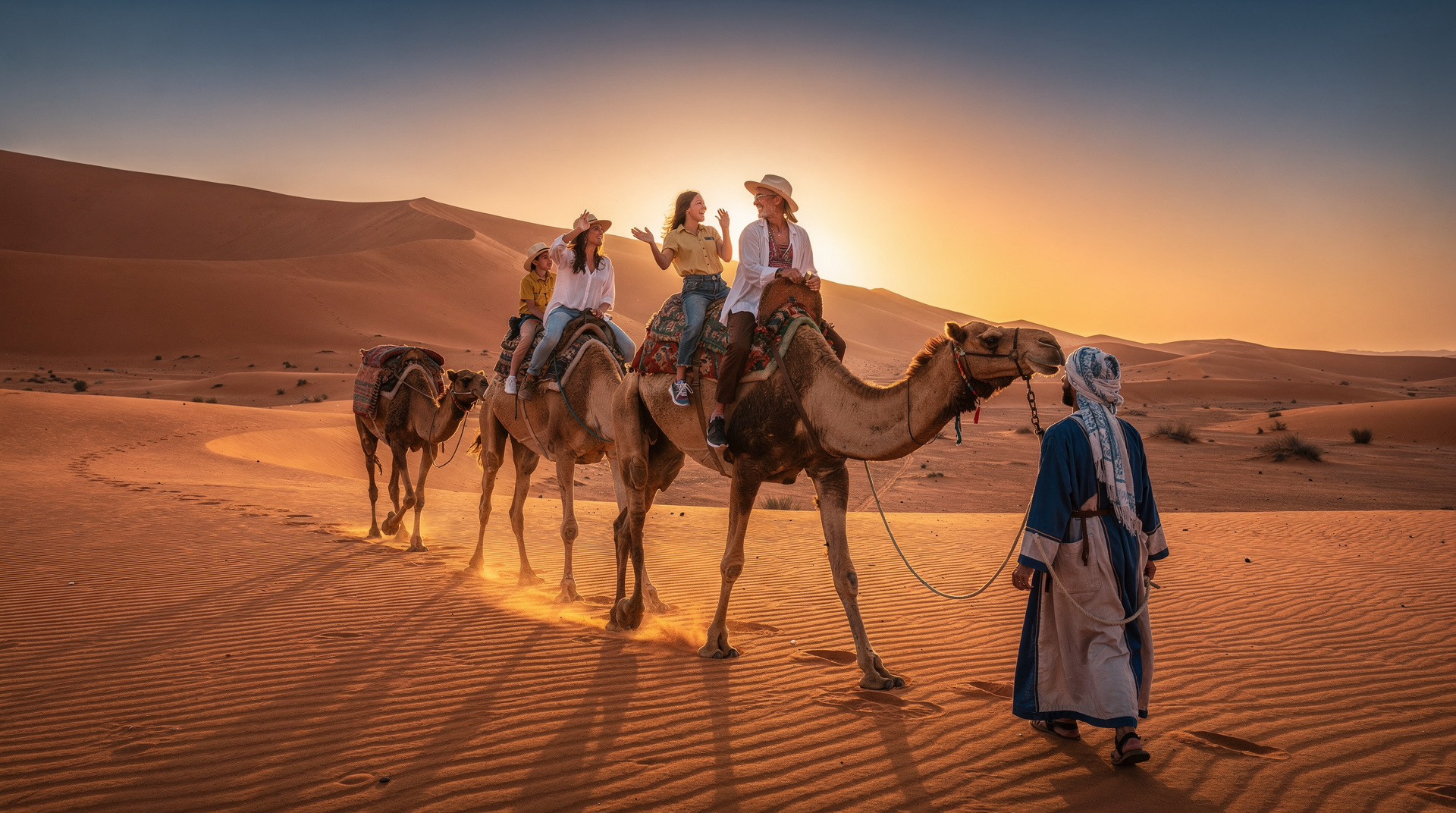
Moroccan camels are dromedaries (one hump) — not to be confused with Bactrian camels (two humps). They are significantly larger than they appear in photographs: a seated dromedary has its back at about shoulder height on most adults. When the camel stands from a sitting position, it does so in stages (front legs first, then back) — creating a brief dramatic lurch that startles children who aren’t warned.
Dromedaries used for tourist rides are trained to walk calmly in guided groups. They are led by a handler rather than self-directed by the rider. Riders hold a saddle handle bar, not reins. This removes most of the control variable that makes horse riding riskier for children.
Speed: Guided tourist dromedaries walk at 4-5km/h. They are not ridden at trot or canter in tourist settings. This makes them significantly more stable for young passengers than horses.
What happens during a ride
- The camel is seated (kneeling) before you mount
- You sit in the saddle (or in front of a parent/guide for young children)
- The handler leads the camel to stand — warn children to hold the handle and lean forward slightly during this phase
- The handler walks alongside, leading the camel by a rope
- The group moves in a line at walking pace
- To dismount, the camel sits again — the reverse lurch (backward first, then forward) — which is also disconcerting the first time
Age and weight guidance
Minimum age: the practical reality
Most reputable operators specify age 4+ as a guideline for children riding with a parent (sharing the camel). For solo riding (their own camel), the effective minimum is usually 7-8, with physical size (must reach the handles comfortably) more relevant than age.
Under 4: Not recommended for a riding experience. Young toddlers and infants lack the core stability and grip strength for the mounting/dismounting lurch even with a parent’s arms around them. Some operators allow it; responsible parents should not.
Ages 4-6: Appropriate for a short ride (30-45 minutes) shared with a parent. The child sits in front, the parent’s arms provide stability, and the handler leads. At this age, the mounting and dismounting phases need verbal preparation — “the camel is going to lean, hold on and lean with it.”
Ages 7+: Appropriate for their own camel with handler guidance. Most children this age enjoy the independence of their own camel and the relative safety is comparable to sharing with a parent at this height and weight.
Weight limits
Camels used for tourist rides are typically working with riders up to 100-120kg. For children and adults of normal weight, there’s no weight concern. Avoid operators whose camels appear malnourished or distressed under load — this is both an animal welfare issue and a safety issue (a stressed camel is unpredictable).
Duration: how long is appropriate for children?
For toddlers and children under 6
Maximum 30-45 minutes. Beyond this, young children become uncomfortable, bored, or frightened. A camel saddle is not ergonomically designed for small bodies. Dismounting options mid-route are limited. Keep it short.
For children aged 6-10
1 hour is comfortable; 1.5 hours is the upper limit. Children this age are genuinely engaged for the first 40-45 minutes, then the novelty wanes and the saddle becomes uncomfortable. The Palmeraie and Agafay standard rides (30-60 minutes) are well-calibrated for this age group.
For children aged 10+
Up to 2 hours before serious discomfort. Children 12+ can manage the overnight Sahara camel trek (45-60 minutes to camp), which is within the tolerance range.
The overnight desert camel option
The Sahara overnight experience typically involves a 45-60 minute camel ride from the village edge to the camp, then returning the next morning. This is the most memorable camel experience in Morocco — arriving at a desert camp by camel at sunset is genuinely extraordinary for children.
Age guidance for the overnight: 8+ for a genuinely positive experience. Younger children can manage the 45-minute ride but may become distressed at the camp (unfamiliar, remote, night sounds of the desert). See the Morocco with kids guide for the full Sahara family assessment.
Comparing the main camel ride locations for families
| Location | Distance from Marrakech | Typical duration | Best for |
|---|---|---|---|
| Palmeraie | 15-20 min | 30-60 min | Young children, first-timers, short trips |
| Agafay desert | around 45 min | 30-45 min (plus dinner package) | Dramatic photos without a long drive |
| Merzouga (Erg Chebbi) | around 10 hours drive | 45-75 min | Kids 8+, the once-in-a-trip memory |
| Zagora | around 5 hours drive | 45-60 min | Families wanting real dunes with less driving |
The main camel ride locations near Marrakech
Palmeraie (closest to Marrakech)
The Palmeraie — the palm grove area north of Marrakech, 15-20 minutes from the medina — is the most convenient camel ride option. Several operators run guided rides through the palm groves, typically 30-60 minutes.
The positives:
- Short transfer from central Marrakech
- Well-organised operations with experienced handlers
- Suitable for all ages including young children
- Can be combined with quad biking in the same area
The negatives:
- Less dramatic landscape than Agafay or the desert
- Can feel commercial and crowded at peak times
- Sunset lighting is less spectacular than Agafay plateau
The Marrakech Palmeraie camel ride at sunset is the standard option — 30-60 minutes through the palm grove with a sunset finishing time.
Agafay desert (the better family option)
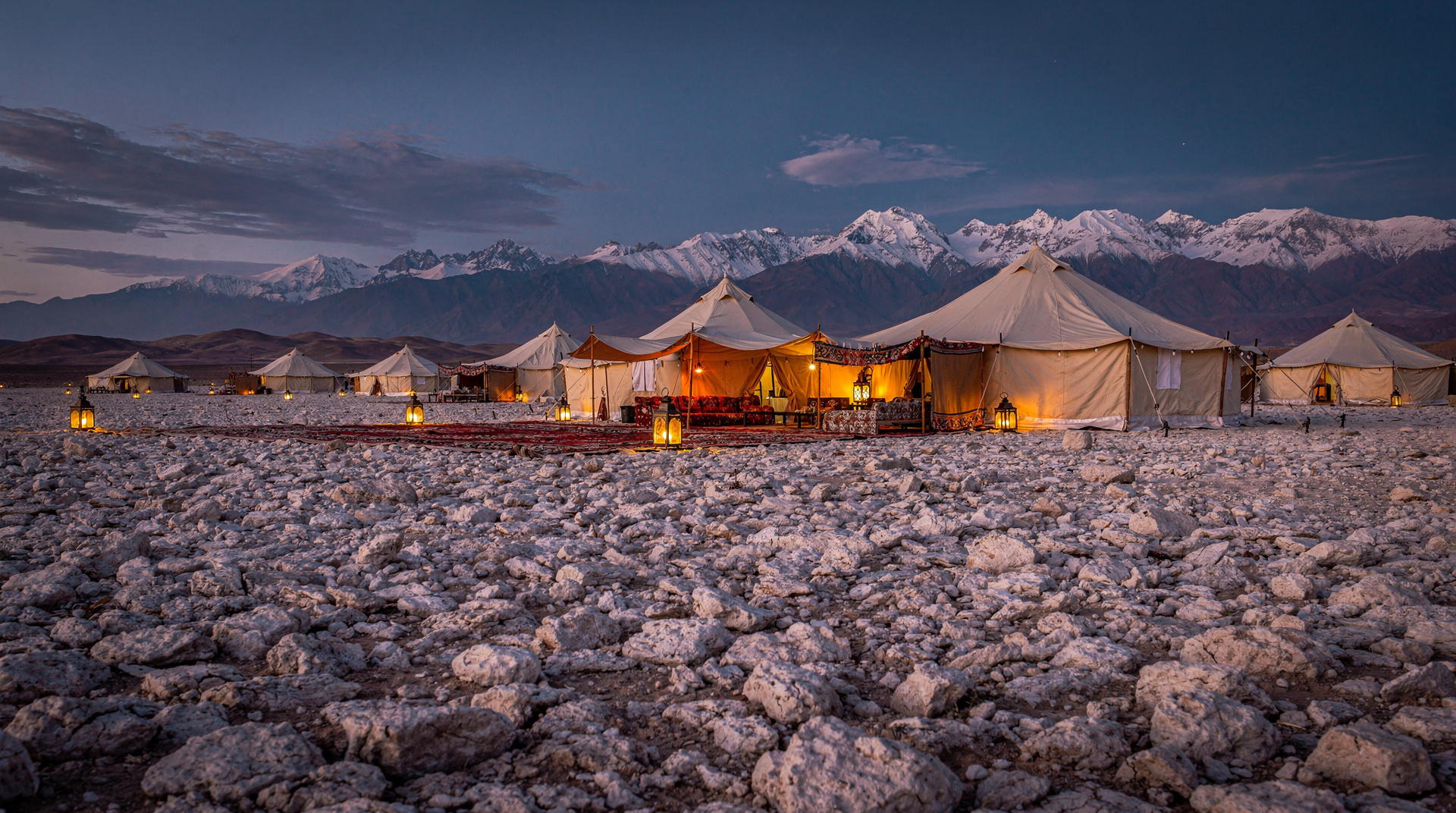
The Agafay plateau, 45 minutes southwest of Marrakech, offers camel rides in a more dramatic landscape than the Palmeraie. The rocky mineral plateau with Atlas Mountain backdrop produces better photography and a more atmospheric experience.
Camel rides in Agafay typically run 30-45 minutes as part of a larger package — combined with quad biking, buggy rides, dinner, and a sunset show. This combination format works well for families because children aren’t solely dependent on the camel ride for the event’s success — there are multiple activity layers.
The Agafay desert sunset camel ride with dinner under the stars packages the camel component with dinner at a desert camp — making the full evening into a memorable family event rather than a single short ride.
Merzouga / Erg Chebbi (the authentic desert experience)
Merzouga in the Sahara offers the most dramatic camel setting — towering dunes of up to 150m, genuine desert atmosphere, and the overnight camp experience. The camel ride from the village into the dunes takes 45-75 minutes and is typically done at sunset for the best photography.
For families: Best for children 8+ and requires the 10-hour Marrakech-Merzouga drive (break in Ouarzazate is strongly recommended). The result, for the right age group, is genuinely one of the most memorable experiences in family travel.
Alternative: Zagora (5 hours from Marrakech) offers smaller, more accessible dunes with a similar camel ride experience — more appropriate for families with younger children or limited driving time.
Safety considerations parents should know
Animal behaviour
Trained dromedaries used for tourist rides are generally calm. Triggers for unexpected behaviour include: sudden loud noises (a screaming child can occasionally startle the animal), being approached from behind without warning, and poorly handled mounting/dismounting by guides.
What to tell children beforehand: Stay quiet and calm on the camel. Hold the handle bar. Don’t kick or hit the camel. Follow the guide’s instructions for mounting and dismounting.
The mounting/dismounting lurch
This is the single most common reason children have a negative first camel experience. The camel rises and sits in a two-phase movement that throws the rider backwards then forwards (rising) or backwards then forwards again (sitting). Children who aren’t warned about this find it alarming; children who are prepared find it exciting.
Preparation script for children: “When the camel gets up, it’s going to move quite suddenly — first your bottom goes back, then forwards. Hold on and lean with it. It’s not dangerous, just surprising. Same thing when it sits down.”
Helmets
Not provided or used for camel rides (unlike horse riding). The walking pace and handler control make falls unlikely, but the height (seated camel back is 1.5m off the ground) means a fall could cause injury. Very young children should always be seated in front of an adult.
Operator quality indicators
- Handler accompanies each camel on foot (not riding ahead)
- Animals appear healthy weight and calm
- Saddles are properly fitted and include a handle bar
- No evidence of whipping or sharp tools to control animals
- Operator can explain the route length and return point clearly
Dos and don’ts for camel rides with children
Do:
- Warn children about the mounting lurch before they get on
- Dress children in long trousers (camel saddle on bare legs is uncomfortable)
- Bring water — even a 30-minute ride in afternoon sun dehydrates children
- Take photos during the ride (the guide can assist; experienced operators know the best moments)
- Let children know they can ask to stop at any time
Don’t:
- Book rides longer than the appropriate age-duration guideline
- Put infants or toddlers under 4 on a camel without very careful assessment
- Choose the cheapest option without verifying operator quality
- Book a ride immediately after lunch (heat and food combination on a swaying animal)
- Ignore a child’s genuine distress mid-ride — request the animal to be stopped
Prices: what to expect
Palmeraie 30-minute ride: 100-200 MAD per person (9-18 EUR)
Agafay 30-45 minute ride (standalone): 150-250 MAD per person
Agafay combined package (camel + dinner + show): 350-550 MAD per person (32-51 EUR)
Sahara camel ride (sunset to camp, one night): Included in overnight desert camp packages — typically 2,000-4,000 MAD per person for the full overnight including camp, dinner, and breakfast
Connecting the camel ride to a broader family Morocco trip
The camel ride is typically a highlight of a family Morocco trip but should be contextualised within a realistic itinerary. For the full family travel picture, the Morocco with kids guide covers itinerary structure by age. The Atlas Studios Ouarzazate guide is a good pairing for families — particularly if combining with the Agafay or Zagora camel experience on a road trip south.
Frequently asked questions about camel rides for children
Can I hold my toddler on a camel?
Yes — for a short ride (20-30 minutes), a toddler (age 2-3) can ride in front of a parent with the parent’s arms wrapped around them and both hands on the handle bar. The toddler must be cooperative and physically capable of sitting upright. Do not attempt this with an infant under 18 months or any child who is distressed before mounting.
Will my child be scared?
Some children are initially nervous and become comfortable; others are nervous throughout. Preparation (describing the lurch, explaining the handler’s role) significantly reduces fear. If a child is genuinely terrified at the mounting point, do not force the experience — a negative memory is not worth the photograph.
Are the camels well-treated?
This varies by operator. Look for animals at healthy weight, with properly fitted saddles (no sores visible around saddle edges), and handlers who use verbal commands rather than striking. Reputable operators — particularly those running organised tours through GetYourGuide or equivalent platforms — are subject to more oversight than individual roadside operators in Agafay or the Palmeraie.
Is it okay to take photos while on the camel?
Yes — the walking pace makes phone photography easy. A camera with a wrist strap or a phone in a case is practical. Avoid taking both hands off the handle bar for extended periods, particularly during the first few minutes when you’re still stabilising.
Does the camel smell?
Yes, noticeably. This is part of the experience. Most children find it interesting rather than unpleasant. Adults with sensitive noses may prefer the windward side of the animal.
Should we do the camel ride in Marrakech or wait for the desert?
If your itinerary includes a Sahara trip, it’s worth waiting — the camel trekking in Morocco guide explains why the Merzouga or Zagora setting is a genuinely different experience from a Palmeraie ride. If the Sahara isn’t on your route, the Agafay or Palmeraie option is a very good substitute and easy to fit into a day trip from Marrakech.
Building the camel ride into your family itinerary
For families staying mainly in Marrakech, the Palmeraie or Agafay options fit easily into a half-day slot and pair well with an Agafay desert day trip or quad biking in Agafay for older children. For families heading south, Ait Benhaddou is a natural stop en route to Zagora or Merzouga, and the family travel Morocco guide covers how to structure the wider trip around nap times, driving distances, and kid-friendly stops.