Morocco with kids: the honest family travel guide
Is Morocco suitable for family travel with young children?
Yes — Morocco is family-friendly in most respects. Marrakech, Essaouira, and the Atlas foothills work well with children of all ages. The Sahara desert requires more planning with young kids. Moroccan culture is generally welcoming toward families and children receive warm attention from locals.
What nobody tells you about family travel in Morocco
Morocco’s reputation as a complex destination — crowded medinas, chaotic traffic, unfamiliar food — leads many families to hesitate or skip it entirely. This is a mistake.
Moroccan culture is profoundly family-centred. Children are welcomed into restaurants, riads, and shops without the stiffness you encounter in some European destinations. Locals engage with children directly and warmly — a toddler at Jemaa el-Fna will receive smiles and conversation from vendors who might otherwise be pushy.
The challenges are real but manageable: medina navigation with a pushchair is difficult; summer heat is brutal for young children; mountain roads cause car sickness; food options require strategy. This guide deals with all of it honestly, age by age.
Age-by-age: what Morocco looks like for different children
Toddlers (0-3 years)
What works: Riads with pools (safe play space); the sensory environment of souks (colours, smells, sounds); camel rides with parent; hammam (the warm room only — not the hot room); Agafay desert evenings.
Challenges:
- Medina surfaces: cobblestones, steps, and narrow alleyways make pushchairs nearly impossible in older medinas like Marrakech and Fes. Baby carriers (structured ERGOs, Lillebaby, Manduca) are essential.
- Heat: toddlers overheat faster than older children. July and August with toddlers in Marrakech is inadvisable. March-May and October-November are the right seasons.
- Nap logistics: riads are much better than hotels for managing nap schedules — quiet courtyard environments, no elevator noise, accommodating staff.
- Food: Moroccan food is generally gentle (mild tagines, couscous, bread) but finding plain pasta or familiar toddler food requires effort in traditional restaurants. Supermarkets in Marrakech (Marjane, Carrefour on the outskirts) stock familiar European-format baby food.
Verdict: Doable with planning. Keep itineraries short and flexible. The riad-centred days work; overly ambitious day trips don’t.
Ages 4-9 years
The sweet spot for Morocco family travel. Children this age are old enough to engage with camel rides, short hikes, and cultural sights, but young enough to find the novelty (snakes at Jemaa el-Fna, monkeys, market chaos) genuinely thrilling rather than overwhelming.
What works:
- Camel rides (appropriate age group — see the camel rides for kids guide)
- Ourika Valley waterfalls — the short hike to Setti Fatma cascades is exactly the right length for this age
- Cooking classes with child participation
- Surfing lessons at beginner beaches (Essaouira beach is gentle)
- Agafay quad biking (as passenger in buggy from age 6)
- Atlas Kasbah villages — children engage well with the ruined kasbahs and fortress architecture
Challenges:
- Attention span at cultural sites: Bahia Palace and Koutoubia Mosque are impressive for 10 minutes; plan for shorter visits
- Jemaa el-Fna at night: exciting but overwhelming and loud — good in small doses, exhausting for extended evenings
- Restaurant timing: traditional Moroccan restaurants serve late; by 9pm most children this age need to be in bed. Book early dinners or eat at your riad.
Food strategy: Moroccans eat tagine, couscous, brochettes, and harira soup as daily staples. Most children tolerate these well — the flavours are mild. Brochettes (skewered grilled meat) are almost universally eaten by children. Pizza and pasta exist in Marrakech’s Gueliz district. For safety, stick to cooked food and bottled drinks; avoid raw salads in street settings.
Ages 10-14 years
This age group often has the best Morocco experience of all. Old enough to read history, engage with the medina maze, negotiate at souks (a skill they love developing), and appreciate the scale of the Sahara.
Specifically good:
- The Sahara — overnight in the desert is memorable for this age group in a way that doesn’t register with younger children
- Zip lines at Terres d’Amanar (most operators: 12+)
- Learning to surf at Taghazout or Essaouira
- Medina navigation challenges (give them a map and let them lead)
- Photography in Chefchaouen
- Fes medina complexity and history
Challenges: Mainly around pacing and interest alignment. A 14-year-old may not want to spend 3 hours in the souks when an older sibling does. Build activities specifically for this age (active, skill-based) alongside the family cultural program.
Teenagers (15+)
Morocco for teenagers depends heavily on the individual but has strong draws: surf culture, photography opportunities, souks and negotiation, food exploration, and the Sahara. The key is giving them genuine agency — choosing the market negotiation, selecting the restaurant, navigating in the medina.
Teenagers who travel with a camera or strong visual interest have an exceptional Morocco experience. Chefchaouen’s blue streets, Fes’s tanneries, and the Sahara dunes are Instagram-generation destinations in the best sense.
Best destinations for families with children
Marrakech (essential, requires management)
Marrakech is dense, loud, and stimulating — everything that makes it exciting for adults creates overwhelm for young children if you don’t pace it right. The key is using the riad as a genuine base (not just sleeping there) and limiting medina time to morning hours when it’s quietest.
Best Marrakech activities for families:
- Jardin Majorelle (beautiful, manageable, children enjoy the Yves Saint Laurent museum’s bold colour)
- Agafay desert half-day (quad, camel, sunset)
- Hot air balloon (age-appropriate from about 5+ with parental judgment)
- Atlas Mountains day trip with waterfall hike
Essaouira (the easiest Morocco city for families)
Essaouira is the most relaxed family destination in Morocco. The medina is smaller and less intense than Marrakech, the beach is long and safe (Atlantic but with manageable waves in the surf-free zones), and the scale of everything is more human.
The downside is the wind — Essaouira is windy most afternoons, which is fine for older children, irritating for toddlers, and impractical for infants who need sun protection.
Best for families: 2-4 days combined with Marrakech.
Atlas Mountains and Ourika Valley
The Ourika Valley is 40 minutes from Marrakech and produces a day trip that works for almost all ages. The Ourika Valley day trip from Marrakech with lunch includes the waterfall hike and a traditional lunch — appropriate for children from age 5 with basic fitness.
For the Ouzoud Waterfalls (Morocco’s most spectacular waterfall, 3h from Marrakech): the Ouzoud Waterfalls guided hike and boat trip combines the walk down to the falls with a short boat trip and Barbary macaque encounters that children consistently rate as a trip highlight.
The Sahara (for the right age group)
The Sahara is extraordinary for families when the children are old enough to appreciate it — generally 7+ for a meaningful experience, 10+ for it to be genuinely memorable.
Challenges with young children:
- Long drives (Marrakech to Merzouga is 10 hours — extremely difficult with toddlers)
- Desert heat (June-August: dangerously hot for young children)
- Camel rides are limited to 1-2 hours with young children
- Limited medical facilities in remote areas
Solutions:
- Consider Zagora (5h from Marrakech) instead of Merzouga (10h) for a shorter desert experience
- Go in October-November or March-April to avoid heat
- Break the journey (stay one night in Ouarzazate at 4h)
- Book a luxury camp with proper toilets and beds rather than a standard camp
Car sickness on mountain roads
The Atlas Mountain roads are winding, often narrow, and can trigger car sickness in children and adults who are susceptible. The Tizi n’Tichka pass (on the road to Zagora and Ouarzazate) is particularly prone to causing issues.
Practical strategies:
- Sit children in the front seat where available (legally permitted in Morocco — always use appropriate car seat)
- Drive in the morning before the day heats up (heat amplifies nausea)
- Make regular stops — 30 minutes of fresh air dramatically resets the tolerance threshold
- Avoid screens and reading (most important factor in mountain road sickness)
- Ginger sweets or ginger tablets (available in Moroccan pharmacies — “gingembre” — or bring from home)
- Antihistamine-based motion sickness tablets (Dramamine/Dioramine) are available without prescription at Moroccan pharmacies
Riads with pools: the family essential
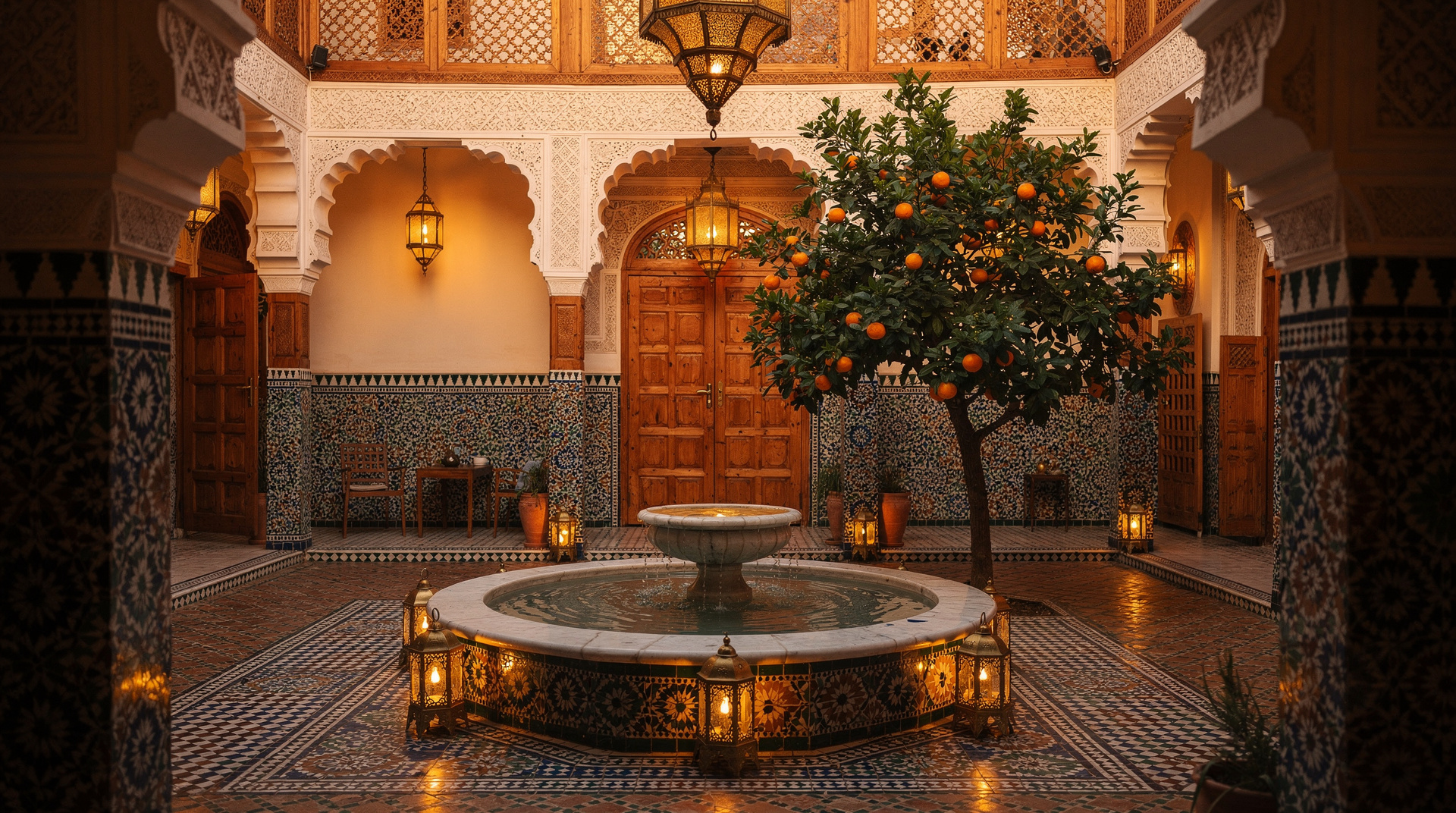
A pool transforms a riad stay with children. It provides a safe activity space during the noon-3pm heat period when outdoor exploration is inadvisable, gives children downtime that adults can share (at the pool edge), and reduces the pressure on constant activity scheduling.
Not all riads have pools — pools in traditional medina architecture require specific spatial conditions. The kid-friendly riads guide covers specific recommendations for Marrakech riads that work for families.
What to verify before booking:
- Pool dimensions (some riad pools are plunge pools rather than swimming pools — fine for cooling off, not for swimming)
- Depth (safety for young children)
- Whether the pool is heated (relevant October-April)
- Fencing or cover options for toddlers
Food strategy for families in Morocco
What children typically eat without complaint
- Brochettes (grilled meat skewers) — plain, familiar, everywhere
- Pastilla b’dajaj (savoury chicken pie with a hint of sweetness) — children often love this
- Couscous with vegetables — mild, familiar texture
- Fresh orange juice — excellent in Morocco, available everywhere
- Moroccan bread (khobz) with olive oil — reliable backup for picky eaters
- Msemen (flatbread) at breakfast — similar to pancakes, universally popular
- Fresh fruit — excellent quality in Morocco
What to be cautious about
- Raw salads from street food stalls (hygiene variables)
- Tap water (always bottled or filtered)
- Dairy from small stalls in hot weather (refrigeration questions)
- Spicy harissa — warn children before they try it
Supermarkets for backup
Marrakech has Carrefour (Menara Mall, outskirts) and Marjane (Route de Casablanca). Familiar European-format food for breakfast and snacks: yogurt, cheese, crackers, familiar cereals. Most riads are happy for guests to bring food in — important for families with picky eaters or allergies.
Pacing: the most important family travel principle in Morocco
Morocco’s medinas are overstimulating by design — they evolved as commercial spaces optimised for sensory engagement. An adult can handle this for hours; children saturate quickly. The rule of thumb: half the time you’d spend in the medina without children. Prioritise one or two things per medina session, always have the riad as a reachable retreat, and schedule pool/rest time in the early afternoon as a non-negotiable.
The Morocco trip planning guide covers how to structure a full itinerary. The best time to visit Morocco guide is particularly important for family travel — the wrong season creates avoidable suffering for children in the heat.
Frequently asked questions about Morocco with families
Is Morocco safe for children?
Yes — Morocco is one of the safer destinations in the Arab world for family travel. Violent crime is low. The main safety considerations are traffic (medina motorcycles), heat management, and food/water hygiene — all manageable with standard precautions.
What vaccinations do children need for Morocco?
Check your home country health advisory, but standard travel vaccinations for Morocco: hepatitis A, typhoid (for longer stays). Rabies vaccination is recommended if your children might interact with animals (medina cats, rural dogs). Consult your GP or travel health clinic 6-8 weeks before departure.
Is the Sahara worth the effort with children?
For the right age (8+) at the right time of year (October-November or March-April): absolutely. The Sahara overnight is one of the most memorable family travel experiences available. For toddlers or in summer heat: not worth the logistics and discomfort.
Can we do Morocco without a tour operator?
Yes. Morocco is well-suited to independent family travel with a rental car. The main advantage of an operator is the logistics of the Sahara route, where having a driver and guide who knows the roads removes significant stress. City-based travel is entirely manageable independently.
How do Moroccan locals interact with foreign children?
Very warmly. Moroccan culture places high value on children and family. Expect attention, smiles, and occasional gifts of sweets or small tokens to your children from shopkeepers and passersby. This is genuine cultural warmth, not a sales tactic. Children are usually delighted by this attention and it contributes significantly to family travel enjoyment.