Best riads in Fes: Fes el-Bali and Fes el-Jdid picks
Which riads in Fes are genuinely worth booking?
Riad Laaroussa and Riad Fes lead on design and service in Fes el-Bali. For mid-range, Dar Seffarine and Riad Idrissy are strong picks near the main attractions. Budget well: medina navigation in Fes is harder than Marrakech, so location within the medina matters more here than in any other Moroccan city.
Why staying inside Fes el-Bali changes everything
Fes is the most complex medina in Morocco — and in the world, by most architectural measures. The ancient city of Fes el-Bali has around 9,000 lanes, many too narrow for a bicycle. Navigation is genuinely difficult. Visitors who stay outside the medina (in the Ville Nouvelle or in modern hotels near the train station) spend significant time and money on taxis just to reach the core attractions.
Staying inside Fes el-Bali, within a riad in walking distance of the tanneries, Al-Attarine Madrasa, and Bou Inania Madrasa, transforms the experience. The medina has a completely different quality in the early morning before tour groups arrive and in the late evening after they leave. That quality is only accessible if you’re sleeping inside it.
This guide covers the best riad options across Fes el-Bali and Fes el-Jdid, with honest commentary on price tiers, what you actually get, and the location considerations that matter most.
At a glance
| Where | Inside Fes el-Bali, close to the tanneries and main madrasas |
| Cost | Roughly €45-90/night budget, €90-180 mid-range, €180-400 premium |
| Time needed | 2-3 nights minimum; the medina rewards a slower pace |
| Getting there | Train from Marrakech or Rabat into Fes, then meet-and-greet on foot into the medina |
| Best time | October-November and March-April; December-February has better availability |
Understanding the two medinas
Fes el-Bali is the ancient medina — the UNESCO-listed core, where the tanneries, the great madrasas, and the dense souk network sit. This is where most visitors spend their time, and where the best riad accommodation is concentrated. Streets are narrow enough that luggage porterage on foot (often by a mule or a porter with a handcart) is the only way to reach your property.
Fes el-Jdid is the “new” medina built in the 13th century — which gives you a sense of Fes’s scale. It contains the Mellah (Jewish quarter), the Royal Palace (exterior only), and a less touristic character. Riads here are fewer, tend to be larger and quieter, and suit travellers who want medina proximity without being at the centre of the action.
Ville Nouvelle is the French colonial city, entirely outside the medinas. Modern hotels dominate here. We don’t cover it in this guide — if you’re visiting Fes, staying inside the medina is strongly recommended.
Premium tier riads (€180–400/night)
Riad Laaroussa One of the finest traditional riads in Morocco, not just in Fes. Located in the heart of Fes el-Bali, Riad Laaroussa has 8 suites decorated with museum-quality Moroccan craft work — hand-cut zellige tilework, hand-carved plasterwork, cedarwood ceilings in original or restored condition. The property is owned by a Franco-Belgian family and has been renovated with genuine attention to historic material. The courtyard is exceptional.
Standout: Architectural authenticity, quality of craft, attentive service Limitation: Remote location within the medina — luggage porterage takes 15-20 minutes on foot from the nearest road; confirm this before arrival
Riad Fes A larger property (30 rooms) with more hotel-like infrastructure — spa, pool, restaurant, roof terrace. The scale means you lose some of the intimacy of a smaller riad, but the facilities compensate. The hammam here is genuinely good and well-supervised. A reliable choice for travellers who want medina character with hotel-standard amenities.
Standout: Facilities, spa, consistent service quality at scale Limitation: Larger scale feels less personal than smaller properties
Dar Bensouda A beautifully restored 19th-century dar in the Andalusian quarter of Fes el-Bali. 5 suites, all different in configuration and decoration. The property has been in continuous use as a family residence until recently — the furnishing reflects genuine occupation rather than decorator-applied “authenticity.” Garden terrace, exceptional breakfast.
Standout: Historic authenticity, small scale, garden Limitation: Very small — books quickly; reserve well in advance
Mid-range tier (€90–180/night)
Dar Seffarine Named for its location near Place Seffarine (the coppersmiths’ square), Dar Seffarine is one of the best-located mid-range properties in Fes el-Bali. 7 rooms, rooftop terrace with views over the medina. The property is close to Al-Qarawiyyin University and a short walk from the Chouara Tanneries — the two main stops on any Fes visit.
Standout: Location, rooftop views, access to key attractions on foot Limitation: Rooms vary in quality; the upper-floor rooms are better lit than the ground-floor options
Riad Idrissy Named for its proximity to the Moulay Idriss II mausoleum, this 9-room riad is a reliable mid-range choice with a genuinely warm management team. Breakfast is served in the courtyard and is one of the better hotel breakfasts in Fes — msemen, baghrir (Moroccan crumpets), fresh orange juice, and local honey. The building dates from the 16th century, and the original woodwork in the salon is extraordinary.
Standout: Location, breakfast, original architectural detail Limitation: Street noise from the nearby souk carries into some rooms
Riad Maison Bleue A well-established property in the Batha district, with a central location that makes it easy to reach both the tanneries and Bab Bou Jeloud (the Blue Gate) on foot. 11 rooms, consistently reliable reviews, and a rooftop restaurant that is good enough to eat at beyond the included breakfast.
Standout: Location in the Batha area, rooftop restaurant, reliability Limitation: Popular with tour groups, so can feel busier than smaller properties
Dar Roumana 10 rooms in a quiet lane near Place de l’Istiqlal. The building is 15th century with careful restoration — exposed brick sections, painted cedarwood, handmade tiles. Good sound separation between rooms; sleep quality is better here than in many medina properties.
Standout: Quiet location, restoration quality, room insulation Limitation: Further from the tanneries than some competitors — 20-minute walk
Budget tier (€45–90/night)
Dar Bouanania Near Bou Inania Madrasa — one of the best budget locations in Fes. 8 rooms, basic but clean, with a small rooftop terrace. The management are helpful with navigation and local restaurant recommendations. Not luxurious but genuinely good value.
Riad Rcif Near the Rcif gate, convenient for the tanneries circuit. Small (6 rooms), family-managed, with a breakfast that punches above the price point. Rooms are modest but well-maintained.
Pension Talaa Less of a riad and more of a guesthouse in the traditional sense, on Talaa Kebira (the main street through the medina). Useful for budget travellers who want the best possible location with basic accommodation — the street access here is the easiest of any medina property, which simplifies arrival logistics significantly.
The architecture question: what to look for in a Fes riad
Fes riads differ from Marrakech riads in important ways. The original Fes courtyard tradition emphasizes carved plasterwork (stucco), cedarwood ceilings, and zellige tilework in specific geometric patterns particular to the Idrisside and Marinid periods. The best properties preserve or accurately restore these elements.
What distinguishes a genuinely historic riad from a renovated house:
- Zellige patterns: Traditional Fes zellige uses more colours and finer cuts than Marrakech patterns
- Cedarwood ceilings: Look for interlocking geometric panels (muqarnas in alcoves) rather than flat painted surfaces
- Courtyard proportions: Historic riads have specific proportions between courtyard width and surrounding gallery height — narrower courtyards than Marrakech, with taller surrounding walls
Most premium properties in this guide have authentic elements. The mid-range tier has a mix — some with significant original material, others that have been plastered and painted in broadly traditional style without historic material.
Silence inside the medina — the honest picture
One of Fes el-Bali’s great qualities is also a practical challenge. Deep inside the medina — where the best riads sit — the streets are medieval in width. No vehicles. The silence during Ramadan morning prayers, or during the mid-afternoon lull, is extraordinary. The soundscape of a copper-worker, a leather souk, or a bread oven nearby is part of the texture.
What you won’t find: quiet in the modern sense. There is no completely silent block inside Fes el-Bali. Muezzin calls carry across the open courtyard of every riad at dawn. Donkeys and handcarts pass most major lanes throughout the day. If you are an exceptionally light sleeper, book a room on the upper floor of a riad (away from courtyard-level noise) and bring earplugs.
The best of the medina silence comes between 10pm and dawn — after the souks close and before the morning activity begins. This window is what makes a medina stay worthwhile.
Comparison table: Fes riads by key factors
| Riad | Location | Price/night | Pool | Rooftop | Best for |
|---|---|---|---|---|---|
| Riad Laaroussa | Fes el-Bali (deep) | €200–380 | No | Yes | Architecture lovers |
| Riad Fes | Fes el-Bali | €180–320 | Yes | Yes | Comfort + facilities |
| Dar Bensouda | Andalusian quarter | €190–350 | No | Yes (garden) | Couples, intimacy |
| Dar Seffarine | Near tanneries | €100–175 | No | Yes | Location-focused |
| Riad Idrissy | Central el-Bali | €90–160 | No | Yes | Value + breakfast |
| Riad Maison Bleue | Batha | €100–180 | No | Yes (restaurant) | Facilities, touring |
| Dar Roumana | Istiqlal area | €95–165 | No | No | Quiet, sleep quality |
| Dar Bouanania | Near Bou Inania | €50–85 | No | Yes | Budget + location |
Getting to your riad in Fes: what actually happens
Your taxi from the airport or train station can only reach the medina perimeter — Bab Bou Jeloud (Blue Gate area) on the western side, or Bab Rcif on the eastern. From there, a local guide or porter meets you and walks you to the riad. This walk can be 5-20 minutes depending on the property’s location within the medina.
All good riads arrange this meet-and-greet service as standard. You should receive a WhatsApp contact or phone number before arrival to confirm the meeting point. If your riad doesn’t proactively send this information, request it.
Luggage: If you have large rolling suitcases, bring straps — some lanes have uneven paving stones. Better yet, bring bags you can carry over your shoulder for the medina walk-in. Riads will usually store your large bags and provide a temporary holding point if you arrive before check-in time.
Booking your Fes riad: practical tips
Book 4-6 weeks in advance for high season (October-November, March-April). December through February has genuine availability even at short notice, with some properties offering 10-15% discounts.
Email or WhatsApp the riad after booking to confirm: your arrival time, the meeting point for the medina walk-in, and whether you want a private guide arranged for your first day. Many properties have relationships with licensed guides and can arrange this at fair rates.
A full-day cultural tour of the Fes medina on your first day is strongly recommended. Fes is significantly more complex to navigate independently than Marrakech, and a guide who can explain what you’re seeing (not just where to walk) makes the tanneries, madrasas, and souk sections make sense. After the guided day, independent navigation becomes manageable.
For food during your stay, the cooking classes in Fes guide covers where to learn Fassi cuisine — the most distinct regional cooking tradition in Morocco. A cooking class and old medina visit pairs well with a 3-night riad stay.
For internal context on how Fes fits into a broader Morocco trip, the Fes destination guide covers all the key sights and logistics. The 7-day Morocco itinerary includes Fes as a 2-night stop; the 10-day itinerary allocates 3 nights for a more thorough visit.
Frequently asked questions about Fes riads
Is Fes el-Bali safe to navigate alone at night?
The main routes — Talaa Kebira, the streets around Bab Bou Jeloud, and the Rcif market area — are fine at night with reasonable awareness. The deep interior lanes are not recommended for solo navigation after dark on a first visit, simply because getting lost in the dark in a maze-like medina is stressful rather than dangerous. Use your riad as a base: go out for dinner to a recommended restaurant, return by the same route you know.
Do riads in Fes have WiFi?
Most do. Quality varies, with better connections in properties that have recently renovated. Deep medina properties occasionally have weaker signals due to the thick walls. Ask about WiFi quality specifically if this matters for your trip.
Can I visit Fes as a day trip from another city?
Technically possible from Meknes (45 minutes) or Rabat (2.5 hours by train). But Fes el-Bali rewards time — the medina has a different character at 7am and 9pm than it does during the tourist rush from 10am to 4pm. A day trip means you get only the peak hours. Two nights minimum, three nights ideally, is the recommendation if Fes is a genuine priority.
What is the Fes Festival and should I plan around it?
The Fes Festival of World Sacred Music runs each June for 10 days. It’s one of Morocco’s most respected cultural events — performances in the Batha Museum courtyard and other venues throughout the medina. Accommodation books up months in advance during this period. Prices rise significantly. If you want to attend, plan 3-4 months ahead; if you’re not interested in the festival, avoid these dates for easier booking and lower rates.
Is Fes worth it if I’ve already been to Marrakech?
Yes, and for many travellers it’s the more memorable of the two. Fes el-Bali is less tourist-adapted, the food tradition is considered Morocco’s finest, and the medina’s silence at night is unlike anything in Marrakech. The Marrakech vs Fes guide compares the two directly if you’re deciding between them or how to split time.
Should I book a riad with a hammam or use a public one?
Most premium riads in this guide (Riad Fes in particular) have in-house hammams, which are more private and convenient but cost more. A traditional public hammam in the medina is cheaper and arguably more authentic. The hammam etiquette guide covers what to expect either way.
How Fes fits into your Morocco itinerary
Fes is most often combined with Marrakech (direct train, 5 hours; or via Casablanca, 4 hours then 3 hours) or Chefchaouen (3-hour road transfer, no direct train). The imperial cities circuit typically runs Fes-Meknes-Volubilis-Rabat as a loop.
For the Fes destination full overview, visit the destination page for transport connections, day trip options, and what to see beyond the medina. For those continuing to Chefchaouen, the transfer can be done by shared grand taxi (3 hours) or private car — the budget Morocco itinerary has the logistics detail.
What makes Fes different from Marrakech as a base
Travellers who have been to Marrakech often compare the two cities directly. Fes is harder, quieter in a deeper way, and rewards effort differently.
What Fes does better than Marrakech:
- The medina is more intact and less tourist-adapted — the Chouara tanneries are a working leather facility, not a museum
- The food tradition (Fassi cuisine) is considered Morocco’s finest — bastilla, pastilla, and harira are all done better in Fes than elsewhere
- The historic monuments (Bou Inania Madrasa, Al-Attarine Madrasa, Al-Qarawiyyin University) are more concentrated and walkable
- The atmosphere at night — less night-market theatre, more actual city life
Where Marrakech is easier:
- English is more widely spoken
- Navigation aids (signposting, landmarks) are better
- The medina layout, while complex, is less vertiginous than Fes el-Bali
- Accommodation options are more diverse at every price point
The traveller who chooses to stay in a Fes riad rather than a modern hotel accepts the navigation challenge and gets access to a more unfiltered version of Moroccan city life. It’s the right choice for most visitors who are in Morocco for more than a transit stop.
Food from your Fes riad base
Fes cuisine is the most sophisticated regional tradition in Morocco. Your riad’s breakfast is typically the best starting point — most properties in this guide serve a Fassi-style breakfast that includes:
Harcha: A semolina and butter griddle bread eaten warm, with amlou or honey Seffa: Thin noodles with butter and icing sugar (Fassi tradition; unusual and excellent) Msemen: Layers of folded flatbread, best eaten immediately off the griddle Briouat: Small triangular pastries filled with almond paste
For dinner beyond the riad, the medina has excellent options. Three reliable restaurants near properties in this guide:
Riad Rcif restaurant: Open to non-guests, the roof terrace serves tagines with better sourcing than the tourist-oriented places near Bab Bou Jeloud. Dinner for two: 200-280 MAD.
Clock Café Fes (Derb el-Magana): The original Fes branch of a small Morocco-wide chain. The camel burger is famous; the harira is excellent; the rooftop view of the minaret is the best dinner view in the medina. Open late — useful after a long day of medina walking.
Les Ruines de Batha: Adjacent to the Batha Museum, this restaurant uses a renovated historic space for a mid-range Moroccan dining experience. The pastilla (pigeon pie in flaky pastry with almonds and cinnamon) here is one of the best in Fes.
A cooking class and old medina visit gives you a morning structure and the context for what you’re eating all week.
The Fes tanneries: what to know before you visit
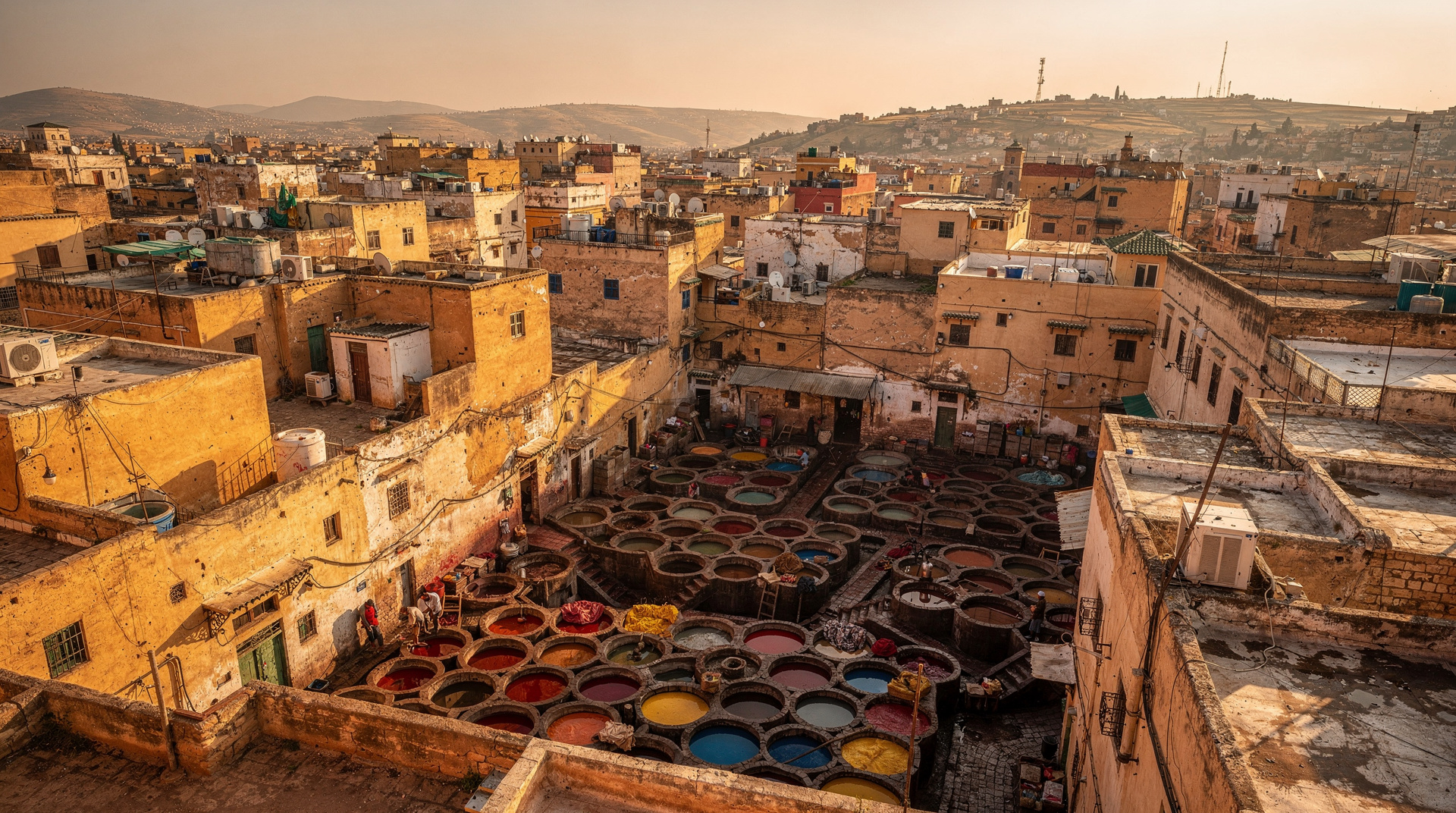
No Fes visit is complete without the Chouara Tanneries — the medieval leather-dyeing facility in the Fes el-Bali. Several leather workshops surrounding the tanneries offer free viewpoints from their rooftop terraces (in exchange for the expected retail pressure below). The best viewing is from 9am-noon, when the dye vats are actively worked.
The smell is significant — the traditional organic dyes use pigeon excrement as a setting agent, and the tanneries genuinely smell. Shops offer sprigs of mint for visitors — take one. Properties in this guide that are closest to the tanneries (Dar Seffarine, Riad Idrissy) mean you can be there before the tourist crowds; properties in the Andalusian quarter are 30 minutes walk away but completely quiet until mid-morning.
For a guided tour covering the museum, madrasa, and tannery, this combines the main Fes el-Bali highlights in a single structured half-day.
The medina at different hours: how a riad base changes your access
The commercial medina closes at dusk — the souk vendors pack up by 7pm. After 8pm, the food stalls and restaurants operate but the craft and goods market is quiet. By 10pm, most lanes in the deep medina have almost no foot traffic.
This after-hours medina is the experience only riad guests access. Walking from Riad Laaroussa toward the Al-Qarawiyyin University at 9pm, past lit mashrabiya windows and the sound of a family’s television through a doorway, and with the distant sound of a Sufi music lesson — this is what differentiates a medina riad stay from any alternative accommodation.
For how to fit a Fes riad stay into your Morocco trip, the 10-day Morocco itinerary allocates 3 nights in Fes and covers the day-by-day structure including medina exploration, a day trip to Meknes and Volubilis, and the onward journey to Chefchaouen or the Atlantic coast.