Quick facts
- Altitude
- 1,740 m
- Distance from Marrakech
- 1h 30min by car (64 km)
- Mount Toubkal
- 4,167 m — North Africa's highest peak
- Best for
- Trekking, Toubkal ascent, Berber culture
Gateway to the Roof of North Africa
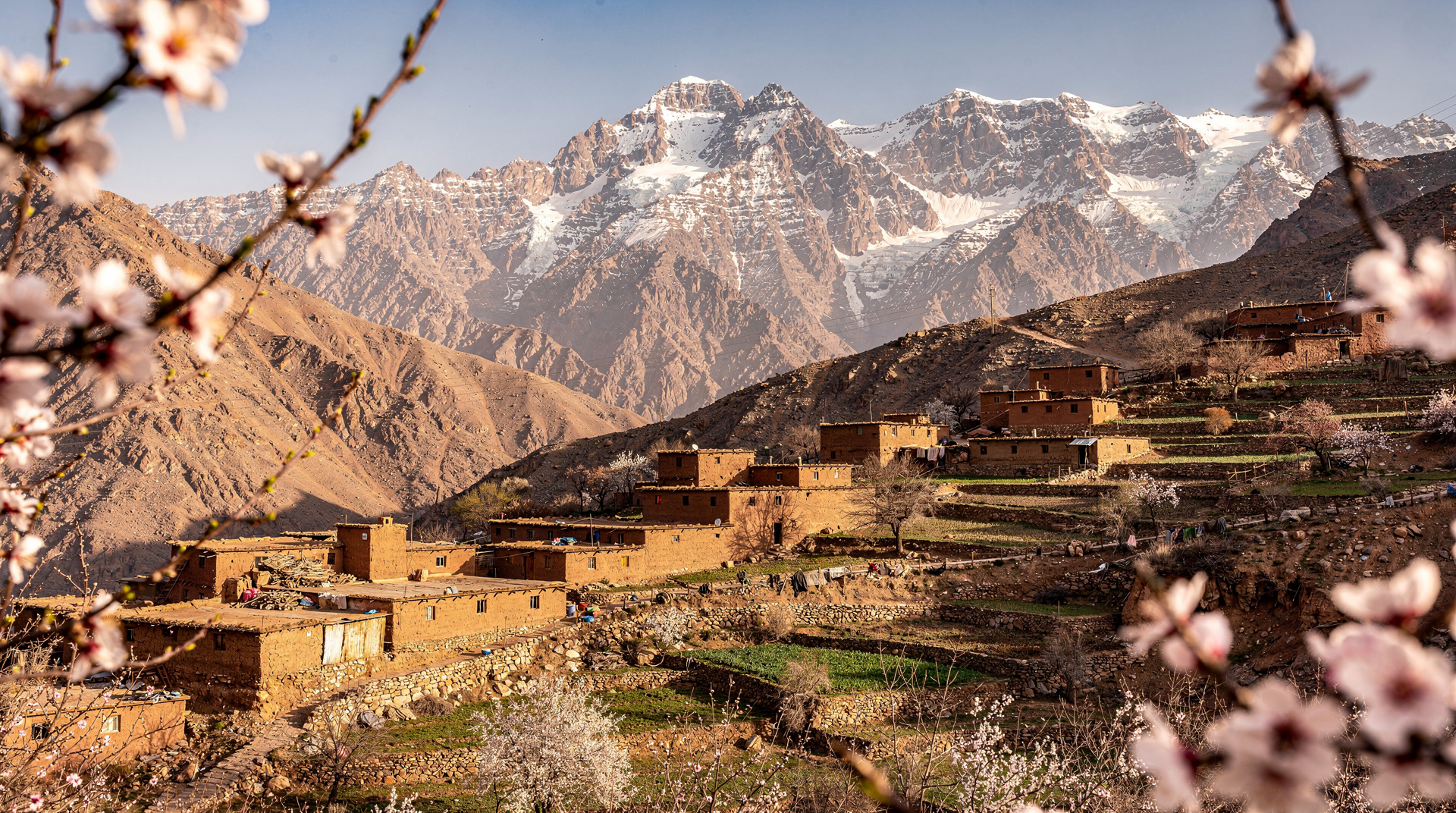
The road from Marrakech climbs steadily through the Mizane Valley for 90 minutes until Imlil appears around a bend in the gorge — a scatter of stone and terracotta houses on the valley floor, terraced fields on either side, and the snow-capped shoulders of the High Atlas rising above everything. It is, for many first-time visitors, a quietly revelatory moment: 90 minutes from one of Africa’s most crowded medinas to this. The silence alone is startling.
Imlil sits at 1,740 metres in the Toubkal massif and functions as the principal trailhead for Jbel Toubkal (4,167 m), North Africa’s highest mountain. Every year, several thousand climbers pass through en route to the summit — a two-day ascent that requires reasonable fitness but no technical climbing skills in summer. But Imlil is more than a waypoint for peak-baggers. The surrounding valleys — the Ait Mizane, the Azzaden, and the Tacheddirt valley — support a network of Berber villages whose inhabitants have farmed these steep terraces for centuries. Walking between them, sleeping in traditional guesthouses, and eating tagines cooked over wood fires is, for many visitors, the Atlas experience that stays with them longest.
The mountains here carry genuine weight. In September 2018, Imlil became internationally known for a tragedy: two Scandinavian hikers were murdered on a trail above the village. Security has since been significantly increased. It remains one of Morocco’s safest trekking environments, but the event is part of the valley’s recent history.
| At a glance | |
|---|---|
| Where | Ait Mizane valley, High Atlas, ~64 km / 1h30 from Marrakech |
| Cost | Gîte half-board around 150–400 MAD/night; Toubkal guide+mule package roughly 1,200–2,000 MAD per person over 2 days |
| Time needed | Half-day for the cascades walk, 1 full day for village trails, 2 days for the Toubkal summit |
| Getting there | Grand taxi via Asni, private car, or an organised day trip from Marrakech |
| Best time | April–June and September–November for trekking; avoid solo winter ascents above 3,000 m without gear |
Getting There
By car from Marrakech: The most flexible option. Take the N9 south from Marrakech through Asni, then the winding mountain road up to Imlil. Total distance: 64 km. Journey time: 1 hour 30 minutes. Park in the car park at the entrance to the village (around 20 MAD per day).
By grand taxi from Marrakech: Shared grand taxis depart from Bab er-Rob in Marrakech to Asni (around 30 MAD per seat, 1 hr), from where another shared taxi continues to Imlil (15–20 MAD per seat, 30 min). The full journey takes 1.5–2 hours with connections.
By organised tour: The most convenient option for those without a car. Day trips and guided treks can be arranged from Marrakech, including transport, guide, and sometimes lunch in a village guesthouse.
Book an Atlas Mountains and Berber village day trip from MarrakechGetting Around
Within Imlil, everything is on foot. The village is compact, and the trailheads for all the major routes begin within a 5-minute walk of the main square. Mules are available for hire to carry luggage between Imlil and the Toubkal base camp refuge (CAF Refuge du Toubkal) or between villages — essential for multi-day treks with heavy packs.
Mule hire runs approximately 150–200 MAD per day per mule (plus tip). Licensed mountain guides charge around 400–600 MAD per day for day hikes; Toubkal summit guides charge more. Engage guides through the Bureau des Guides in the centre of Imlil, which displays official rates and guide credentials.
Top Things to Do
Climb Jbel Toubkal
The ascent of North Africa’s highest peak is one of Morocco’s greatest adventures. The standard route from Imlil is a two-day affair: Day 1 walks up the Mizane Valley to the CAF Refuge du Toubkal (3,207 m, about 5 hours); Day 2 involves a pre-dawn start and a 3–4 hour push to the summit (4,167 m), followed by descent back to Imlil by late afternoon.
The climb requires no ropes or technical equipment in summer (June–September), but it is a serious mountain ascent: the final section involves steep, loose scree and exposed ridges. Cold, wind, and altitude effects are real. Acclimatise for a night in Imlil before the climb, hire a guide, and wear proper layered clothing.
In winter (November–April), the upper mountain is covered in ice and snow, and crampons, ice axe, and mountaineering experience are required. The views from the summit — Atlas ridges in every direction, the Sahara haze to the south — are extraordinary.
Walk to Berber Villages
The valley above and below Imlil contains several Berber villages connected by mule tracks that make for superb half-day or full-day walks. The village of Armed (Aremd), 30 minutes above Imlil on the main Toubkal trail, offers sweeping views down the Mizane Valley and a handful of small guesthouses. Sidi Chamarouch, a further 2 hours up the valley, centres on a marabout shrine perched beside a waterfall — a significant local pilgrimage site.
The Azzaden Valley loop, accessible from Imlil via Tacheddirt pass (2,100 m), takes hikers through remote villages and exceptional scenery over two to three days. This is the Atlas trek that most local guides recommend for those who want more than the Toubkal summit.
Book a 3 Valleys and waterfalls Atlas Mountains day tripStay in a Berber Gîte
The single best way to experience Imlil is to spend a night — or several — in one of the village guesthouses (gîtes) that dot the valley. Most are family-run, serve home-cooked Berber food, and charge 150–300 MAD per person for a bed and dinner. The experience of waking at altitude in a stone room, eating msemen and argan honey for breakfast while looking up at the Toubkal massif, and setting out on the trail as the sun hits the peaks is difficult to replicate anywhere.
Visit the Kasbah du Toubkal
The Kasbah du Toubkal is a beautifully restored Berber kasbah perched on the hillside above Imlil, now operating as a lodge and day-visit destination. Non-guests can visit for mint tea and the views — which are genuinely spectacular — or have lunch on the terrace (200–350 MAD per person). It functions partly as a community development project, and a percentage of profits goes to local Berber hamlets. The architecture and the panorama combine to make this one of the most satisfying places to sit in the High Atlas.
Waterfall Hike to the Cascades
Below Imlil on the valley floor, a short trail leads to a series of small waterfalls on the Mizane River. The walk takes about 45 minutes from the village and is accessible to all fitness levels. In spring (April–May), snowmelt swells the river and the falls are at their most dramatic. In summer, local children swim in the pools below.
Where to Stay
Luxury / Boutique (2,500–5,000 MAD / €250–500 per night)
Kasbah du Toubkal is the definitive Imlil luxury experience — a restored hilltop kasbah with exceptional views, atmospheric rooms, a hammam, and a kitchen sourcing ingredients from local farmers. The only property of its category in the immediate area, it sells out months ahead in peak season.
Mid-range (400–900 MAD / €40–90 per person half-board)
Riad Atlas Toubkal offers comfortable rooms and warm hospitality in the village, with excellent Berber cooking and helpful owners who can arrange guides and mule hire.
Gite Chez Moustafa is a reliable, well-reviewed village guesthouse with clean rooms, good food, and an owner who has guided Toubkal for 20 years. Half-board runs around 400 MAD per person.
Budget (150–250 MAD / €15–25 per person half-board)
Numerous simple family guesthouses throughout the valley offer basic rooms (shared bathroom, floor mattresses) and excellent home cooking. Ask at the Bureau des Guides for a current list.
Where to Eat
Imlil’s food scene is resolutely Berber — tagines, harira, couscous on Fridays, fresh bread, argan honey, and mountain herbs. This is not a place for culinary variety; it is a place for genuine, honest mountain cooking.
Kasbah du Toubkal restaurant serves the finest food in the area, with a thoughtful menu of Moroccan and Berber dishes using local produce. Lunch for non-guests: 200–350 MAD.
Village restaurants near the main square serve tagines and omelettes for 60–100 MAD per person. The quality is consistent — nothing spectacular, but exactly right after a long day on the trail.
Gîte cooking is usually the highlight of any multi-day trek: the standard combination of soup, bread, tagine, and mint tea, prepared in a clay pot over a wood fire and eaten with a mountain view, is hard to beat for satisfaction.
Practical Tips
Guides are strongly recommended: The mountain terrain around Imlil is serious. Even experienced hikers can get into difficulty in rapidly changing weather. The Bureau des Guides in the village provides government-licensed guides with verifiable credentials. Day rates are regulated; agree on everything in advance.
Altitude acclimatisation: If you are climbing Toubkal, plan one night in Imlil (1,740 m) before ascending to the refuge (3,207 m). Headaches, fatigue, and nausea are common without acclimatisation.
What to bring: Layered clothing (temperatures drop sharply at altitude even in summer), a warm sleeping bag if camping, good walking boots with ankle support, sunscreen (UV intensity is high at altitude), and plenty of water. A trekking pole helps significantly on the scree sections.
Connectivity: Maroc Telecom has reasonable coverage in Imlil village but it drops quickly on the trails above. Download offline maps (Maps.me) and trail routes (AllTrails) before leaving Marrakech.
Money: There are no ATMs in Imlil. Bring enough cash for your entire stay — guides, guesthouses, food, and mule hire are all cash transactions.
Timing the ascent: The summit should ideally be reached by 11 am to avoid afternoon cloud build-up and lightning risk. This means a 4–5 am start from the refuge.
When to Visit
April to June is the prime trekking season: snow is melting from the lower slopes, wildflowers are in bloom, the days are long and clear. The summit is typically accessible from late May without crampons.
September to November is equally excellent — stable weather, clear air after the summer heat, and dramatically fewer climbers than the peak months.
July and August see the most Toubkal summit attempts. Trails are crowded, the refuge is packed, and the heat in the valley is manageable but noticeable. Still a perfectly good time if you book accommodation ahead.
December to March: For experienced winter mountaineers only above 3,000 m. Below that elevation, the valley walks remain doable with appropriate winter clothing.
| Season | Trail conditions | Crowds | Notes |
|---|---|---|---|
| Apr–Jun | Snow melting below 3,500 m, wildflowers | Moderate | Summit typically snow-free from late May |
| Jul–Aug | Dry, hot in the valley | Highest (refuge books out) | No technical gear needed above the refuge |
| Sep–Nov | Stable, clear air | Low | Best guide availability and value |
| Dec–Mar | Ice/snow above 3,000 m | Low | Crampons and ice axe required for the summit |
Toubkal Summit vs a Valley-Only Visit
Not every visitor to Imlil wants — or has time for — the two-day summit push. A one-day valley visit (Armed, Sidi Chamarouch, the cascades, and a gîte lunch) delivers most of the atmosphere with none of the altitude risk, and suits families or anyone short on time. The summit itself is worthwhile mainly for hikers who want the “highest point in North Africa” achievement and don’t mind an early, cold, physically demanding second day.
Comparing the two before booking a guide saves money: valley-only guests don’t need a summit-rated guide or mule support to the refuge. See our dedicated Toubkal summit guide and the Toubkal trek planning guide for route-by-route detail, or the Imlil vs Ourika trek comparison if you’re deciding between the two most popular Atlas bases.
How to Fit Imlil Into a Morocco Itinerary
Imlil is 90 minutes from Marrakech, which makes it one of the most rewarding day trips in Morocco — though a single day does not allow for the summit. For a 7-day itinerary centred on Marrakech, two nights in Imlil is the ideal Atlas interlude: one day of valley walking and village visits, one day for the Toubkal refuge ascent, and back to Marrakech refreshed.
For a 10 or 14-day Morocco itinerary, Imlil pairs naturally with a southward journey through the Atlas toward Ouarzazate, Aït Benhaddou, and the Draa Valley, or with a sweep through the valleys toward Skoura and the eastern oases.
See also: our Atlas Mountains hiking guide, the Marrakech to Sahara itinerary, and the High Atlas day trips guide. Those with only a few hours in the region can also do Imlil as a structured day trip from Marrakech, and the broader Atlas Mountains destination page covers the wider range beyond the Toubkal massif.
Frequently asked questions about Imlil Travel Guide
Do I need a guide to hike around Imlil, even without climbing Toubkal? For the short cascades walk or the path up to Armed, no — these are well-marked and busy enough that a guide isn’t essential. For anything beyond Sidi Chamarouch, or for the Toubkal ascent itself, hire a licensed guide through the Bureau des Guides; the terrain and weather change quickly and rescue options are limited.
Can you visit Imlil as a day trip without climbing Toubkal? Yes. A day trip from Marrakech (around 1.5 hours each way) comfortably covers the village, a walk to Armed or the cascades, and lunch at a gîte or the Kasbah du Toubkal terrace, without any need for altitude acclimatisation or mountain gear.