Quick facts
- Language
- Tachelhit, Darija
- Altitude
- 1,250 m
- Distance from Fes
- 1h 30min by car (78 km)
- Best for
- Cedar forest, Barbary macaques, Saturday souk
The Cedar Town at the Heart of the Middle Atlas
The road south from Fes climbs steadily through increasingly green hills for 78 kilometres before arriving at Azrou — a name that means “rock” in Tachelhit, the Berber language spoken throughout this part of the Middle Atlas. The rock in question is the huge volcanic basalt outcrop (the azrou) that sits at the edge of town, and around it and through the surrounding cedar forest, Azrou organises its identity as the most authentically Berber town in the Middle Atlas.
Azrou is not a tourist destination in the usual sense. There is no medina of the Fes or Marrakech kind, no UNESCO site, no particular monument to tick off. What Azrou has instead is old-growth Atlantic cedar forest that begins at the edge of town and extends for tens of kilometres in every direction; a population of Barbary macaques that has adapted to human proximity to a degree that makes encountering them among the most memorable wildlife experiences in Morocco; and a Saturday souk that functions as a genuine market for the surrounding Berber farming communities rather than as a tourist showcase.
The forest itself — part of the wider Ifrane National Park cedar ecosystem — is extraordinary. Atlas cedars (Cedrus atlantica) here reach heights of 40 metres and ages of 400–600 years. Walking beneath them produces a silence and a scale that is unusual in Morocco, where most landscapes are open and sun-exposed. The Barbary macaques live in the forest canopy and the rocky outcrops, descending to the road and established viewpoints where they have learned that tourists carry food.
| At a glance | |
|---|---|
| Where | Middle Atlas, 78 km south of Fes |
| Cost | Day trip from Fes around 300–500 MAD per person, or self-drive/taxi for less |
| Time needed | Half a day for the macaques and forest edge; a full day combined with Ifrane |
| Getting there | Car, CTM bus, or grand taxi from Fes (around 1.5 hours); day tour is easiest |
| Best time | April–June or September–November; Saturdays for the souk |
Getting There
From Fes by car: Take the N8 highway south from Fes toward Azrou. The road is well-maintained and passes through increasingly dramatic Middle Atlas scenery. Azrou appears at 78 km, roughly 1.5 hours from central Fes. After Azrou, the road continues south to Ifrane (17 km) and then Khénifra.
From Fes by bus or grand taxi: CTM and other lines connect Fes to Azrou (60–70 MAD, 1.5–2 hours). Grand taxis from Fes depart from near Bab Guissa; cost around 50–60 MAD per seat, journey around 1.5 hours.
By organised day trip from Fes: The most convenient option. Tours typically combine Ifrane, Azrou, the cedar forest, and the macaques in a single full day.
Book a Middle Atlas, Ifrane and Monkey Forest day trip from Fes Book a full-day Middle Atlas adventure from FesGetting Around
Azrou town is compact and walkable — the main square, souk area, and cedar forest edge are all within easy walking distance. For deeper forest exploration, the macaque viewpoints on the Azrou–Ifrane road, and the volcanic rock outcrop above town, a car or bicycle is useful.
Bicycle rental is available from a few shops near the main square (60–80 MAD per half-day). A 5 km cycle north on the N8 through cedar forest to the main macaque viewpoints and back is the most efficient way to combine the town and the forest in a half-day.
Grand taxis can shuttle between Azrou and Ifrane for around 60–80 MAD for the car (17 km, 20 minutes).
Top Things to Do
Meet the Barbary Macaques
The Barbary macaque (Macaca sylvanus) is the only species of macaque native to Africa — and one of only two non-human primates found north of the Sahara (the other being the hamadryas baboon in the Atlas). In the Azrou cedar forest, several semi-habituated troops of 30–50 animals frequent the roadsides and established viewpoints north of town on the N8, where they have become accustomed to human presence over decades of tourist interaction.
The main viewpoint, about 3 km north of Azrou toward Ifrane, typically holds 20–40 macaques at any given time. Family groups — mothers carrying infants, juveniles playing, dominant males patrolling — are visible at close range. The animals are not aggressive but should be treated with respect: they are wild animals with strong social structures and the ability to bite if they feel threatened.
A note on feeding: vendors at the viewpoint sell bags of nuts for tourists to offer the macaques, and most visitors do so. This practice has habituated the animals to road environments in ways that are not ideal for their welfare. Observing rather than feeding — watching the troops forage naturally among the cedar roots and rocks — is a richer experience and better for the animals.
Walk in the Cedar Forest
The forest between Azrou and Ifrane is one of Morocco’s most biologically significant habitats — old-growth Atlantic cedar stands of a scale and quality rare in North Africa. Walking trails are limited and mostly unmarked, but the forest is open enough that off-trail walking is feasible.
A recommended approach: park or cycle to the main macaque viewpoint and walk northwest into the forest away from the road. Within 10 minutes, the road noise fades and the cedar interior takes over — shafts of light through the canopy, the soft carpet of cedar needles underfoot, and the occasional crash of macaques through the upper branches. An hour of forest walking is one of the quieter, more meditative experiences available in the Moroccan mountains.
Spring (April–May) is the finest time for the forest: the undergrowth is green, wildflowers push through the duff, and the birdlife is at its most active. Autumn brings spectacular mushroom fruiting beneath the cedars, which local families harvest in quantity.
Visit the Saturday Souk
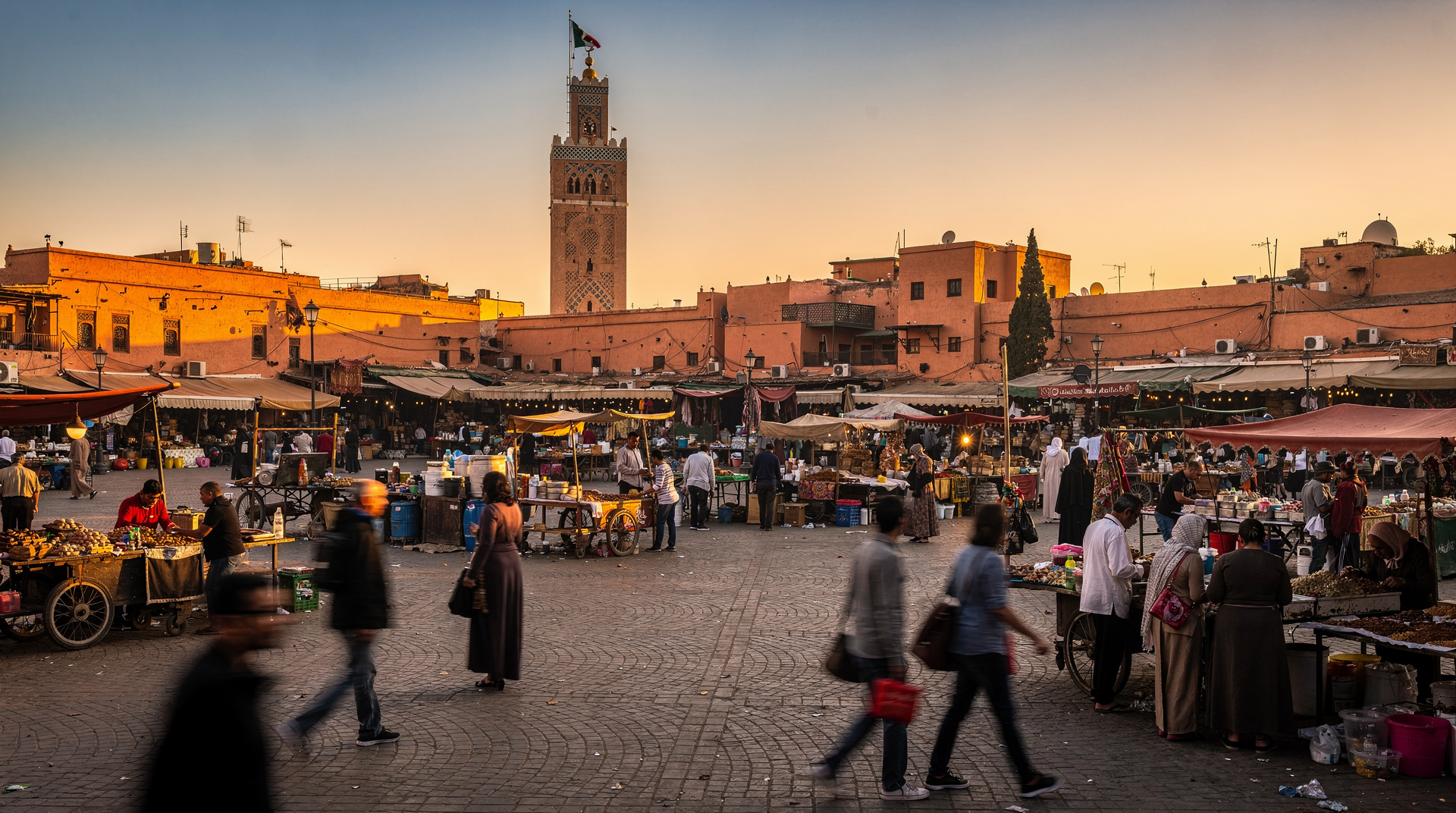
Azrou’s weekly market takes place every Saturday and remains one of the most genuine rural souks in the Middle Atlas — a market that functions for the benefit of local Berber farmers and traders rather than as a tourist attraction. Produce stalls sell saffron from the Talaouine plateau, mountain honey, dried herbs, preserved lemons, and seasonal vegetables from the surrounding hills. Live animal trade (sheep, goats, cattle) takes place in the livestock section. Textile merchants sell traditional Berber woven goods — blankets, rugs, and jellabas — at prices determined by Berber market logic rather than tourist economics.
The souk typically operates from early morning until early afternoon. Arriving at 8–9 am gives the best energy and the widest selection.
Explore the Azrou Rock
The volcanic basalt rock formation that gives the town its name stands at the south-western edge of town. A trail climbs to the summit (about 1,280 m — just above the town level on this plateau) through scrub and cedar. The views from the top — south across the Middle Atlas plateau, north toward the forested ridges — are worth the 30-minute climb.
Drive the Middle Atlas Road South
The road south from Azrou through the Cedraie (cedar forest zone) toward Khénifra and Midelt is one of Morocco’s finest mountain drives — largely unknown to tourists. It passes through high-altitude cedar and oak forest, Berber villages with traditional agadir granaries, and eventually descends through the Ziz Gorge toward Erfoud and the edge of the Sahara. This southward extension is the basis of the Middle Atlas loop itinerary that ends in the desert.
Where to Stay
Azrou’s accommodation options are functional rather than atmospheric — most visitors stay in Fes or Ifrane and visit Azrou as a day trip.
Mid-range (400–800 MAD / €40–80 per night)
Hotel Panorama is Azrou’s most reliable accommodation — a comfortable hotel on the main road with clean rooms, good views toward the cedar forest, and a restaurant serving Moroccan and continental food. Doubles from around 500 MAD.
Hôtel des Cèdres is a traditional hotel in the town centre with simple but acceptable rooms and a ground-floor restaurant popular with local families. Around 400 MAD per night.
Dar Azrou is a newer guesthouse with a more personal atmosphere — a converted traditional house with four rooms and an owner who is a knowledgeable source of local hiking routes. Around 500–650 MAD per night.
Budget (under 300 MAD / €30 per night)
Several basic auberges and pensions cluster around the main square. Standards are minimal; useful for those on a strict budget who want to stay in the forest area rather than driving back to Fes.
Where to Eat
Azrou’s food scene is unpretentious and Berber.
Restaurant Beau Séjour (near the main square) is consistently recommended for its straightforward Moroccan menu — tagines, harira, and an excellent couscous on Fridays. Prices are local (50–100 MAD per person).
Café-Restaurant de la Paix serves breakfast and lunch on the main square — mint tea, msemen, amlou with argan honey, and a solid lunch tagine. Good for fuelling before a forest walk.
Souk food (Saturdays): The souk food stalls on market day offer the most authentic eating experience in Azrou — freshly grilled kefta, msemen cooked on griddles, and harira from large communal pots. Budget 30–60 MAD for a full market breakfast.
Cedar honey: Azrou’s most distinctive food product is the forest honey produced by bees that forage among the cedar, thyme, and wildflowers of the national park. It has a distinctive, slightly medicinal character very different from the clover honeys sold in city markets. Buy directly from beekeepers at the Saturday souk (80–150 MAD per 500g).
Day Trips from Azrou
Ifrane: 17 km north, Ifrane — Morocco’s alpine-style university town with Swiss-chalet architecture and a ski station — makes a natural half-day complement to Azrou’s more Berber, market-town character. See the stone lion, walk the lake, and continue to the ski station viewpoint.
Fes: 78 km north, Fes is the day-trip city. A morning in the Azrou cedar forest followed by an afternoon in the Fes medina is one of the great Morocco contrast-days — ancient forest and urban labyrinth.
Aguelmam Azigza: A crater lake about 20 km south, surrounded by cedar forest. Unusually beautiful and almost completely unvisited by tourists. The road requires a car (some sections are dirt road).
Khenifra: 60 km south on the N8, Khenifra is a Ziane Berber market town and gateway to the Ahansal valleys — some of Morocco’s most remote trekking country. An advanced day trip or the start of a multi-day south-facing journey.
Practical Tips
Best macaque encounter times: Early morning (8–10 am) and late afternoon (3–5 pm) see the most active troops. Midday in summer the macaques shelter in the forest canopy and are harder to find at the roadside.
Saturday souk timing: Arrive by 8 am for the full market energy. By 1 pm the stalls begin packing up. Parking in Azrou on Saturday mornings can be very limited — park outside town and walk in.
Weather and clothing: Azrou sits at 1,250 metres and the Middle Atlas weather is changeable. Bring a warm layer even in summer — afternoon thunderstorms are common in July and August. Winter temperatures regularly fall below freezing.
Cedar forest trails: There are no marked hiking trails in the cedar forest beyond the main macaque viewpoint. GPS navigation (AllTrails, Gaia GPS) is useful for extended forest walks. The forest is not technically difficult to navigate, but it is easy to lose orientation in dense stands.
Combining with Ifrane: The natural pairing is Azrou + Ifrane in a single day from Fes. The two towns are 17 km apart; see both comfortably in a day with an early start.
Market ethics: At the Saturday souk, bargaining is expected for crafts and textiles but not for food produce (prices are roughly fixed by the market dynamic). Photographing people requires asking first — this is a working market, not a tourist site.
When to Visit
April to June is the finest season: the cedar forest floor is green and alive with wildflowers, the macaque juveniles born in spring are visible with their mothers, and the Middle Atlas weather is warm by day and cool at night.
September to November: Excellent for forest atmosphere. Autumn colour appears in the oaks and maples beneath the cedars; mushroom season brings local foragers into the forest; the air is crystal clear after the summer heat.
December to March: Snow is possible and in heavy years the cedar forest under snow is extraordinary. The Saturday souk in winter is less crowded and more atmospheric. Road conditions require care in heavy snow.
July to August: Peak domestic tourism. The macaque viewpoints are busiest on weekend mornings. The forest interior is always cooler than the town.
How to Fit Azrou Into a Morocco Itinerary
Azrou fits most naturally into a Middle Atlas day trip from Fes — the standard combination with Ifrane that tour operators offer from the imperial city. An early start (7 am from Fes), arrival in Azrou by 8:30 am for the macaques and forest, market day if it is Saturday, then a short drive to Ifrane for the alpine town experience, and back to Fes by late afternoon.
For those on a longer itinerary wanting to explore the Middle Atlas in depth, Azrou makes a good overnight base for a southward journey toward Khénifra, Midelt, and eventually the Ziz Gorge and Erfoud at the edge of the Sahara. This Middle Atlas traverse — through the cedar zone, over the High Atlas passes, and into the desert — is one of Morocco’s great road journeys and is almost entirely off the tourist circuit.
See also: the Ifrane travel guide, our Fes travel guide, the Middle Atlas hiking guide, and the imperial cities and beyond itinerary.
Frequently asked questions about Azrou Travel Guide
Is it ethical to see the Barbary macaques at Azrou?
Observing them is fine; feeding them is discouraged and increasingly restricted, since it habituates wild animals to roadside begging and human food that is not good for their health. Vendors at the viewpoint sell nuts for tourists to offer, but watching the troops forage naturally in the cedar canopy is both more responsible and, for most visitors, a richer experience.
Is Azrou worth visiting if I’ve already seen the Atlas Mountains around Marrakech?
Yes — Azrou and the Middle Atlas are a genuinely different landscape and culture from the High Atlas around Imlil and Toubkal: cedar forest rather than bare peaks, a market town rather than a trekking base, and an easy half-day rather than a multi-day commitment. It pairs naturally with Fes rather than Marrakech.