Northern Morocco itinerary
Northern Morocco — the overlooked half
Most Morocco itineraries start and end in Marrakech and push south to the Sahara. The north gets added as a bolt-on, a quick Chefchaouen photo stop between Fes and the coast. This itinerary makes the north the destination.
The northern circuit — Tangier, the Rif Mountains, Chefchaouen, the Rif coast, Fes, Meknes, and Volubilis — covers some of the most varied and culturally concentrated landscape in Morocco in 8 days. No desert. No long southbound drives. A different Morocco from the one that appears on most highlight reels.
Who this is for: Travellers who have either already done the Sahara circuit or who specifically want the cultural and architectural depth of the north. History enthusiasts (Roman Morocco at Volubilis is extraordinary). Photography travellers (Chefchaouen needs no introduction). Anyone who wants to understand the Islamic urban tradition of Morocco at its most complete.
Budget expectation (per person, car excluded): €700–1100 mid-range for 8 days. The north is generally less expensive than the tourist infrastructure around Marrakech.
Pace: easy. You move every 1–2 nights. No day exceeds 4 hours of driving. This is a deliberately sustainable pace designed to allow depth rather than coverage.
Trip snapshot
| Where | Tangier → Tetouan → Chefchaouen → Akchour → Fes → Meknes/Volubilis |
| Cost (per person, car excluded) | around €700–1,100 mid-range |
| Time needed | 8 days as written; workable in 5 with cuts, or extend to 12 with the Atlantic coast |
| Getting there | fly into Tangier (TNG), fly out of Fes (FEZ) |
| Best time | March–May or September–November |
| Difficulty | easy — no day exceeds 4 hours of driving, self-drive recommended |
At a glance
| Day | Route | Drive | Highlights | Overnight |
|---|---|---|---|---|
| 1 | Arrive Tangier | — | Kasbah, Petit Socco, Cap Spartel | Tangier |
| 2 | Tangier → Tetouan → Chefchaouen | 2.5h | Tetouan medina, mountain arrival | Chefchaouen |
| 3 | Chefchaouen | — | Blue alleys, Ras el Maa, evening | Chefchaouen |
| 4 | Chefchaouen → Akchour | 30min | Waterfall hike (full day) | Chefchaouen |
| 5 | Chefchaouen → Fes | 4h | Mountain road, Fes arrival | Fes |
| 6 | Fes | — | Tanneries, Bou Inania Medersa, medina | Fes |
| 7 | Fes → Volubilis → Meknes → Fes | 3h round trip | Roman mosaics, Bab Mansour | Fes |
| 8 | Fes | — | Final medina, depart | — |
Day-by-day narrative
Day 1: Tangier — Africa’s European city
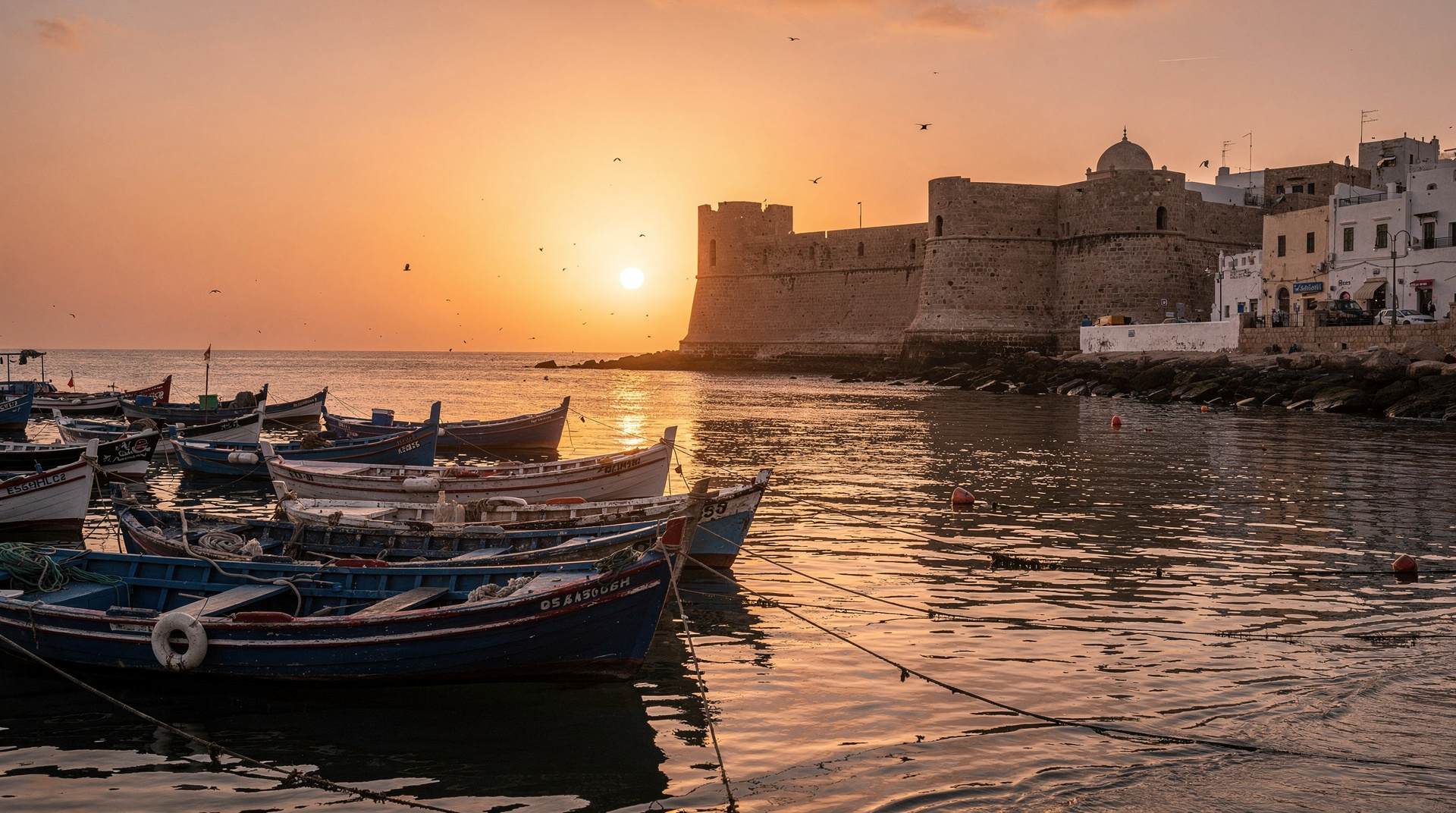
Tangier is the most cosmopolitan city in Morocco. It has been genuinely international in a way that Marrakech’s tourist industry only approximates — the famous international zone from 1923 to 1956 brought diplomats, artists, writers, spies, and bankers to a city exempt from any single nation’s laws. The legacy persists in the architecture, the cafe culture, and the demographic mix of the city.
Afternoon: the kasbah quarter
Drive or taxi from the airport to the medina. Park outside the walls (there is parking at the foot of the kasbah hill) and walk up. The Kasbah Museum occupies a former sultan’s palace and has a rooftop terrace with the view that defines Tangier: the Strait of Gibraltar, Spain visible on a clear day 14 km to the north, the Atlantic meeting the Mediterranean. Entry: €3.
Below the kasbah: the Petit Socco, the old café square of the international zone. Burroughs wrote at the Café Central; Matisse painted the terrace light. The cafes are still there, the light is unchanged, the trade is now WiFi and mint tea.
Late afternoon: Cap Spartel
14 km west of Tangier: the northwestern tip of Africa. The lighthouse at Cap Spartel marks the point where the Atlantic and Mediterranean officially meet. On a clear day the contrast in water colour between the two seas is visible. The Hercules Caves 2 km south (entry: €3) are a sea cave system with an opening shaped like the continent of Africa facing the ocean.
Evening: the medina restaurants
Saveurs de Poisson near the medina gate is legendary — no menu, no choices, the owner decides what you eat (always fish, always fresh, always excellent). Book ahead or arrive at 19:00. €25–35pp. For a more conventional experience, the restaurants along the port waterfront offer good fish at honest prices.
Where to sleep: El Minzah Hotel (historic hotel, upscale: €120–180); Dar Nour (boutique riad in the kasbah: €90–130)
Budget estimate today: €80–160
Day 2: Tetouan and the blue city arrival
Morning: Tetouan
50 km east of Tangier on the N16: Tetouan is one of Morocco’s most overlooked medinas. It was settled by Moorish and Jewish refugees from the Reconquista in 1484 — the Andalusian influence is visible in the architecture (wrought-iron balconies, elaborate plaster mouldings, a different spatial logic from the Arab medinas further south). Entry through the main gate is free; the Museum of Moroccan Art (inside the Spanish area, entry €2) has a good collection of Tetouan-specific crafts. Allow 2–3 hours. The Tetouan destination guide goes deeper on the medina, and the Tetouan day trip from Tangier shows how the same stop works as a standalone outing.
The drive to Chefchaouen (1.5 hours from Tetouan)
The Rif Mountain road from Tetouan climbs through increasingly dramatic gorge country. The road is good but winding — allow more time than the map suggests. The approach to Chefchaouen reveals the city’s setting first: a steep ravine between two mountain peaks (Bab Taza and Jebel Tisouka), with the white and blue medina visible clinging to the hillside.
Afternoon: first impression of Chefchaouen
Enter through Bab el-Ain gate into the medina. The blue-washed lanes begin immediately and do not stop. Chefchaouen is famous enough — Instagram has done its work — but the experience in person is genuinely different from the photographs. The blue is not uniform: house owners paint their walls at different intervals and in different shades of blue, creating a range from powder blue to cobalt to near-purple. The Ras el Maa spring at the east end of the medina is where locals do laundry and children play in cold mountain water.
Evening: Place Outa el-Hammam
The main square with the red-walled kasbah on one side and cafe terraces on the other. Sit here with mint tea and watch the evening rhythm of the city. Dinner at Restaurant Tissekmadin or at one of the terrace restaurants on the square.
Where to sleep: Dar Meziana (mid: €60–90); Riad Cherifa (charming mid: €70–100); Hotel Lina Ryad (mid: €50–80)
Budget estimate today: €80–140
Day 3: Chefchaouen — the medina in depth
Morning: the blue alleys before the crowds
The photographers and day-trippers from Fes arrive by midday. Be in the medina by 08:00 for the morning light on the blue walls. The lane that runs from the square toward the Ras el Maa spring is the most photographed alley in Morocco — the blue-painted steps, the terracotta pots, the cats on the windowsills. At 08:30 it is yours; at 11:00 it will have 50 people in it.
The kasbah in the square (entry: €3) contains a small museum and a garden that gives a view over the medina rooftops. The tower of the kasbah is the highest point accessible to visitors — the view of the surrounding Rif peaks and the white-and-blue medina below is the best orientation possible.
Afternoon: the souks
Chefchaouen’s medina souks are smaller and more local than Marrakech’s tourist-oriented version. The specialty here is woollen goods: heavy jalaba cloaks, striped blankets (the djellabas and fouta textiles of the Rif), leather goods. The prices are lower than Marrakech for comparable quality. The women weaving on horizontal looms in some workshop doorways are doing the actual work — not a demonstration.
The Ensemble Artisanal near Bab el-Ain has fixed-price crafts if you want to buy without bargaining pressure.
Evening
The light changes dramatically in Chefchaouen between 18:00 and sunset. The terracotta tiles go red, the blue walls intensify, the shadows lengthen. This is the time to walk without any shopping agenda — just let the city work on you.
Budget estimate today: €60–100 (one of the cheapest days on this itinerary)
Day 4: Akchour — the waterfall hike
The drive (30 minutes, 20 km)
Grand taxi or car to the Akchour trailhead in the Talassemtane National Park. The road runs along the Oued Farda gorge through oak and cedar forest.
The hike (5–6 hours round trip)
The Akchour Waterfalls trail follows the Oued Farda river through an increasingly dramatic gorge. The first major waterfall (90 minutes from the trailhead) is the most visited — a cascade into a pool suitable for swimming in summer. The natural bridge above (additional 2 hours from the first waterfall) is more remote and less visited: a rock arch over the gorge, genuinely spectacular.
The trail is well-marked and physically moderate — some scrambling in the upper section, a river crossing on stepping stones. Wear proper walking shoes; the path is rocky and the river crossing requires balance. Bring lunch and water. Our Akchour waterfalls hike guide and the Akchour destination page cover the trail in more detail.
The Akchour waterfalls guided hike from Chefchaouen includes transport to the trailhead and a guide who knows the upper trail — particularly useful if you want to reach the natural bridge without route-finding uncertainty.
Evening: return to Chefchaouen
Return by grand taxi (€4) or with your own car. Dinner at a medina restaurant, feet up, possibly the best sleep of the trip in the cool mountain air.
Budget estimate today: €40–80 (hike + transport, simple dinner)
Day 5: Mountain road to Fes
The drive (4 hours, 200 km)
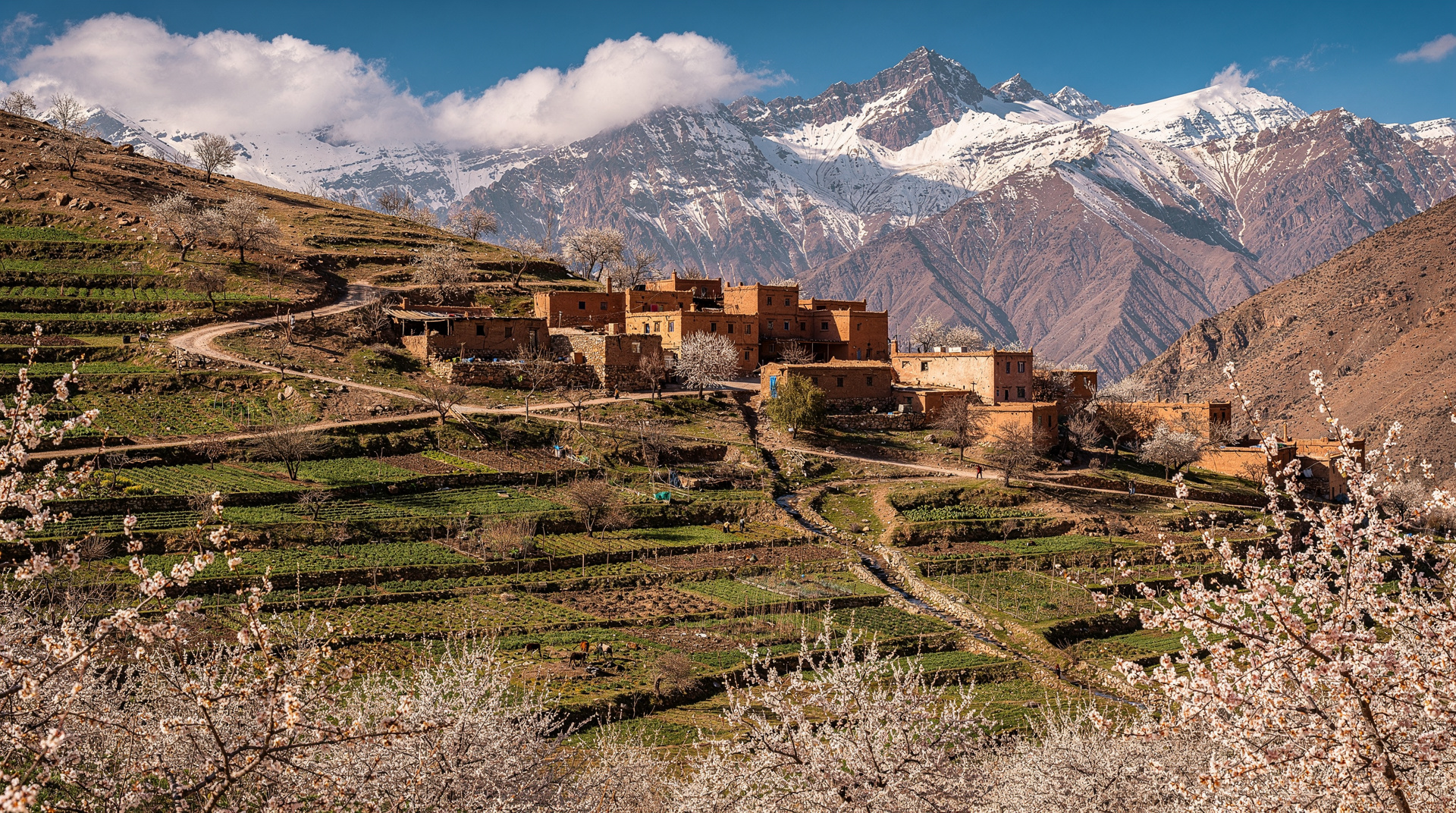
The road from Chefchaouen to Fes runs south through the Rif foothills via Ouezzane. It is a mountain road — winding, occasionally narrow, scenic throughout. The landscape transitions from the green Rif cedar forests through the limestone plateau country and then drops into the Middle Atlas foothills approaching Fes.
Leave by 09:00 to arrive in Fes by early afternoon — navigating to your riad in Fes el-Bali for the first time should be done in daylight. The GPS works imperfectly in the medina; coordinate your parking spot (outside the walls) and walking route to your riad with the riad itself before departure.
Afternoon: first impression of Fes
Check in, leave your bags, and walk Talaa Kebira from Bab Bou Jeloud straight south without turning. This is the main artery of Fes el-Bali — the most direct path through the medina and the best orientation walk. Do not try to navigate to the tanneries today. Let the scale and density of the city be your only agenda.
Fes el-Bali is genuinely disorienting on the first afternoon. The medina is the largest preserved medieval urban fabric in the world — over 9000 streets, inhabited by 150,000 people. The working-city reality (butchers, leather workers, muezzins, donkey freight, students from the Qarawiyyin university) is the experience. Touristic Morocco is not the primary register here.
Where to sleep: Dar Bensouda (mid: €80–130); Riad Fes (upscale: €150–250); Palais Amani (boutique luxury: €200–400)
Budget estimate today: €90–160 (including driving fuel, dinner)
Day 6: Fes el-Bali — full immersion
The guide question
Fes rewards having a licensed guide more than any other city in Morocco. The difference between having one and not having one is not just the avoidance of getting lost — it is the transformation of what you see. The tanneries become legible; the medersa history has context; the guild organisation of the souks makes sense. The Fes souks guide and the medersas of Fes guide are good preparation before you go. Book the Fes full-day cultural tour for today.
Morning: Chouara Tanneries
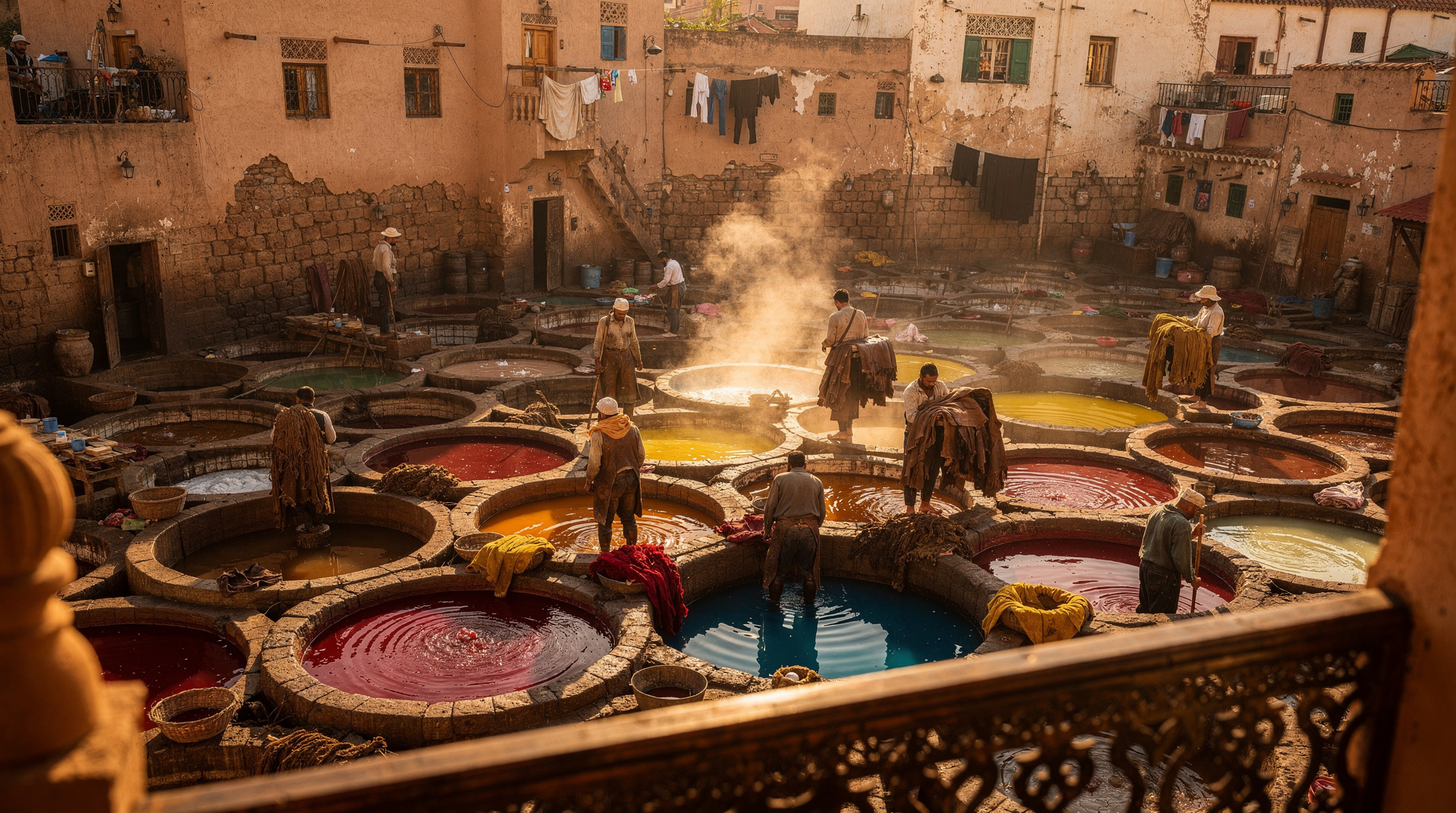
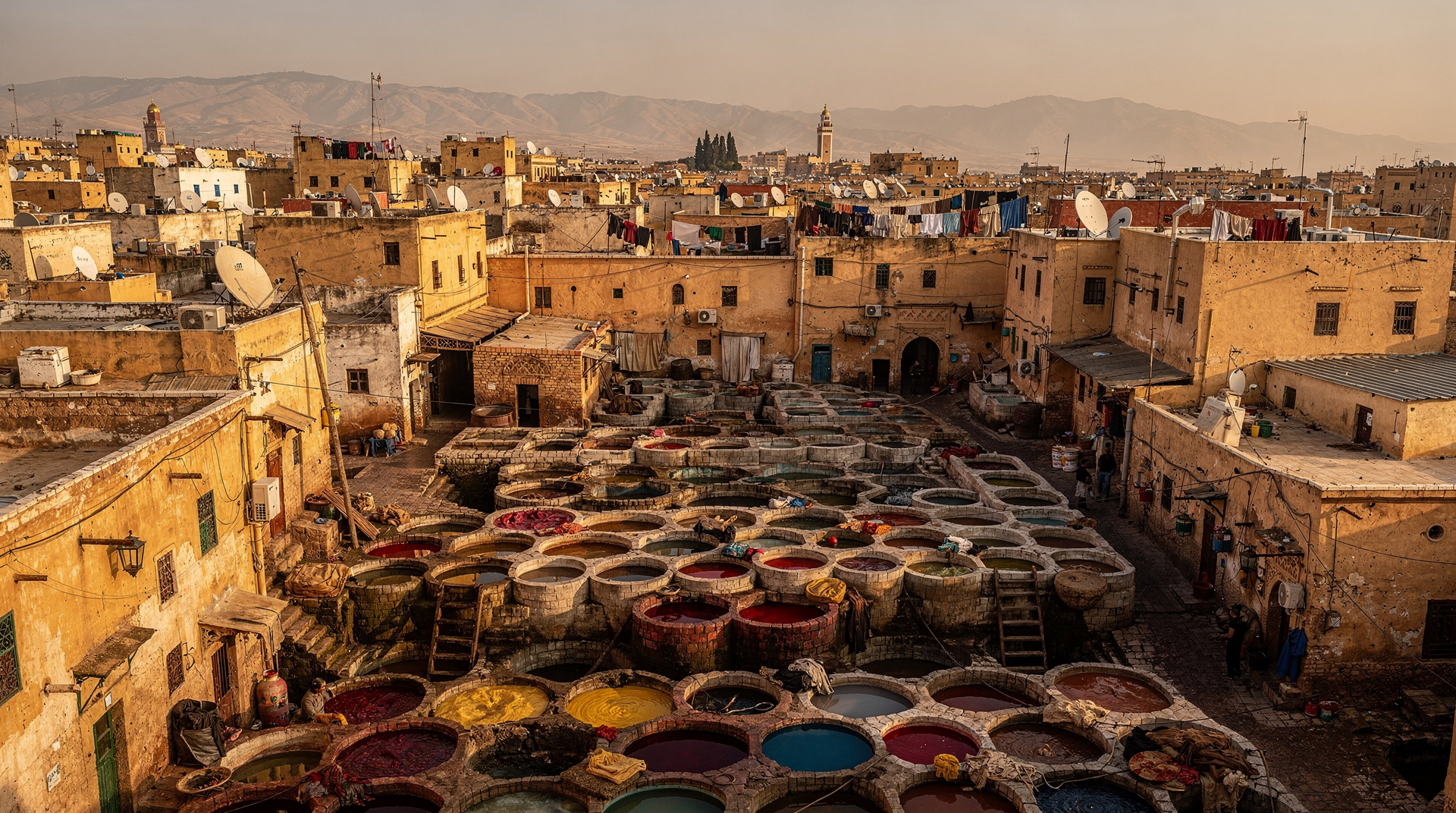
The Chouara Tanneries are the oldest still-operating tanneries in the world. The stone honeycomb vats of coloured dye — saffron yellow (safflower), green (mint), red (poppy), white (chalk) — have been processing animal hides here since the 10th century using methods unchanged in over a thousand years. Workers stand waist-deep in the vats treading hides. The smell announces itself from 200 metres. View from the surrounding leather-shop terraces (free to go up if you agree to browse, not obligated to buy). The merchants hand you a sprig of mint to hold under your nose.
Mid-morning: Bou Inania Medersa and the souk quarter
The Bou Inania Medersa (built 1351) is the finest Islamic building open to non-Muslims in Morocco. Three layers of ornament ascending vertically: zellige tilework at base (up to the dado rail), carved plaster in the middle tier, carved cedar wood at the top — all in proportions so balanced they read as inevitable rather than elaborate. Entry: €3. The minaret still calls to prayer. The courtyard reflects in the central fountain pool.
Walk the souk alleys from Bou Inania south: the copper souk (hammering audible from two streets away), the henna souk, the Attarine Spice Market adjacent to the Qarawiyyin mosque, the carpenter’s souk in Ain Azliten where the traditional carved cedar doors and furniture of Fes are still made.
Afternoon: Qarawiyyin quarter and the Andalusian district
The Qarawiyyin mosque (founded 859 AD, the oldest continuously operating university in the world) is closed to non-Muslims. You can see the entrance from the alley and hear the prayer call from within. The fountain in the street outside is where students have washed for 1100 years.
Cross to the Andalusian quarter (Fes el-Andalus) via the river bridge for the quieter, less-touristed half of the medina. The Andalusian mosque’s carved stone doorway is among the finest in Fes.
Evening: riad dinner
The good riad restaurants in Fes serve full Fassi cuisine — bastila (the remarkable pigeon pie with almonds and sugar), harira, tagine with preserved lemon, pastilla au lait for dessert. La Maison Bleue (€60pp) is the apex of this tradition. Mid-range riads usually offer a set dinner for €20–30pp.
Budget estimate today: €90–160 including guide, meals, entry fees
Day 7: Meknes and Volubilis
The day trip (3 hours driving total)
Meknes is 60 km west of Fes by road or 45 minutes by ONCF train — the train is simpler if you park at the Fes station. Alternatively, drive yourself and park at the central square near Bab Mansour.
Meknes
Sultan Moulay Ismail (r. 1672–1727) chose Meknes as his capital and spent 50 years building what he intended to be the rival of Versailles: 40 km of defensive walls, 20 city gates, 50 palaces, stables for 12,000 horses. Most is now ruin or inaccessible; what remains is still formidable.
Bab Mansour (completed 1732): the main ceremonial gate of the imperial city. 20 metres of carved marble and zellige panels, flanked by columns taken from Volubilis. It is possibly the finest ornamental gateway in North Africa. The Mausoleum of Moulay Ismail inside the imperial precinct is open to non-Muslims — an unusual permission, reflecting the sultan’s importance to Moroccan national identity. The Heri es-Souani granaries are underground vaulted storage chambers of monumental scale, built to keep grain cool using an underground water system.
Volubilis (33 km north of Meknes)
The Roman city of Volubilis was continuously occupied from the 1st century BC to the 11th century AD. It served as the administrative capital of the Roman province of Mauretania Tingitana under the Severan dynasty. The in-situ floor mosaics are among the best-preserved in Africa: Bacchus riding a panther, the labours of Hercules, Diana bathing, the chariot race of Amphitrite — intricate and largely intact under open sky. The Triumphal Arch of Caracalla (dedicated 217 AD) still stands in the decumanus maximus. Entry: €7.
Allow 2 hours at Volubilis with a guide, 90 minutes without. For more on the site, see the Volubilis Roman ruins guide and the Volubilis day trip from Fes.
Between Volubilis and Meknes: Moulay Idriss Zerhoun
The holy city of Moulay Idriss — burial place of Idris I, founder of Morocco’s first Islamic dynasty — clings to two hills 10 km south of Volubilis. Non-Muslims cannot enter the sanctuary but the town is worth a 30-minute stop for the view from the lower streets up to the green-roofed shrine and the panorama of the Zerhoun hills behind.
Where to sleep: Riad Fes (as previous nights)
Budget estimate today: €70–130 including fuel, Volubilis entry, meals
Day 8: Final Fes and departure
Early morning: the medina before 08:00
The Fes medina before the working day begins properly is the best time to be in it. The bread sellers carrying trays of flatbread on their heads from the communal oven to the households. The water man with his mule. The students walking to the Qarawiyyin. The shutters of the souk coming up one by one. Have coffee at the traditional cafe near Bab Bou Jeloud (glass of black coffee and a msemen flatbread: €1 total).
Morning: final purchases
The Fes blue-and-white ceramics are distinctive and genuinely beautiful — the geometric style is specific to the city and the craft is still practiced in the pottery quarter. Buy direct from the potters’ area (Fakharine, near the tanneries) rather than from souk stalls. A good medium-sized plate costs €15–25; an ornate large platter €60–80.
Departure
Fes Saiss Airport (FEZ) has connections to European cities. If departing by train, Fes station is 30 minutes from the medina by taxi. If continuing to Marrakech, the train takes 6 hours (change in Casablanca) or a CTM bus runs direct in 8 hours.
Budget estimate today: €60–100
Transport logistics
Rental car: Collect at Tangier airport, return at Fes Saiss airport (one-way rental, check availability and drop fee — typically €50–80 extra). A standard 4x2 is fine for all roads on this itinerary, including the Rif mountain road and the Volubilis track (paved).
Driving times:
- Tangier → Tetouan: 45 minutes (50 km)
- Tetouan → Chefchaouen: 1.5 hours (65 km)
- Chefchaouen → Fes: 3.5–4 hours (200 km via Ouezzane)
- Fes → Meknes: 1 hour (60 km)
- Meknes → Volubilis: 30 minutes (33 km)
Chefchaouen parking: Cars cannot enter the medina. There is parking at the bus station and near the main gate. Walk from parking (5–10 minutes).
Fes medina: Do not attempt to drive inside. Park at the Place de la Résistance (new city) or use the hotel/riad’s indicated parking. Most riads will give GPS coordinates and instructions for meeting point.
Budget estimate
| Item | Budget (pp) | Mid-range (pp) | Comfort (pp) |
|---|---|---|---|
| Accommodation (8 nights) | €200 | €540 | €1000 |
| Car rental (8 days, 2 people) | €160 | €230 | €350 |
| Fuel + tolls (approx 800 km) | €60 | €60 | €60 |
| Food and drink (8 days) | €130 | €260 | €480 |
| Entry fees, tours, activities | €60 | €140 | €250 |
| Total (flights excluded) | €610 | €1230 | €2140 |
What to pack for the north
Warm layer: The Rif Mountains and Fes in winter can be genuinely cold — Chefchaouen sits at 600 metres and is noticeably cooler than the coast. Pack a fleece or light down jacket for evenings.
Comfortable medina shoes: Fes medina involves hours of walking on uneven cobblestones. Proper walking shoes rather than sandals, particularly for the tannery quarter where the lanes are slick with water and dye overflow.
Conservative clothing: The northern medinas — Tetouan, Chefchaouen, Fes — are more conservative in dress expectations than Essaouira. Shoulders and knees covered is the standard. Women: carrying a headscarf for medersa visits is courteous though not required.
Best time of year
March–May: Spring is the best time for northern Morocco. The Rif Mountains are green, wildflowers are out in the valleys around Chefchaouen, temperatures are ideal (20–25°C in Chefchaouen, 22–28°C in Fes). The Akchour waterfall hike is at its best when the rivers are full.
September–November: Also excellent. The summer heat has broken, the tourism crowds have thinned, the Fes medina is at its most manageable.
December–February: Chefchaouen can be cold and sometimes snowy — the blue city in snow is extraordinary if you get lucky. Fes in January can be 10°C and rainy. Carry warm gear.
Avoid June–August: Fes in summer exceeds 38°C. The tanneries in July heat are an intense sensory experience. The Chefchaouen medina is full of summer tourists and the alleys can be genuinely crowded.
Common mistakes to avoid
Arriving in Fes after dark: The medina is a complex maze even in daylight. Finding your riad after dark with luggage, jet lag, and a unreliable GPS is one of the worst possible Morocco introductions. Arrive in Fes by 16:00 minimum.
Treating Chefchaouen as a photo stop: Most visitors spend 4 hours and leave. The city deserves 2–3 nights. The Akchour hike alone justifies an extra day.
Skipping Tetouan: It is 50 km from Tangier and 2 hours from Chefchaouen. It is also the most authentic Andalusian-Moroccan medina in the country, almost completely unknown to tourists. Spend 2 hours here minimum.
Hiring an unofficial guide in Fes: Unlicensed “guides” who approach you at Bab Bou Jeloud will lead you to commission shops. Licensed guides carry ONMT badges and their prices are regulated. The difference in quality is significant.
How to extend or shorten
Shorter (5 days): Remove Tetouan and the Meknes/Volubilis day trip. Spend 2 nights in Chefchaouen (including the Akchour hike) and 2 nights in Fes.
Longer (12 days): Add the Atlantic coast leg (Tangier → Asilah → Rabat → Casablanca → Essaouira) before or after the northern loop. See our Atlantic coast itinerary for the coastal extension. Or add the Sahara loop south of Fes — see our 10-day Morocco itinerary which uses Fes as the pivot point between north and south.
For a Fes-focused deep dive, the imperial cities itinerary treats the four imperial capitals as the primary destination. Our Chefchaouen guide and Fes guide have full detail on each city. See also our Tangier destination guide for more on the international-zone history, and the Meknes destination guide for the imperial city beyond the day-trip summary above.
Frequently asked questions about Northern Morocco itinerary
Do I need to rent a car for this itinerary, or can I do it by public transport?
A car is recommended but not strictly required. CTM buses and grand taxis cover every leg — Tangier to Tetouan to Chefchaouen, Chefchaouen to Fes, and Fes to Meknes/Volubilis (by train or shared taxi). Without a car you lose flexibility on the Meknes/Volubilis day trip and add some waiting time at bus stations, but the itinerary is fully doable without driving.
Is northern Morocco safe and easy for a first Morocco trip?
Yes. The north is generally calmer and less commercially aggressive than Marrakech’s medina, and Tangier’s old reputation for hassle is largely outdated (see the Day 1 section above). It works well as a first Morocco trip if you specifically want cultural and architectural depth over Sahara desert scenery — pair it with a Marrakech add-on later if you want both.