Morocco, Spain, and Portugal: 3-week itinerary
The classic Atlantic-to-Sahara route
Lisbon to Marrakech. Three countries, two continents, one ferry crossing between them. This is one of the most satisfying overland routes in the world: starting with Atlantic Portugal’s maritime culture, crossing into Andalusia’s Moorish history, then boarding a ferry to the continent that shaped all of it.
The Tangier crossing is a threshold moment that stays with travellers long after the trip. You board the ferry in Europe and step off 35 minutes later in Africa. The air is different. The sounds are different. The call to prayer replaces church bells. The orange trees of Seville give way to the mint-scented chaos of Tangier’s medina.
This 21-day itinerary allocates roughly equal time to each country: 5 days Portugal, 5 days Spain, and 11 days Morocco. You can adjust the balance based on what interests you most. Most people on this route end up wishing they had more time in Morocco — plan accordingly.
Route at a glance: Lisbon (3 nights) → Seville (3 nights) → Tarifa/ferry → Tangier (1 night) → Chefchaouen (2 nights) → Fes (3 nights) → Marrakech (3 nights) → Essaouira (2 nights) → Marrakech airport → home
Total estimated cost (per person, flights excluded): €1400–2200
Trip snapshot
| Where | Lisbon → Seville → ferry to Tangier → Chefchaouen → Fes → Marrakech → Essaouira |
| Cost (per person, flights excluded) | around €1,050–2,005 depending on budget vs mid-range |
| Time needed | 21 days for the full three-country balance; 14 days workable if you cut Portugal |
| Getting there | fly into Lisbon, fly out from Marrakech (or Essaouira via Casablanca) |
| Best time | March–May or September–November |
| Difficulty | moderate — one ferry crossing, several long bus/train legs |
At a glance
| Day | Route | Overnight |
|---|---|---|
| 1–3 | Lisbon: Alfama, Belém, day trip Sintra | Lisbon |
| 4 | Train Lisbon → Seville (6h) | Seville |
| 5–6 | Seville: Alcázar, Giralda, tapas | Seville |
| 7 | Day trip Córdoba or Ronda | Seville |
| 8 | Bus Seville → Tarifa, ferry to Tangier | Tangier |
| 9 | Tangier medina + bus to Chefchaouen | Chefchaouen |
| 10 | Chefchaouen: blue city, Rif hike | Chefchaouen |
| 11 | Bus Chefchaouen → Fes (4h) | Fes |
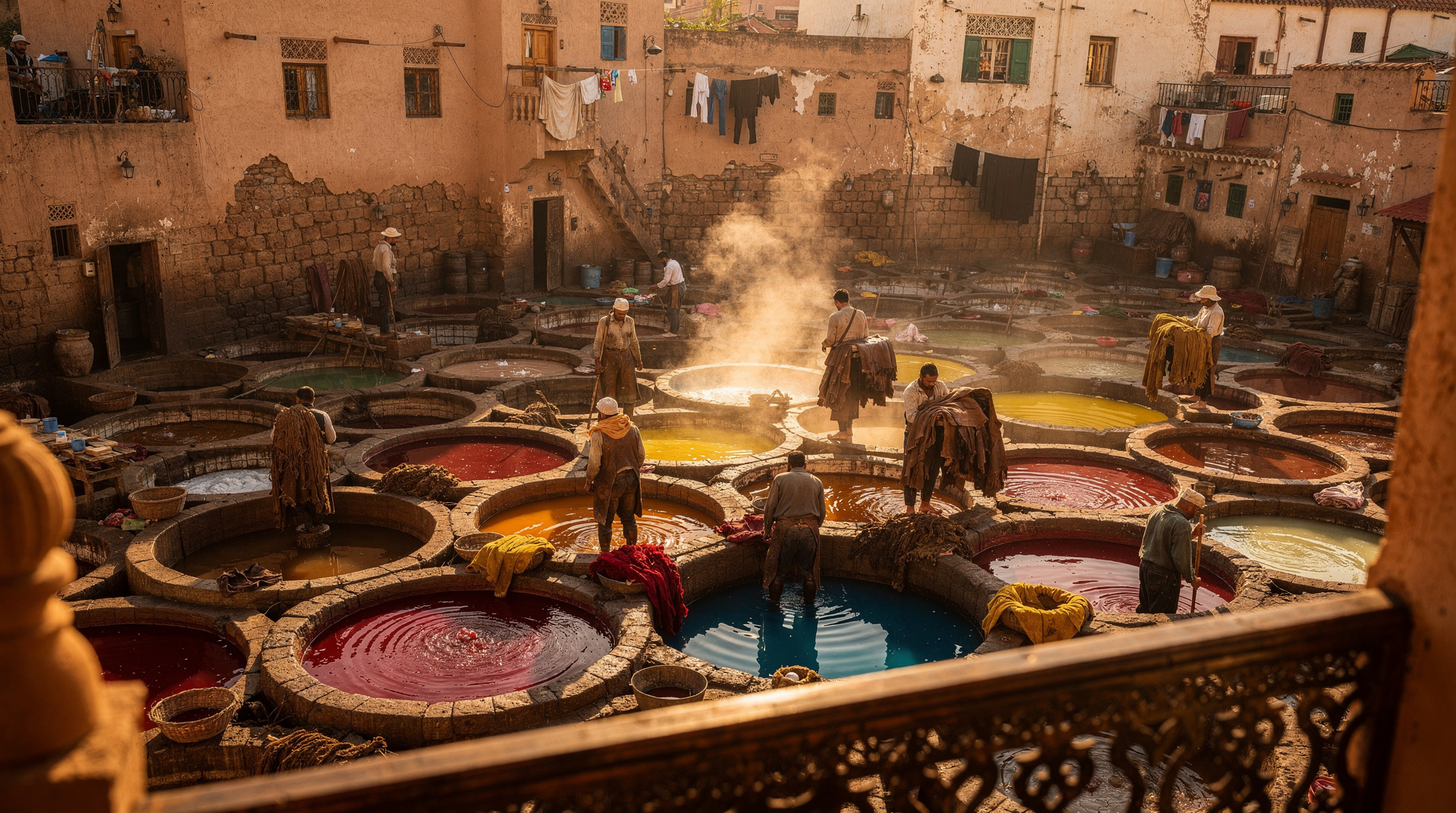
| 12 | Fes el-Bali: tanneries, souks, medersas | Fes |
| 13 | Fes: Andalusian quarter, Volubilis day trip | Fes |
| 14 | Bus Fes → Marrakech (8h) or train via Casa | Marrakech |
| 15 | Marrakech: medina, Majorelle, hammam | Marrakech |
| 16 | Marrakech: Aït Benhaddou day trip | Marrakech |
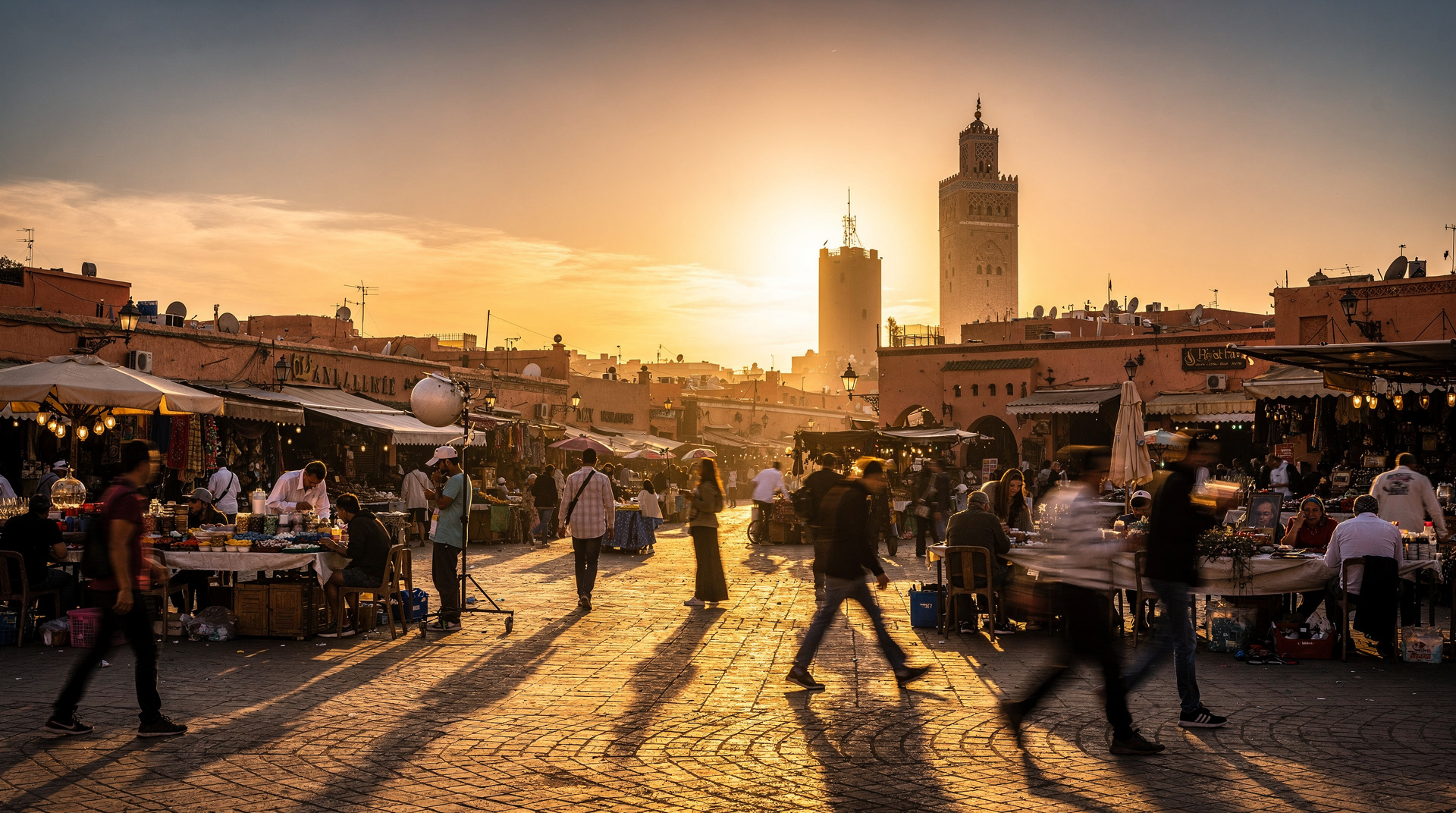
| 17 | Marrakech: palaces, souks, Djemaa el-Fna | Marrakech |
| 18 | Transfer to Essaouira (2h30) | Essaouira |
| 19 | Essaouira: medina, beach, sunset | Essaouira |
| 20 | Essaouira: Atlantic coast morning | Essaouira |
| 21 | Return Marrakech, fly home | — |
Portugal: Lisbon and the Atlantic foundation (Days 1–3)
Lisbon is one of Europe’s great cities — hilly, melancholic, tile-decorated, and built on the wealth of a 15th-century maritime empire that reached Morocco, Brazil, India, and Japan simultaneously. The historical connection to Morocco is concrete: the Moorish occupation of Portugal lasted 500 years and left the Alfama district, the castle, and the azulejo tile tradition that pervades the city.
Alfama: The oldest district, the one the Moorish city left behind, with the São Jorge Castle (€10 entry) and the Sé Cathedral. Fado music originated here — many small restaurants host fado nights (€20–35 cover including dinner).
Belém: The westernmost district, site of the Tower of Belém and the Jerónimos Monastery, both monuments to the Age of Discovery. The Pastéis de Belém café (the original custard tart shop, 1837) serves the archetypal pastel de nata for €1.30.
Day trip Sintra: 40 minutes by train from Rossio station (€5 return). The UNESCO-listed palaces of Sintra — Pena Palace, Moorish Castle, Quinta da Regaleira — occupy wooded hills above the Atlantic. Allow a full day.
Accommodation: Mid-range hotel in Baixa or Alfama, €70–120/night. Lower Chiado neighbourhood for best access to everything.
Spain: Seville and the Moorish inheritance (Days 4–7)
The train from Lisbon to Seville takes approximately 6 hours (two services daily, €40–70 depending on class and booking time). Seville was the capital of Moorish Andalusia’s most prosperous era and the launching point for the conquest of the Americas. The Alcázar palace — still a royal residence — is the finest surviving example of Mudéjar architecture in Europe: an Islamic building built for Christian kings using Muslim craftsmen.
Alcázar de Seville: Book tickets weeks in advance (€14.50 + gardens). The similarity to what you will see in Morocco — geometric tilework, carved plasterwork, central courtyard fountains — is not coincidental. These are the same craft traditions, the same aesthetic principles, separated by the Strait of Gibraltar.
The Giralda: The cathedral bell tower was the minaret of the Almohad Great Mosque before the Reconquista. It is 98 metres high and climbed via a ramp rather than stairs. The Almohad architectural influence is the direct link between Moroccan mosque architecture (the Koutoubia minaret in Marrakech is a near-contemporary twin) and Spanish sacred architecture.
Day trip option 1 — Córdoba: 45 minutes by AVE high-speed train (€15–25). The Mezquita — the Great Mosque of Córdoba, converted to a cathedral with a baroque nave inserted into the prayer hall — is the greatest monument of Moorish Spain. Book entry tickets in advance (€11).
Day trip option 2 — Ronda: 2 hours by bus or train. A dramatic white town above a 100-metre gorge. More authentically Andalusian than the coastal resorts; the bullring is the oldest in Spain.
Accommodation Seville: Mid-range hotel near the Alameda de Hércules, €70–110/night. Boutique guesthouses in the Santa Cruz neighbourhood for atmosphere, though they fill fast.
The crossing: Seville to Tangier (Day 8)
This is the day the trip changes in character.
Transport: From Seville’s Prado de San Sebastian bus station, buses run directly to Tarifa (2h30, €20–25) or you can take the train to Algeciras (€10, 4h via Granada or Antequera) and then bus to Tarifa (30 min). The FRS and Inter Shipping ferry companies operate the Tarifa–Tangier crossing: 35 minutes, €40–50 including port fees. Ferries run every 1–2 hours from 07:00 to 22:00.
Alternatively, Balearia and FRS both run a slightly longer crossing from Algeciras to Tangier Med (90 minutes, €35–55); Tangier Med is 45 km east of Tangier city and requires a bus or taxi onward.
Tarifa: If you have time before the crossing, Tarifa itself is worth an hour — the southernmost point of mainland Europe, with Africa visible across the Strait, kitesurfers on the beach, and a medina that feels already halfway between continents.
Tangier: The city has a complicated reputation that is largely outdated. The aggressive hustle of the 1980s and 1990s is significantly reduced since the Moroccan government cracked down on the informal “guide” economy. The medina and kasbah are genuinely interesting — the city that Graham Greene, Truman Capote, and William Burroughs called home has an atmosphere unlike any other Moroccan city.
Book the Tangier guided medina and kasbah tour on arrival — a 2-hour orientation with a licensed guide is the fastest way to understand the city and avoid the unofficial touts.
Where to stay: El Minzah Hotel (historic colonial grande dame: €100–160) or El Tangerino boutique hotel (€60–90).
Chefchaouen: the blue city (Days 9–10)
The CTM bus from Tangier to Chefchaouen runs twice daily (approximately 09:00 and 15:00, 3–4 hours, €8). Alternatively, a grand taxi from Tangier to Chefchaouen costs €8–12 per seat and is faster.
Chefchaouen sits in the Rif mountains 600m above sea level. The medina’s blue-painted walls and lanes are genuinely as photogenic as the photographs suggest — but the town is more than an Instagram backdrop. It is a Moroccan market town with its own architectural tradition, craft specialities (woven wool blankets and jellabas), and a hike into the surrounding hills that most visitors miss entirely.
The Chefchaouen blue city private walking tour is worth booking for a deeper understanding of the town’s history — founded by Moorish refugees from Andalusia in 1471, it has Spanish cultural DNA alongside the Moroccan.
Akchour Waterfalls: A day hike from Chefchaouen (or accessible by shared taxi: €4 each way to the trailhead). The Akchour river gorge trail leads through forest to two waterfalls and a natural swimming pool. The full circuit takes 4–5 hours and is genuinely beautiful — the Rif mountains north of Chefchaouen are underrated hiking territory.
Where to stay: Dar Meziana (boutique riad: €60–90); Hotel Dar Echchaouen (mid: €40–70); dozens of family guesthouses from €20–35.
Fes: the medieval world preserved (Days 11–13)
CTM bus from Chefchaouen to Fes: €8–10, approximately 4 hours. Arrive Fes mid-afternoon and navigate directly to your riad near Bab Bou Jeloud before dark — the Fes medina at night on your first visit is not a navigation challenge you want to face with luggage.
Day 12 — Fes el-Bali in depth: Book a full-day guided tour of the medina. This is the one city in Morocco where a guide is not optional — it is essential. The Fes medina contains 150,000 inhabitants in a city grid unchanged since the 9th century. Without context, it is beautiful and bewildering. With a knowledgeable guide, it is one of the most extraordinary living monuments in the world.
The Fes full-day cultural tour covers the tanneries, Bou Inania Medersa, Qarawiyyin university (founded 859 AD), the Attarine Spice Market, and the Andalusian quarter.
Day 13 — Volubilis and Meknes day trip: Hire a grand taxi for the day (€50–70 for the vehicle, shareable) to visit Volubilis (Roman ruins, 3rd-century mosaics in-situ) and Meknes (Bab Mansour, Moulay Ismail’s mausoleum). Return to Fes by evening.
Where to stay: Riad Fes (upscale: €150–250); Dar Bensouda (mid: €80–130); Equity Point Fes (budget hostel: €12–18 dorm).
Marrakech: the southern capital (Days 15–17)
From Fes to Marrakech: the ONCF night train departs around 22:00 and arrives at 06:30–07:30 (€15–20 in a couchette compartment), saving a hotel night. Or the CTM daytime bus (8h, €15) through the Middle Atlas and Tadla plains.
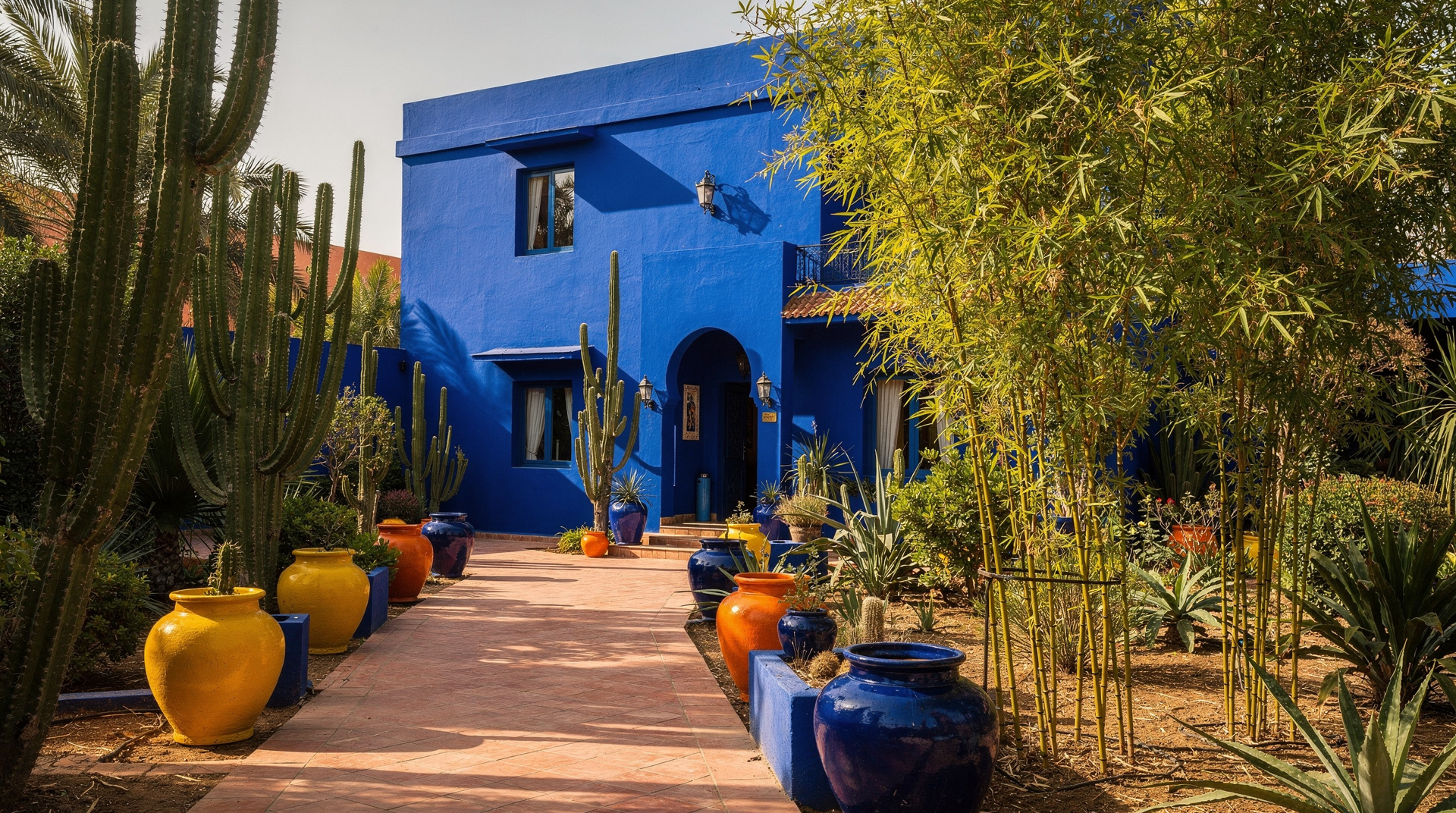
Three days in Marrakech requires prioritisation. The medina, Djemaa el-Fna, and the Bahia Palace complex are non-negotiable. Majorelle Garden requires booking in advance (€8–10 entry). A hammam is essential — Les Bains de Marrakech or a neighbourhood hammam.
Day trip to Aït Benhaddou: By this point in the 3-week trip, a day trip to the UNESCO ksar of Aït Benhaddou (3h30 each way) is possible but tiring. Alternatively: the Ourika Valley or Ouzoud Waterfalls are closer options for a day out of the city. The full-day Ouzoud Waterfalls tour from Marrakech handles transport and is one of the best day trips from the city.
Where to stay: Riad Jardin Secret or Riad BE Marrakech (mid: €80–140). Book weeks ahead in March–April and October.
Essaouira: the Atlantic finale (Days 18–20)
The CTM bus from Marrakech to Essaouira runs twice daily (2h30–3h, €6–7). Alternatively, a grand taxi from Bab Doukkala: €8 per seat, 2h15.
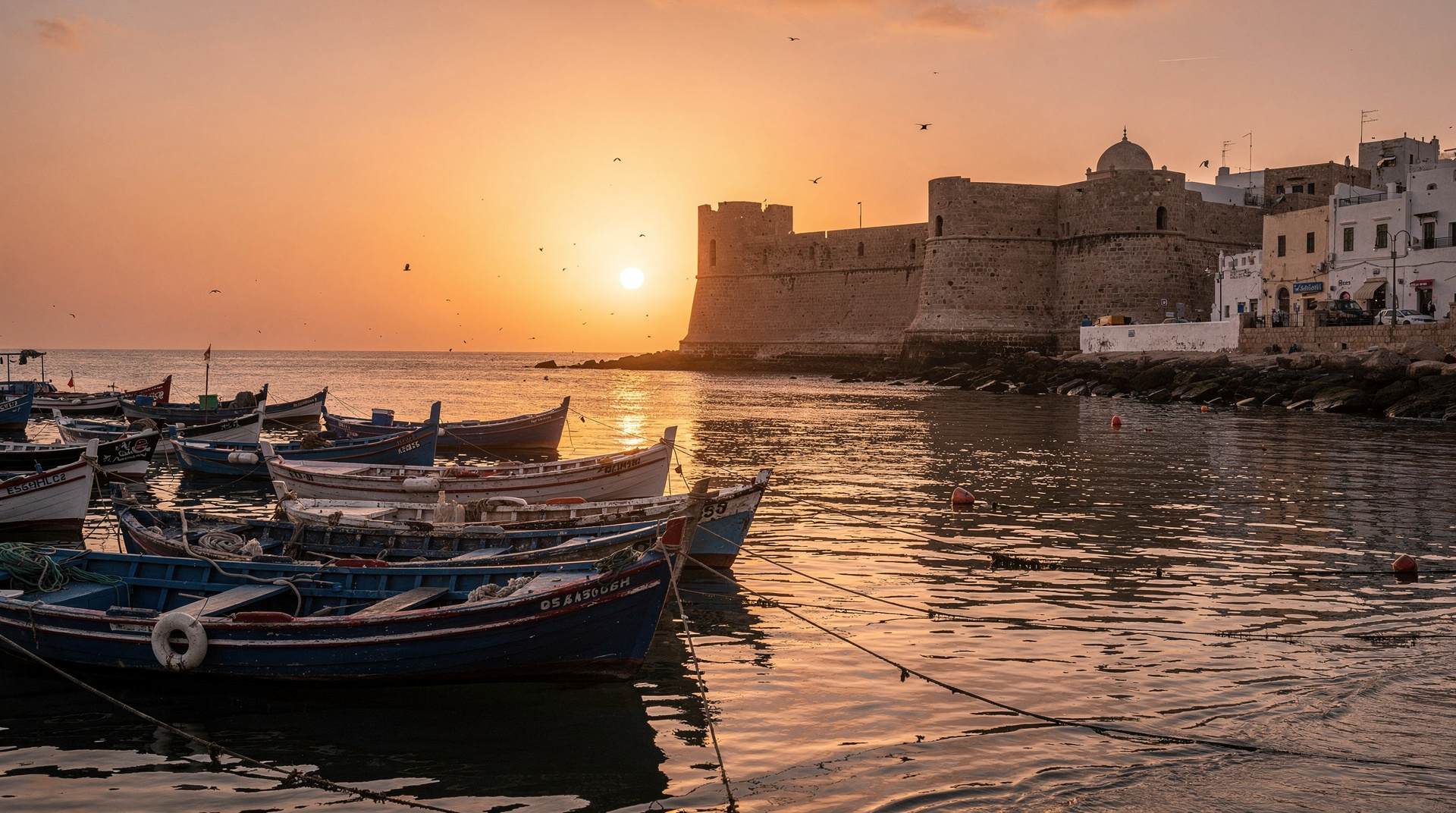
Essaouira is the ideal ending to this three-country circuit: it is coastal, relaxed, and simultaneously Moroccan and European in character — the French protectorate years left wide boulevards and whitewashed walls alongside traditional blue-painted medina lanes. The wind never stops, the seafood is extraordinary, and the pace is dramatically slower than Marrakech.
Two full days here are genuinely restful after 18 days of moving. Walk the beach, eat at the fish stalls, buy argan oil at the cooperative (honest prices, not tourist-inflated), and sit on the Skala de la Ville ramparts watching the Atlantic.
Departure (Day 21): Return to Marrakech by CTM bus (2h30) in time for your flight, or take the morning bus and fly from Essaouira’s small airport (ESU) to Casablanca for international connections.
Transport logistics for the full route
Lisbon → Seville: Comboio Alfaiataria train (direct, 6h, €40–70) or Rede Expressos bus (€20–30, longer but cheaper).
Seville → Tarifa: Bus from Estación de Autobuses Prado de San Sebastian (€20–25, 2h30).
Tarifa → Tangier: FRS ferry (35 min, €40–50). Book online at frs.es at least the day before in summer.
Morocco internal transport: CTM buses, Supratours buses, ONCF trains, and grand taxis. See our Morocco transport guide for full details.
Budget estimate (21 days)
| Item | Budget (pp) | Mid-range (pp) |
|---|---|---|
| Accommodation (21 nights) | €400 | €900 |
| Transport (all legs) | €200 | €300 |
| Food (21 days) | €300 | €500 |
| Entry fees, tours, activities | €100 | €250 |
| Ferry crossing | €50 | €55 |
| Total (flights excluded) | €1050 | €2005 |
What to pack
The three-country circuit covers varied climates. In Portugal and Spain, dress is casual European. In Moroccan medinas, covered shoulders and knees are respectful. In the Rif Mountains (Chefchaouen), temperatures drop at night even in summer.
- One smart-casual outfit for Seville’s restaurants and Lisbon’s fado venues
- Light scarf for Moroccan medinas (women especially)
- Comfortable walking shoes for cobblestones in all three countries
- Rain jacket — Lisbon and Seville both get rain in autumn and spring
Best time of year
March–May is ideal for all three countries: mild temperatures everywhere, wildflowers in the Rif mountains, comfortable walking weather in the medinas, not yet peak-tourist season in Lisbon or Seville.
September–November is equally good. Seville is cooler after the brutal Andalusian summer (it regularly exceeds 40°C in July). Morocco is at its best in October–November.
Avoid July–August for the Spain and Morocco sections — Seville in August is genuinely extreme heat, and Marrakech and Fes are barely manageable.
Common mistakes
Under-allocating Morocco time. Most travellers who do this circuit spend too long in Portugal and Spain (which are well-known, easy to plan) and not long enough in Morocco (where the most surprising and memorable experiences tend to happen). The 11-day Morocco allocation in this itinerary is a minimum; extend it if you can cut anything.
Not booking the Tarifa ferry in advance. High-season crossings (July–August) sell out. Book at frs.es as soon as your travel dates are confirmed.
Arriving in Tangier expecting the worst. The city’s bad reputation belongs to a previous generation. Modern Tangier has largely cleaned up the worst of the hustle. Engage a licensed guide on arrival and you will find it genuinely interesting rather than threatening.
Direction: Lisbon-first or Marrakech-first?
This itinerary runs Lisbon-first, and for most travellers that is the right call — but the reverse works too, and the choice affects both pacing and visa logistics.
| Lisbon-first (this itinerary) | Marrakech-first | |
|---|---|---|
| Narrative arc | Atlantic Europe → Moorish Spain → source culture in Morocco; builds toward the “aha” moment | Morocco → the Andalusian echo of it in Spain → familiar Europe to end on |
| Schengen visa | Single entry (into Tarifa, out never — you fly home from Marrakech, outside Schengen) | Single entry (into Lisbon, out of Tarifa/Algeciras) — also fine, but check your flight’s exit point |
| Best for | First-timers who want Morocco as the emotional high point | Travellers who prefer to “decompress” into familiar Europe before flying home |
| Flight cost pattern | Often cheaper into Lisbon, pricier out of Marrakech in low season | Often cheaper into Marrakech (Ryanair/easyJet routes), pricier or less frequent out of Lisbon |
Neither direction is objectively better. If Morocco is the main draw, Marrakech-first gets you there while your energy is freshest. If you want the trip to build to a climax, Lisbon-first (as written here) does that more effectively.
Alternative variations
Cut to 14 days: Remove Lisbon entirely (fly direct to Seville or Madrid, then bus to Seville) and reduce Seville to 2 nights. This gives you 5 days Spain and 9 days Morocco — a more Morocco-focused trip.
Add Gibraltar: If you have an extra day between Seville and Tarifa, Gibraltar is 2 hours from Seville and 30 minutes from Tarifa. The Rock, the Barbary macaques, and the views of both continents make it a worthwhile detour.
Reverse the route: Fly into Marrakech, end in Lisbon. This is logistically equivalent and has the advantage of ending in a European capital with excellent international flight connections.
For more detail on the Morocco portion, explore our 14-day Morocco itinerary, Chefchaouen guide, Fes guide, Marrakech guide, Tangier guide, and Essaouira guide — or see the shorter Morocco + Andalusia 10-day itinerary if 21 days is more than you have.
Frequently asked questions about Morocco, Spain, and Portugal
Is 21 days realistic for three countries, or should I cut one?
Twenty-one days is enough to do all three countries without feeling rushed, provided you accept the roughly 5/5/11-day split. If your total trip time is closer to 14 days, cut Portugal entirely (fly directly into Seville or Madrid) rather than shortchanging Morocco — most travellers who do this route end up wishing they had spent more time in Morocco, not less.
Which direction should I book flights for?
Fly into Lisbon and out of Marrakech (or Casablanca, which has more international connections than Marrakech if your Essaouira timing is tight). Round-trip flights to a single city are sometimes cheaper than open-jaw routings — compare both before committing, since the saving can be substantial on some airlines.