Atlas Mountains itinerary: 10 days in the High Atlas
Morocco beyond the medinas
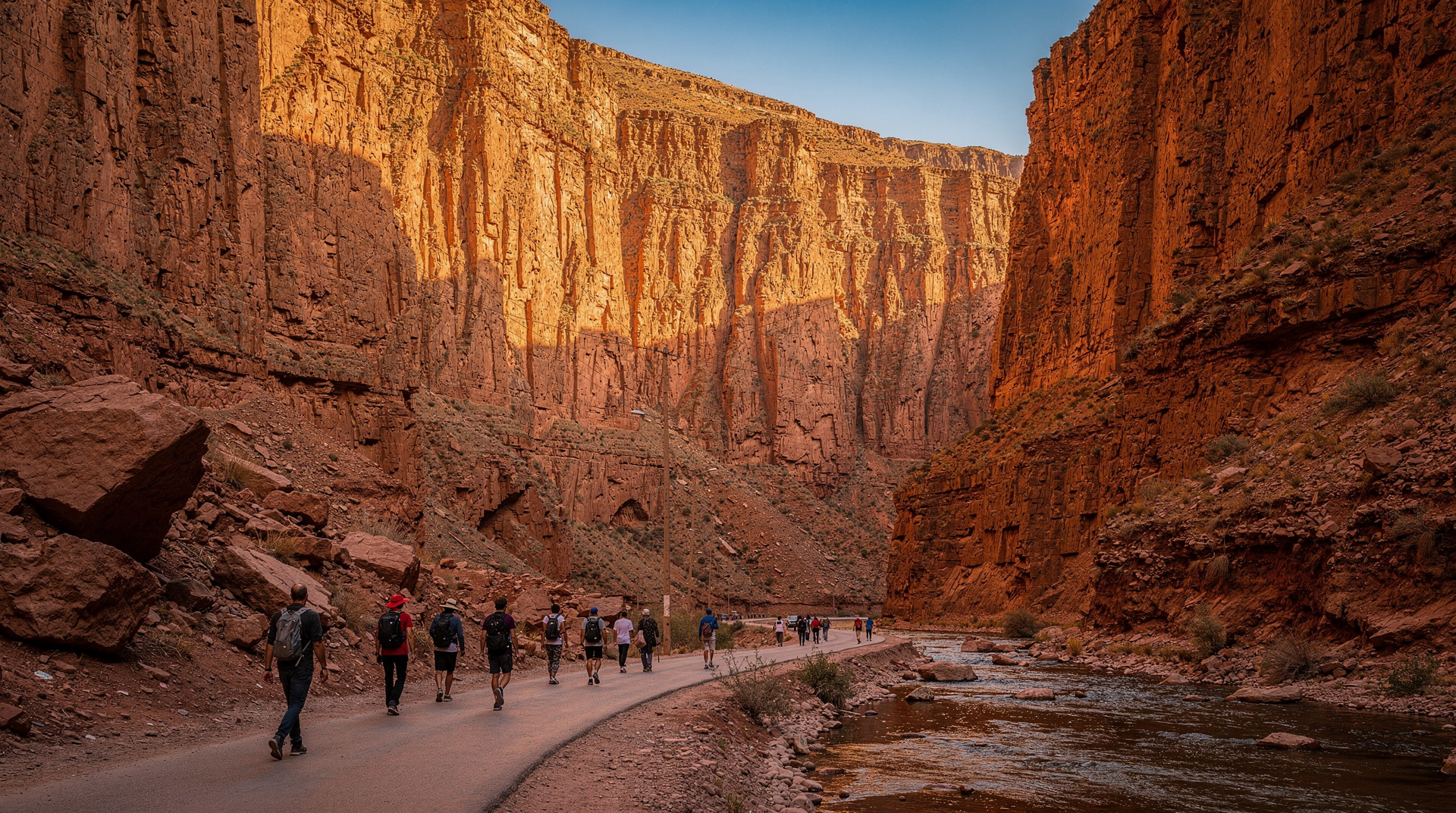
Most Morocco itineraries treat the Atlas Mountains as a day trip from Marrakech — a morning in the Ourika Valley, back for dinner. This itinerary inverts the relationship: Marrakech is the base and the mountains are the destination. Ten days in the High and Middle Atlas, covering the highest summit in North Africa, a remote valley that feels unchanged for centuries, and the finest waterfall in Morocco.
The Atlas ranges run northeast-southwest across central Morocco for 2400 km. The High Atlas (Haut Atlas) south of Marrakech includes Jbel Toubkal at 4167m; the Middle Atlas further north is a plateau of cedar forests, crater lakes, and Barbary macaque populations. The two zones offer completely different landscapes and experiences, and this itinerary covers both.
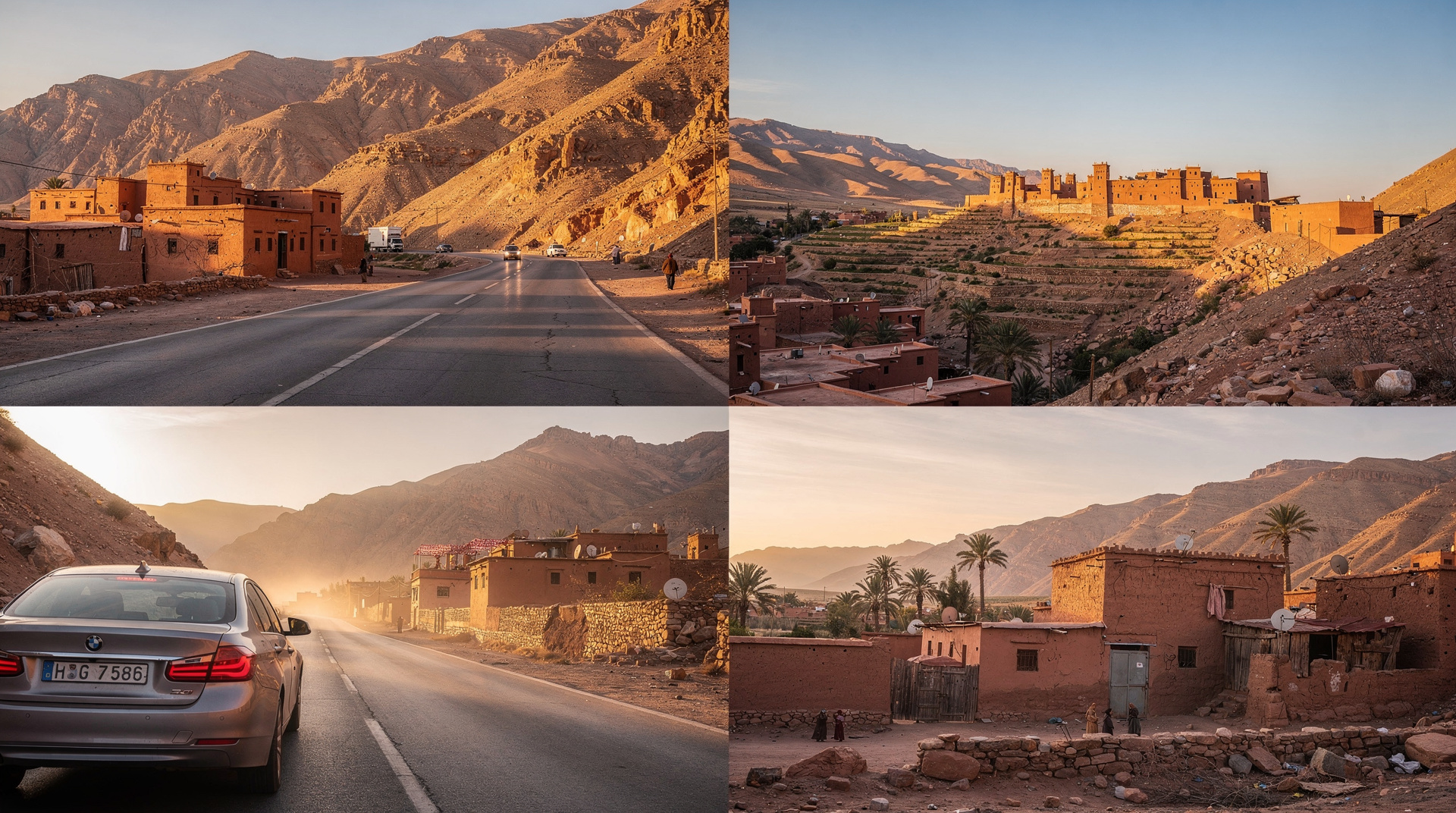
A rental car is strongly recommended for this itinerary. The Ait Bouguemez Valley and some of the Atlas plateau roads are served by irregular local transport. With a car, you control the pace, stop for photography, and access valleys that most tour groups never reach.
If you are still deciding between mountains and dunes, our guide to the Atlas versus the Sahara lays out the trade-offs, and the desert-focused itinerary is the natural counterpart to this route. For a wider look at the range itself, see the Atlas Mountains destination page and our Middle Atlas guide.
Route at a glance: Marrakech (1 night) → Imlil base (3 nights, Toubkal trek) → Ourika Valley → Ait Bouguemez / Happy Valley (2 nights) → Azilal (1 night) → Ouzoud Waterfalls → Marrakech (1 night)
Total estimated cost (per person, flights excluded): €900–1500
At a glance
| Day | Route | Overnight |
|---|---|---|
| 1 | Arrive Marrakech, pick up rental car | Marrakech |
| 2 | Drive to Imlil (1h30), acclimatise, valley walk | Imlil |
| 3 | Trek to Refuge du Toubkal (3207m) | Refuge du Toubkal |
| 4 | Summit Toubkal (4167m) + descend to Imlil | Imlil |
| 5 | Imlil valleys: Aroumd circuit, rest | Imlil |
| 6 | Drive: Ourika Valley → over the Atlas → Ait Bouguemez | Ait Bouguemez |
| 7 | Ait Bouguemez: Happy Valley full day walk | Ait Bouguemez |
| 8 | Drive: Ait Bouguemez → Azilal | Azilal |
| 9 | Ouzoud Waterfalls (40km from Azilal) → return toward Marrakech | Near Ouzoud / Beni Mellal |
| 10 | Return Marrakech, flight home | — |
Day 1: Arrive Marrakech + rental car pickup
Arrive at Marrakech Menara Airport (RAK) and collect your rental car directly from the airport. Book the car in advance — at least 2 weeks ahead in peak season (October–November, March–April). A compact 4x4 or Dacia Duster-class vehicle is ideal for the Atlas roads. Budget €40–70/day including full insurance.
Why self-drive for this itinerary:
The Ait Bouguemez Valley has no regular bus service. The Ouzoud Waterfalls are accessible by tour from Marrakech but not practically by public transport independently. The Imlil road is accessible by grand taxi but timing is inflexible. A rental car gives you the freedom this mountain itinerary requires.
Arrive in Marrakech and spend the night near the medina or airport. An early departure tomorrow (07:00) means this is a transit night. See our Marrakech guide for recommendations if you have more time.
Where to stay: Hotel Les Jardins de la Koutoubia (upscale, 5 min from medina: €120–200); Riad Yasmine (mid: €70–110)
Day 2: Drive to Imlil — into the High Atlas (1h30 from Marrakech)
The road from Marrakech to Imlil runs 74 km south through the Haouz plain before climbing rapidly into the Atlas via Asni. The Asni Saturday market — one of the largest livestock and produce markets in the Atlas region — is worth a 30-minute stop if your timing aligns. Then the single-track valley road climbs to Imlil at 1740m.
Imlil is the jumping-off point for the Toubkal circuit and a genuine mountain village with its own agriculture (apples, walnuts, barley) and architectural tradition. The village has been oriented toward trekking tourism since the 1980s, and the infrastructure is good: licensed guides, mule hire, guesthouses with good food and comfortable beds.
Afternoon: acclimatisation walk
Do not skip the acclimatisation walk. The Aroumd valley circuit from Imlil takes 3–4 hours and climbs 300m — enough to begin adjusting your physiology to the altitude before the Toubkal approach tomorrow. The path passes through the village of Aroumd (1850m) and continues to a viewpoint above the valley with views of the Toubkal massif.
Park your car at the Imlil guesthouse. Leave it here for 3 days while you trek — it is safe in the village.
For more on the village and its surroundings, see the Imlil destination page and the Imlil day trip guide. If you want to compare the area with the neighbouring valley before committing, the Imlil vs Ourika trek comparison is a useful read.
Where to stay: Kasbah du Toubkal (the benchmark: €80–150); Riad Imlil (mid: €40–70); several unnamed family guesthouses €20–35 HB
Day 3: Trek to Refuge du Toubkal (3207m)
Start by 08:00. The trail from Imlil to the Toubkal Refuge climbs 1467m over 9 km and takes 4–5 hours at a steady pace. A licensed mountain guide is required by regulation and is essential in practice — route-finding in the upper sections, especially in winter when snow covers the trail, is not intuitive.
The lower valley trail passes through Berber villages and apple orchards before the path narrows and the gradient increases. Sidi Chamharouch at 2350m — a white-painted shrine complex on a large boulder above the river — marks the halfway point and is a traditional resting spot. Many Moroccan pilgrims make this their destination; for trekkers it is where the real climb begins.
Above Sidi Chamharouch, the vegetation disappears and the terrain becomes rock and moraine. The refuge appears abruptly at 3207m in a cirque of high peaks — a functional mountain hut managed by the Club Alpin Français and several private operators. Beds are in dormitories (8–16 people per room); bedding is provided but a sleeping bag liner improves comfort significantly. Dinner and breakfast are included in the refuge fee (€15–20 per person).
Preparation for tomorrow: Study the route from the refuge entrance. Your guide explains the approach, the descent options, and any weather or route conditions to consider. The summit is visible from the refuge at 4167m — another 960m of vertical above you. In clear conditions, you can see the Algerian Atlas range to the east.
Day 4: Summit Jbel Toubkal (4167m)
05:00 alarm. The summit approach starts in the dark: the path from the refuge to the start of the main slope is familiar enough by headlamp, and the pre-dawn start avoids afternoon weather windows and soft afternoon snow (in winter and spring).
The route climbs the broad southwest face of Toubkal via stable scree (summer) or consolidated snow (winter, requiring crampons). Your guide sets the pace. The summit takes 2.5–3.5 hours from the refuge. At the top: the highest point in North Africa, a 360-degree panorama of the Atlas, and — on a clear day — the Sahara visible to the south as a pale ochre haze.
The descent back to the refuge takes 2 hours, then the return to Imlil another 3 hours. You arrive in Imlil in the early afternoon, tired and euphoric.
This is the day the body needs recovery. Hot shower at the guesthouse (possible in most places, though the water pressure is modest). Excellent Berber dinner at the guesthouse table: vegetable harira, tagine with prunes and almonds, fresh bread baked on a clay plate. Sleep arrives without effort.
Our Toubkal summit guide and Toubkal trek guide go deeper on the route, the refuge and what to expect on the day. Travellers who want a longer walk through the range can look at the multi-day Atlas trek as an alternative to the summit push.
Book your guide: The Imlil Mountain Guides Association has a booking desk in the village square. Expect to pay €80–120/day including their accommodation at the refuge. Book 1–2 days ahead in peak season.
Day 5: Imlil valleys — a rest and exploration day
The body needs an easy day after the summit. This is the day for the Imlil valleys at leisure: walking at low altitude, visiting the traditional watermill on the Rheraya river, exploring the village of Armed (also spelled Aroumd) with its distinctive flat-roofed earthen architecture.
The Berber village and Atlas Mountains day trip from Marrakech covers the Imlil valley culture for visitors doing a day trip — if you have family members not doing the Toubkal summit, this offers a structured alternative for the trekking days.
The Azzadene valley above Imlil (north of the Toubkal approach) is a quieter alternative walking area. The path follows an irrigation channel (seguia) through terraced fields to the hamlet of Tiziane — 3 hours round trip with no altitude gain, beautiful orchards, and local family life undisturbed by tourism.
Afternoon: pack the car for tomorrow’s long drive. The route from Imlil to the Ait Bouguemez Valley crosses the Atlas via the Tizi n’Ait Imguer pass — a spectacular but demanding road. Leave before 08:00 tomorrow.
Day 6: Cross-Atlas drive → Ait Bouguemez (Happy Valley)
The drive (4–5 hours):
From Imlil, return briefly to Asni, then east to the Ourika Valley road. The Ourika Valley itself — a popular day trip from Marrakech — is worth a 30-minute stop at the Setti Fatma waterfalls before continuing into the mountains. Beyond Setti Fatma, the road becomes progressively more remote. If you would like more detail on the valley before you go, see the Ourika Valley destination page and the Ourika Valley day trip guide.
The route continues east over the Atlas watershed via mountain tracks (tarmac but narrow and steep) toward the Ait Bouguemez Valley, also accessed from the north via Azilal. GPS is essential; the route has several junctions where signage is unclear or absent. Download the offline maps for this area before leaving Imlil.
Ait Bouguemez — the Happy Valley:
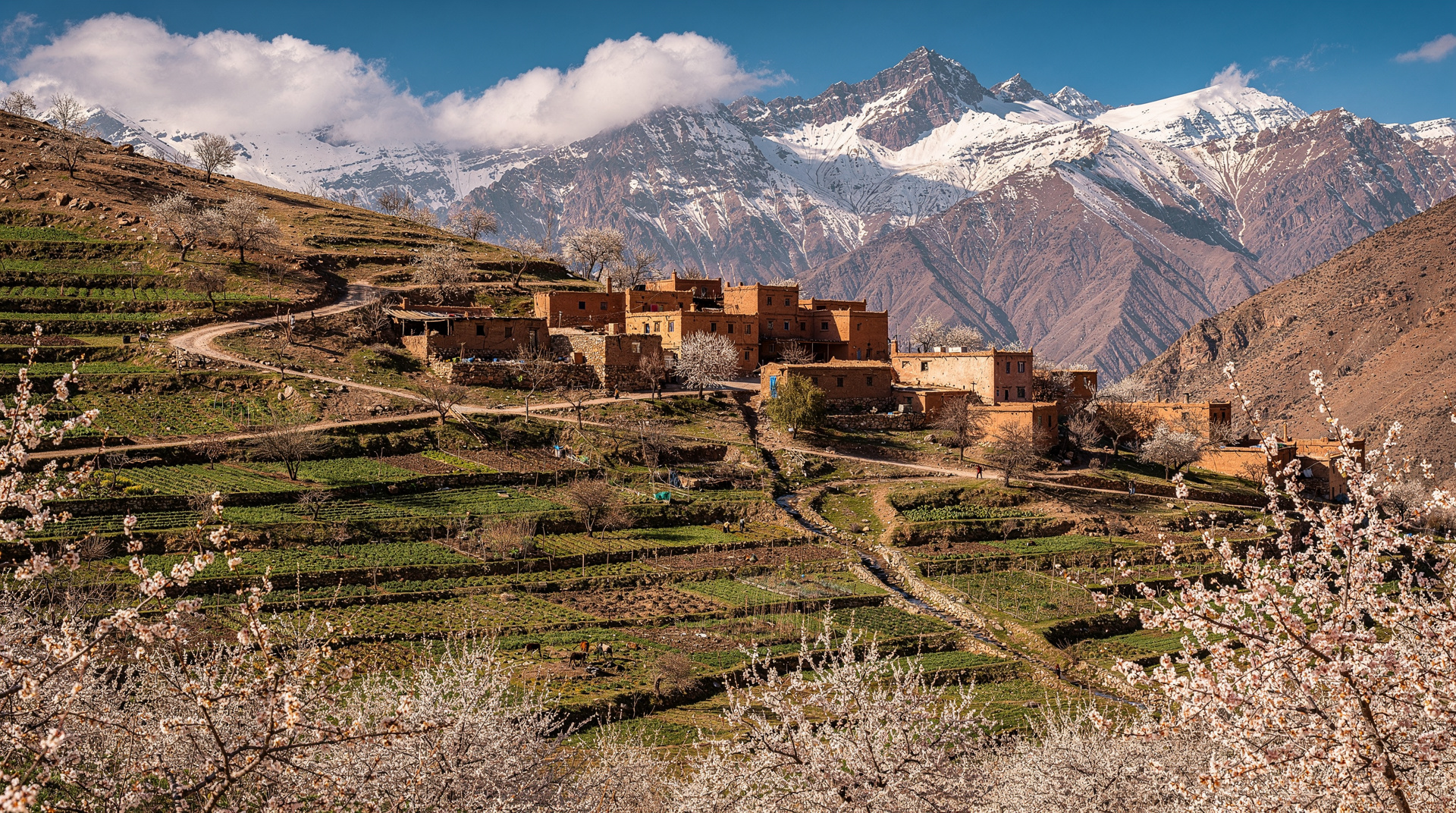
The Ait Bouguemez Valley at 1800–2000m is one of Morocco’s most beautiful and least-visited regions. A wide valley of terraced wheat fields, walnut orchards, and flat-roofed earthen villages, backed by limestone peaks and populated by the Ait Bouguemez Berber communities who have farmed here for centuries with minimal change to their agricultural methods.
The valley has limited accommodation: a small number of guesthouses in the villages of Agouti, Tabant, and Ifrane de l’Anti-Atlas (not the Middle Atlas Ifrane). Gîtes d’étape (walkers’ hostelries) offer simple but clean rooms and home-cooked meals for €20–35 per person HB. Book ahead — rooms are limited.
Where to stay: Gîte Taoujgalt (Agouti village) or Gîte d’étape Tabant: €20–35/person HB
Day 7: Ait Bouguemez full day — the valley at walking pace
A full day in the Happy Valley. No rushing.
Morning: the high pastures circuit
A guided walk (arrange through your gîte) to the high pasture zone above the valley takes 3–4 hours. The path climbs through the village terraces to the plateau above at 2400–2600m where shepherds graze their flocks in summer. The views back down the valley — the patchwork of fields, the earthen houses, the snow on the peaks beyond — are some of the finest in Morocco.
Afternoon: village walks and granary towers
The Ait Bouguemez communities maintain traditional earthen granaries (agadirs) on ridges above the villages — communal storage towers built to protect grain from raiders and floods. Several are accessible by short paths from the valley floor. Your gîte host knows which are open and which still hold community significance.
The local produce: fresh walnuts (€2–4/kg), dried apricots, honey from the valley hives, and saffron from the surrounding hills (the Ait Bouguemez produces some of Morocco’s finest saffron — the genuine article, not the tourist-grade powder sold in city souks).
Day 8: Drive Azilal and position for Ouzoud
The drive from Ait Bouguemez north to Azilal takes 2–3 hours on a mountain road that descends through cedar forest and spectacular gorges (the Gorge du Ahansal is viewable from the road — a deep canyon with a famous multi-day trekking route along its floor).
Azilal is a market town on the edge of the Atlas plateau, 40 km east of Ouzoud. It is not beautiful but it is functional: good guesthouses, ATMs, a reasonable town market, and an excellent position for an Ouzoud morning start.
Where to stay Azilal: Hotel Tanout (mid: €35–55); or push through to one of the guesthouses near the Ouzoud Waterfalls (more expensive but perfectly positioned for an early morning visit).
Day 9: Ouzoud Waterfalls + return toward Marrakech
Morning: Ouzoud
The Ouzoud Waterfalls are Morocco’s most spectacular. A series of three-tiered falls dropping 110 metres into a turquoise pool below, surrounded by wild olive trees from which the falls take their Berber name (ouzoud means olive). Barbary macaques inhabit the surrounding cliffs and are habituated to tourists — they will approach for food (feeding not recommended, but they approach regardless).
Arrive before 09:00 for the best light and fewest other visitors. Descend the path to the pool base (30 minutes, steep but straightforward). The pools at the base are swimmable in summer and the spray is constant even in winter. A wooden boat ride across the main pool costs €2–3 and positions you for the best views of the falls.
For the falls in more depth, see the Ouzoud Waterfalls destination page and the Ouzoud day trip guide.
A guided alternative from Marrakech: the Ouzoud Waterfalls guided hike and boat trip from Marrakech is excellent if you prefer not to self-drive.
Afternoon: drive back to Marrakech (2h30)
The return road from Ouzoud to Marrakech runs via Beni Mellal and the foothills — a well-paved route that takes 2.5 hours. Return the rental car at the airport if your flight is tomorrow morning, or at a city office if you have time.
Day 10: Marrakech and departure
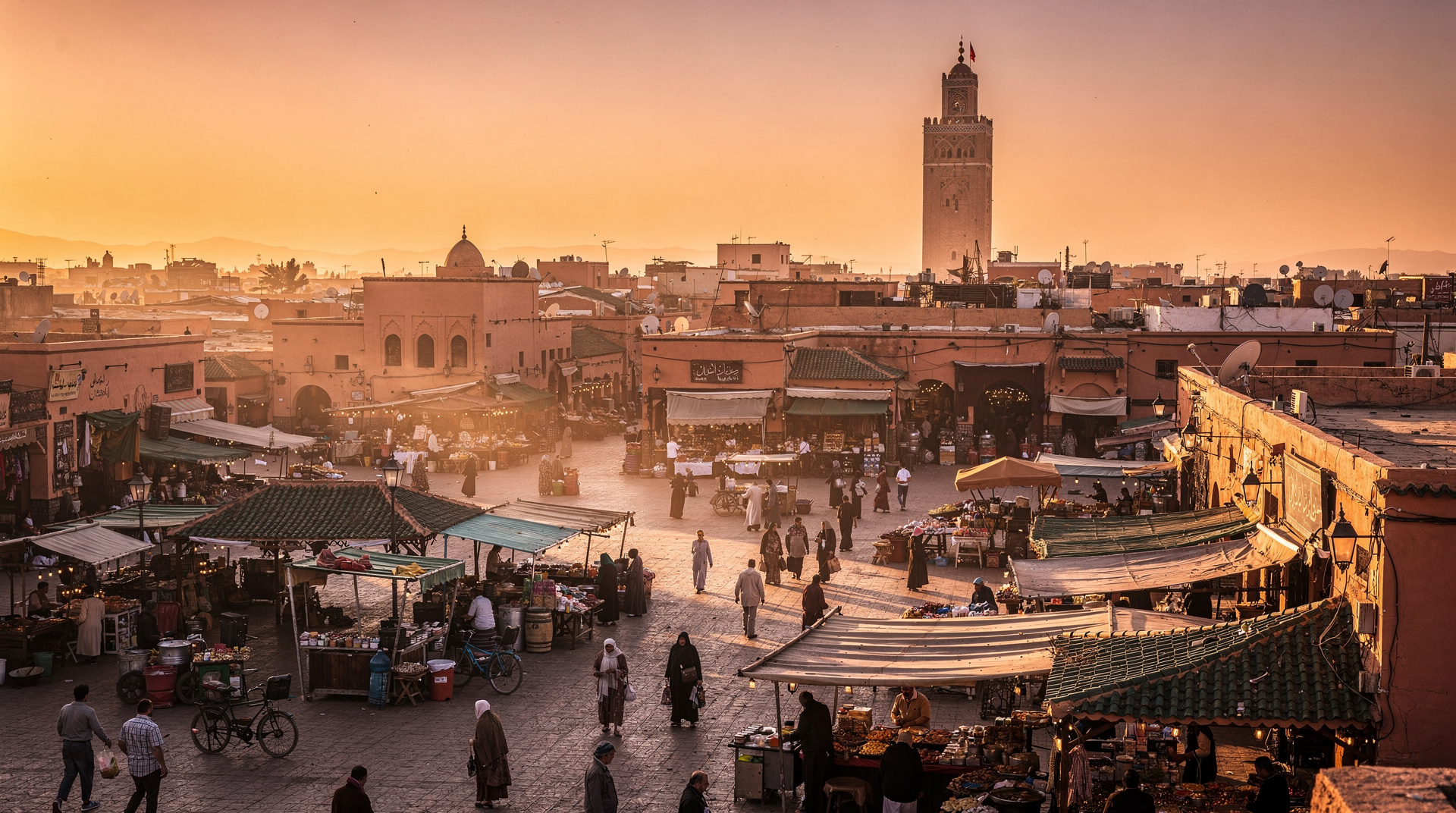
A final morning in Marrakech before your flight. If you have time before check-out: Djemaa el-Fna for breakfast (Moroccan pancakes, mint tea, at the cafe terraces), a last walk through the Souk Semmarine for any remaining purchases, and one final hammam if you have 2 hours.
Return the rental car if not done yesterday. Marrakech Menara Airport (RAK) has good connections to most European cities.
Rental car practicalities for Atlas driving
Best car choice: A Dacia Duster or similar compact SUV is ideal. It handles the mountain tracks, fits through the narrow village streets, and is inexpensive to rent. A standard compact car (Volkswagen Polo, Renault Clio) is sufficient for the main roads but will struggle on the tracks above Setti Fatma and the Ait Bouguemez approach.
For a broader view of driving in the country, our getting around guide and the private tour vs self-drive comparison help you decide how much of the route to drive yourself. The self-drive Morocco itinerary covers the same question on a wider circuit.
Insurance: Take the full comprehensive cover including gravel damage. The Atlas tracks generate stone chips. Decline the minimal cover that leaves you liable for excess.
Fuel: Fill up in Marrakech, Asni, and Azilal. The Ait Bouguemez valley has no fuel stations. Carry a 5-litre reserve if possible.
GPS vs. phone: A downloaded offline map (Maps.me or Google Maps offline for this area) is more reliable than live GPS in mountain terrain. Signal is intermittent.
Budget estimate (10 days)
| Item | Per person (couple sharing) |
|---|---|
| Accommodation (10 nights, mix) | €300–500 |
| Rental car (10 days) | €250–400 |
| Mountain guide (2 days Toubkal) | €200–280 |
| Food (10 days, mix of guesthouse HB + restaurants) | €150–220 |
| Entry fees and activities | €40–70 |
| Total (flights excluded) | €940–1470 |
What to pack for Atlas mountain trekking
- Hiking boots (waterproof, ankle support) — essential for Toubkal
- Trekking poles (very useful on the descent)
- Sleeping bag liner (refuge provides blankets; liner adds warmth and cleanliness)
- Layered clothing system: base layer, fleece, waterproof outer layer
- Sunscreen SPF 50+ (mountain UV at 4000m is severe)
- Headlamp with spare batteries for summit approach
- Trekking snacks (energy bars, nuts, dried fruit) for the summit day
- Cash in MAD — ATMs do not exist above Asni or in Ait Bouguemez
Best time of year
For month-by-month detail, see the best time to visit Morocco guide, and our packing list for what to bring beyond the trekking kit above.
June–September: Toubkal summit is snow-free. No crampons required. Warm valley temperatures (25–30°C in Imlil). Ouzoud Waterfalls are spectacular in spring runoff (June).
October–November: Best overall. Lower snow risk on Toubkal. Autumn colour in the Ourika Valley. Ait Bouguemez harvest season — the valley is at its most beautiful.
March–April: Snow possible on Toubkal summit (crampons and guide assessment required). High Atlas wildflowers. Ouzoud at peak flow from winter rains.
December–February: Toubkal requires crampons, ice axe, and experienced guide. Ait Bouguemez can be snow-covered and cold. Not recommended without specific winter mountaineering experience.
Common mistakes
Attempting Toubkal without a licensed guide. The summit is non-technical in summer but requires route knowledge, altitude awareness, and emergency judgment. The regulation requiring a licensed guide exists for good reasons.
Underestimating the Ait Bouguemez road. The access road is tarmac but narrow and has steep sections. If you are not comfortable with mountain driving, hire a local driver for this section (your Imlil guesthouse can arrange this).
Visiting Ouzoud at midday. The morning light from the east illuminates the falls directly. Midday light is flat. Arrive before 09:30.
Alternative variations
Without the summit: Remove Days 3–4 (Toubkal) and instead spend 3 nights based in Imlil doing valley treks: Tizi Oussem, the Azzadene gorge, and the Lac d’Ifni (4 hours from Imlil, beautiful high-altitude lake). Less strenuous, equally beautiful, no guide required.
Without a car: Use grand taxis for Marrakech–Imlil (€5–7 per seat, 1h30) and Marrakech–Ouzoud (€8–12 per seat, 2h30). The Ait Bouguemez Valley requires either a car or a 2-day shared transport arrangement through Azilal. See our transport guide for options.
For comparison, the adventure Morocco itinerary combines Toubkal with Sahara and surf for a more varied active trip. The 14-day Morocco itinerary includes the Atlas as part of a broader circuit.
Fitness and altitude preparation
This itinerary’s demanding core is the same as any Toubkal-inclusive trip: a 7-9 hour summit day at up to 4167m, on scree, following a 1467m ascent the day before to reach the refuge. Unlike the shorter adventure itinerary, you have a rest day built in afterward (Day 5), which meaningfully reduces the injury and exhaustion risk that comes from stacking the summit against an immediate onward transfer. Still, arrive with a real fitness base — regular hill walking or stair training for 4-6 weeks beforehand makes a genuine difference to how much you enjoy Day 4 rather than simply endure it.
The Ait Bouguemez leg (Days 6-8) is a different kind of demand: long, remote driving on narrow mountain tracks with intermittent phone signal. If you or your travel partner are not confident with this kind of driving, budget for a local driver through your Imlil guesthouse rather than pushing through discomfort — the valley itself is worth reaching regardless of how you get there.
Guesthouses and gîtes: what to expect
Accommodation on this route shifts character as you move deeper into the mountains. Imlil offers proper guesthouses with hot showers and varied menus; by the time you reach Ait Bouguemez, you are in gîtes d’étape — simple, family-run walkers’ hostelries with shared bathrooms, home-cooked meals eaten with the household, and no choice on the menu (whatever the family is cooking that day, usually excellent). This is part of the appeal, not a compromise: it is the most direct cultural contact of the whole itinerary. Bring cash, since neither Imlil’s smaller guesthouses nor the Ait Bouguemez gîtes reliably take cards, and there are no ATMs beyond Asni until you reach Azilal.
Frequently asked questions about Atlas Mountains itinerary
Do I need previous mountain trekking experience for this itinerary? No technical climbing experience is needed — the Toubkal route is a non-technical trek in summer conditions with a licensed guide. What matters more is a solid fitness base for sustained multi-hour days, since this itinerary stacks a refuge ascent, summit day, and several days of valley walking across ten days.
Is this itinerary suitable outside summer? Yes, with adjustments. October-November is considered the best overall window (see Best time of year above), while December-February requires winter mountaineering experience or should be avoided for the summit specifically. The Ait Bouguemez and Ouzoud sections are feasible year-round, just colder and occasionally snow-affected in winter.