Atlantic coast Morocco itinerary
Morocco’s Atlantic coastline — an underrated route
Most visitors to Morocco head straight inland to Marrakech and the Sahara. The Atlantic coast runs 3500 km from Tangier in the north to Dakhla in the far south, and it is one of the country’s most rewarding and under-visited routes. This 10-day itinerary covers the northern two-thirds: Tangier to Agadir, with Essaouira as the centrepiece.
This is a road trip that combines urban depth (Rabat, Casablanca) with coastal beauty (Asilah, Oualidia, Essaouira), historical sites (the Portuguese fortifications at El Jadida, the Roman mosaics at Volubilis reachable from Rabat), and genuine beach time that is impossible to squeeze into the standard Marrakech-Sahara loop.
Who this is for: Road trippers who have either already done the Sahara or who want to experience a different Morocco. Beach and ocean lovers. Travellers who appreciate the contrast between Morocco’s imperial city depth and its Atlantic-facing, cosmopolitan coast culture.
Budget expectation (per person, car excluded): €700–1100 mid-range for 10 days. The coast is generally less expensive than the major inland tourist destinations.
Pace: easy to moderate. No dramatically long driving days (longest is 4 hours). The route is designed with overnight stops that give you 2 hours minimum of daylight at each destination before dinner.
At a glance
| Day | Route | Drive | Highlights | Overnight |
|---|---|---|---|---|
| 1 | Fly into Tangier | — | Kasbah, Cap Spartel | Tangier |
| 2 | Tangier → Asilah | 45min | Blue medina, murals | Asilah |
| 3 | Asilah → Rabat | 3h | Kasbah Udayas, Hassan Tower | Rabat |
| 4 | Rabat | — | Chellah, medina, Salé | Rabat |
| 5 | Rabat → Casablanca | 1h | Hassan II Mosque | Casablanca |
| 6 | Casablanca → El Jadida → Oualidia | 2.5h | Portuguese cistern, oysters | Oualidia |
| 7 | Oualidia → Essaouira | 2.5h | Coastal drive, arrive | Essaouira |
| 8 | Essaouira | — | Medina, beach, ramparts | Essaouira |
| 9 | Essaouira → Agadir | 3h via Sidi Ifni | Mirleft cliffs, Sidi Ifni | Agadir |
| 10 | Agadir | — | Beach, departure | Agadir or fly out |
Day-by-day narrative
Day 1: Tangier — Africa meets Europe
Tangier Ibn Battouta Airport is 12 km southeast of the city. Collect your rental car at the airport and drive straight to the kasbah district — hotel parking near the medina is limited, so check with your accommodation before arrival.
Afternoon: the kasbah and the Petit Socco
The Kasbah Museum (former sultan’s palace) has a terrace that looks across the Strait of Gibraltar to Spain — on a clear day the distance is 14 km and the coastline of Europe is distinct. The Andalusian Gate below the kasbah leads down through the kasbah to the Petit Socco, the small square that was the heart of Tangier’s famous international zone from 1923 to 1956. Bowles, Burroughs, and Ginsberg all spent time at the cafes here; the atmosphere has changed but the cafe terrace habit has not. If you prefer some local context on the way, a private walking tour of the kasbah, medina, and souks covers this ground with a guide.
Afternoon: Cap Spartel and Hercules Caves
14 km west of Tangier by road: Cap Spartel, the northwestern tip of Africa where the Atlantic meets the Mediterranean. The lighthouse marks the continental edge. 2 km further south: the Hercules Caves, where according to legend the hero rested after separating Africa from Europe. The main cave opening faces the Atlantic in the shape of the continent of Africa — viewed from inside, looking out at the ocean. Entry: €3.
Evening: Tangier port area
The restaurants along the port waterfront have improved significantly in the last decade. Villa Josephine (fine dining: €40–60pp), Saveurs de Poisson (the legendary fish-only experience near the medina: €25–35pp, no menu — the owner decides), or the simpler harbour-side grills for €10–15pp.
Where to sleep: El Minzah Hotel (historic, upscale: €120–180); Dar Nour (boutique riad: €90–130); Hotel Continental (old-school classic: €50–80)
Budget estimate today: €80–160
Day 2: Asilah — the art city
The drive (45 minutes, 40 km)
South from Tangier on the A1 motorway. Asilah is 40 km south: a whitewashed Portuguese-era port city with blue-painted accents and a remarkable tradition of public murals. The medina walls are repainted annually during the August International Festival — artists from across the world have contributed works over the decades, ranging from Amazigh geometric patterns to contemporary political art.
Morning: the medina
Walk through Bab el-Kasaba into the medina. The lanes are whitewashed and clean — Asilah is maintained to a standard unusual in Moroccan medinas, which partly reflects its relatively small size and partly the influence of the arts festival. The platform by the northern sea gate gives a view of the Atlantic straight down to the cliffs below.
Afternoon: the ramparts and beach
The Portuguese-era ramparts (1471 AD) are mostly intact and walkable along the seaward side. The beach immediately south of the medina is one of the best day beaches on the northern coast — calm enough for swimming (unlike Tangier or Essaouira), wide enough to spread out, uncrowded except in August.
The fish market near the harbour (best in the morning but open most of the day) is where local restaurants buy their catch. Have lunch at one of the restaurants along the medina seafront wall.
Where to sleep: Hotel Azayla (boutique: €80–120); Dar Manara (mid: €60–90)
Budget estimate today: €70–130
Day 3: Rabat — the capital
The drive (3 hours, 220 km)
From Asilah south on the A1 — Morocco’s main motorway (toll road, approximately €8 Tangier to Rabat). The drive is fast and comfortable through flat Atlantic agricultural land. Pass through Kenitra (no stop needed) and arrive in Rabat in the early afternoon.
Rabat is Morocco’s administrative capital and one of its most underrated cities. The medina is compact and authentic, the traffic is manageable by Moroccan standards, and the architecture ranges from Almohad to Andalusian to Art Deco colonial.
Afternoon: Kasbah of the Udayas
The kasbah sits on a promontory above the Bou Regreg river, looking simultaneously over the Atlantic ocean and south over the estuary to the sister city of Salé. The 12th-century Bab Oudaia gate is the most beautiful monumental gate in Morocco — a horseshoe arch of carved geometric and floral stone decoration in proportions that feel simultaneously massive and delicate. Inside: a Moorish garden (orange trees, bougainvillea, fountains), whitewashed alleys with blue-painted doors, artists’ studios. Walk to the Atlantic cliff edge at the far end of the kasbah.
Late afternoon: Hassan Tower and Mohammed V Mausoleum
The Hassan Tower (10 minutes by taxi from the kasbah) was intended to be the minaret of the largest mosque in the world — begun in 1195, left incomplete on the sultan’s death in 1199, and partially destroyed by the 1755 Lisbon earthquake. The truncated tower stands alone in a field of broken column stubs: the ghost of the mosque’s intended pillars. Adjacent: the Mausoleum of Mohammed V, a 1960s masterwork of traditional Moroccan craftsmanship built to honour the king who led independence.
Where to sleep: Dar El Batoul (boutique riad: €100–160); Hotel Balima (Art Deco, Mohammed V Ave: €70–100)
Budget estimate today: €90–160
Day 4: Rabat — the full city
Morning: Chellah
The Chellah is the ancient walled necropolis at the south edge of Rabat — a Roman city (Sala Colonia) overlaid by a medieval Muslim funerary complex, now ruined and inhabited by white storks. Entry: €3. The storks nest on every available surface from January to July; the sound of their bill-clattering is remarkable. The ruins include a minaret, a zaouia, ornamental tile panels, and an eel-inhabited pool that is the site of a fertility ritual for local women.
Midday: Rabat medina
The Rabat medina is small (15 minutes end-to-end) but genuine — less touristified than Marrakech or Fes, more working city, with better prices. The rue des Consuls (former diplomatic quarter) has some of the best antique and craft shops in Morocco. The Grand Mosque’s exterior is visible from the main street.
Afternoon: Salé
Cross the Bou Regreg river by the Moulay Hassan Bridge to Salé — once a notorious pirate republic, now a quiet twin city to Rabat. The Salé medina is less visited than Rabat’s and more conservative in feel. The 14th-century Bou Inania Medersa (named for the same patron as the more famous one in Fes) is worth seeing for comparison.
Where to sleep: Same riad
Budget estimate today: €70–120
Day 5: Casablanca
The drive (1 hour, 90 km)
South from Rabat on the Al Boraq high-speed rail is faster (45 minutes, €8) — but then you lose the car for the day. Drive instead; Casablanca traffic is easier than its reputation suggests if you stay off the ring road at peak hours (avoid 08:00–09:30 and 17:30–19:00).
The Hassan II Mosque
Morocco’s most ambitious modern building. The mosque was completed in 1993 under King Hassan II, who decreed it should be visible from the sea, built over the ocean, and feature the world’s tallest minaret (210 metres). All three were delivered. The mosque extends over the Atlantic on a glass floor above the sea; the retractable cedar roof opens in clear weather. Non-Muslims enter on guided tours (approximately every 30 minutes in English): €14, 90 minutes. Do not skip this even if you are not interested in religious architecture — the scale and craftsmanship are extraordinary.
Corniche and the city
Casablanca is Morocco’s economic engine rather than a tourist destination, but the Art Deco architecture of the city centre (Maarif and Quartier des Habous) is genuinely handsome — a French colonial city designed in the 1920s–1940s in a hybrid Moroccan-Deco style. The Quartier des Habous is an attempt to build a new Moroccan medina in the 1930s (strange but interesting). The Corniche beach road north of the city has restaurants and the local leisure culture visible on weekends.
Where to sleep: Hotel Transatlantique (Art Deco: €90–130); Kenzi Tower Hotel (business hotel, Atlantic view: €120–180)
Budget estimate today: €90–150
Day 6: El Jadida and Oualidia
The drive (2.5 hours with stops)
South from Casablanca on the A3 motorway to El Jadida (90 km), then coastal road to Oualidia.
El Jadida: the Portuguese Cistern
El Jadida is a UNESCO-listed Portuguese fortified city (Mazagão, founded 1506). The main sight is the Portuguese cistern — an underground vaulted water reservoir from 1514 that became famous when Orson Welles filmed the mirror-on-water scene from Othello here in 1951. The cistern is open, entry: €2. The reflected arches in the thin water on the stone floor are genuinely remarkable. The Portuguese ramparts above the city are walkable and give Atlantic views.
Oualidia: oysters
Oualidia is a small lagoon town 80 km south of El Jadida where the Atlantic ocean is partially enclosed by a natural lagoon with calm swimming conditions and one of the best oyster beds in North Africa. The oysters have been cultivated here since the 1950s and are served raw at the waterfront restaurants for €1–1.50 each. Order a dozen with a glass of local white wine, sit on the terrace above the lagoon, watch the flamingos if the season is right. This is the best lunch on the entire trip.
Where to sleep: Auberge du Lagune (mid: €70–100, above the lagoon); La Sultana Oualidia (boutique luxury: €200+)
Budget estimate today: €80–140 (oysters are very affordable)
Day 7: The coastal drive to Essaouira
The drive (2.5 hours, 170 km)
The coastal road south from Oualidia through Safi to Essaouira is one of the most scenic drives in Morocco. Safi (a mid-size port city with a Moroccan-Portuguese kasbah and a famous pottery tradition) is worth 90 minutes if you have the time — the pottery quarter produces the traditional Fassi-influenced style in quantity.
The argan forest begins south of Safi and thickens as you approach Essaouira — the UNESCO Arganeraie Biosphere Reserve covers this entire coastal strip. Stop at a roadside argan cooperative for oil tasting (the culinary-grade toasted argan has a distinctive nutty taste; the cosmetic-grade oil is pressed untoasted and has almost no smell).
Essaouira arrival
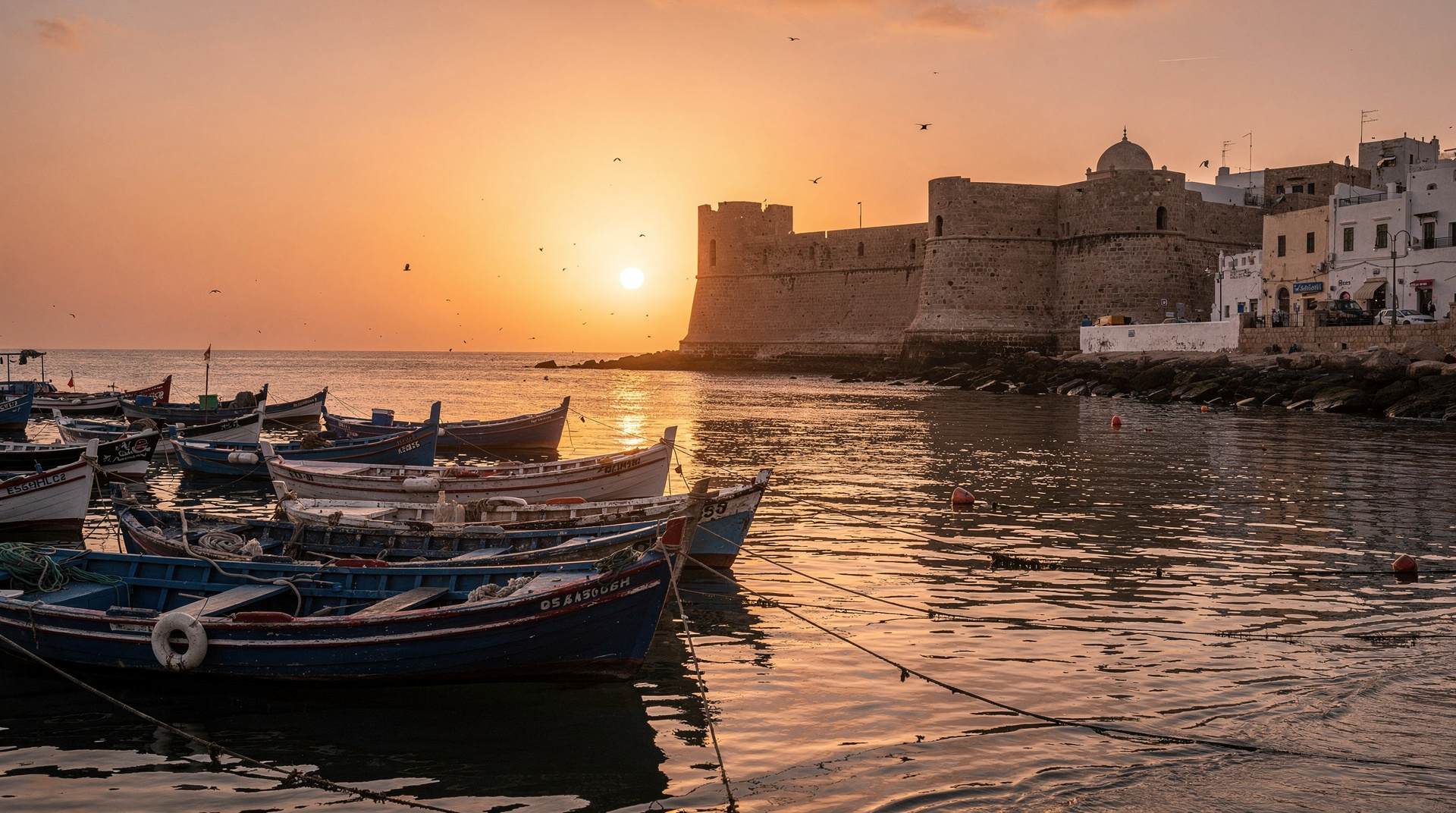
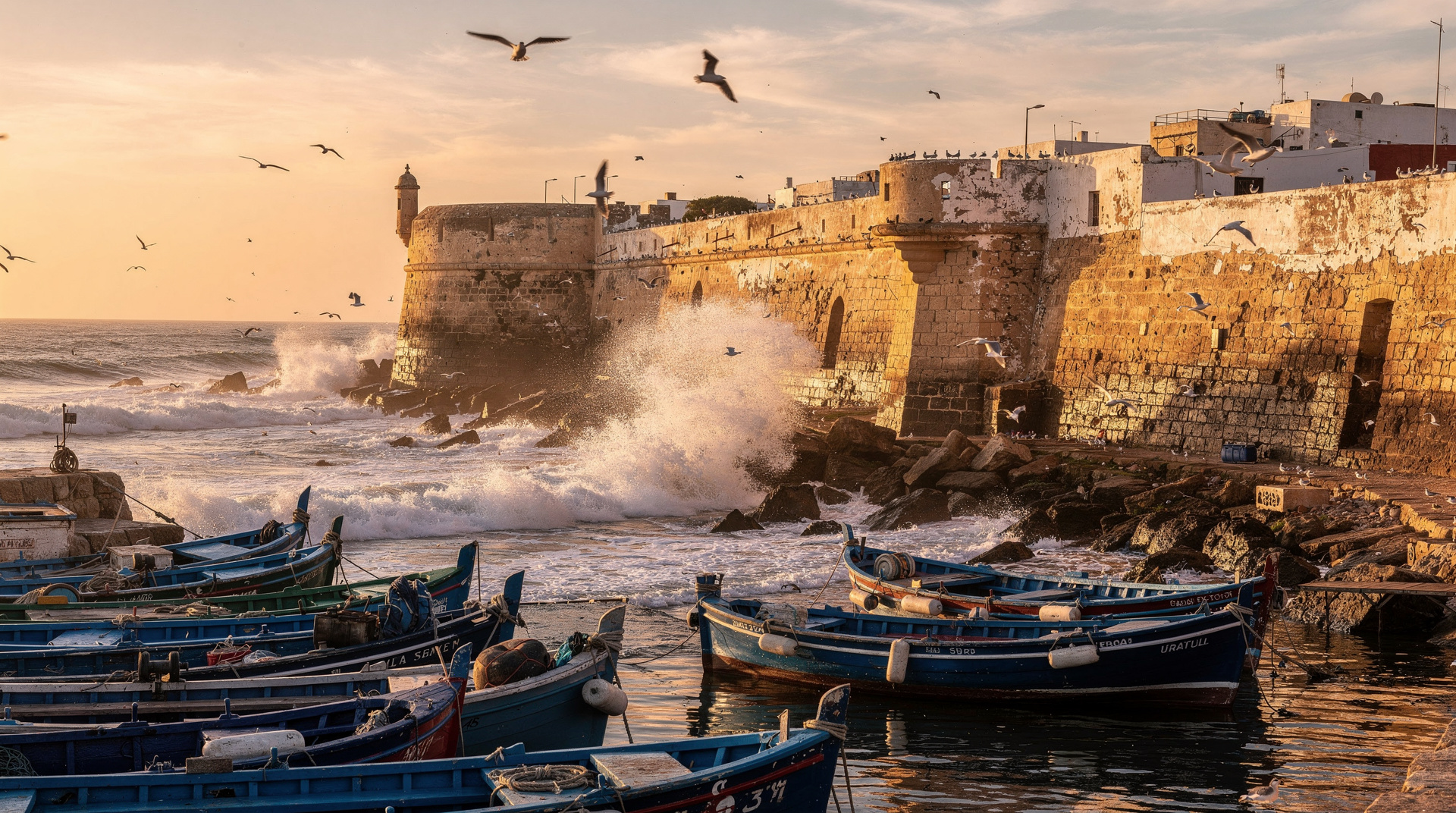
The city appears at the end of a straight road through low scrubland: whitewashed walls, blue boats in the harbour, the sound of wind. Check in and walk the Skala de la Ville ramparts before dinner. The Atlantic from the battlements in the late afternoon light is the best welcome to the city.
Where to sleep: Heure Bleue Palais (upscale: €150–220); Riad Baladin (mid: €70–110); Villa Quieta (charming: €80–120)
Budget estimate today: €80–140
Day 8: Essaouira — a full day on the Atlantic
Morning: medina deep dive
The Essaouira medina is compact, whitewashed, and unhurried in a way that distinguishes it from every other Moroccan medina. The Thuya wood workshops near the Skala de la Kasbah are a genuine craft tradition — the artisans work the local Thuya burl wood (which smells faintly of cedar and sandalwood) into decorative objects. A well-made small box costs €20–40 and is one of the best souvenirs from the coast.
The port is working and commercial — the blue fishing boats in the harbour, the fish auction in the morning, the seagulls above the catch being unloaded. The harbour-front fish stalls grill whatever came in that morning for €5–8 per plate. Eat here for lunch.
Afternoon: beach and surf
The beach extends 5 km south from the medina. In the afternoon the trade wind picks up (this is among the windiest spots in Morocco, which is why it is the country’s kite-surfing capital). Watch the kitesurfers on the beach or take a surf lesson — beginner conditions are better in the morning, and the wave break north of the beach is suitable for intermediates year-round. If you would rather book ahead, a surf lesson for all levels is an easy way to get started.
For those who want a guided introduction to the medina and its history as a Portuguese, Moorish, and French trading port, the Essaouira medina half-day guided walking tour gives excellent local context.
Evening: seafood dinner
Restaurant Taros on the main square has an excellent roof terrace with views over the medina and reasonable modern Moroccan cooking (€25–35pp). Elizir on the Rue d’Agadir is smaller and more intimate, with wine and better fish (€25–30pp). Or return to the harbour stalls for a second round of sardines.
Budget estimate today: €70–130
Day 9: South to Sidi Ifni and Mirleft
The route (3 hours, optional longer)
The coastal road south of Essaouira through Agadir and beyond toward Mirleft and Sidi Ifni is the least-driven section of the Atlantic coast and arguably the most dramatic. The clifftop roads, the Atlantic breakers on red rock headlands, and the near-total absence of other tourists make this the discovery section of the itinerary.
Mirleft
120 km south of Agadir: Mirleft is a small hillside town above a series of small coves with dramatic cliff-backed beaches. The swimming here is calmer than Essaouira. The town has a cluster of guesthouses and a growing surf community but remains genuinely quiet outside summer.
Sidi Ifni
20 km further south: Sidi Ifni is one of the strangest towns in Morocco — a Spanish colonial city that was returned to Morocco in 1969, still full of Art Deco Spanish architecture with rounded corners, turquoise-tiled facades, and a central square that looks like it was transplanted from Cadiz. The Art Deco courthouse (now a ruin), the Spanish consulate, the sea-facing cathedral (converted to a mosque): the architectural collision of mid-20th century Spain and Atlantic Morocco is unlike anything else in the country.
Continue to Agadir
60 km north from Sidi Ifni back to Agadir (or stay in Sidi Ifni if the end of the earth feel appeals).
Where to sleep (Agadir): Hotel Petite Suède (budget: €30–50); Riad Villa Blanche (boutique: €100–160)
Budget estimate today: €80–140
Day 10: Agadir — departure
Morning: beach or market
Agadir’s 9 km beach has the calmest Atlantic swimming in Morocco — the bay is naturally protected and the water is warmer than Essaouira. The Souk el Had market (open every day, not just Sunday despite the name) is the largest market in the south: fresh produce, live chickens, spices, argan oil, cheap clothing. Good for last-minute food purchases to take home.
Fly out from Agadir Al Massira Airport (AGA), which has direct connections to most European cities. Or drive north to Marrakech (3 hours) for a return flight from Menara.
Budget estimate today: €50–90
Transport logistics
Rental car: Pick up at Tangier airport on Day 1, return at Agadir airport on Day 10. One-way rental is available from most major companies (Europcar, Avis, National/Sixt) but typically costs a one-way drop fee of €50–100. Book this in advance. The toll road (Al Boraq motorway from Tangier south) costs approximately €8 Tangier to Rabat, €6 Rabat to Casablanca.
Driving conditions: The Atlantic coast roads are Morocco’s most user-friendly — wide, paved, well-signed. The mountain sections inland are more demanding. The coastal route is suitable for any driver comfortable with European roads.
Ferries (optional Day 1 extension): If arriving by ferry from Spain (Tarifa–Tangier takes 35 minutes by fast ferry, Algeciras–Tangier takes 60–90 minutes), you arrive at Tangier Med port rather than the city — 45 km east of Tangier. Allow 90 minutes to reach the city.
Budget estimate
| Item | Budget (pp) | Mid-range (pp) | Comfort (pp) |
|---|---|---|---|
| Accommodation (10 nights) | €250 | €600 | €1200 |
| Car rental (10 days, 2 people) | €175 | €270 | €400 |
| Fuel (approx 1200 km + tolls) | €80 | €80 | €80 |
| Food and drink (10 days) | €150 | €320 | €600 |
| Entry fees, activities | €50 | €120 | €200 |
| Total (flights excluded) | €705 | €1390 | €2480 |
What to pack
Windproof layer: Essential for Essaouira and the northern coast in any season. Essaouira’s trade wind is constant and can be cold even in August at the ramparts.
Swimming gear: Multiple beaches have safe swimming — pack swimwear and a quick-dry towel.
Comfortable walking shoes: The Rabat and Essaouira medinas involve cobblestone lanes. Sandals are fine in summer; closed shoes in winter.
Oyster etiquette: Oualidia oysters are eaten raw with lemon. Bring no fear and a willingness to eat off a quayside table with Atlantic views.
Best time of year
May–June and September–October: The best windows for the coast. Warm enough for swimming (20–24°C sea temperature), less crowded than July–August, good driving weather throughout.
November–April: Cooler but perfectly feasible. The winter Atlantic can be dramatic — storms visible from Essaouira’s ramparts. Swimming is cold but not impossible south of Oualidia.
July–August: Hot inland (Rabat and Casablanca get warm) and very busy on the coast. Agadir and Essaouira are full of Moroccan and European beach-holiday visitors. Book well ahead.
How to extend or shorten
Shorter (7 days): Skip Casablanca and El Jadida. Drive direct Rabat to Oualidia (2.5 hours), adding El Jadida as a stop en route. Reduce Rabat to 1 night.
Longer (14 days): Add 2 days in Tangier for the hinterland (Tetouan, Chefchaouen day trip), or add 3 days south of Agadir to Mirleft, Sidi Ifni, and Tiznit. See the northern Morocco itinerary for the Tangier extension.
Without a car: The train covers Tangier–Rabat–Casablanca efficiently (Al Boraq high-speed, book in advance). Essaouira requires a CTM bus from Casablanca via Marrakech, which adds time. The deep south (Mirleft, Sidi Ifni) is impractical without a car. See our Morocco by train itinerary for the full public-transport version.
Our Essaouira guide, Rabat guide, and Tangier guide have full detail on each major coastal city.
If you want more depth on the smaller stops, the Asilah guide, Oualidia guide, Mirleft guide and Sidi Ifni guide cover what this route can only touch briefly. For the big southern finish, the Agadir guide and the Casablanca guide help you decide how long each deserves.
Swapping stops to suit your style. The route is built so that individual days can be traded without breaking the logic of the drive. If the coastal pace tempts you to stay longer in one place, Essaouira vs Agadir and Taghazout vs Essaouira help you choose where an extra night is best spent, and the surfing in Morocco guide is useful if the waves are your reason for travelling. Travellers who prefer a different base for the Casablanca leg can read the Rabat day trip from Casablanca and El Jadida day trip from Casablanca guides to see how those places work as side trips, and the Volubilis guide explains the Roman site mentioned above.
Before you book, the best time to visit Morocco and getting around Morocco guides add practical context for planning the weeks around this route.
How this compares to an inland Morocco trip
Travellers weighing this route against the classic Marrakech-Sahara loop should know the trade-off going in: you get calmer roads, cooler temperatures, less haggling pressure, and genuine beach time, but you give up the Sahara dunes and the High Atlas entirely. If those are non-negotiable, this itinerary is the wrong starting point — pair it with a shorter add-on instead, or look at the desert-focused Morocco itinerary for the inland counterpart. Many travellers who have already done Marrakech and the Sahara on a previous trip choose the Atlantic coast specifically because it shows a different, more cosmopolitan side of the country that the standard first-timer loop skips entirely.
Driving is also meaningfully easier here than inland: no mountain passes, no unpaved sections, and the toll motorway covers most of the northern legs. If self-driving Morocco makes you nervous, this is the route to start with — see our self-drive Morocco itinerary for general driving guidance that applies well beyond the coast.
Frequently asked questions about Atlantic coast Morocco itinerary
Is the Atlantic coast route better for a first visit to Morocco or a second trip? It works well for both, but for very different reasons. First-timers get an easy, low-stress introduction to Moroccan driving and culture without the intensity of Marrakech’s medina or a Sahara tour. Repeat visitors who have already done the classic loop often prefer it because it shows an entirely different, more cosmopolitan and coastal side of the country.
Can I do this itinerary without renting a car? Partially. The Al Boraq high-speed train covers Tangier-Rabat-Casablanca efficiently, but Essaouira and the deep south (Mirleft, Sidi Ifni) require buses or private transfers that add significant time. See our Morocco by train itinerary for the full public-transport version of a similar route.