Summiting Mount Toubkal 4,167m: altitude, kit, and what nobody tells you
What do I need to summit Mount Toubkal safely?
Solid aerobic fitness, proper hiking boots, trekking poles, warm layers for the summit, and respect for altitude. A licensed guide is strongly advised. April-October is safe without specialist equipment; November-March requires crampons and ice axe.
North Africa’s roof: 4,167 metres above sea level
Standing on Toubkal’s summit on a clear spring morning, you can see the Atlas range extending in every direction, the pre-Saharan plains to the south, and the faint smudge of Marrakech to the north. The Milky Way equivalent of mountain experiences in North Africa — this is the ceiling.
Toubkal (4,167m) is Morocco’s highest peak and the highest point in North Africa outside Ethiopia. It’s not a technical climb in summer, but it is a genuine high-altitude mountain objective that demands serious preparation. The gap between “fit person who hikes regularly” and “fit person properly prepared for 4,167m” is significant. This guide covers that gap.
| At a glance | |
|---|---|
| Where | Atlas Mountains, 75km south of Marrakech, starting from Imlil |
| Cost | Around 1,500-2,500 MAD (150-250 EUR) guided, 2 days all-inclusive |
| Time needed | 2 days minimum (1 night at the refuge) |
| Getting there | Grand taxi or private transfer from Marrakech to Imlil, around 1.5 hours |
| Best time | April-June and September-October for the safest, most stable conditions |
Understanding altitude at 4,167m
4,167m is the elevation where altitude-related problems reliably affect significant percentages of unprepared visitors. At this height:
- Atmospheric pressure is approximately 63% of sea level
- Oxygen partial pressure is proportionally reduced — each breath delivers meaningfully less oxygen than at sea level
- The body responds by breathing faster and pumping blood more aggressively, which is manageable for most people when ascending gradually
- Rapid ascent without acclimatisation overloads this response
Acute Mountain Sickness (AMS): The primary altitude concern for Toubkal trekkers. Symptoms include headache (the cardinal symptom), nausea, loss of appetite, dizziness, and fatigue beyond what the exertion warrants. AMS can affect anyone — fitness level does not prevent it. The Lake Louise Score is the standard assessment tool: a headache score plus one or more additional symptoms qualifies as AMS.
The Toubkal AMS context: Most trekkers arrive in Imlil (1,740m), sleep one night at the refuge (3,207m), and attempt the summit (4,167m) the following morning. This involves a 1,467m elevation gain on Day 1 and a further 960m on summit day — rapid by altitude medicine standards. The body hasn’t had time to produce additional red blood cells (the primary acclimatisation mechanism, which takes 2-3 weeks).
The result: a meaningful proportion of Toubkal trekkers experience AMS symptoms at the refuge or on the summit ascent. Most are manageable with rest and hydration; a small percentage are forced to descend.
Acclimatisation strategies
The slow approach: Spend a night in Imlil (1,740m) before ascending to the refuge. This gives 24 extra hours at moderate altitude before the significant elevation gain. Many experienced Toubkal guides recommend this.
The Ouirgane approach: Drive to Ouirgane (1,025m) two days before the summit attempt, spend one night, then Imlil, then refuge, then summit. This incremental approach is impractical for most visitors with limited time but genuinely reduces AMS incidence.
Hydration: The most actionable prevention measure. Drink 3-4 litres per day during the trek — significantly more than you feel you need. Dehydration accelerates AMS symptoms. Avoid alcohol the night before the ascent.
Acetazolamide (Diamox): A prescription medication that accelerates acclimatisation by stimulating faster breathing. Some trekkers and expedition doctors recommend it; others find the side effects (tingling extremities, increased urination, carbonate drink taste alteration) unacceptable. Discuss with your doctor before the trip if you’re concerned about altitude response. It should be started 24 hours before ascent and continued for 2 days above altitude.
The golden rule: Never ascend with worsening AMS symptoms. If your headache isn’t improving with rest and water at the refuge, the correct action is to descend, not push for the summit. High-altitude pulmonary and cerebral oedema (HAPE, HACE) are rare but life-threatening progressions from untreated AMS.
Seasonal conditions and their implications
April-June (optimal window)
The best overall conditions. Snow has usually cleared the main route by mid-April, though late snow is possible in early April and can require crampons. From May, conditions are reliably summer: stable weather, clear mornings (cloud builds in afternoon), excellent visibility.
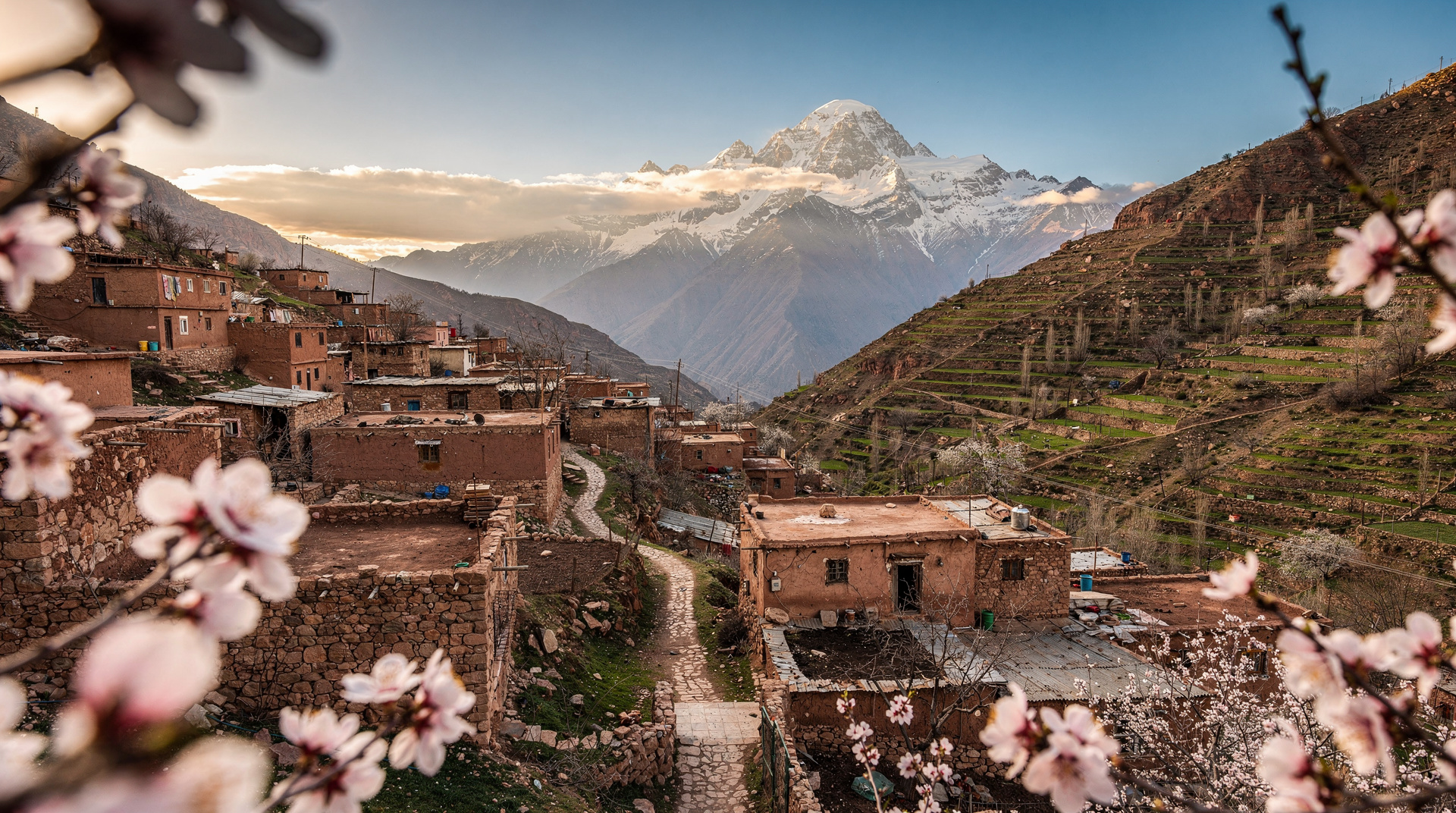
The spring wildflower display in the lower valleys (Imlil area, 1,400-2,000m) is exceptional from April into May. The summit views in spring are often the clearest of the year — winter dust has settled, summer haze hasn’t built.
July-August (peak season)
Hot in the lower valley (30-35°C in Imlil midday) but cooler on the upper mountain (summit temperature typically 5-15°C, wind chill can bring effective temperature below 0°C). This is the busiest period — the refuge is crowded, the summit trail has the most traffic, and advance booking for the refuge is essential.
The main summer disadvantage is afternoon cloud buildup. Summit by 10-11am to ensure clear views. Storms can develop quickly in August; check the forecast and be prepared to turn around.
September-October (second optimal window)
The ideal combination: past the summer crowds, reliably settled weather, comfortable temperatures throughout. October daytime temperatures at the summit run 0-10°C — manageable with proper layering. The autumn light is excellent for photography.
November-March (technical conditions)
This is a fundamentally different objective. Snow arrives on the upper mountain in November and persists until March-April. The south cwm — the main technical section — accumulates ice and requires crampons. Without them, the ascent is extremely dangerous (hard ice on a steep slope).
Winter Toubkal requirements:
- 10-12 point crampons (rigid frame, suitable for front-pointing)
- Ice axe (for self-arrest on ice slopes)
- Winter mountaineering boots (compatible with crampons)
- A guide with winter mountain experience (not all licensed guides operate in winter)
- Full winter layering including insulated down jacket and waterproof shell
- Avalanche awareness (the upper mountain has avalanche terrain in heavy snow years)
Winter Toubkal is a legitimate and rewarding mountaineering objective for those equipped and experienced. It’s genuinely dangerous for unprepared trekkers.
Seasonal conditions at a glance
| Period | Snow/ice | Temperature (summit) | Crowds | Notes |
|---|---|---|---|---|
| Apr-Jun | Clearing, possible early April snow | 0-10°C | Moderate | Wildflowers below 2,000m |
| Jul-Aug | None | 5-15°C (colder with wind chill) | Highest | Book refuge well ahead |
| Sep-Oct | None | 0-10°C | Low-moderate | Best overall window |
| Nov-Mar | Ice, crampons required | Below 0°C common | Low | Guide + winter gear mandatory |
The full summit day: hour by hour
4:30-5:00am: Wake up at the refuge. Temperature inside typically 5-10°C. Outside can be -5°C to +5°C in spring and autumn. Full layering goes on immediately.
5:00-5:30am: Breakfast (soup, bread, coffee or tea at the refuge kitchen — simple but sufficient). Pack your summit kit: extra layers, water (2L minimum), food, headtorch, first aid.
5:30-6:00am: Depart refuge. Headtorches required. The path is clear but some early navigation needed in darkness.
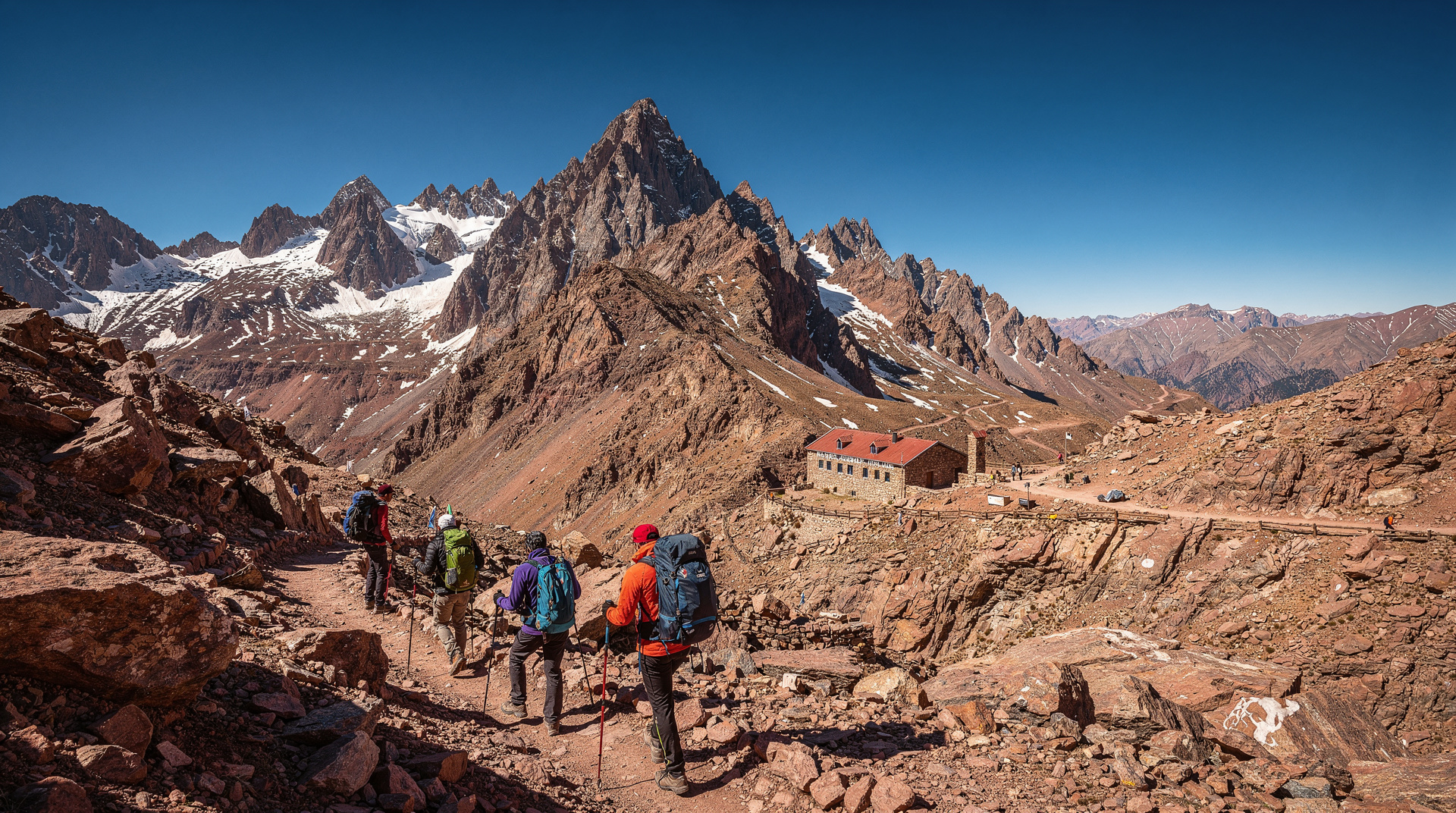
6:00-7:30am: Cross the refuge basin and begin the scree ascent. The loose shale scree section (approximately 2,500m of elevation, starting around 3,300m) is the most demanding section. Use trekking poles and keep a consistent slow pace. “Rest step” technique — locking the rear knee straight at each step — reduces muscle fatigue on steep slopes.
7:30-8:00am: Reach the South Cwm (approximately 3,900m). This is where winter ice forms; in summer it’s a steep but walkable rocky slope. Rest here for 5-10 minutes.
8:00-9:30am: Rocky ridge to summit pyramid. The gradient eases slightly. Views open dramatically. The final approach to the summit involves a short exposed ridge — nothing technical but watch footing.
9:00-10:00am (typical arrival): Summit. Metal pyramid marker. Summit register (worth signing). Spend 20-30 minutes in good weather before beginning descent.
Descent total time: 3-4 hours to refuge, then 3-4 hours to Imlil. The scree descent is faster than ascent but harder on the knees — poles are critical.
The Toubkal refuge: everything you need to know
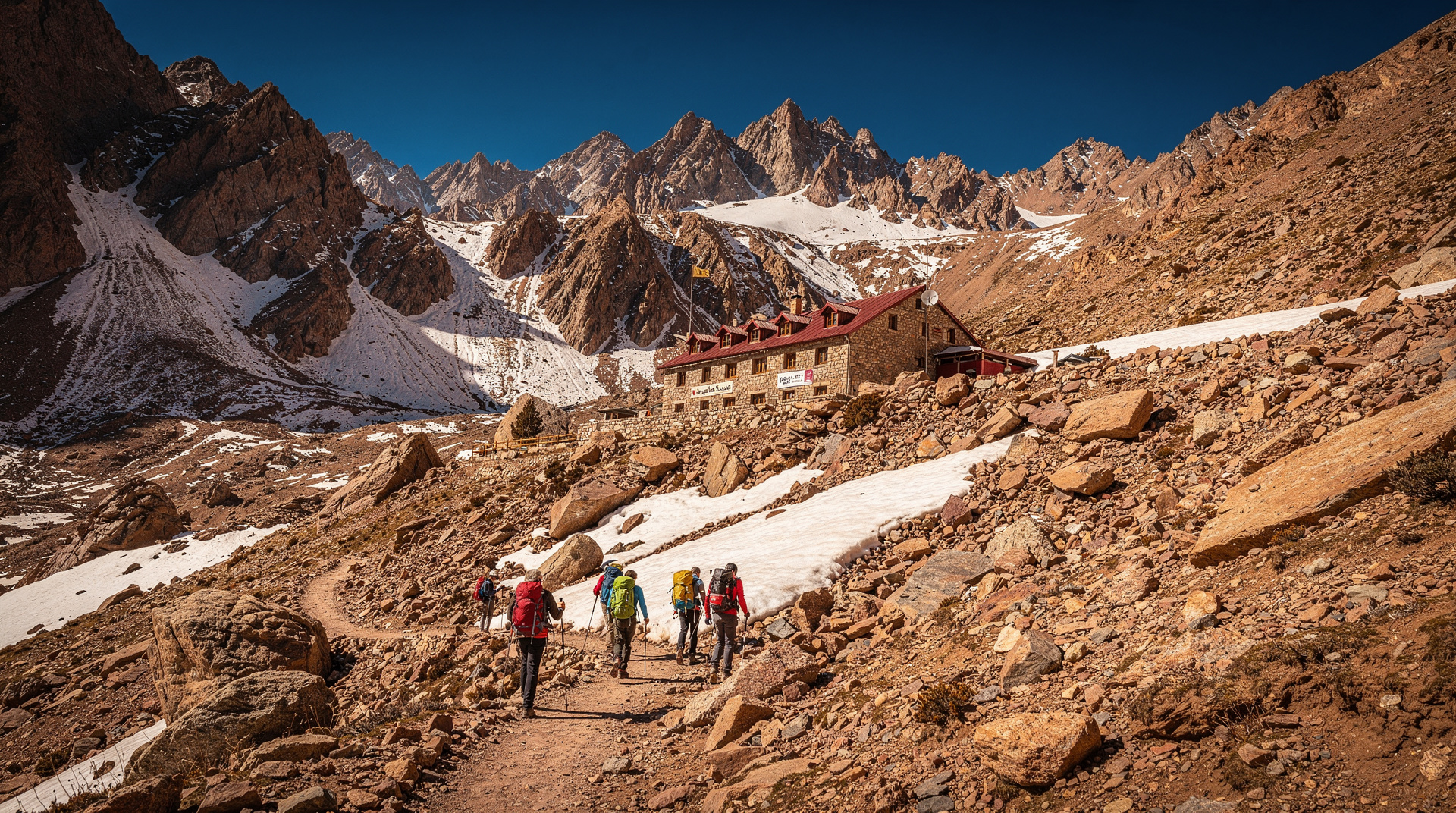
The Neltner Refuge (CAF Toubkal Refuge), operated by the Club Alpin Français du Maroc, sits at 3,207m and is the standard overnight before the summit.
Capacity and booking: Dormitory-style, approximately 90 beds total. Must be booked in advance for July-August and popular spring/autumn weekends. Book through CAF Maroc website or contact directly. Walk-in is possible in shoulder season but risky.
Cost: Approximately 250-320 MAD per person per night (dormitory). Meals extra: breakfast 70-100 MAD, dinner 120-160 MAD (soup, tagine, bread, tea).
Facilities: Dormitory bunks with blankets provided. Shared toilets (cold water). No hot shower. Limited phone charging (solar panels with restricted capacity). No WiFi or reliable mobile signal.
What to bring for the refuge night:
- Sleeping bag liner (the blankets are functional but a liner adds significant warmth)
- Earplugs (shared dorms can be noisy with early-rising groups)
- Headtorch (essential — the path to the toilet block is unlit)
- Personal medications including ibuprofen (for AMS headache management) and rehydration salts
Alternative: private accommodation near the refuge. Several small camps have set up near the Neltner refuge in recent years offering slightly more comfortable accommodations (private tent or small room) at premium prices (350-500 MAD per person). These require advance booking.
Complete gear list for a Toubkal summit attempt
Lower body
- Lightweight hiking trousers (convertible/zip-off work well)
- Base layer (thermal for overnight, regular for summit day)
- Hiking boots with ankle support — this is non-negotiable on the scree descent; trail runners are insufficient
- Hiking socks (merino wool, at least 2 pairs)
- Gaiters (useful for scree, essential if any snow)
Upper body
- Moisture-wicking base layer
- Insulating mid-layer (fleece or light down)
- Wind/waterproof shell jacket
- Warm insulating jacket (down or synthetic) for refuge and early morning
- Gloves (thin liner + warm outer)
- Warm hat/beanie
- Buff or neck gaiter (for wind on the summit ridge)
Equipment
- Trekking poles (two, not one — both poles for the ascent and especially descent)
- Daypack 20-30L for summit day (larger pack with camping gear if doing independent style)
- Headtorch with fresh batteries
- Water bottles or hydration bladder (2-3L capacity for summit day)
- Sunscreen SPF 50+
- Sunglasses with UV protection (UV intensity is high at altitude)
- First aid kit basics: blister treatment, ibuprofen, altitude med if prescribed
Winter additions (November-March only)
- 10-12 point crampons
- Ice axe (70-75cm for standard mountain use)
- Warm winter boots (crampon-compatible)
- Insulated overtrousers for cold conditions
Guide costs and requirements
A licensed mountain guide is not legally mandatory but is strongly recommended, particularly for:
- First-time mountain trekkers
- Anyone without winter mountaineering experience (November-March mandatory)
- Trekkers unfamiliar with navigation in cloud
- Groups with young or elderly members
Finding a guide in Imlil: The Bureau des Guides in Imlil is the official licensing body. Licensed guides display their credentials. Cost: 400-600 MAD per day per guide. A complete 2-day guided package (Imlil to summit and back, with refuge) costs 1,500-2,500 MAD per person depending on group size and what’s included.
For organised summit trips from Marrakech, the Atlas Mountains hiking and Berber village day trip covers the lower Atlas approach. Full summit packages (2 days, transport, guide, refuge) run 130-200 EUR per person on shared group basis.
If you want a lower-altitude warm-up before the summit, or a gentler alternative if the summit feels too ambitious, a private Ourika Valley day trip from Marrakech and an Atlas Mountains day trip covering three valleys and waterfalls are two options that keep you at moderate elevation.
Connecting Toubkal to the Atlas trekking world
The Toubkal summit is one piece of a larger High Atlas trekking ecosystem. For those wanting more than the standard 2-day route, the multi-day Atlas trek guide covers the Toubkal Circuit (5-7 days around the massif) and the M’Goun Traverse. The M’Goun trek guide covers the alternative 4,068m peak — quieter, longer, and in some ways more rewarding.
For the standard 2-day route overview with less technical detail, the Toubkal trek guide is the companion piece to this deeper summit focus.
Getting ready before Imlil
Before you commit to a summit attempt, it’s worth reading the broader context: the Toubkal trek guide covers the standard 2-day itinerary in less altitude-focused detail, and the Berber villages tour guide covers the lower valleys around Imlil and Aroumd if you want a day of acclimatisation hiking before the summit push.
If you’re deciding whether to hire a driver for the Marrakech-Imlil leg or manage everything independently, the private tour vs self-drive guide covers that decision more broadly. For general fitness and packing context across a Morocco trip, the Morocco packing list is a useful companion for the non-mountain parts of your itinerary.
Frequently asked questions about Summiting Mount Toubkal 4,167m
What is the success rate for reaching the summit?
There are no official statistics, but experienced operators suggest that 80-90% of adequately prepared trekkers reach the summit in summer conditions. The primary causes of turning back are AMS symptoms and severe weather. Winter success rates depend heavily on conditions and are lower.
How does Toubkal compare to Kilimanjaro in difficulty?
Toubkal is lower (4,167m vs Kilimanjaro’s 5,895m) and typically faster to complete (2 days vs 5-8 days). Altitude effects are proportionally less severe. Technically, summer Toubkal is less demanding. Winter Toubkal is more technical than standard Kilimanjaro routes due to ice on the south cwm.
Can I camp instead of using the refuge?
Yes. Wild camping is permitted in the Toubkal National Park (there is a nominal fee). Some trekkers carry tents and camp at the basin below the refuge or at other spots. The logistics are more demanding but the experience of a private camp at 3,000-3,500m is exceptional.
Should I hire a mule for luggage?
A practical option if you have a heavy pack or if any member of your group has difficulty carrying weight uphill. Mules carry loads to the refuge (they don’t go higher). Cost: 200-300 MAD per mule per day. Arrange in Imlil — mule handlers work from the central corral area.
What’s the difference between the summit attempt and the standard trek?
This guide focuses on altitude, acclimatisation, and the specific risks of the 4,167m summit push. For the day-by-day route overview with less altitude-medicine detail, see the Toubkal trek guide — the two are companion pieces covering the same route from different angles.