Tagine vs couscous: which should you order in Morocco?
What is the difference between tagine and couscous in Morocco?
Tagine is an everyday slow-braised stew cooked in a conical clay vessel — available any day at any Moroccan restaurant. Couscous is the Friday communal dish — hand-steamed semolina with seven vegetables and meat broth — requiring hours of preparation and traditionally reserved for the family Friday lunch. If it's Friday, order couscous. Any other day, the tagine is the right choice.
The question every Morocco visitor asks
Walk into any Moroccan restaurant and the menu has the same two anchors: tagine and couscous. Both are described as the national dish. Both are central to Moroccan food culture. Both can feature lamb, chicken, or vegetables. Both come with bread. Both are delicious.
The question — which to order? — seems straightforward until you realise they’re fundamentally different dishes prepared in different ways, eaten on different occasions, and carrying different cultural weight. The choice reveals something about how Moroccan food works: not two versions of the same thing, but two entirely distinct traditions that happen to share a table.
This guide settles the comparison.
| At a glance | Tagine | Couscous |
|---|---|---|
| Where | Any restaurant, any day | Best at a local restaurant on Friday |
| Typical cost | Around 60-450 MAD depending on setting | Around 80-500 MAD, slightly more than tagine |
| Time needed | 30-60 minutes braise-to-order | Full Friday lunch slot (1-3pm); 3-4h if made fresh |
| How to order | By meat/filling type | Ask “is it made today” on non-Fridays |
| Best time | Any day, lunch or dinner | Friday lunch specifically |
The fundamental difference: everyday versus ritual
Tagine is the everyday Moroccan dish. It’s prepared continuously at homes, in restaurants, and at street stalls. A good tagine takes 2-4 hours of braising, but the actual preparation is minimal — spice the meat, layer the vegetables, cover, and wait. One cook, one vessel, any day of the week.
Couscous is the Friday ritual dish. It requires multiple people, multiple steamings, and a full morning of preparation. The grain must be rolled (or purchased fresh from a specialist vendor), steamed three times, worked by hand between steamings, and finished with enough butter to make a French chef wince. The broth takes parallel preparation. A full seven-vegetable couscous with meat takes 4-5 hours of active cooking.
This is the core distinction that everything else follows from.
The vessel and technique
Tagine
Named for its cooking vessel — the shallow clay base with a conical lid. The lid design is the technical key: steam from the braising liquid rises, condenses on the sloping walls, and drips back into the pot. This creates a self-basting environment with minimal liquid.
You can produce similar results in a Dutch oven or cast-iron pot, but you need more liquid and the result is slightly different in texture. The clay tagine pot also slowly absorbs the spices of the braises it holds, building flavour over years of use.
Couscous
The grain and the preparation vessel are the centre of couscous culture. The couscoussier — a two-part steamer with a perforated top vessel above a broth-filled base — is the required equipment. No shortcuts: a sieve over a pot is not the same. The steam that carries the broth’s flavour into the grain is the cooking medium.
The three-steam process (see the couscous guide for full detail) cannot be condensed without affecting texture. A couscous that arrives in under 30 minutes was not made to order.
Flavour profile comparison
| Factor | Tagine | Couscous |
|---|---|---|
| Primary flavour | Concentrated, reduced broth; spiced meat or vegetables | Broth-infused grain; lighter, more neutral base |
| Texture | Fall-apart meat, soft vegetables in rich sauce | Fluffy separate grain with distinct vegetable pieces |
| Richness | High (fat from meat and olive oil concentrates during braising) | Moderate (broth flavour infuses grain; finished with butter) |
| Spice intensity | High and direct (spices braise in direct contact with food) | Moderate and indirect (spices are in the broth below the steam) |
| Sweetness | Varies by type (lamb with prunes is very sweet-savoury) | Present in tfaya version (caramelised onions and raisins) |
| Acidity | Often present from preserved lemon | Less common |
Occasion and timing
When tagine is appropriate
Any day, any meal, any setting. Tagine is the democratic dish of Moroccan food culture:
- Weekday family lunch
- Dinner for guests
- Solo lunch at a local restaurant
- Street food variant (kefta tagine)
- Tourist restaurant dinner
- Restaurant in any city, any size
Time of day: Tagine works at both lunch and dinner. In traditional Moroccan meal culture, the main meal is lunch; tagine appears more frequently then, but dinner is entirely appropriate.
For first-time visitors: Tagine. It’s available everywhere, reliably prepared, and the range of types (chicken with preserved lemon, lamb with prunes, kefta, vegetable) gives you options on a first visit.
When couscous is appropriate
Friday lunch, specifically. The cultural weight of couscous is tied entirely to this timing. At a family table on a Friday, couscous is not just food — it is the act of gathering after prayers, the most domestic and communal of Moroccan meals.
At restaurants:
- Tourist restaurants serve couscous daily — the quality reflects this (it’s made ahead, kept warm, reconstituted for service)
- Local restaurants may only serve couscous on Fridays — when they do, it’s made fresh for the day
- Upscale Moroccan restaurants (Al Fassia in Marrakech, The Ruined Garden in Fes) serve couscous daily or weekly with the quality of a properly prepared version
For the best couscous experience: Find a local restaurant on a Friday. Arrive at lunch (1-3pm). If the restaurant has couscous, it was made this morning. This is the definitive version.
Regional variations: where to find the best
Tagine regional variations
Marrakech: Bold ras el hanout spicing, lamb with prunes and almonds, heavy use of saffron. At Dar Moha and Al Fassia, tagines reach their most elaborate expression.
Fes: More complex spice blends, Andalusian influence in sweet-savoury combinations, preserved lemon in everything. Café Clock’s modern versions and the medina’s family restaurants show the Fassi approach.
Coastal cities (Essaouira, Agadir): Seafood tagine with chermoula marinade. The fish arrives fresh; Essaouira harbour restaurants are the best address for this version.
Atlas mountain villages: Earthy, minimal seasoning, cooked on wood fires. The smoke dimension adds something no restaurant version replicates.
Couscous regional variations
Casablanca (bidaoui style): The most refined urban version. More carefully calibrated broth, more precisely cooked vegetables, richer butter finish.
Fes: Strong in the traditional seven-vegetable format with lamb. The Fassi couscous is considered among the best urban versions.
Souss and anti-Atlas: Argan oil instead of butter as the finishing fat — a significant difference. Coarser grain, earthier character.
Rif mountains: More vegetables relative to meat; broader bean and chickpea presence. Lighter overall.
How to order: what to say and ask
Ordering tagine
“Je voudrais le tagine de poulet au citron confit, s’il vous plaît” — the chicken with preserved lemon tagine, please.
Key questions to ask:
- “Est-ce que c’est mijoté sur place?” (Is it braised on-site, or reheated?)
- “Est-ce que vous avez le tagine de kefta?” (Do you have kefta tagine?)
- “C’est pour combien de temps?” (How long will it take?) — a proper tagine should take at least 30-40 minutes; if the answer is “10 minutes,” it’s reheated
Ordering couscous
“Est-ce que vous faites le couscous aujourd’hui?” (Are you making couscous today?) — this question on a non-Friday will tell you whether the restaurant takes it seriously.
Key questions:
- “C’est fait maison?” (Homemade, or from a box?)
- “Vous avez la version avec tfaya?” (Do you have the version with caramelised onions and raisins?)
- “Est-ce qu’il y a du couscous au vendredi?” (Is there couscous on Fridays?) — use this to plan ahead
Home cooking versus restaurant versions
Tagine at home versus restaurant
At home: The clay tagine pot used directly over charcoal or a wood fire, with a long slow braise, produces the best tagines. The smoke dimension from a traditional brazier (kanoun) is impossible to replicate on a gas stove. Moroccan home cooks generally produce better tagines than most restaurants.
At a restaurant: Quality ranges enormously. The best restaurants use slow-braising for service (accepting the 45-60 minute wait time). Most tourist restaurants pre-braise large batches and plate from a holding pot — the results can be good but lack the final-stage intensity. Local restaurants serving a neighbourhood clientele tend to have better everyday quality than tourist-facing establishments.
Couscous at home versus restaurant
At home: The Friday home couscous, made by experienced Moroccan cooks using the three-steam method, is categorically different from any restaurant version. The scale (a large family quantity), the texture attention (worked by hand three times), and the broth quality (made from the morning’s shopping) create the definitive version.
At a restaurant: Even good restaurants struggle to replicate the home version. The volume economics of restaurant couscous (making enough for a table of two uses the same equipment as making enough for twelve) often mean restaurants pre-steam large batches. The premium Moroccan restaurants (Al Fassia, Dar Moha) manage this better than most.
The honest truth: If a Moroccan family invites you to Friday couscous, cancel whatever you had planned and go. No restaurant version competes.
Nutrition and portion size
Both dishes are substantial and designed to be the entire meal rather than a course within a meal.
| Factor | Tagine | Couscous |
|---|---|---|
| Primary macronutrient | Protein (from meat) and fat (from oil and braising fats) | Carbohydrate (from semolina grain) and protein |
| Typical serving size | One tagine vessel for one person (generous) or shared for two (standard) | A large communal platter for 4-6 people |
| Caloric density | High — especially lamb and prune versions | Moderate — depends heavily on butter quantity |
| Vegetable content | Present but secondary to meat | Central — seven vegetable minimum |
| Bread requirement | Mandatory — it’s the utensil | Optional — the grain is its own carbohydrate |
| Dessert after | Light — a plate of fruit or mint tea | Rarely — the meal is already very substantial |
Price comparison: what to expect
| Setting | Tagine (per person) | Couscous (per person) |
|---|---|---|
| Local restaurant (medina) | 60-100 MAD (6-10 EUR) | 80-130 MAD (8-13 EUR) |
| Mid-range restaurant | 120-200 MAD (12-20 EUR) | 140-220 MAD (14-22 EUR) |
| Quality riad restaurant | 180-280 MAD (18-28 EUR) | 200-320 MAD (20-32 EUR) |
| Fine dining (Al Fassia, Dar Moha) | 280-450 MAD (28-45 EUR) | 300-500 MAD (30-50 EUR) |
Couscous typically costs slightly more than the equivalent tagine at the same restaurant because of the preparation time and labour involved.
The verdict: which to choose
Choose tagine when:
- It’s not Friday
- You’re at a restaurant for the first time and want the most reliable Moroccan experience
- You’re eating alone or with one other person (tagine portions suit pairs)
- You want to try multiple types across multiple meals (chicken one meal, lamb the next, kefta the next)
Choose couscous when:
- It’s Friday and you’re at a restaurant that makes it fresh
- You’re in a group of four or more (the communal format is designed for groups)
- You’ve had tagine already and want the other side of Moroccan food culture
- You’re at a special-occasion restaurant (Al Fassia, Dar Moha) where the quality justifies it
Don’t order couscous:
- At any restaurant on a Tuesday at 7pm unless you’ve confirmed it’s made fresh that day
- At tourist-trap restaurants that list it in fifteen languages on a laminated menu
- When the price is the same as the tagine at the same restaurant (the labour cost difference should be reflected in price)
Frequently asked questions about Tagine vs couscous
Is couscous more authentically Moroccan than tagine?
Both are authentically Moroccan. Tagine has deeper historical roots in North African cooking; the grain itself (couscous) originated in the Berber culinary tradition and spread across North Africa and the Maghreb. Neither is more authentic — they represent different dimensions of the same food culture.
Can I get both tagine and couscous in one meal?
Technically yes at large restaurants, but it’s an enormous amount of food and not how either is traditionally eaten. If you want to try both, a better approach is to order tagine at one meal and couscous at another, in different restaurants, rather than ordering both at once.
Is vegetarian couscous as good as the meat version?
Yes — some cooks argue the vegetable couscous shows the technique more clearly because there’s no meat fat to compensate for a mediocre broth. The seven-vegetable version, properly prepared with a rich vegetable broth, is a complete dish. Ask for “couscous végétarien” and confirm the broth is also vegetable-based (not chicken stock).
Why does the instant couscous I make at home taste nothing like Moroccan couscous?
Two different products. Instant couscous is precooked, dried, and rehydrated — the texture becomes gummy and clumped because the structure of the grain is already broken down. Traditional Moroccan couscous is raw semolina steamed from scratch, which creates a different cellular structure and a grain that is genuinely fluffy and separate. The couscous guide covers the technique in detail.
What’s the single most important difference between tagine and couscous for a visitor to understand?
Occasion. Tagine is the everyday dish; couscous is the Friday ritual. If you can only experience one authentic Moroccan food moment, find a Friday lunch with real couscous — either at a family table if you have the invitation, or at a serious restaurant that makes it fresh for the day.
Cooking classes: learning to make both
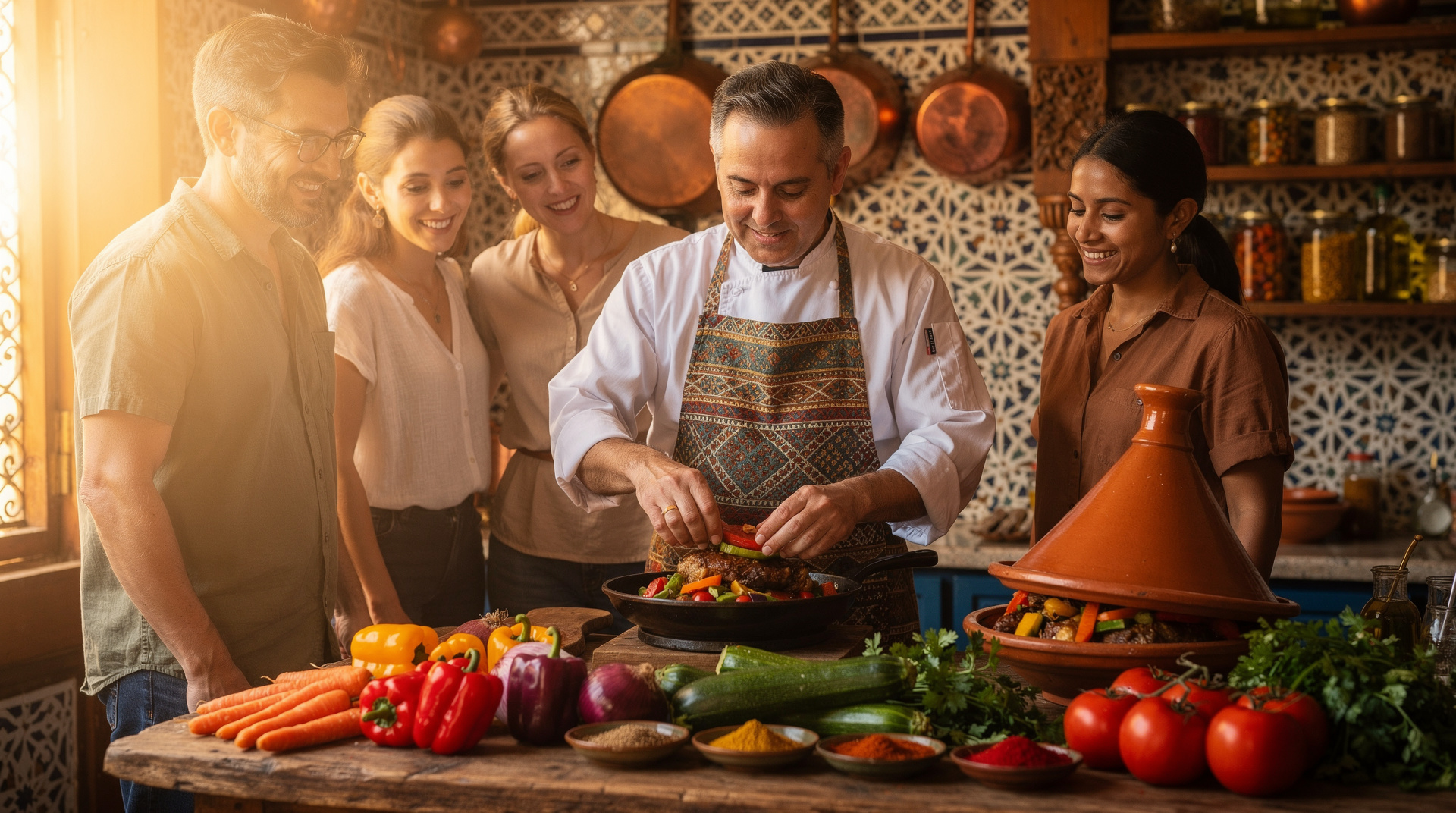
The best way to understand the difference between tagine and couscous is to make both. Most cooking classes in Marrakech and cooking classes in Fes include at least one tagine in the curriculum. Fewer include full couscous (the three-steam process takes 3-4 hours and requires more class time), but some dedicated classes focus specifically on couscous preparation.
Book the La Maison Arabe cooking workshop — Marrakech’s most professional culinary classWhat a tagine class teaches: how the spice blend is assembled, how to brown the meat before adding liquid, the layer order for vegetables, and the importance of the slow braise. What a couscous class teaches: how to hand-work the grain between steamings, how to calibrate the seven vegetables by cooking time, and what butter and rose water do to the finished grain.
Taking both classes in the same trip gives you the fullest possible picture of Moroccan cooking technique — the braising tradition through tagine, the steaming tradition through couscous.
Book the Flavors of Fez market visit and hands-on cooking classThe shared ingredients: what tagine and couscous have in common
Despite their differences, tagine and couscous share a significant ingredient overlap that reflects their common root in Moroccan food culture:
Preserved lemon: Used in the classic chicken tagine, also available as a garnish for couscous. The preserved lemon is a unifying flavour thread through Moroccan cooking.
Ras el hanout: The spice blend appears in more elaborate tagines and in the broth of some couscous preparations. The specific blend varies by cook and region.
Saffron: A small pinch in the braising liquid for chicken tagine; in the broth for some couscous preparations. Morocco produces quality saffron (see the Moroccan spices souks guide) and uses it in both dishes.
Olive oil: Tagines begin with olive oil for browning. Couscous is sometimes started by tossing the dry grain with olive oil before the first steaming. Both are finished with additional olive oil.
Preserved butter (smen): More central to couscous (worked through the grain at the end of each steaming) but also used in some tagine preparations, especially festive versions.
Chickpeas: A standard element in couscous (the seven vegetables typically include chickpeas). Also appear in vegetarian tagines and some lamb tagines.
Ginger: Fresh ginger appears in both as one of the primary aromatic components of the Moroccan spice palette.
Understanding these shared ingredients helps demystify both dishes — they’re different expressions of the same foundational Moroccan flavour vocabulary.
How food culture connects the two dishes
Tagine and couscous exist in relationship to each other, not just as separate dishes. The most important connection: the tagine broth and the couscous broth are produced by the same technique — slow braising of meat with aromatics and spices in liquid. The difference is what happens to that liquid.
In a tagine: the liquid reduces and concentrates around the meat and vegetables in the sealed pot, becoming the sauce.
In couscous: the liquid (broth) is kept in the bottom vessel of the couscoussier, and the steam rising from it carries flavour into the grain. The broth is then served separately alongside the finished dish, poured over the couscous mound at the table or served in cups to drink alongside.
This means that a cook who makes excellent broth — understanding how to balance aromatics, when to add different spices, how long to braise — is producing the foundation of both dishes simultaneously. The couscous guide and the tagine guide both describe this broth-making knowledge in detail.
Making the choice in practice: a quick decision guide
You’re at a Moroccan restaurant. The menu has both. Here’s the decision in 30 seconds:
What day is it?
- Friday lunch: order couscous if the restaurant makes it fresh (ask)
- Any other time: tagine is the safer, more reliable choice
How hungry are you?
- Very hungry (haven’t eaten since breakfast): couscous — the grain is more filling
- Moderately hungry: tagine — the broth and meat are satisfying without being overwhelming
How many people are eating?
- 1-2 people: tagine (individual vessels work better for small groups)
- 4+ people: couscous (communal platter format designed for groups)
What’s your budget?
- Tight: tagine (generally 20-50 MAD cheaper at the same restaurant)
- Flexible: either — couscous costs more but the Friday version at a good restaurant is worth it
Have you already had tagine this trip?
- Yes: order couscous to complete the picture
- No: start with tagine, then couscous on another meal
Where to plan this into your itinerary
If Friday couscous matters to you, plan around it deliberately rather than hoping it lines up. Check whether your trip touches a Friday while you’re in Fes or Marrakech, and build that day’s lunch around finding a restaurant that makes couscous fresh — Fes souks guide and Marrakech souks guide both cover neighbourhoods with genuine local restaurants rather than tourist-square options. If your dates don’t line up with a Friday at all, don’t force it — a well-made tagine any day beats a mediocre off-day couscous.
A note on cooking classes and which dish to pick
If you only have time for one cooking class and want to decide based on this comparison: choose a tagine class if your trip is short (the technique is teachable in 2-3 hours), and look specifically for a couscous-focused class only if you have a free afternoon, since the three-steam process needs real time to demonstrate properly.