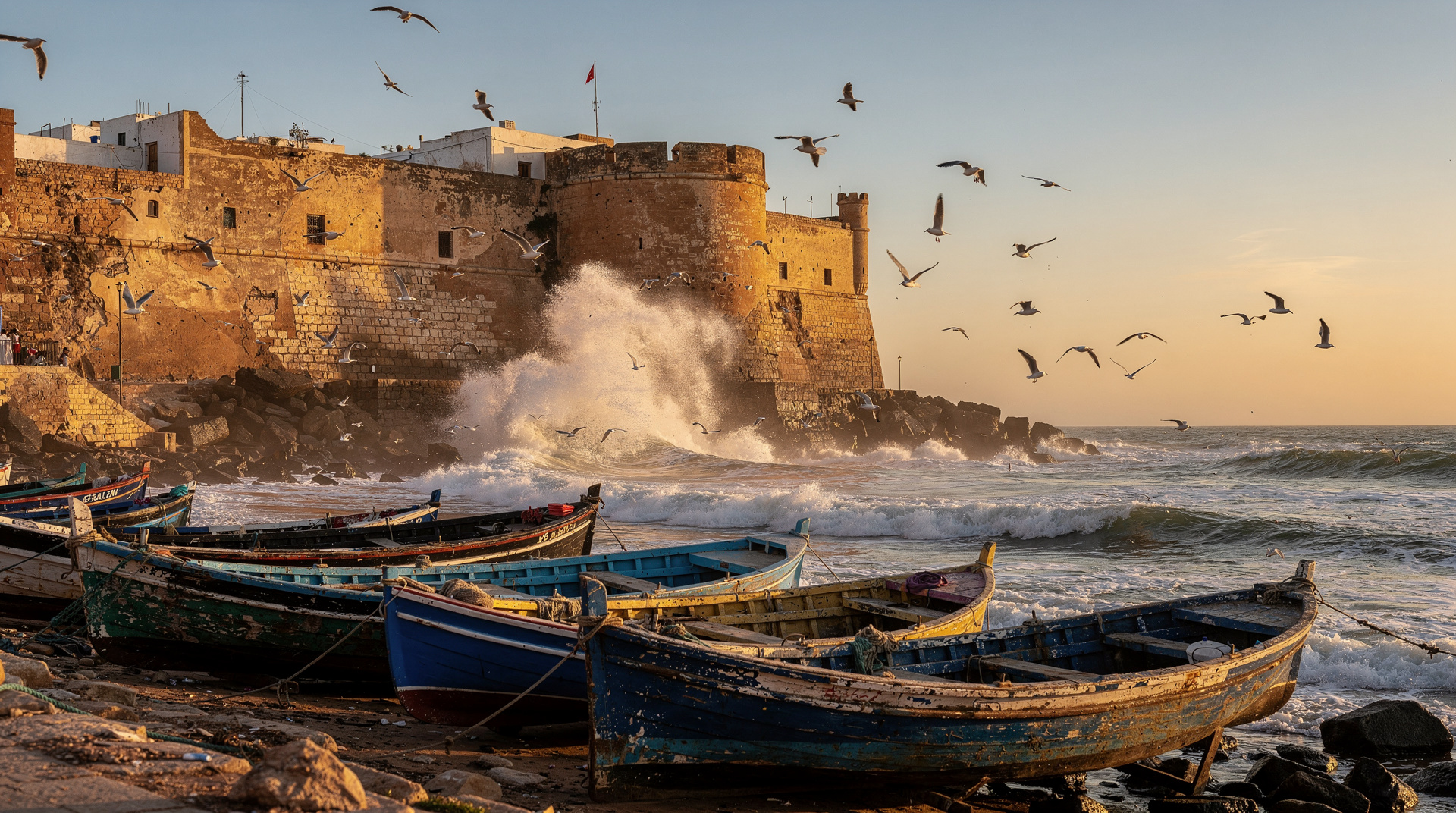
Surfing Taghazout: the complete guide to Morocco's surf capital
When is the best time to surf Taghazout?
September through April is the prime window. October to February delivers the most consistent swell with offshore winds. Complete beginners do best October–November or March–April when conditions are powerful but not overwhelming.
Why Taghazout became Africa’s most famous surf destination
| Where | Taghazout village, 20km north of Agadir, Atlantic coast |
| Cost | Around 250-400 MAD group lesson; 400-700 EUR/week all-inclusive camp |
| Time needed | 1 week minimum for real progress; 2 weeks for meaningful level jump |
| Getting there | Fly to Agadir-Al Massira (AGA); grand taxi 30-40 MAD, 30-40 minutes |
| Best time | September-April; October-February for the most consistent, powerful swell |
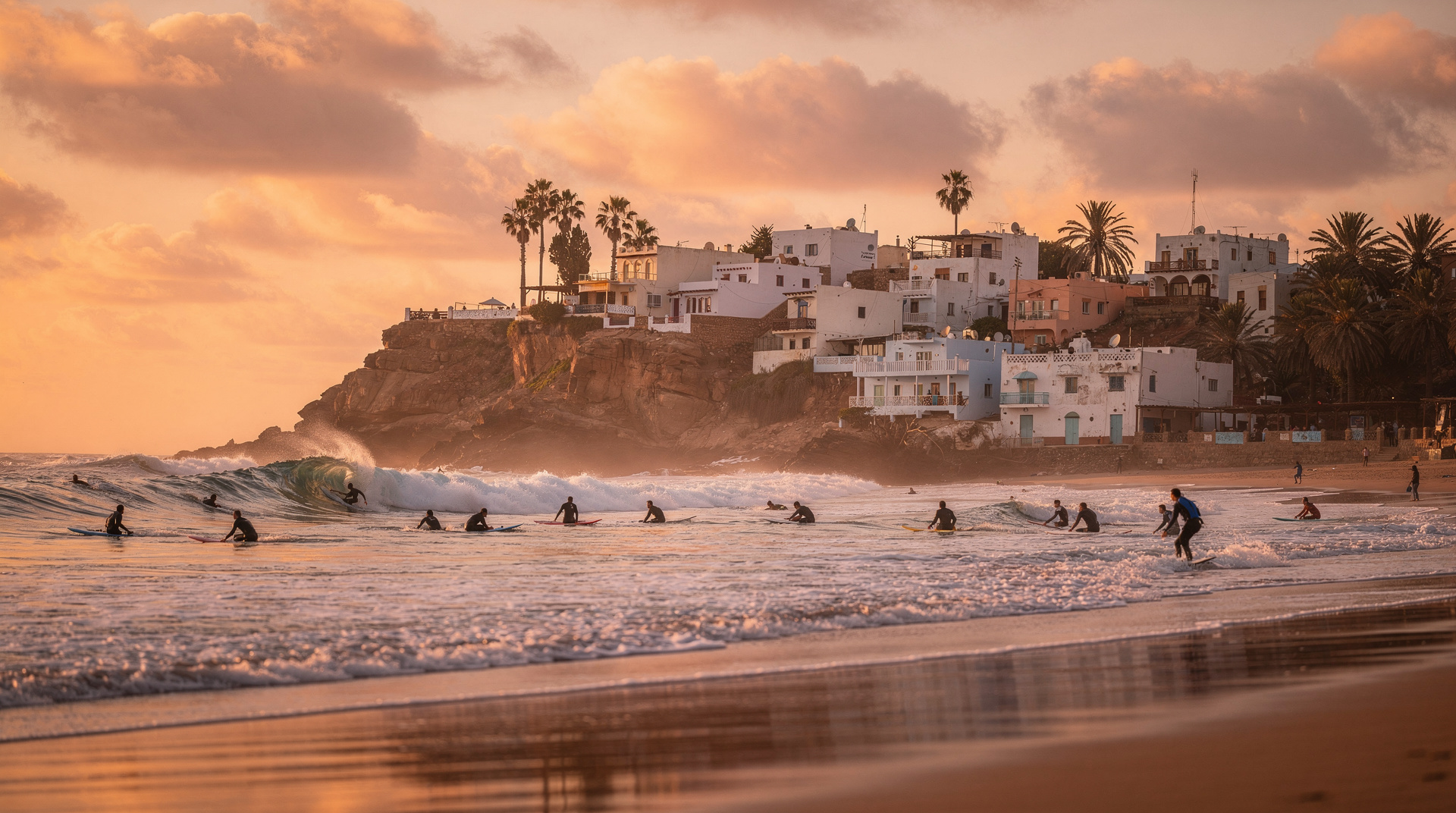
In the early 1970s, a handful of Californian and Australian surfers driving along Morocco’s Atlantic coast stopped at a small fishing village called Taghazout. They found empty point breaks peeling for hundreds of metres with no one out. Word spread slowly — remote location, cheap living, extraordinary waves. Forty years later, Taghazout has a surf camp on almost every rooftop and queues at the main breaks in October.
The waves are still excellent. The infrastructure has grown dramatically. Understanding which breaks work for which level, and when to go, means you get the best of both: quality surf without drowning in crowds.
The breaks of Taghazout: a realistic guide
Taghazout sits on a headland about 20km north of Agadir. The point breaks that made its reputation are strung along a 15km stretch of coast.
| Break | Level | Best swell |
|---|---|---|
| Anchor Point | Intermediate-advanced | 2-4m, north wind |
| Hash Point | Intermediate | 1-2.5m, NE/N wind |
| Banana Point | Beginner-lower intermediate | Small-moderate |
| Killer Point | Advanced only | Medium-large |
| Boilers | Intermediate-advanced | Mid-tide |
| Mysteries | Intermediate-advanced | Variable |
Anchor Point
The jewel of Taghazout. A right-hand point break that can produce waves over 300 metres long when conditions align. Best in solid north or northwest swell, offshore in the prevailing northeast wind. Works from 1.5m to 4m+.
At its best — October through February — Anchor Point is a legitimate world-class wave. Long walls, hollow sections near the point, and a forgiving channel make it accessible for experienced surfers even at size. During peak season it draws international surfers who time their Morocco trip specifically around the Anchor Point season.
Level: Intermediate to advanced. Do not paddle out at Anchor Point as a beginner — the sets are powerful and the lineup is competitive. On a large swell day, getting caught inside can be genuinely dangerous.
Best conditions: 2-4m swell, north wind, incoming tide. The left peak that sometimes forms on the inside is friendlier for intermediates.
Hash Point
Directly below the village, visible from the main strip of cafe terraces. A right-hand point that’s shorter and more forgiving than Anchor. Works in smaller swell — 1-2m — and handles southwest wind better than Anchor.
Hash Point is where intermediate surfers at Taghazout spend a lot of their time. When Anchor Point is too big for your level, Hash is often firing. The crowd can be heavy here because it’s close to all the camps.
Level: Intermediate. Beginners in controlled conditions can attempt the shoulder sections with a guide present.
Best conditions: 1-2.5m swell, northeast or north wind.
Banana Point
Between Taghazout and the village of Aourir (often called “Banana Village” for its roadside banana sellers). A mellow right-hand point that breaks over sand. The most beginner-friendly of the main breaks in the area.
Banana Point is where most surf schools run their lessons once students are past the white water stage. Slower wave, longer time to make decisions, forgiving wipeouts. Gets crowded with lesson groups October through April.
Level: Beginner to lower intermediate.
Killer Point
North of Anchor Point, accessible by 4WD track. A heavier right-hander that holds bigger swell better than the village breaks. Less consistent than Anchor but emptier on most days. The wave has a more abrupt takeoff and sections that demand experience.
Level: Advanced only on medium to large swell.
Boilers
Named for the rusted boiler wreck visible at low tide on the inside. One of the more complex breaks in the area — a right-hander that becomes hollow and fast on the right swell. Works best mid-tide when the inside section doesn’t drain completely.
Level: Intermediate to advanced.
Mysteries
Further north, requiring local knowledge to access. A long right-hand point similar to Anchor but less consistent. When it’s working, Mysteries can be emptier than the village breaks — worth asking your surf camp about current conditions.
Level: Intermediate to advanced.
Surf seasons: month by month
September–October
The season opener. Swell begins arriving from north Atlantic storms. Crowds build through October as European surfers arrive. Water temperature around 21-22°C. October is arguably the peak month: consistent swell, offshore winds, warm enough to stay out for long sessions without a thick wetsuit.
November–January
The deepest part of the swell season. North Atlantic lows send consistent groundswell. Waves can be powerful — 3-5m faces possible at Anchor Point and Killer. Cold front weather systems occasionally bring onshore conditions for 2-3 days. Water at 18-19°C. 3/2mm wetsuit minimum, 4/3mm on colder days.
Crowds thin from Christmas through January as European tourists avoid the Moroccan winter. This is when experienced surfers find the best ratio of quality to crowd.
February–April
Swell remains consistent into March, easing in April. Water warming back toward 20°C. Spring crowds build again in March as surf camp bookings fill. April is popular with intermediate surfers who want quality waves without the size and power of winter.
May–August
Summer sees swell drop significantly. The coast becomes good for beginners and SUP, but lacking the quality that defines Taghazout’s reputation. Water temperature peaks (22-24°C). August is the worst month for surf quality at Taghazout; many professional camps close or run reduced operations.
Surf camps: what to expect and how to choose
Taghazout now has dozens of surf camps ranging from basic rooms above a shop to properly designed facilities with pools, yoga, and quality instruction.
What a good surf camp includes
A legitimate intermediate-to-advanced camp provides: daily surf check and coaching for at least 2 hours on the water, video analysis sessions, gear included (board and wetsuit), airport transfers from Agadir, and either an in-house restaurant or arranged meals. Basic price range: 400–700 EUR per week all-inclusive.
Beginner camps add structured progression from white water to green waves, smaller group sizes (4-6 per instructor), and structured theory sessions. Same price range applies.
Key questions before booking
- Maximum group size per instructor? (6 is good; 10+ is not)
- Do they provide boards matched to your level, or just hand you a longboard?
- Video coaching included or paid extra?
- What’s the ratio of days in the water vs. days lost to poor conditions?
Combining Taghazout with Agadir
Agadir is 25 minutes south of Taghazout. Many travellers base themselves in Agadir (more accommodation options, easier flights) and travel daily to Taghazout’s breaks. Grands taxis run the route for around 30–40 MAD per person. The Taghazout surf lesson for beginners is an excellent option for those staying in Agadir who want a single quality session without committing to a full camp week.
Surf lessons: prices and what to expect
Single 2-hour lessons at Taghazout run 250–400 MAD (approximately 23–37 EUR) per person for group lessons. Private lessons: 500–700 MAD (46–65 EUR) per session. Equipment rental (board and wetsuit) is typically included in lesson packages but costs 150–250 MAD/day if rented separately.
Most operators provide foam beginner boards (longboards or mid-lengths for safety) for first sessions. Once you’re consistently riding green waves, instructors move you to a shorter board. Expect 2-3 lessons before you’re consistently standing on green waves from scratch.
Extending the trip: Essaouira for surf
Essaouira, 170km north of Taghazout (about 2.5 hours by road), is Morocco’s second surf destination. The wave profile is different: beach break and reef, more consistent wind (the city is nicknamed “the windy city of Africa”). The surf is generally smaller and less powerful than Taghazout — more appropriate for beginners and improving surfers.
Essaouira is also where the kitesurfing scene concentrates. If you’re surf-touring Morocco, combining a Taghazout week with 3-4 days in Essaouira makes geographic sense. The Essaouira surf lesson for all levels covers the beach break sessions that suit a wider range of abilities than Taghazout’s point breaks.
Practical logistics for Taghazout
Getting there: Fly to Agadir-Al Massira Airport (AGA). Most surf camps offer airport pickup (often included). Grand taxis run Agadir to Taghazout for 30-40 MAD per person, taking 30-40 minutes.
Where to stay: Taghazout village has surf camp accommodation at all price points. Budget dorm rooms: 150-200 MAD/night. Mid-range private rooms with camp facilities: 400-600 MAD/night. Agadir is the alternative base for those wanting city amenities.
What to bring: Your own board if possible (ding repair shops are limited at Taghazout). 3/2mm full suit is the minimum for October-April. Boardshorts only in summer months. Reef boots for Boilers and Killer Point at low tide.
Board rental: 150–250 MAD/day for shortboards to longboards. Decent selection available at main camps and rental shops on the main strip.
Taghazout surf etiquette and safety
The breaks around Taghazout see experienced international surfers alongside beginners in lesson groups. Mixing doesn’t always go well. Points to understand:
Right of way: The surfer closest to the peak (furthest back) has priority. At Anchor Point, the lineup is respected by experienced surfers — dropping in is considered serious disrespect and can cause accidents.
Beginners stay off main breaks: Do not paddle out to Anchor Point or Killer Point as a beginner. Beyond the disrespect element, big waves are genuinely dangerous for unprepared surfers. Banana Point and the beach breaks near Aourir are appropriate beginner zones.
Riptides: The points generate localised rips, particularly at Hash Point at mid-low tide. Know how to read and escape a rip (paddle sideways to the current, not against it). Surf with your camp’s guidance on current conditions.
Crowds and patience: On prime days at Anchor Point, the lineup can have 40+ surfers. Patience and reading when to paddle is more effective than aggression.
Taghazout beyond surfing
Between sessions, Taghazout has developed enough infrastructure to fill the time well. The village cafe terraces overlooking Hash Point are the social hub — fresh-squeezed orange juice, eggs, and argan oil on bread. The beach at Agadir (25 minutes south) offers a contrast to the rocky points if you want flat swimming water.
Day trips from Taghazout include Paradise Valley — a palm-filled gorge about 45 minutes inland — and the Souss-Massa National Park south of Agadir, where flamingos and rare bald ibis gather. Marrakech is 3 hours northeast, manageable as a 2-day side trip from a surf camp week.
Combining Taghazout with a Morocco itinerary
Taghazout doesn’t naturally fit with the classic Morocco circuit (Marrakech–Fes–Chefchaouen–Sahara), because it’s on the Atlantic coast in the south. The easiest integration is a split trip: fly into Agadir for a surf camp week, then travel north to Marrakech (3h by road or coach) and continue from there.
The Morocco trip planning guide covers how to build itineraries that combine surf and city travel. For the seasonal angle, the best time to visit Morocco explains the October–March Atlantic swell window in the context of full country planning.
If you’re based in Marrakech first, the Essaouira day trip from Marrakech guide covers how to combine a day in Essaouira with a surf session before continuing south to Taghazout. The dedicated surf-focused Morocco itinerary sequences a longer coastal trip properly, and the broader Morocco surfing guide covers Imsouane, Essaouira and Safi if Taghazout’s crowds aren’t for you.
Taghazout vs Agadir as a base
Many surfers weigh whether to stay in Taghazout itself or commute daily from Agadir. Taghazout wins on morning-session access — the best surf happens before 8am, before wind picks up, and staying in the village means you’re in the water instead of in a taxi. Agadir wins on amenities: more restaurant variety, better nightlife, and a wider choice of accommodation outside the surf-camp model. Committed surfers doing a dedicated week should stay in Taghazout; those combining surf with a broader beach holiday can reasonably base in Agadir and day-trip up, as covered in the Taghazout day trip from Agadir guide.
Frequently asked questions about surfing in Taghazout
Do I need to be able to surf before coming to Taghazout?
No. Complete beginners are well catered for, with Banana Point and beach breaks providing appropriate beginner terrain, and numerous schools running structured progressive lessons. Come without expectations and book a beginner camp rather than renting equipment and winging it.
How big do the waves get?
Anchor Point and Killer Point see 4-6m faces on big winter swells. The average during the season is 1.5-3m — manageable for intermediates in the right spots. January and February see the largest, most powerful conditions.
Is Taghazout safe for women surfing alone?
Generally yes. The surf community is international and relatively liberal compared to city medinas. Solo women surfers are common. Respect local norms in the village (cover up outside the beach), and choose camps with good reviews from solo female travellers specifically.
Can I rent a surfboard without joining a surf camp?
Yes. Multiple rental shops on the main strip rent boards and wetsuits daily. 150-250 MAD/day covers a basic foam longboard. Higher-performance boards are available at some shops. For intermediate to advanced surfers who want freedom without camp structure, this is a practical option.
What wetsuit thickness do I need?
October-April: 3/2mm full suit minimum; 4/3mm comfortable in December-February. May-September: 2/2mm or even boardshorts in mid-summer when water hits 22-24°C. Most camps provide wetsuits in their packages — check thickness before committing if you’re temperature sensitive.
Is a week enough time to learn to surf at Taghazout?
A week of daily instruction is enough to consistently catch and ride green waves at a beginner break like Banana Point. It is not enough to surf Anchor Point or Killer Point competently — those breaks take multiple trips of experience. Set expectations accordingly and choose your camp’s break assignments to match.
Should I stay in Taghazout or Agadir for a surf trip?
Stay in Taghazout if surfing is the main purpose of your trip — morning session access matters more than amenities. Base in Agadir if surfing is one part of a broader beach holiday and you want more restaurant and nightlife variety, day-tripping up to Taghazout as needed.