Scarabeo Camp review: Agafay desert's benchmark luxury tent
Is Scarabeo Camp worth the price?
Yes, if Agafay is the right choice for your trip. Scarabeo is the best luxury camp in the Agafay desert — individually positioned tents, solar power, excellent food, and Atlas Mountain views 45 minutes from Marrakech. The limitation: it's not the Sahara. If you want real sand dunes, Merzouga is the destination. If you want desert luxury close to Marrakech, Scarabeo is the answer.
Scarabeo Camp: the property that defined Agafay luxury
Scarabeo Camp opened in 2015 and has been the benchmark for luxury desert camping in the Agafay desert since. The property sits on a private plateau 45 minutes south of Marrakech — close enough to see the Koutoubia Mosque in clear conditions, but far enough that the city’s noise and light pollution entirely disappear.
Before Scarabeo, Agafay had basic camps serving day-trip visitors from Marrakech. Scarabeo introduced a different model: individually positioned luxury tents designed for overnight stays, with solar power, quality food, and an environmental philosophy that has become increasingly central to the property’s identity. Several competitors have opened in Scarabeo’s wake, but none has matched the original in design or execution.
This review covers the property as it operates in 2026, including the genuine standouts, the honest limitations, and who the camp is and isn’t right for.
At a glance
| Where | Agafay plateau, around 45 minutes south of Marrakech |
| Cost | Around €350-500 per person per night, including dinner, breakfast, and sunset aperitif |
| Time needed | 1 night minimum; 2 nights recommended for the full experience |
| Getting there | Private taxi or camp-arranged transfer (~300 MAD one-way); no 4WD required |
| Best time | October-November and March-April for the best light and temperatures |
The location: Agafay vs Merzouga
The Agafay desert is not the Sahara. It’s a rocky limestone plateau (not sand dunes), located in the foothills of the Atlas Mountains, 35km south of Marrakech. The landscape is stark and dramatic — pale rock, sparse scrubland, wide sky — but distinctly different from the dune sea of Erg Chebbi or Erg Chigaga.
What Agafay offers that Merzouga doesn’t:
- 45-minute proximity to Marrakech (vs 10 hours to Merzouga)
- Cleaner supply chain for food and linen (Scarabeo can source from Marrakech daily)
- More reliable weather window (less prone to sandstorm disruption)
- Atlas Mountain backdrop visible from camp (not possible at Merzouga, which faces east)
What Agafay lacks compared to Merzouga:
- Sand dunes — the primary Sahara visual experience
- True isolation (Marrakech is visible on the horizon from some angles)
- The scale of darkness that Merzouga provides (Agafay has more ambient light from the city)
For travellers on a 7-day Morocco trip who want a desert night without the Merzouga driving time, Agafay is the sensible choice. For travellers for whom the Sahara sand dune experience is the primary goal, Merzouga is non-negotiable. The Merzouga vs Agafay guide goes into full comparative detail.
The tents: what you actually get
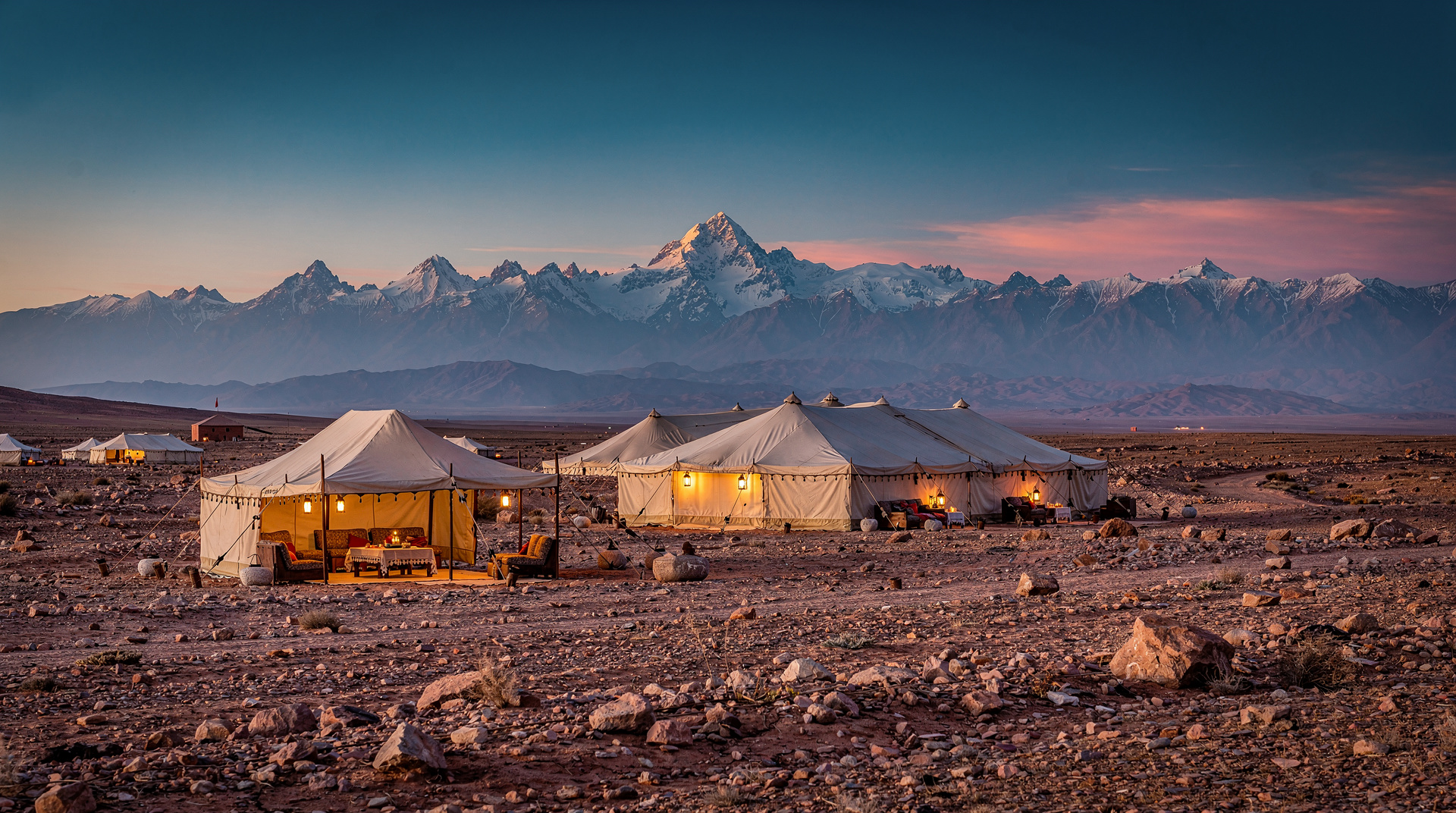
Scarabeo has 16 tents positioned individually across the plateau — not in a line or cluster but separated by sufficient distance that you have genuine privacy. This positioning was thought through deliberately: you can see the camp’s central areas from your tent, but not the neighbouring tent.
Tent construction: The tents use a Berber-influenced frame structure with quality canvas — weatherproof, wind-resistant, and (critically for winter visits) thermally designed to retain heat. Wood-lined interior floors, proper Moroccan rugs, a real bed with quality mattress and bedding. The interior is approximately 25-30m².
The bathroom: Private en-suite bathroom, which separates Scarabeo from any camp that isn’t genuinely luxury. Flush toilet, hot shower with proper water pressure, and quality bathroom products (argan oil soap, rhassoul clay). The shower water is solar-heated — in summer this works perfectly; in winter, mornings occasionally require a brief wait for hot water to arrive.
Heating and cooling: Wood-burning stove in each tent for cold nights — the camp team lights this before you arrive in cooler months. No air conditioning — the tents use natural ventilation (canvas sides can be partially rolled up) and thermal mass from the stone floors. This works well April-October; December-February requires extra blankets that the camp provides.
Power: Solar-powered throughout. Each tent has USB charging points and low-level lighting. Hair dryers and high-wattage appliances are not available — the solar system isn’t designed for them. The camp includes this in its pre-arrival information, but it’s worth noting.
Connectivity: No WiFi in tents (and limited signal). The central communal tent has WiFi for brief use. The camp’s environmental philosophy explicitly addresses this — the disconnection is part of the design intention. If this is an issue for your trip, Agafay’s proximity to Marrakech means you’re never more than 45 minutes from reliable connection.
Food: the strongest argument for the price
Scarabeo’s food program is the single strongest argument for the €350-500/person price point. The kitchen team is based at the camp year-round and prepares everything from scratch — there’s no catering truck from Marrakech. The supply chain runs daily from the city, which means fresh vegetables, quality meat, and variety that a more remote camp can’t match.
Dinner: Served in the central tent or under the stars (the team checks conditions and preferences). The format is a multi-course Moroccan dinner rather than a standard buffet:
- Cold mezze: beetroot zaalouk, carrot harissa, cucumber with chermoula, fresh bread from the clay oven
- Main course: slow-cooked lamb tagine (a genuine 4-hour preparation, not reheated), or a vegetable couscous for non-meat guests
- Dessert: fruit salad with orange blossom water, almond paste pastries, and Moroccan mint tea in the traditional three-pour ceremony
Wine is available (unusual at a desert camp — most camps in Morocco are dry or offer basic options). Scarabeo maintains a small but thoughtful wine list sourced from Moroccan and international producers. The Moroccan wines — the Gris de Boulaouane rosé and the Domaines Brahim Zniber reds — are genuinely good.
Breakfast: Served at whatever time you request, in your tent or at the communal table. The Berber breakfast is the signature offering: msemen flatbreads fresh from the clay oven, amlou (almond-argan-honey paste), fresh-pressed orange juice, harira soup (in cooler months), eggs prepared to order, and a fruit platter. This is one of the best camp breakfasts in Morocco.
The Atlas Mountain backdrop
Scarabeo’s west-facing position means the Atlas Mountains form the backdrop to sunset and the morning view. The Toubkal range — including North Africa’s highest peak at 4,167m — is visible on clear days as a grey-blue silhouette that turns pink and orange at sunset.
This is the visual distinction between Scarabeo and camps at Merzouga, which face east toward the dunes. Scarabeo’s Atlas backdrop is the primary landscape element; the rocky plateau is context, not spectacle. The combination — open rocky land, wide sky, Atlas Mountains — is quietly dramatic rather than immediate and theatrical.
Sunset: The best 30 minutes at Scarabeo is the half hour before sunset, sitting outside your tent with the Atlas turning gold. The camp team serves aperitif drinks and tea at this time — the timing is part of the design.
Night sky: Better than city-viewing, not as dark as Merzouga. The ambient light from Marrakech reduces the star density compared to a true Sahara location. Stars are visible and impressive; the Milky Way is faint rather than dramatic. Manage expectations relative to what Merzouga or Erg Chigaga offers.
The environmental philosophy
Scarabeo’s sustainability commitment is more substantive than most camp marketing suggests. Specific practices:
Energy: 100% solar power. The system is sized to run the camp lighting, water heating, and communication equipment without generator backup during good solar conditions. The October-April period occasionally requires supplementary power from a small generator during overcast periods, which the camp discloses.
Water: All water is transported to the camp (there’s no natural water source on the plateau). Water recycling — greywater from showers and sinks goes through a biological treatment system and is reused for garden irrigation. Laundry water is similarly treated. The camp’s water impact is lower than a comparable-sized hotel operation in Marrakech.
Food sourcing: The camp sources from local markets in Marrakech, prioritising Moroccan produce — argan oil from cooperatives, honey from Atlas mountain hive keepers, and vegetables from organic farms in the Ourika Valley. Imported products (some wines, certain cheeses) are minimized.
Staffing: The core team is local — Berber workers from nearby communities with accommodation and transport provided. The camp also contributes to a local school project in the nearest village.
What it’s not: Carbon-neutral is not a claim the camp makes. The regular supply runs from Marrakech by vehicle have a measurable carbon cost. The solar system is sustainable in operation but required manufacturing. The environmental commitment is real and meaningful; it’s also partial and honest about its limitations.
Who Scarabeo Camp is for
Best fits:
- Couples wanting a desert night close to Marrakech without the Merzouga drive
- Honeymooners seeking private outdoor space and quality food within budget
- First-time Morocco visitors who want the desert element in a more accessible version
- Environmentally-conscious travellers who want sustainability credentials that go beyond marketing
- Travellers combining a Marrakech riad stay with a one-night desert experience
Less ideal for:
- Travellers for whom sand dunes are the primary motivation (Merzouga is the answer)
- Groups wanting entertainment, music, or activities beyond the landscape
- Travellers requiring reliable electricity (solar limitations matter)
- Families with young children — the rocky terrain and lack of structured programming doesn’t suit well
Pricing and packages
Scarabeo prices vary by season and room configuration:
Standard tent (per person): €350-420/night — includes dinner and breakfast, sunset aperitif Suite tent (per couple): €420-500/night — larger configuration with more outdoor space Minimum stay: 1 night minimum, though 2 nights is recommended for the full experience
Prices are per person and include: all meals (dinner and breakfast), sunset aperitif, non-alcoholic drinks with meals, and camel or 4WD optional experience (confirm what’s included when booking — this varies by package). Wine and premium spirits are charged separately.
Booking: Direct booking through Scarabeo’s website is recommended. The team is responsive to WhatsApp enquiries for specific questions about sustainability practices, dietary requirements, or logistics.
Getting to Scarabeo Camp
The camp is 45 minutes from central Marrakech by car. The route leaves the Marrakech ring road south toward the Agafay plateau — good tarmac road for the majority of the drive, with the final 3-4km on a piste (unpaved track). A standard hire car or taxi can manage this; no 4WD required.
Transfer options:
- Private taxi from Marrakech: ~300 MAD (€30) one-way
- Camp-arranged transfer: Available on request at similar prices; ask at booking
- Rental car: Feasible but unnecessary given the short transfer
The camp sends a GPS pin and what3words code on confirmation. Mobile signal is available on the approach road.
Comparison: Scarabeo vs other Agafay camps
Several camps have opened in Agafay since Scarabeo established the format. Honest comparisons:
| Factor | Scarabeo | Luxury 2 (mid-range) | Budget camp |
|---|---|---|---|
| Solar power | Yes (full) | Partial | Generator only |
| Private bathroom | Yes (en-suite) | Yes | Shared |
| Food quality | Excellent | Good | Standard tagine |
| Environmental commitment | Substantive | Partial | Minimal |
| Tent isolation | Yes (individual) | Clustered | Clustered |
| Price/person/night | €350-500 | €180-280 | €80-150 |
| Pool | No | Some | No |
The mid-range Agafay camps are decent value if budget is a primary consideration. The gap in food quality and tent isolation between Scarabeo and the mid-range tier is genuine — but so is the price gap. For a one-night special occasion, the Scarabeo premium is justified; for a traveller primarily interested in the Agafay landscape at a reasonable price, mid-range is viable.
For the full desert camp context — including how Agafay compares to Merzouga and Erg Chigaga — the luxury desert camps guide has the complete breakdown. For Agafay activities beyond the camp, the Agafay destination guide covers day activities on the plateau. The honeymoon hotels Morocco guide includes Scarabeo as part of a broader romantic Morocco itinerary.
A sunset camel ride and dinner in the Agafay desert is an alternative for travellers who want the Agafay experience without an overnight stay — the logistics are simpler and the sunset and dinner elements are the primary draws anyway. This Agafay desert dinner with sunset is an alternative format.
Honest verdict
Scarabeo Camp is excellent at what it sets out to do. The private tent positioning, food quality, and environmental commitment are all genuine — not marketing positioning. The price is high for a single night’s tent accommodation but appropriate for the total experience delivered.
The limitation that applies to all Agafay options: you’re staying in a beautiful rocky plateau 45 minutes from Marrakech, not in the Sahara. If the emotional and visual experience of real sand dunes matters to your trip, Merzouga delivers what Agafay cannot. If you want a quality desert night that integrates naturally with a Marrakech itinerary, Scarabeo is the best option available.
Scarabeo in context: how it fits into a Marrakech trip
Scarabeo works best as a one or two night addition to a Marrakech riad stay. The typical pairing:
Nights 1-3: Marrakech — medina, souks, hammam, cooking class Night 4: Scarabeo Camp, Agafay Night 5-6: Return to Marrakech, or depart
This structure gives the Agafay night the right context — you arrive with an understanding of Moroccan food and craft from your medina days, and the desert night contrasts with the medina experience in a meaningful way. The 45-minute transfer (either private taxi or camp vehicle) makes the transition effortless.
For a longer stay, two nights at Scarabeo allows you to properly decompress — the second night is typically more relaxed than the first, when novelty has settled into appreciation.
Activities during the day at Scarabeo
Scarabeo is not an activity-intensive camp. The landscape is the activity. But for guests who want structure beyond sitting with tea and watching the Atlas:
Walking the plateau: The camp is surrounded by open plateau. Walking circuits of 1-3 hours cross different terrain types — pale limestone, sparse scrubland, occasional Berber shepherd paths. The camp team can indicate good walking directions and landmarks.
Camel and 4WD options: Some packages include a camel walk or 4WD circuit across the plateau at sunset. These are optional add-ons rather than core activities — check what’s included in your specific package at booking time.
Photography: The Agafay plateau is extraordinary for landscape photography. The light at golden hour — 5:30-7pm depending on season — turns the pale rock warm and the Atlas Mountains behind the camp glow. If photography is a priority, book a west-facing tent.
Complete rest: Scarabeo’s most popular activity, officially unstated. Reading in the shade of your tent terrace, sleeping through the hottest part of the afternoon, and sitting with tea watching the light change are legitimate uses of the day that the camp’s design implicitly encourages.
Seasonal guide to Scarabeo
October-November: The most popular months. Temperatures at the camp: 22-28°C midday, 12-16°C at night. Atlas Mountains clearly visible, often snow-capped from November. The best combination of comfortable temperatures and dramatic backdrop.
December-February: Cold (5-12°C at night), occasional rainfall, and the Atlas Mountains covered in snow. The camp is open and can be genuinely beautiful — the plateau after rain smells of wet stone and herbs. Heating in the tents (wood stove) is functional. The camp is quietest in these months and sometimes offers 10-15% discounts.
March-April: Spring flowers on the plateau — small wildflowers and flowering herbs appear in March. Temperatures rising (15-25°C midday). One of the best periods visually.
May-June: Warming rapidly. May is still comfortable (25-30°C). June is the start of the hot season — midday temperatures approach 35°C and the camp is less comfortable without the wind that Agafay lacks (unlike Essaouira). Evening and night remain pleasant.
July-August: Hot at midday (35-40°C). The camp stays open and is primarily visited as an evening-to-morning experience — arrive at sunset, leave after breakfast. Not recommended for day activities during these months.
Booking checklist for Scarabeo Camp
Before confirming your reservation, verify:
- Which inclusions are in your package: Dinner and breakfast should be standard; confirm whether the aperitif drinks are included or charged separately; confirm whether any activities (camel, 4WD) are included or add-ons
- Dietary requirements: The kitchen can accommodate vegetarian, vegan, and most dietary restrictions with advance notice; confirm at booking rather than on arrival
- Tent orientation: Ask for a west-facing tent for Atlas views at sunset and sunrise
- Transfer arrangement: Confirm whether you’re arranging private taxi from Marrakech or booking through the camp; the camp can recommend taxi drivers
- Payment: Scarabeo accepts card payment; confirm the policy for any incidentals (wine, additional activities)
For the Agafay destination guide covering the broader plateau context beyond Scarabeo, and for how Agafay compares to the Merzouga desert experience, the Merzouga vs Agafay guide is essential reading before finalising your desert accommodation choice.
The luxury desert camps guide covers the full spectrum — Scarabeo, the Merzouga luxury camps, and Erg Chigaga — if you’re still deciding between Agafay and the Sahara. The honeymoon hotels Morocco guide positions Scarabeo within the broader Morocco romantic accommodation landscape for couples planning a special trip.
What guests consistently overlook
A few practical details don’t come up in the marketing but shape the experience meaningfully:
Pack layers even in warmer months. Even during the October-April season when days are pleasant, the plateau cools fast after sunset — the wood stove helps, but a proper mid-layer for the walk between your tent and the dinner tent matters more than most guests expect.
Wine and premium extras add up. The base rate covers meals and non-alcoholic drinks; a bottle of the Moroccan wine list can meaningfully change the final bill for a couple who assumed everything was included. Confirm this at booking, not on arrival.
It’s a quiet camp by design. Guests expecting evening entertainment (music, group activities) in the style of some Merzouga camps will find Scarabeo deliberately understated. If a livelier desert night matters more than an intimate one, the luxury desert camps guide covers alternatives with more programming.
Frequently asked questions about Scarabeo Camp review
Is Scarabeo Camp suitable for a proposal or anniversary?
Yes — it’s one of the more popular special-occasion choices near Marrakech precisely because of the private tent positioning and sunset timing. Mention the occasion when booking; the camp can arrange small touches (a decorated tent, a private dinner setup) with advance notice.
How far in advance should I book Scarabeo?
For October-November and around major holidays, 6-8 weeks ahead is sensible — the camp only has 16 tents and sells out during peak season. Outside peak months, 2-3 weeks is usually enough.