Rhassoul clay and argan oil: Morocco's beauty secrets explained
Is Moroccan argan oil worth buying, and how do you know if it's authentic?
Authentic cold-pressed argan oil is genuinely exceptional for skin and hair. The test for purity: it should smell faintly nutty (cosmetic grade) or strongly of roasted nuts (culinary grade). Pure oil is deep golden. Pale yellow or odourless oil is usually diluted. Price: expect 150–300 MAD (14–28 EUR) for 100ml of genuine cosmetic grade.
Two ingredients that define Moroccan beauty culture
Before argan oil appeared on Parisian pharmacy shelves and rhassoul clay filled spa treatment menus in London and New York, Moroccan women were using both products as everyday routine items. Argan oil for skin and hair conditioning, rhassoul for washing hair and deep-cleansing skin — both extracted from the natural geography of Morocco with minimal processing.
The global spa industry discovered them. The marketing got elaborate. The quality range got enormous. This guide strips back the promotion and covers what both products actually are, how to use them correctly, and how to buy genuine versions in Morocco without getting scammed.
At a glance
| Where to buy | Women’s cooperatives on the Marrakech-Essaouira and Agadir-Essaouira roads, or cooperative storefronts in the medinas |
| Cosmetic argan oil cost | Around 100-250 MAD per 100ml at a genuine cooperative |
| Rhassoul powder cost | Around 40-80 MAD per 500g |
| Time needed | 20-30 minutes for a cooperative visit and purchase; longer if watching the pressing process |
| Best paired with | A hammam visit, so you understand the products in the sequence they’re meant to be used |
Rhassoul clay: what it is and where it comes from
The geology of rhassoul
Rhassoul (also spelled ghassoul, derived from the Arabic “ghassala” — to wash) is a mineral-rich clay found only in the Middle Atlas Mountains of Morocco, specifically in the Moulouya River basin northeast of Fes. The main deposits are in the region around Bou Azzer and the Tamlalt area.
The clay was formed over millions of years through volcanic activity and mineral deposit in ancient lake beds. Its unusual composition — high in silica, magnesium, potassium, and calcium — gives it properties that distinguish it from other clays: exceptional ion exchange capacity (it draws impurities from skin and hair), and a uniquely gentle texture that cleanses without stripping natural oils.
Morocco is the world’s only commercial producer of genuine rhassoul. Products sold as “rhassoul” that don’t originate from this specific region are either mislabelled or blended with other clays.
How rhassoul is used traditionally
In a traditional Moroccan hammam, rhassoul is applied after the kessa scrub has removed dead skin. The clay is mixed with warm water (and sometimes rose water, lavender water, or argan oil) to a paste consistency, then spread across the body or scalp. It dries slightly over 5-10 minutes, then is rinsed off. The effect on skin: deeply cleansed, soft, and oddly hydrated despite being a drying clay — the mineral composition prevents the stripped, tight feeling that kaolin or bentonite clays can cause.
For hair, rhassoul is one of the few clay treatments that cleans effectively without completely stripping natural sebum. This makes it useful as a low-poo (low-shampoo) alternative for curly, coarse, or colour-treated hair.
DIY rhassoul treatments at home
Basic body mask: Mix 2 tablespoons rhassoul powder with warm water to a smooth paste. Add a few drops of rose water for fragrance. Apply to damp skin after showering. Leave 5-8 minutes. Rinse with warm water. Follow with argan oil body application.
Scalp and hair treatment: Mix rhassoul paste (slightly more liquid than the body version) into dry or damp hair from root to tip. Cover with a warm towel. Leave 10-15 minutes. Rinse thoroughly (requires more effort than shampoo rinse — the clay binds to hair and needs thorough water work).
Face mask: Mix 1 tablespoon rhassoul with rose water or plain water. Apply to face avoiding eye area. Leave 5-7 minutes maximum on face (more drying than body application). Rinse with warm water.
Argan oil: the world’s most valuable vegetable oil by weight
Where argan comes from
The argan tree (Argania spinosa) grows only in the Sous-Massa plain in southwestern Morocco, primarily in the triangle between Agadir, Essaouira, and Taroudant. This specific biome — semi-arid, with specific soil composition and temperature range — is the only place on Earth where argan trees survive and produce the oil-bearing kernels.
The argan forest (arganeraie) covers about 800,000 hectares and was declared a UNESCO Biosphere Reserve in 1998. The trees live for 200+ years. The crop is entirely hand-harvested — argan fruits fall naturally or are collected from goat droppings (argan kernels pass through goat digestive systems intact; this traditional collection method is still practised).
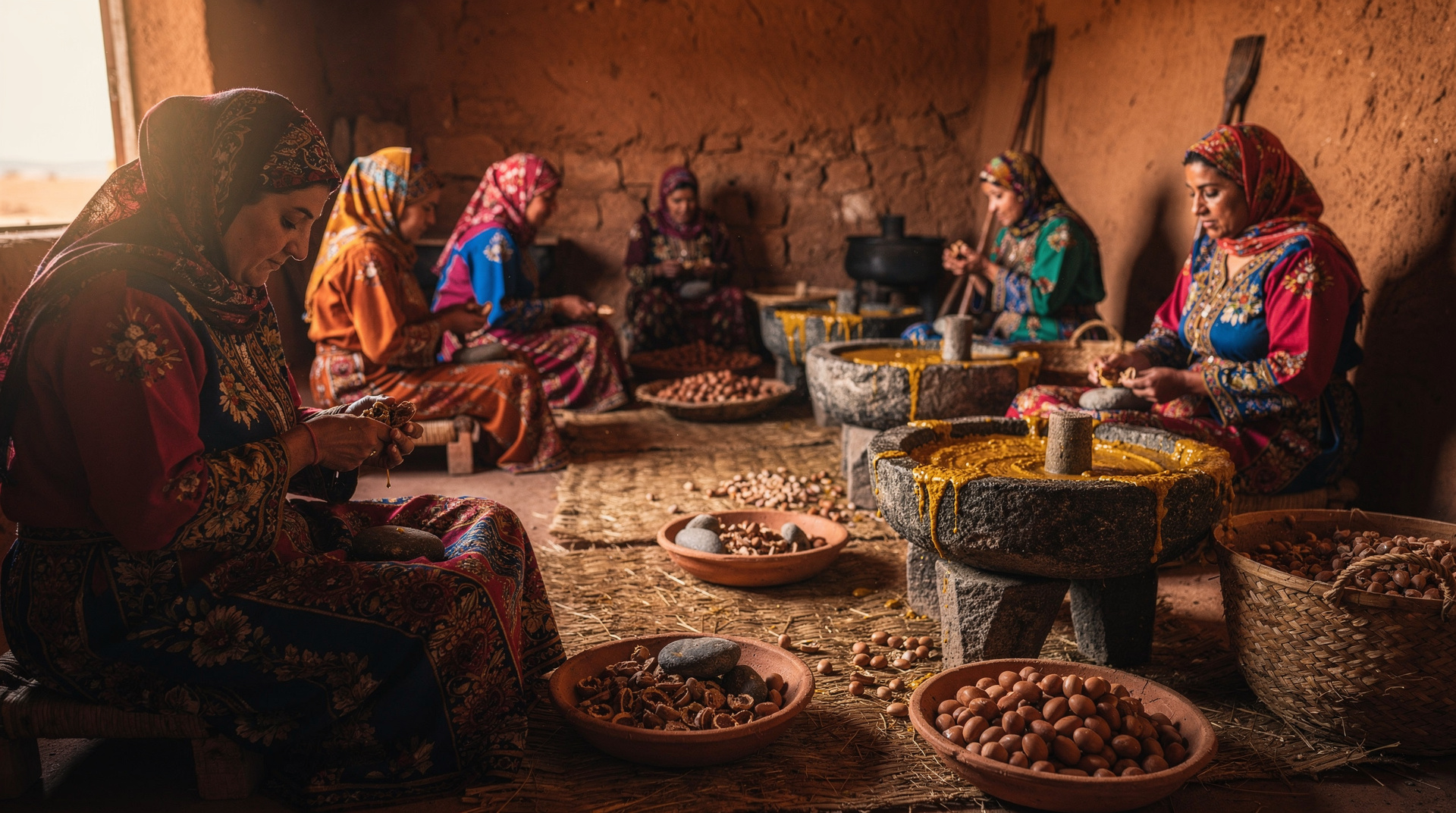
Processing: the outer flesh is removed, the nut is cracked (by hand — the shell is extremely hard), and the kernel is extracted and cold-pressed for cosmetic oil, or lightly roasted then pressed for culinary oil.
Cosmetic vs culinary argan oil
This is a critical distinction that confuses many buyers.
Cosmetic grade argan oil:
- Cold-pressed without roasting
- Colour: deep amber to golden
- Smell: faint, slightly nutty, not strong
- Use: skin, hair, nails, body oil
- Not for eating
Culinary grade argan oil:
- Kernels lightly roasted before pressing
- Colour: darker amber-brown
- Smell: strong roasted nut aroma (similar to sesame oil in intensity)
- Use: dressings, dips (especially with amlou — argan oil and honey paste), cooking at low temperatures
- Can be used on skin but the roasted smell is strong for cosmetic purposes
Buying argan oil in souks without knowing this distinction leads to cosmetic-use disappointment when you end up with culinary grade, or vice versa.
Argan oil quality: how to identify genuine product
Price signal: Genuine cold-pressed argan oil costs money to produce. At source in Morocco, expect to pay 100-250 MAD per 100ml (9-23 EUR) for cosmetic grade from a genuine women’s cooperative. Anything significantly cheaper is almost certainly diluted with other oils (most commonly sweet almond or jojoba oil, which are fine products but not argan).
Colour: Pure cosmetic argan is a clear amber-gold. Pale yellow or almost colourless oil has been either diluted or improperly processed. Very dark brown is culinary grade.
Smell: Cosmetic grade has a mild, slightly nutty scent. If it smells of nothing, it’s been deodorised (common in cheap imported versions and a sign of lower quality processing). If it smells strongly of roasted nuts, it’s culinary grade.
Texture: Pure argan oil absorbs into skin within 1-2 minutes with no greasiness. Diluted versions leave a residue and take longer to absorb.
Bottle: Dark glass bottle protects the oil from light degradation. Plastic bottles or clear glass bottles are functional but suggest the producer is cutting corners.
Where to buy authentic products in Morocco
Women’s cooperatives (best option)
The argan oil industry in Morocco is largely managed by women’s cooperatives, established under government and NGO programs to provide income for rural Berber women in the arganeraie. These cooperatives produce certified-origin argan oil and rhassoul, with fair wages for workers and transparent supply chains.
Buying from a cooperative is the most reliable route to genuine product. Cooperatives have certificates of origin, typically display their production process, and sell at prices that reflect actual production costs.
Finding cooperatives: Look for “coopérative féminine” signage, particularly on the road between Agadir and Essaouira (the Sous-Massa arganeraie zone). On the Marrakech-Essaouira road, several cooperatives have established visitor facilities where you can watch the oil pressing process.
In Marrakech and Fes: Several cooperative storefronts exist in the medinas. Ask your riad host for recommendations — they often know which shops are genuine cooperatives vs. shops claiming cooperative status without the certification.
Souk shopping: the risks
Souk shops in Marrakech and Fes sell argan oil and rhassoul with varying levels of authenticity. The common problems:
The “free show” trap: A man invites you into a shop to “see argan oil production for free.” You watch women cracking nuts, see oil extracted, then face high-pressure sales of products at inflated prices. The oil may be genuine but you’re paying a premium for the performance and the guide’s commission. The same oil is available at a cooperative for 30-40% less.
Diluted oil in genuine packaging: Cooperative-branded bottles sometimes get refilled with diluted product by third-party sellers. Buy directly from cooperatives or established reputable shops (recommendations from your riad host are valuable here).
Tourist-grade rhassoul: Properly sourced Middle Atlas rhassoul is sold in powder form. Some souk sellers sell compressed blocks that may contain filler clay or kaolin. The powder version from a cooperative is more reliably authentic.
What to buy and how much to budget
Cosmetic argan oil: 100ml is enough for 2-3 weeks of daily use. Budget 150-250 MAD for genuine cooperative product.
Culinary argan oil: 250ml is a reasonable amount to bring home. Budget 120-200 MAD.
Rhassoul powder: 500g provides approximately 15-20 body treatments. Budget 40-80 MAD. Avoid compressed blocks — the powder is easier to assess for purity.
Black soap (savon beldi): The other hammam staple. Made from olive oil paste and plant ash, it’s used as the first cleansing step in the hammam sequence. Buy 100-200g (enough for multiple treatments). Price: 20-50 MAD for authentic product.
Argan and rhassoul in the hammam context
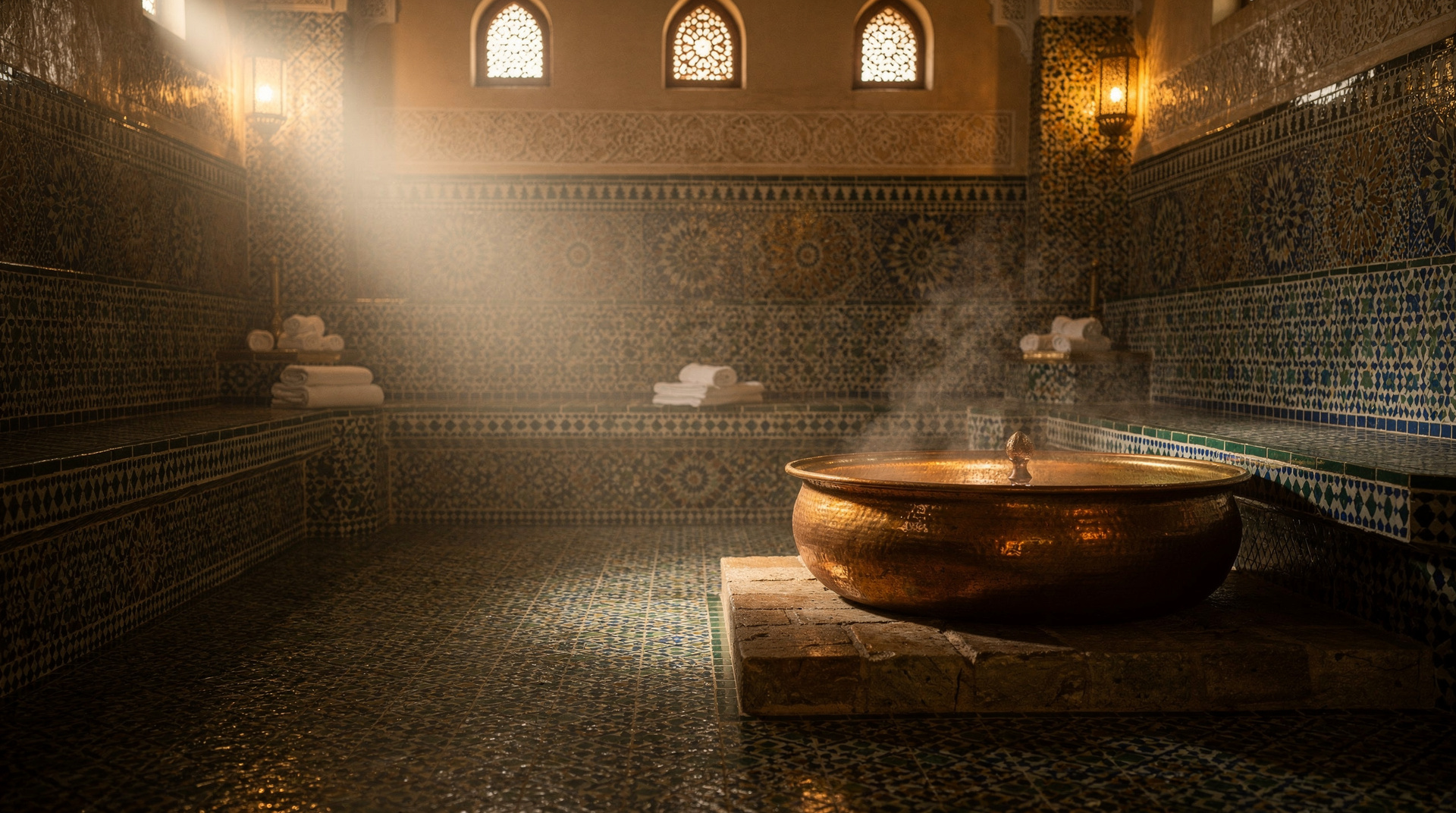
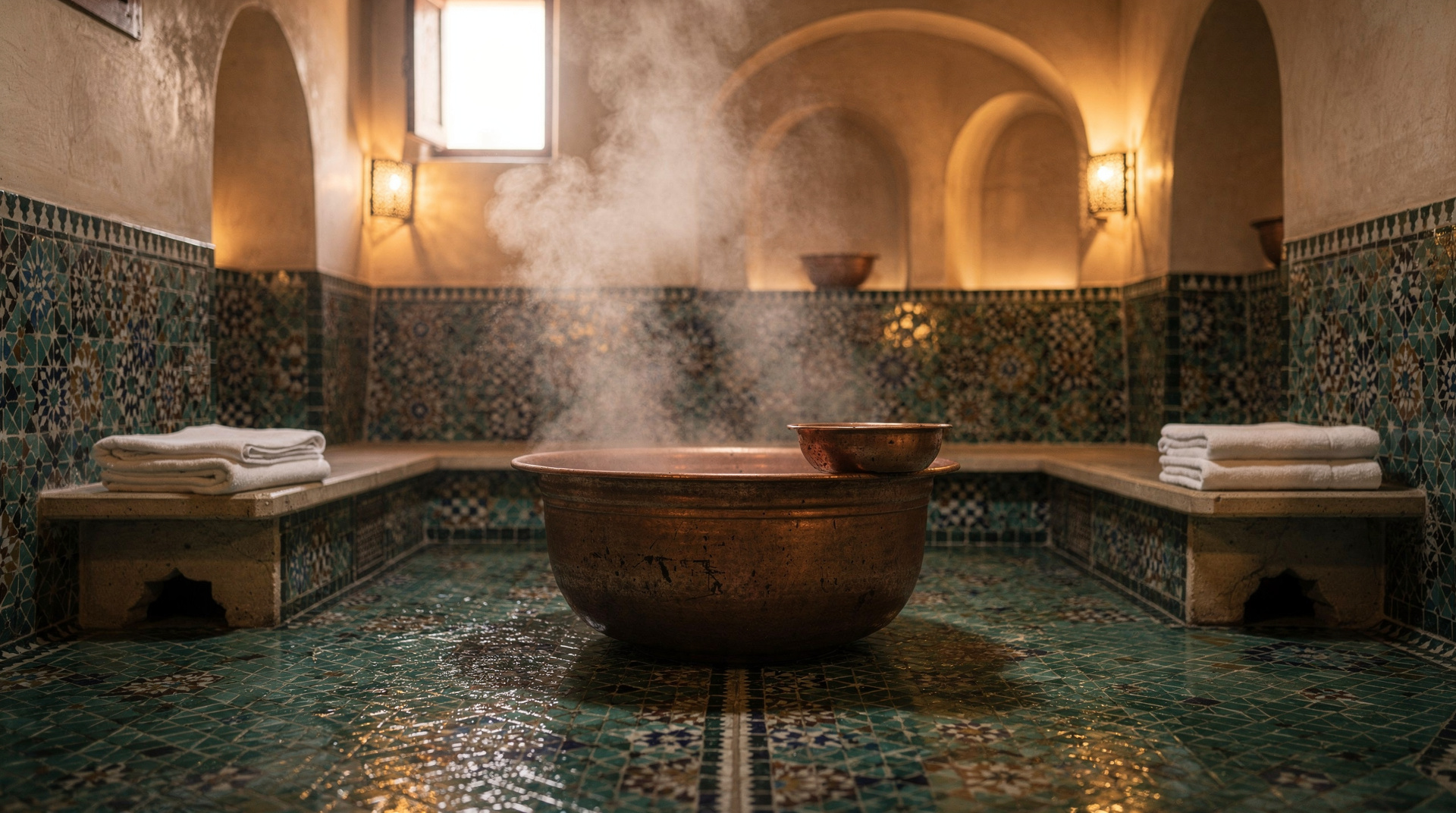
The hammam sequence uses multiple products in sequence. Understanding what each does makes the hammam experience more intentional. For a guided introduction to the full ritual, a traditional Moroccan hammam and spa experience in Marrakech walks you through each step with quality products including rhassoul and argan oil.
- Hot room/steam: Opens pores, softens skin, prepares for removal
- Black soap (savon beldi): Applied and left to sit — emulsifies surface oils and impurities
- Kessa scrub: The exfoliating mitt removes dead skin cells and the black soap residue together
- Rhassoul clay: Applied post-scrub on clean skin — deep-cleanses pores, provides minerals, conditions
- Argan oil: Post-hammam, applied to slightly damp skin — locks in moisture, provides essential fatty acids for skin repair
This sequence is effective precisely because each step prepares for the next. Using argan oil before exfoliation (as some tourist spa menus do for marketing appeal) misses the purpose.
The traditional hammams guide covers the full hammam sequence in context. The hammam etiquette guide covers the practical protocol for using these products correctly in a traditional hammam setting.
Bringing products home: practical notes
Liquid restrictions (air travel)
Argan oil is classed as a liquid. In carry-on luggage: 100ml maximum per container, total of 1 litre per person. Buy 100ml bottles for cabin, or place larger quantities in checked luggage (wrap carefully — the oil does stain if leaked).
Shelf life
Cosmetic argan oil: 12-18 months stored in dark, cool conditions. Keep away from direct sunlight — UV degrades the oil quickly (another reason the dark glass bottle matters).
Rhassoul powder: Indefinite shelf life if kept dry. It’s a mineral clay — it doesn’t spoil.
Customs and import
Both argan oil and rhassoul are natural, plant/mineral-derived products with no import restrictions in EU, UK, or North American countries. Culinary argan oil may technically be classified as a food product — check current USDA or DEFRA guidelines if importing to the US or UK in commercial quantities.
Combining the shopping trip with a hammam visit
The most sensible way to buy these products is right after you’ve experienced them — not before. A hammam visit shows you what rhassoul and argan feel like in the sequence they’re designed for, which makes it much easier to judge quality when you’re standing in front of a cooperative’s shelf later. The hammam etiquette guide covers what to expect and how to behave during your first visit, and pairing that with the best riads in Marrakech guide is useful if you want a property with its own in-house hammam rather than a separate public one.
Bargaining for beauty products in the souk
If you do end up buying outside a cooperative — at a souk stall recommended by your riad, for instance — the general rules in the bargaining in Morocco guide apply, with one adjustment: don’t bargain hard on genuine cooperative-priced argan oil. The cooperative pricing already reflects fair wages for the women who crack and press the kernels by hand; aggressive haggling on a fairly priced product undercuts the system that makes the oil ethical in the first place. Save the bargaining energy for souvenir shops selling non-cooperative goods.
Connecting to other Morocco wellness experiences
Rhassoul and argan oil are the central products in the full spectrum of Moroccan wellness. They appear in the traditional hammams guide (neighbourhood hammam treatments), the luxury spas guide (La Mamounia and Royal Mansour product menus), and the riad wellness guide (in-riad treatment products).
Understanding the source and quality markers of each makes every wellness experience in Morocco more meaningful. If you want the full treatment with hotel transfer included, the 3-hour traditional hammam and massage with hotel transfer in Marrakech is a convenient all-in option.
Frequently asked questions about Moroccan beauty products
Is Moroccan argan oil the same as what I buy at home?
Moroccan cooperative-produced argan oil is typically superior to most internationally distributed versions. The supply chain pressure of global distribution leads to dilution and lower quality extraction. Buying at source from a cooperative gives you product at its best quality and its most reasonable price.
Can men use argan oil?
Yes, for skin and hair. It’s particularly effective as a post-shave moisturiser and beard conditioner. Cultural associations with women’s beauty products are a marketing construct — the oil itself is gender-neutral.
Is rhassoul clay the same as Fuller’s Earth or bentonite?
No. Rhassoul has a unique mineral composition that makes it more effective for hair (it cleanses without over-stripping) and gentler on sensitive skin. Fuller’s Earth and bentonite are effective clays with different mineral profiles. None of them can be authentically labelled as “rhassoul” unless they come from the Middle Atlas.
How do I know if a cooperative is legitimate?
Legitimate cooperatives display their certification (usually from ONSSA — Morocco’s food and product safety authority), have a posted price list, allow visits to the production area without pressure buying, and will provide a product certificate of origin if asked. Women should be visibly involved in the work, not just present for display purposes.
Can I use argan oil on my face?
Yes. Cosmetic argan oil is non-comedogenic (doesn’t clog pores) for most skin types and is used as a facial moisturiser, particularly for dry and combination skin. Apply a few drops to slightly damp skin after washing. For oily or acne-prone skin, test on a small area first — some individuals find any facial oil triggers breakouts.
How much should I budget for a proper cooperative visit and purchase?
For a typical purchase — one 100ml bottle of cosmetic argan oil, one 500g bag of rhassoul, and a bar of black soap — expect to spend somewhere around 250-400 MAD total at a genuine cooperative. That covers enough product for several months of regular use at home.