Middle Atlas guide: Ifrane, Azrou, cedar forest, and the road from Fes
Is the Middle Atlas worth visiting from Fes?
Yes, especially the Azrou cedar forest (Barbary macaques, giant Gouraud cedar) and the mountain town of Ifrane. A day trip from Fes covers both easily, with Moulay Yacoub thermal spa as an optional add-on. Allow 8-10 hours for a comfortable day.
The part of Morocco that surprises everyone
Most first-time visitors to Morocco arrive with a mental image built from medinas, desert, and Atlantic light. The Middle Atlas contradicts all of it. This is Switzerland-in-miniature: pine and cedar forests, alpine meadows, a lake-dotted plateau, and a mountain town (Ifrane) that looks like it was designed by a Swiss architect and dropped into North Africa. Which is more or less what happened.
The Middle Atlas sits between the coastal plains and the High Atlas, reached easily from Fes (70km) or Meknes (80km). As a day trip from Fes, it’s one of the most underrated excursions in Morocco — genuinely beautiful, seasonally dramatic (green in spring, snow in winter), and offering one of the country’s most reliable wildlife encounters with Barbary macaques in the cedar forest near Azrou.
At a glance
| Middle Atlas day trip | |
|---|---|
| Where | Ifrane and Azrou, between Fes and the High Atlas |
| Cost | Around 80-120 MAD lunch plus 150-300 MAD organised day-trip options, or self-drive fuel/rental only |
| Time needed | 8-10 hours round trip from Fes |
| Getting there | Around 70km/1h to Ifrane, 17km further to Azrou |
| Best time | Spring (March-May) for wildflowers, winter for snow |
Getting to the Middle Atlas from Fes
By organised day trip: The most practical option. Guided day trips from Fes pick you up from your riad, cover the main sights with a local guide, and return you by evening. The Middle Atlas, Ifrane, and forest of monkeys day trip from Fes covers the standard circuit with English-speaking guide included.
For a more comprehensive exploration, the Middle Atlas full-day adventure from Fes extends the itinerary and covers additional stops.
By rental car: The most flexible option. The N8 road from Fes through Ifrane to Azrou is well-maintained and straightforward. Fes to Ifrane is approximately 70km (1 hour). No special vehicle is required — standard cars handle this route easily year-round except in heavy winter snow.
By CTM bus: CTM runs regular services from Fes to Ifrane and Azrou. Practical but limiting for reaching the cedar forest and Moulay Yacoub in a single day.
Ifrane: Morocco’s alpine anomaly
Ifrane was built by the French protectorate in 1929 as a mountain resort — specifically designed to house French administrators escaping Fes and Meknes summer heat. The result is surreal: European chalets with red-tiled roofs, a manicured central park, tree-lined boulevards, and an almost total absence of the medina chaos of Morocco’s main cities.
Elevation: 1,665m. This makes Ifrane legitimately cool in summer (averaging 18-22°C when Fes is at 35-40°C) and genuinely cold in winter, with reliable snow cover. The town is home to Al Akhawayn University (English-language Moroccan university), which gives it a slightly different atmosphere from typical Moroccan mountain towns.
The stone lion: Ifrane’s famous landmark is a stone lion — a resting lion carved from a single rock, supposedly commissioned by a German sculptor during WWII. It sits in a small park near the town centre and is a required photo stop on any Middle Atlas day trip.
What to do in Ifrane:
- Walk the Avenue des Tilleuls (the central boulevard)
- Visit the central park and lake
- Photograph the European-style architecture against the cedar backdrop
- Have coffee or a pastry at one of the cafés (the café culture here is notably different from the medina cities)
Allow 1-1.5 hours for Ifrane.
Azrou and the cedar forest
Azrou (population ~50,000) is 17km southwest of Ifrane on the N13. It’s a working Berber market town without Ifrane’s artificial Alpine character — more authentic, less scenic, but worth the stop for its Tuesday market and the gateway it provides to the cedar forest.
The main reason to stop: the cedar forest begins just outside Azrou’s southern edge. The Cèdre Gouraud — Morocco’s most famous individual tree — stands here, a cedar estimated at 800+ years old and approximately 40m tall. It’s easy to find: any local or sign in the forest area will direct you.
The Barbary macaques
The cedar forest around Azrou is the most reliable place in Morocco to encounter Barbary macaques (Macaca sylvanus) — a medium-sized, tailless primate that’s North Africa’s only native non-human primate species. These are wild animals, not trained performers, and the forest population is genuinely habituated to human visitors.
They’ll approach vehicles and people looking for food. The experience is memorable but comes with important caveats — see the ethical wildlife section below.
Population density in the forest varies by season. The macaques tend to gather near roadsides and parking areas, especially in the morning and late afternoon. Large family groups of 15-30 individuals are common. You’re essentially guaranteed to see them; the question is whether your interaction is responsible.
Ethical wildlife viewing: the Barbary macaque problem
The Barbary macaque population in Morocco faces genuine conservation pressure, and the tourist interaction model has contributed to behavioural problems:
What to do:
- Observe from a respectful distance
- Watch natural behaviour without interfering
- Photograph without flash (stress response)
- Keep windows partially closed if macaques approach your vehicle
- Leave no food waste or litter in the forest
What not to do:
- Feed the macaques (bananas and tourist-offered food disrupts natural foraging, creates dangerous dependency, and spreads disease)
- Allow macaques to enter your vehicle (difficult to remove once inside)
- Handle macaque infants (triggers protective response from adults that can be aggressive)
- Support vendors selling food specifically to give to macaques at the forest edge
The Cedar Forest Azrou guide covers this in greater depth — see cedar forest Azrou guide for the full wildlife ethics section.
Moulay Yacoub: thermal spa add-on
Moulay Yacoub is a small town 20km northwest of Fes, built around thermal sulphur springs that have been used medicinally for centuries. The water temperature reaches 54°C at source and is cooled for bathing. The modern thermal complex (Centre de Cures Thermales) offers proper hydrotherapy facilities; older hammams at lower prices serve the same water.
As an addition to a Middle Atlas day trip, Moulay Yacoub works as an afternoon or evening end-point, especially if you’re returning toward Fes. The thermal baths are genuinely restorative — sulphur water for sore muscles after a hiking day makes obvious sense.
Practical details:
- Centre de Cures Thermales: 150-300 MAD per session depending on treatment
- Traditional hammam: 30-80 MAD
- Opening hours: typically 7am-10pm, reduced in July-August peak medical season when visitors fill capacity
The Middle Atlas in different seasons
Spring (March-May): The most photogenic season. Wildflowers across the plateau meadows, waterfalls running full from snowmelt, and the cedar forest a vivid green. The macaque population is active and visible. Highly recommended.
Summer (June-August): Primary local tourist season. Ifrane fills with Moroccan families escaping the heat. Accommodation books up on weekends. The forest is dry and dusty by August. Still good for macaque sightings.
Autumn (September-November): Quieter, comfortable temperatures, good light. Cedar trees show little colour change but the overall atmosphere is pleasant.
Winter (December-February): Ifrane receives regular snow. The town transforms — genuinely alpine character. A different and memorable visit for those prepared for cold. The cedar forest in snow is beautiful. Macaques are less active in cold weather but still visible. Mountain roads can become impassable in heavy snow — check conditions before going.
If you are still choosing when to travel, the best time to visit Morocco guide puts the Middle Atlas seasons in the context of the whole country, and the spring versus autumn comparison helps if you are torn between the two shoulder seasons for a trip that mixes mountains with the imperial cities.
More detail on the two main stops
This page gives the overview of the circuit. If you want a stop-by-stop plan built only around the route itself, the Ifrane and Azrou day trip from Fes guide goes through it in a more focused way. For the towns themselves, see the Ifrane destination page and the Azrou destination page, which are useful if you want to decide how long to give each place before you set out.
The full Middle Atlas day trip itinerary from Fes
7:30am: Depart Fes 9:00am: Arrive Moulay Yacoub — optional 30-minute visit 10:00am: Arrive Ifrane — 1.5 hours exploring 11:30am: Drive to cedar forest Azrou 12:00pm: Cedar forest, Cèdre Gouraud, macaque viewing — 1.5-2 hours 13:30pm: Lunch in Azrou town (Café-Restaurant Dersa or similar, budget 80-120 MAD for tagine and tea) 15:00pm: Drive back via Ifrane lake viewpoint 16:30pm: Arrive back in Fes
This is a comfortable 8-9 hour day with no rushing. Driving distance: approximately 200km return.
Where to eat
Ifrane: Several cafés and restaurants on and near Avenue des Tilleuls. Le Lion de Neige is reliable for a sit-down lunch (130-200 MAD for a main course). Most cafés serve standard Moroccan menus (tagine, couscous, harira) alongside coffee and pastries.
Azrou: More authentic local options. The covered market area has basic cafés serving mint tea, msemen (Moroccan pancakes), and simple tagines for 50-90 MAD. Less tourist-oriented and better value than Ifrane.
Connecting Middle Atlas to the Fes itinerary
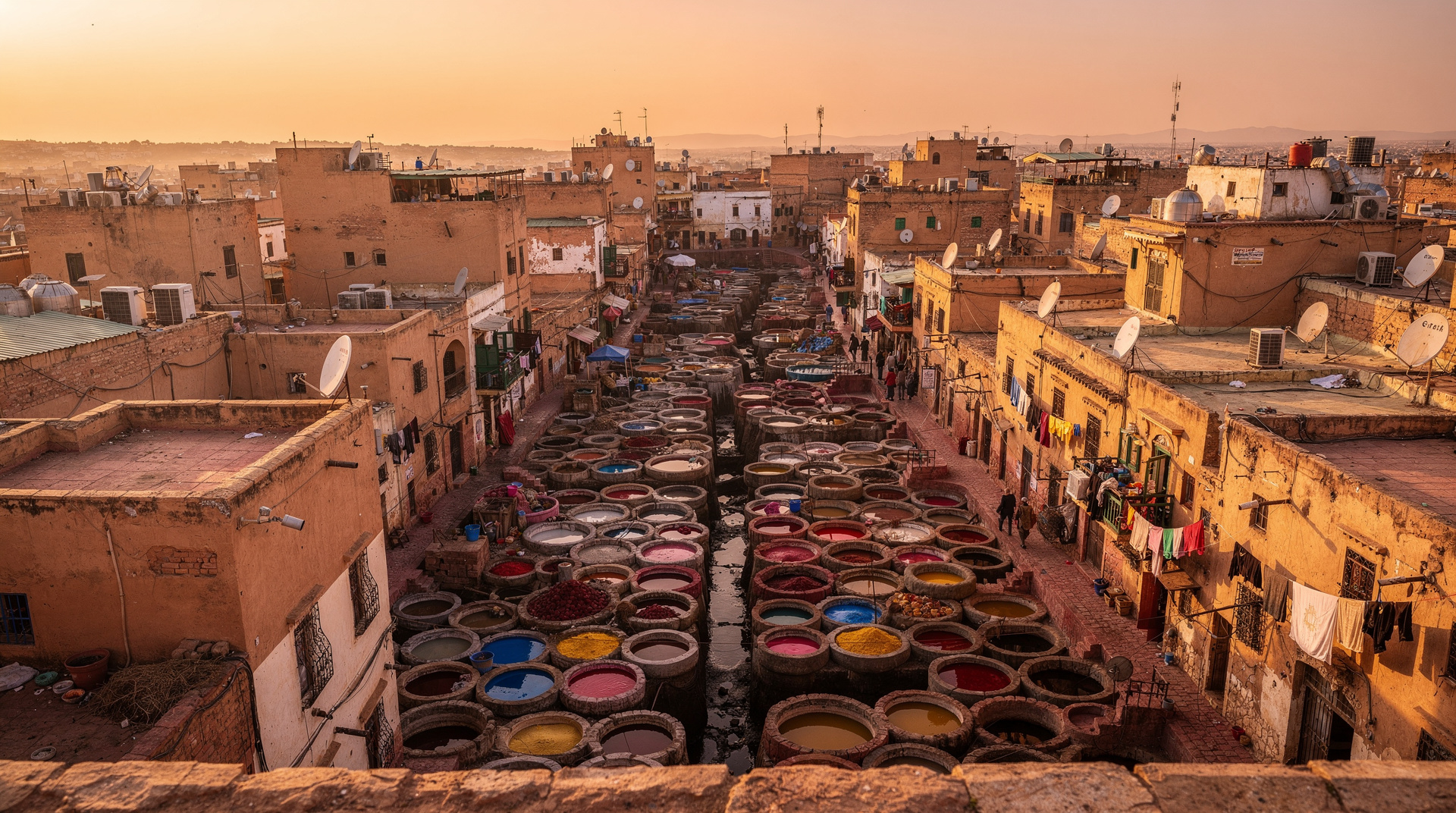
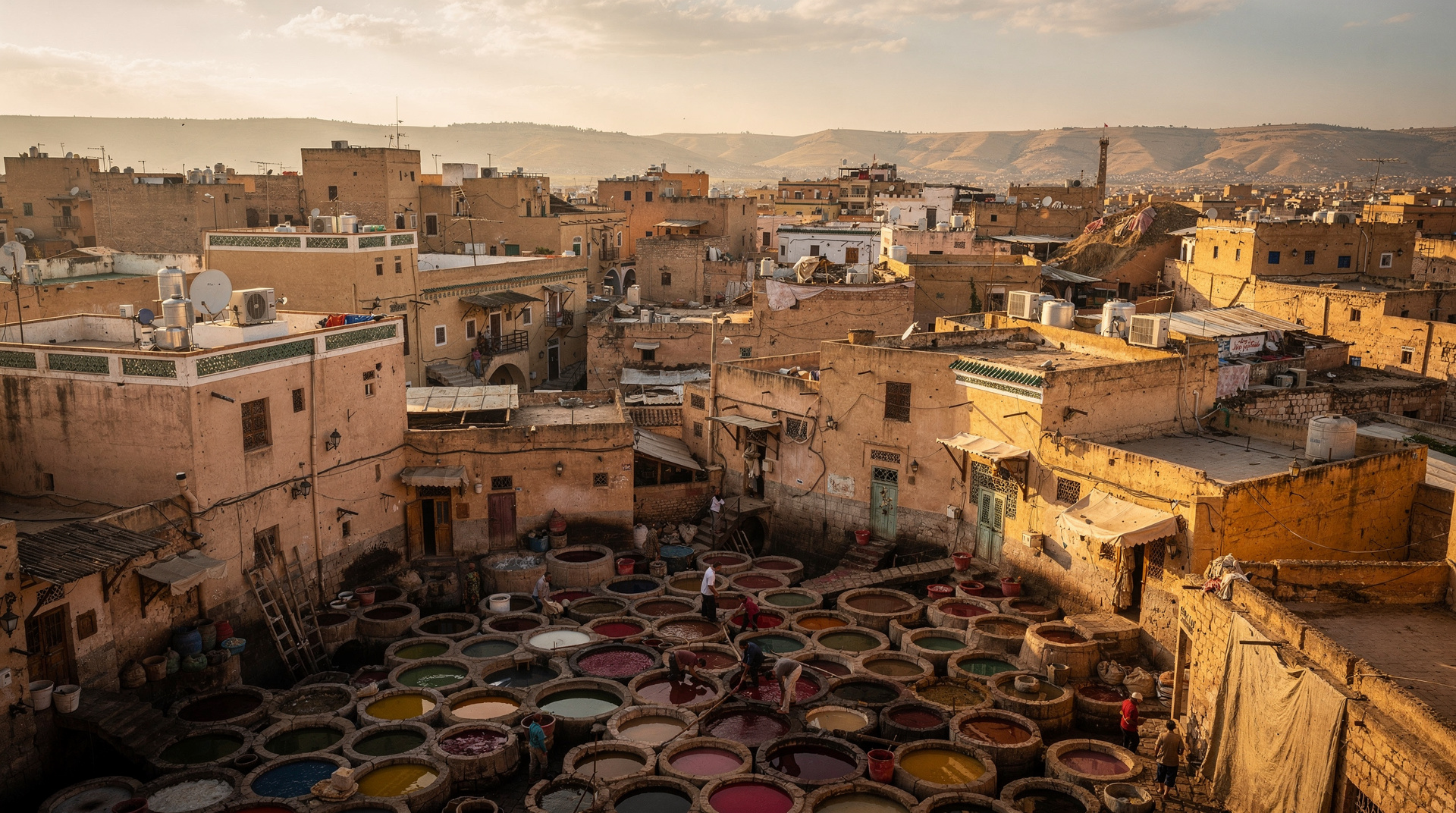
The Middle Atlas works perfectly as a day break from Fes’s intense medina environment. If you’re spending 2-3 days in Fes, allocate one day to the medina highlights (tanneries, Bou Inania madrasa, Al-Attarine souks) and one to the Middle Atlas.
For the full Fes picture, the Fes destination guide covers the medina in detail. The imperial cities itinerary includes Middle Atlas as part of a multi-city routing. If you’re also visiting Chefchaouen, note that the Fes-Chefchaouen road passes through terrain similar to the Middle Atlas — a scenic drive in either direction.
Frequently asked questions about Middle Atlas guide
Is the Middle Atlas safe to visit?
Yes, entirely. The tourist safety situation in Morocco’s mountain regions is good. The main risks are standard road safety considerations (mountain driving, wildlife on roads) rather than security concerns.
Can I visit the cedar forest without a car?
Difficult but possible. From Azrou town centre, the forest is approximately 3-4km on foot. A grand taxi from Azrou to the forest area costs 50-100 MAD return. Organised day trips from Fes handle all transport.
When is the best time to see the macaques?
Early morning (8-10am) and late afternoon (4-6pm). The animals are more active in cooler parts of the day and tend to move away from road areas during midday heat. Spring and early summer are the most reliable periods for large family group sightings.
Is Moulay Yacoub worth including?
If you enjoy thermal spas or have muscle fatigue from travel, yes. If it doesn’t interest you, skipping it saves an hour and simplifies the day. The cedar forest and Ifrane are the priority stops.
Can I combine the Middle Atlas with Meknes or Moulay Idriss?
Yes, if you have a full extra day rather than trying to add it to the standard Ifrane-Azrou circuit. Meknes and the holy town of Moulay Idriss sit roughly between Fes and the Middle Atlas gateway, and some multi-day itineraries route Fes-Meknes-Moulay Idriss-Middle Atlas-Ifrane as a single loop rather than treating each as a separate day trip. Trying to cram all of it into one day, though, turns a relaxed excursion into a rushed one.
Extending the Middle Atlas into a longer route
Travellers with more than a single spare day from Fes can extend the standard Ifrane-Azrou loop rather than treating it as an isolated excursion. The most natural extension continues south toward the M’Goun massif and the Central High Atlas — a genuinely different, higher mountain environment, covered in the M’Goun trek guide for those with a week to spare. For a shorter add-on, Meknes is close enough to combine with an Ifrane-Azrou day if you start early and are comfortable trimming time at the cedar forest.
If you’re deciding how to structure Fes-region days generally, the first-time visitors guide has a broader framework for balancing medina days against out-of-town excursions like this one — useful if the Middle Atlas is competing with Chefchaouen or Meknes for your limited time.