M'Goun trek: Morocco's quieter 4,068m alternative to Toubkal
How long does the M'Goun trek take and is it harder than Toubkal?
The M'Goun traverse takes 5-7 days for a complete circuit. The summit (4,068m) is slightly lower than Toubkal but the overall trek is longer and more remote. The Ait Bougmez Valley approach is one of Morocco's most beautiful mountain valleys.
The High Atlas trek that serious trekkers prefer
Ask a mountain guide who’s done both Toubkal and M’Goun which they prefer, and the majority say M’Goun. Toubkal is higher and more famous; M’Goun is more beautiful, more remote, and offers a week of sustained mountain engagement rather than a 48-hour summit push.
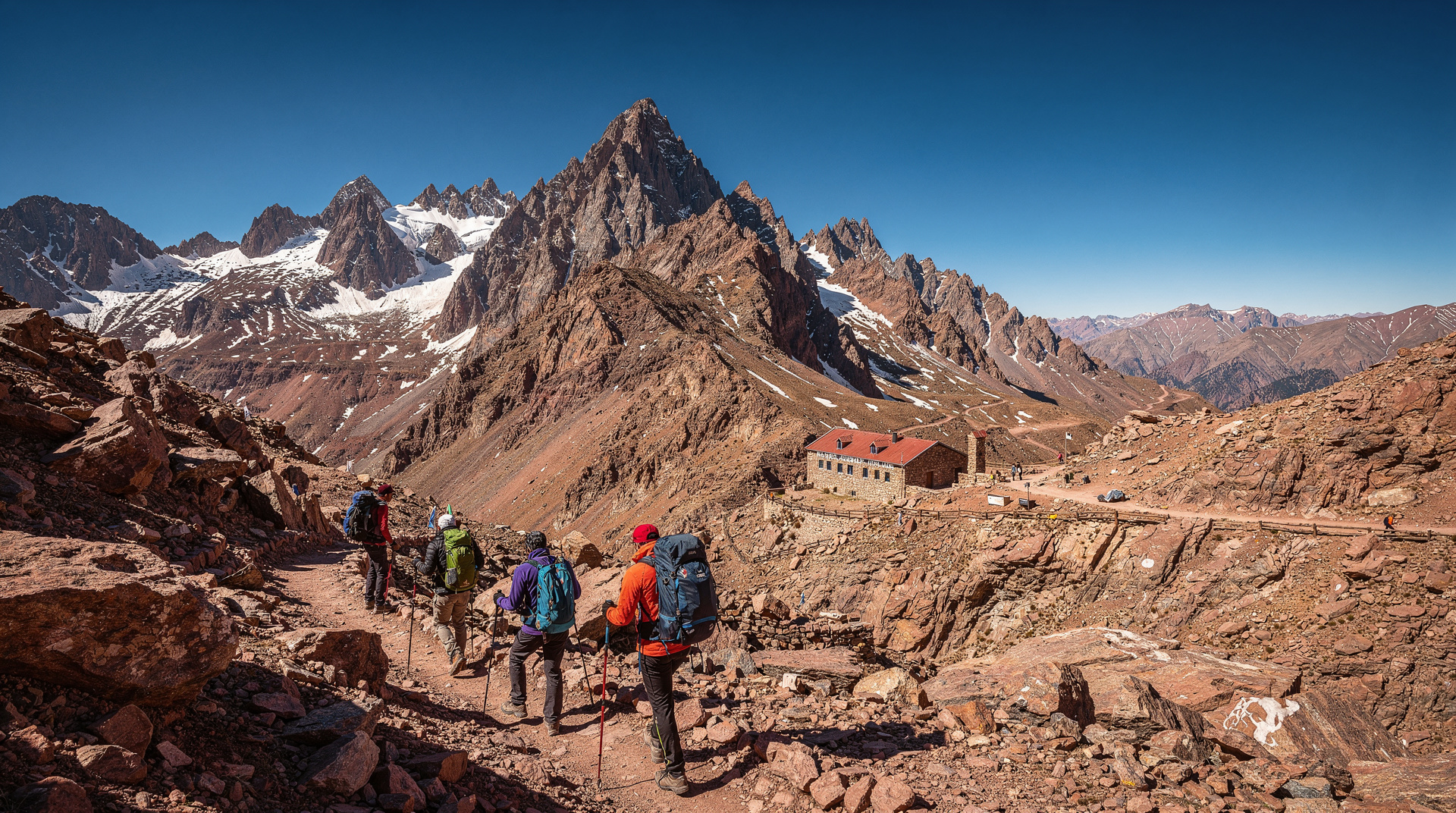
Jbel M’Goun (4,068m) is Morocco’s second-highest peak. The massif it forms part of — the Central High Atlas — extends east from the better-known Toubkal range and encompasses the M’Goun River gorges, the Ait Bougmez Valley (the “Happy Valley”), and a succession of high passes that require 5-7 days to traverse properly. This is the trek to do if you have a week, reasonable mountain fitness, and want something that most Toubkal queues have never heard of.
At a glance
| M’Goun trek | |
|---|---|
| Where | Central High Atlas, Ait Bougmez Valley, via Tabant |
| Time needed | 5-7 days for the full traverse (3 days valley-only) |
| Getting there | Around 2.5-3h from Marrakech to Tabant via Azilal |
| Cost | Roughly 400-600 MAD/day guide + 200-300 MAD/day muleteer self-arranged, or 150-250 EUR/day per person fully organised |
| Best time | May-June and September-October |
The Ait Bougmez Valley: the reason everyone loves this trek
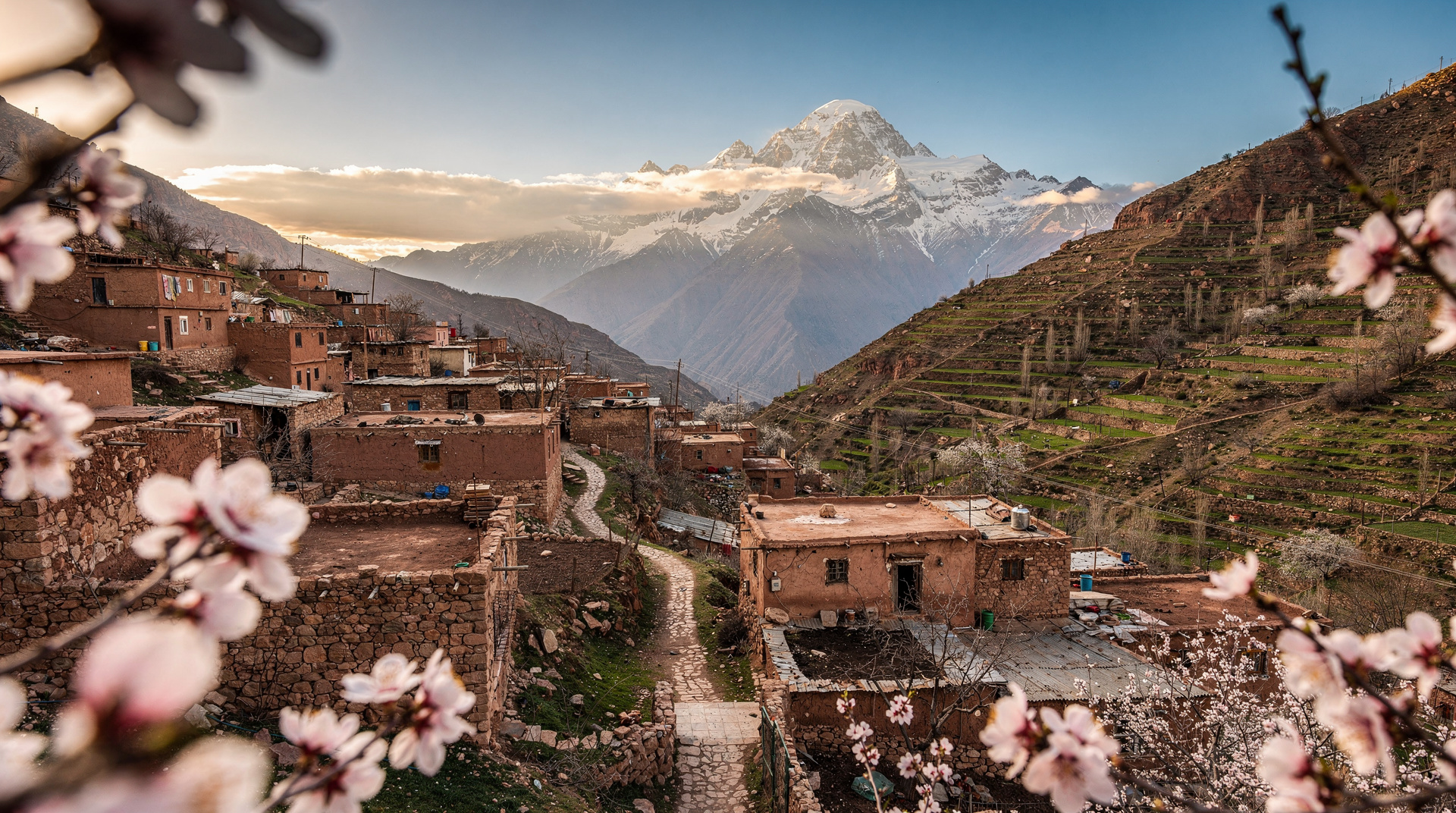
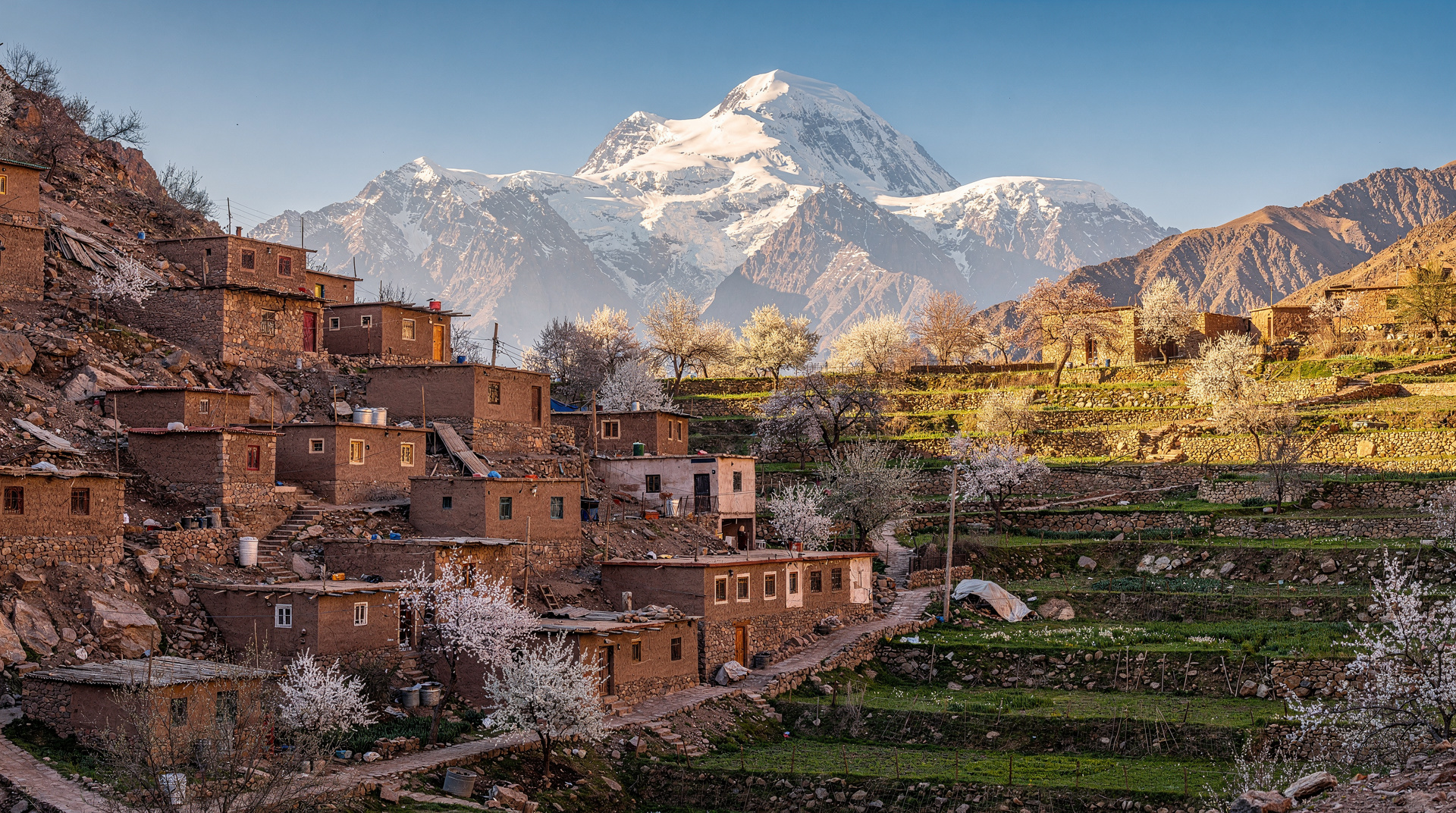
The Ait Bougmez Valley sits at approximately 1,900m elevation and runs east-west for about 30km. It’s an exceptionally fertile basin — unusual at this altitude — with walnut orchards, wheat fields, apple orchards, and a sequence of traditional Amazigh villages that have barely changed architecturally in centuries. The Valley is accessible by road from Azilal (2.5 hours from Marrakech) and serves as the standard approach to the M’Goun massif.
The villages of the Ait Bougmez confederation (the Happy Valley tribes) are among the best-preserved traditional Berber communities in Morocco. Unlike the Imlil area, which has been heavily adapted for tourism, Ait Bougmez remains primarily agricultural. Trekkers passing through are guests in a working farming community rather than participants in a tourism economy.
Key villages in the Ait Bougmez Valley:
- Tabant: The main village and eastern trailhead. Has a weekly souk (Tuesday), guesthouses, and guide services
- Agouti: A particularly well-preserved village with an ancient collective granary (agadir) on the hillside above
- Timit: A quieter hamlet with exceptional views west down the valley
- Ibaqalliwn: The western end of the valley; departure point for passes heading north or south
The valley’s rhythm: Walking through the Ait Bougmez is best done slowly. Morning light on the valley floor, with mist in the walnut orchards and the surrounding 3,000-4,000m peaks catching the first sun, is one of the most beautiful natural scenes in Morocco. The standard trekking pace (Tabant to Ibaqalliwn in 3-4 days, with side trips) allows this.
The M’Goun massif summit
Jbel M’Goun (4,068m): The second-highest peak in Morocco and the highest point outside the Toubkal massif. Unlike Toubkal, which has a clear single summit objective, M’Goun is approached from multiple directions and is often integrated into a traverse rather than an out-and-back.
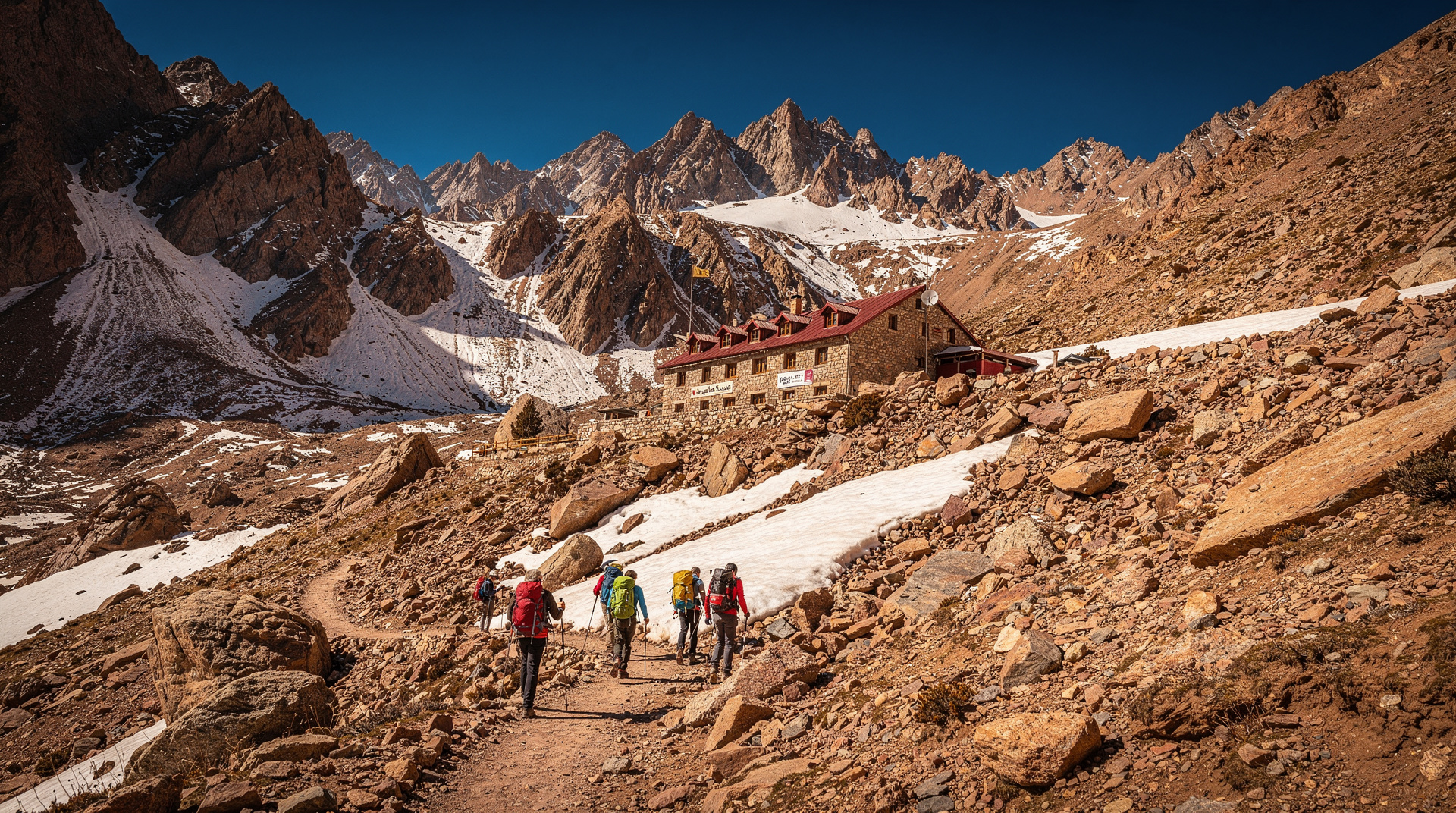
Summit access: The standard approach is from the Ait Bougmez Valley north side, via the Imi n’Ifri pass area, ascending the south or southwest ridge. Total summit day from a high camp is 4-6 hours return. The summit terrain is rocky ridge-walking (no technical difficulties in summer) but sustained altitude demands good fitness.
Summit views: On clear days, a 360-degree panorama encompassing the full Central High Atlas range, south toward the pre-Saharan plains and the Jbel Siroua, and west toward the Toubkal massif. The absence of the crowds that congregate on Toubkal’s summit makes the M’Goun experience notably more peaceful.
The M’Goun River gorges
One of the M’Goun trek’s most distinctive sections is the traverse through the M’Goun River gorges — a canyon system on the south side of the massif where the river has cut through the limestone in a narrow, dramatic passage.
The gorge traverse: A half-day to full-day section involving wading through the river (cold, knee-deep in some sections) through a canyon 200-300m deep and sometimes only 5-10m wide. The light quality inside the gorge in late morning is extraordinary. This section is not possible in spring flood conditions (April-early May, when the river runs high from snowmelt).
Practical logistics: Remove footwear and walk in water socks or accept wet boots. The bottom of the gorge has flat sandy sections and rocky scrambles. Not technically demanding but physically engaging.
Complete 7-day M’Goun trek itinerary
Day 1: Azilal or Marrakech → Tabant (road approach, Ait Bougmez Valley). Settle in Tabant, meet guide. Day 2: Tabant → Agouti → Ighris (walk through the Happy Valley), 4-5 hours Day 3: Ighris → Tizi n’Aït Imi (3,500m) → high camp south of the pass, 6-7 hours Day 4: High camp → M’Goun summit (4,068m) → camp near summit, 6-8 hours Day 5: Descent south → M’Goun gorges traverse, 5-6 hours Day 6: Gorges exit → village of Ait Mohammed, 4-5 hours Day 7: Ait Mohammed → Ouarzazate (road transfer) or reverse to Tabant
Shorter variants:
5-day version: Skip the summit day and traverse the massif via a lower pass (Tizi n’Tirghist, 3,100m). The gorges section and Ait Bougmez Valley are retained; you miss the 4,068m objective.
3-day Ait Bougmez only: Walk the valley floor from Tabant to Ibaqalliwn without ascending the high passes. This is more of a cultural walk than a mountain trek but genuinely beautiful.
Access and logistics
Getting to Tabant (the trailhead):
- From Marrakech: 2.5-3 hours by car via Azilal (N8 road, then south on secondary roads). Azilal is 165km from Marrakech.
- From Ouarzazate: 3-4 hours via Ait Benhaddou and secondary mountain roads (rougher approach, requires 4WD or careful driving)
- Public transport: CTM/Supratours to Azilal from Marrakech (2-3 hours, 60-80 MAD), then local transport to Tabant (30-40 MAD, timing-dependent)
No access from Fes: The Central High Atlas is south of the main Fes-Marrakech axis. Fes-based travellers need to route via Azilal or Ouarzazate.
Guide hire in Tabant: The Tabant Bureau des Guides serves the M’Goun area. Guides here specialise in Central High Atlas routes that Imlil guides don’t necessarily know well. Essential for the summit approach and gorges section.
Muleteer logistics: As with all multi-day Atlas treks, muleteers carry camping equipment and food. Arrange through your guide in Tabant. The M’Goun gorges section is not passable by mules — luggage is transferred by human porter for this section (factor this into your planning).
How M’Goun compares to Toubkal
| Factor | Toubkal (4,167m) | M’Goun (4,068m) |
|---|---|---|
| Access | Imlil, 75km from Marrakech | Tabant, 165km from Marrakech |
| Summit height | 4,167m | 4,068m |
| Standard trek duration | 2 days | 5-7 days |
| Crowd level | High (July-August) | Low (year-round) |
| Technical difficulty | Low (summer) | Low (summer) |
| Cultural content | Limited (trekking infrastructure) | High (Ait Bougmez villages) |
| Gorge experience | No | Yes (M’Goun gorges) |
| Logistics complexity | Simple | Moderate |
| Best for | Summit objective + time constraint | Full trek experience + solitude |
The trekker who has already done Toubkal and wants something new should consider M’Goun their next Atlas objective. The trekker with limited time (2-3 days) should do Toubkal. The trekker with 5-7 days and wanting Morocco’s best mountain experience should consider M’Goun first.
Best season for the M’Goun trek
May-June: Snow clears from the passes by mid-May in most years. The Ait Bougmez Valley is green and in full bloom. The M’Goun gorges are best done after mid-May when the river level drops from spring flood. June is optimal: stable weather, clear passes, accessible gorges.
September-October: The other prime window. Harvest season in the Ait Bougmez Valley is September — the walnut orchards are at peak golden colour, the apple harvest is in progress, and the valley has a completely different atmosphere from spring. Arguably the most beautiful month to walk the valley.
July-August: Hot below 2,500m, manageable above. Crowded by Atlas standards (though still quiet compared to Toubkal). Gorges are at their best water level for crossing (shallow enough to wade comfortably).
Avoid: April (high snowpack on passes, M’Goun gorges in dangerous flood). November-March (winter conditions on the high passes, requiring full mountaineering equipment).
Outfitters for the M’Goun trek
The M’Goun area is less developed for independent booking than the Toubkal region. Options:
Tabant Bureau des Guides: For hiring guides and muleteers directly. Best contacted through Tabant guesthouses, which can make introductions. Price: 400-600 MAD per day for a licensed guide, 200-300 MAD per day for a muleteer.
Specialist Morocco trekking agencies: Several Marrakech-based companies run M’Goun packages with transport, guide, and accommodation pre-arranged. Prices: 150-250 EUR per person per day for a fully organised small-group trek. More expensive than self-arranging but logistically simpler.
If you prefer a verified operator, the Atlas Mountains and Berber villages day trip from Marrakech is a useful warm-up day before committing to a multi-day M’Goun traverse — it covers the approach terrain and lets you assess fitness and altitude tolerance.
Self-arranging: Possible with advance planning. Key components: transport to Tabant, guide hire, muleteer, accommodation in Tabant and village homestays, camping equipment. Requires more preparation than Toubkal logistics.
Where to stay in the Ait Bougmez Valley
Tabant: Several guesthouses cater to trekkers. Chez Brahim is well-regarded for its home-cooked food and local guide connections. Budget 250-400 MAD per person per night with dinner included.
Village homestays along the route: The villages of the Ait Bougmez confederation welcome trekkers in family homes. Your guide arranges these. The experience is genuine — sleeping in an inhabited home, sharing breakfast with a farming family, seeing the valley from the inside rather than the outside.
Camping: Standard for the high mountain section (above the villages). Muleteer carries gear to camp spots your guide selects. Wild camping is standard practice on the high mountain sections.
Connecting the M’Goun trek to the broader itinerary
The M’Goun traverse can be approached from Marrakech and exits toward Ouarzazate — making it a natural component of a southern Morocco loop. After the trek: Ouarzazate → Aït Benhaddou → the Draa Valley → Merzouga is a classic sequence. If the M’Goun exit drops you near Ouarzazate, a 3-day Sahara tour from Marrakech to Merzouga can be pre-booked to continue the circuit without needing to self-arrange the desert leg.
For those comparing High Atlas options, the multi-day Atlas trek guide covers the Toubkal Circuit alongside M’Goun. The Toubkal summit guide provides the Toubkal-specific detail. The Atlas Mountains destination guide covers the full regional context.
For an itinerary that incorporates M’Goun, a 14-day Morocco itinerary can comfortably include the M’Goun traverse plus the main southern and northern highlights.
If the mountains are the main draw of your trip, the Atlas-focused Morocco itinerary and the adventure Morocco itinerary show how a long trek can sit alongside shorter outings. Travellers weighing the high country against the dunes will find the comparison in Atlas vs Sahara useful, and the Anti-Atlas trek guide points to another quieter walking region for a later trip.
Before and after the trek, a few days in Marrakech make a practical base for resting, stocking up and sorting out transport. The getting around guide explains the road and bus options that link the city to the mountains, and the packing list for Morocco is worth checking before you load a daypack for a week above 3,000m.
Frequently asked questions about M’Goun trek
Is M’Goun harder than Toubkal to summit?
The summit difficulties are comparable in summer — both are steep rocky terrain, no technical climbing. M’Goun involves more total days of hiking and the gorge crossing adds a distinct physical element. The longer duration is the main additional demand compared to Toubkal.
Can I combine M’Goun with a Toubkal summit in one trip?
Possible in 10-14 days: start with M’Goun (7 days), transfer to Marrakech, then Imlil for Toubkal (2-3 days). A demanding two-week mountain focus but entirely feasible for fit trekkers.
What’s the best guesthouse to base in Tabant?
Chez Brahim (Dar Itrane) and several other family-run guesthouses in Tabant are the established trekker options. Book a few days in advance in May-June and September peak weeks. No formal advance booking system — WhatsApp or email via guesthouse contact available through guide bureaus.
Is the M’Goun gorge crossing dangerous?
In late June-October, the water level is manageable: knee to thigh depth, strong current in narrow sections but wadeable. In spring (April-May), the gorge can be impassably high and dangerous. Never attempt the gorge crossing if you can’t see the bottom (water clarity drops dramatically in high-flow conditions) or if the current is too strong to wade against. Your guide will know current conditions.
How do I get from the M’Goun exit to Ouarzazate?
The south exit of the trek ends at villages reachable by road from Ouarzazate (approximately 2-3 hours). Local taxis can be arranged from Ait Mohammed or similar villages. Your guide handles this transfer logistics if you brief them in advance.
Do I need previous trekking experience for M’Goun?
Not technical climbing experience, but you need genuine multi-day hiking fitness — 5-7 consecutive days averaging 5-8 hours of walking, including one high-altitude summit push. First-time trekkers who are otherwise fit can manage it with a guide, but this is a step up from a single-day Imlil day trip from Marrakech or similar warm-up walks.
Is M’Goun suitable as a first Atlas trek, or should I do Toubkal first?
Either works, but most trekkers find M’Goun a better second trek. The Toubkal trek guide covers a shorter, more infrastructure-heavy route that’s a gentler introduction to Atlas trekking logistics; M’Goun’s longer duration and more remote villages reward trekkers who already know what multi-day mountain travel in Morocco involves.
Fitness and preparation for the M’Goun traverse
The trek itself is not technical — no ropes, no scrambling beyond easy rock steps — but the cumulative demand is real. Expect daily ascents and descents of 800-1,200m on the pass days, at altitudes where the air is noticeably thinner above 3,000m. Training with multi-day back-to-back hikes carrying a daypack (the mules or porters carry the heavy gear) in the months before is the most useful preparation. Altitude acclimatisation is less of a concern than on Toubkal since the trek builds gradually over several days rather than a rapid two-day ascent.
Pack for a full range of conditions: base layers and a warm jacket for camp nights (even in June, high camps drop close to freezing), sun protection for exposed ridge walking, and broken-in boots with ankle support for the gorge scrambles. A short warm-up walk such as Imlil day trip from Marrakech or a visit to Berber villages beforehand is a reasonable way to test gear and gauge your pace before committing to the full traverse.