Buying leather goods in Fes: tannery quality, prices and scams
Is it worth buying leather goods in Fes, and how do you know if the quality is genuine?
Yes — Fes produces some of the finest leather in Morocco, processed at the Chouara tannery using methods that are centuries old. Quality leather is supple, has consistent stitching, and smells of tanned hide rather than chemicals. Start bargaining at 50% of the opening price for tannery-district shops.
Why Fes leather is different
Morocco has a reputation for leather goods throughout the Islamic world, and Fes sits at the top of that reputation. The Chouara tannery — operational for approximately 800 years, using largely unchanged techniques — produces leather that is recognisable by specialists: a particular suppleness from the organic tanning process, a depth of colour from natural dyes, and a durability that outlasts most contemporary machine-tanned hides.
This does not mean that every leather item sold in Fes medina is quality — the tourist market has created a parallel economy in poorly made souvenir goods that use inferior materials and the Chouara name as a marketing label. Understanding the difference between genuine tannery-quality leather and tourist-grade goods is the central skill for anyone shopping in Fes.
| At a glance | |
|---|---|
| Where | Chouara tannery district, Derb Chouara, off Talaa Kebira, Fes medina |
| Cost | Bags around 400–1,200 MAD, poufs around 200–1,000 MAD, babouches around 120–350 MAD |
| Time needed | Around 1–2 hours for the tannery overlook and a first shop; half a day to compare several shops |
| Getting there | Around 20 minutes on foot east from Bab Bou Jeloud along Talaa Kebira |
| Best time | Mid-morning on weekdays for peak tannery activity; avoid Friday afternoon |
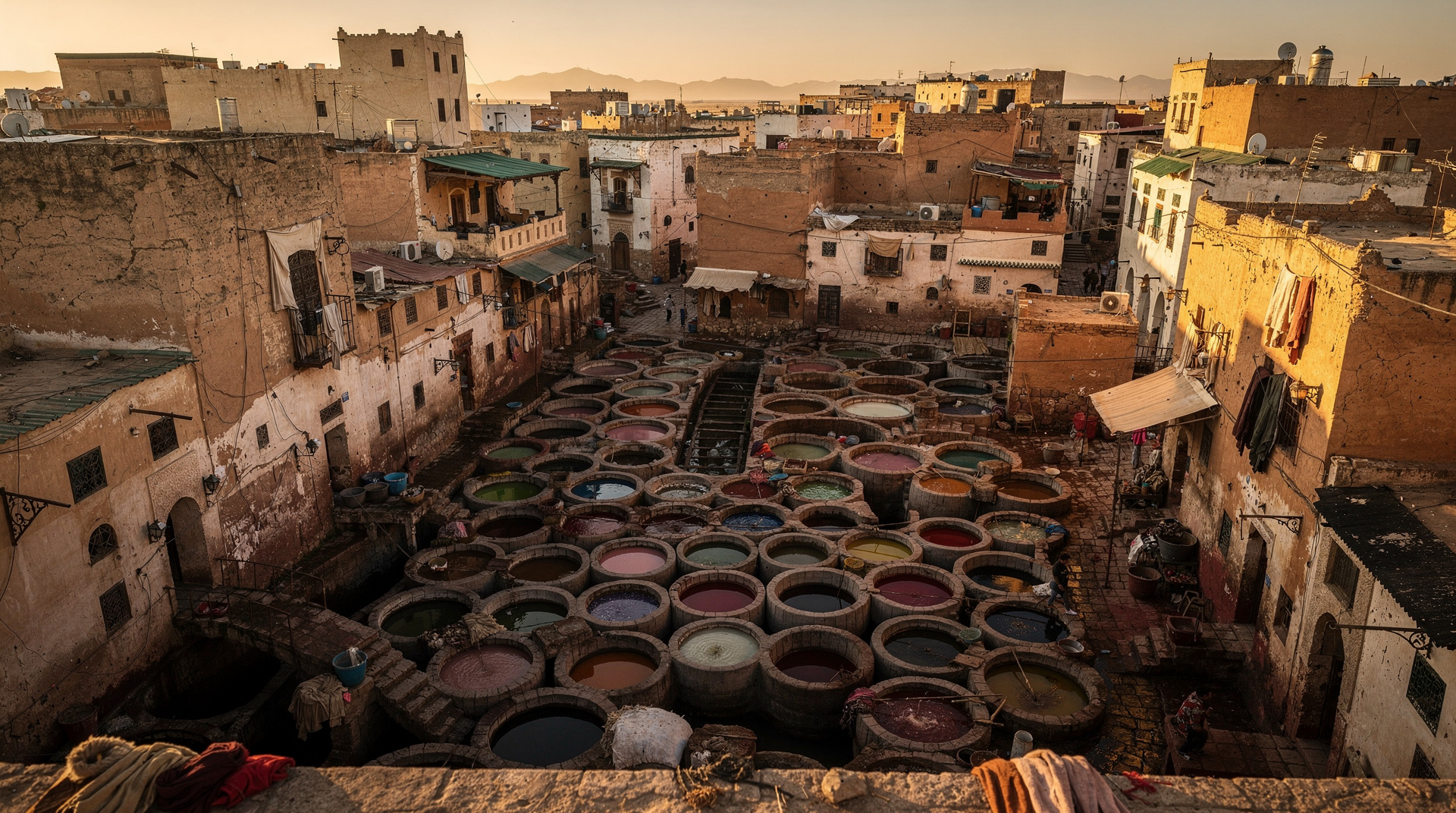
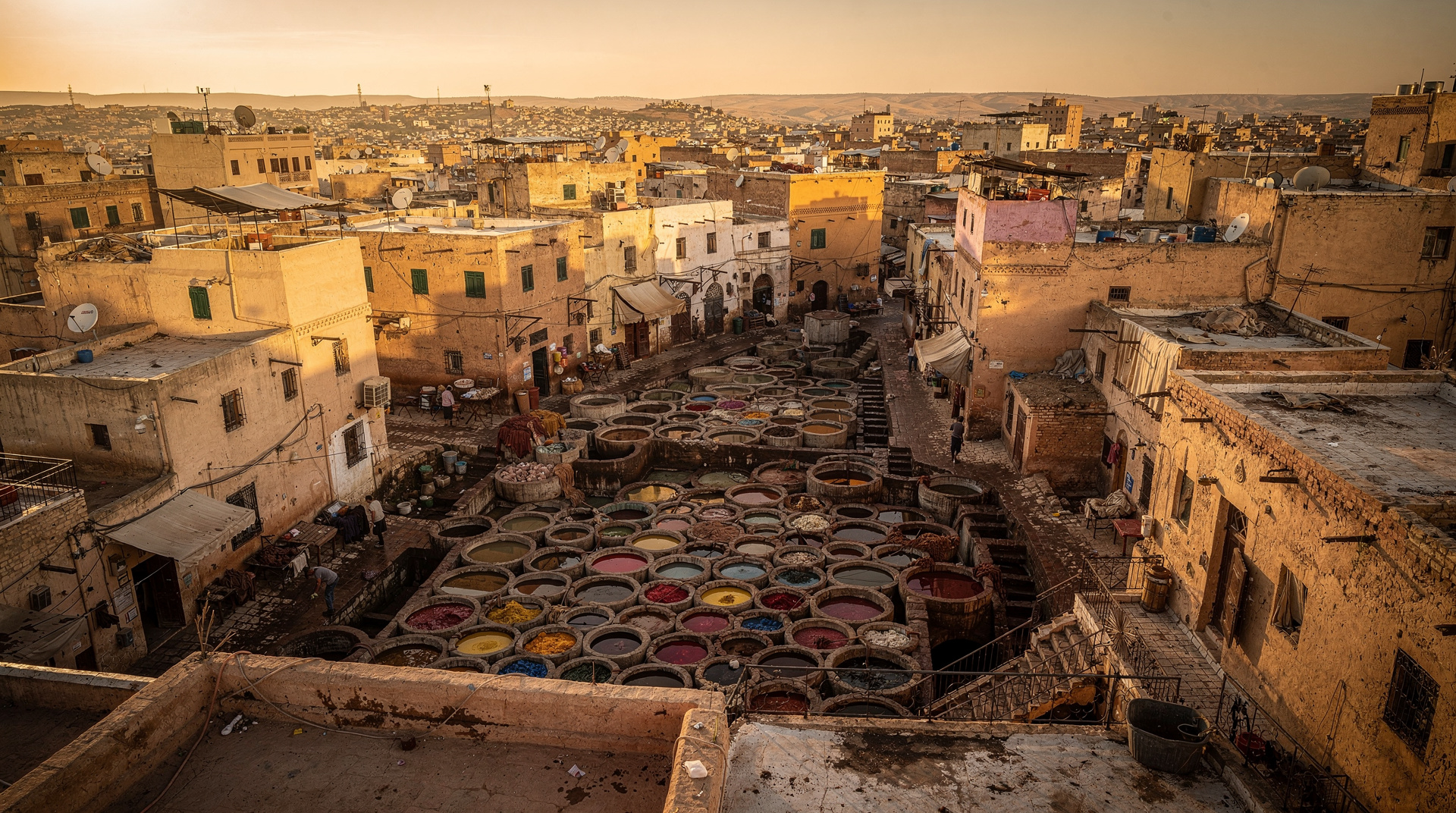
How the Chouara tannery process works
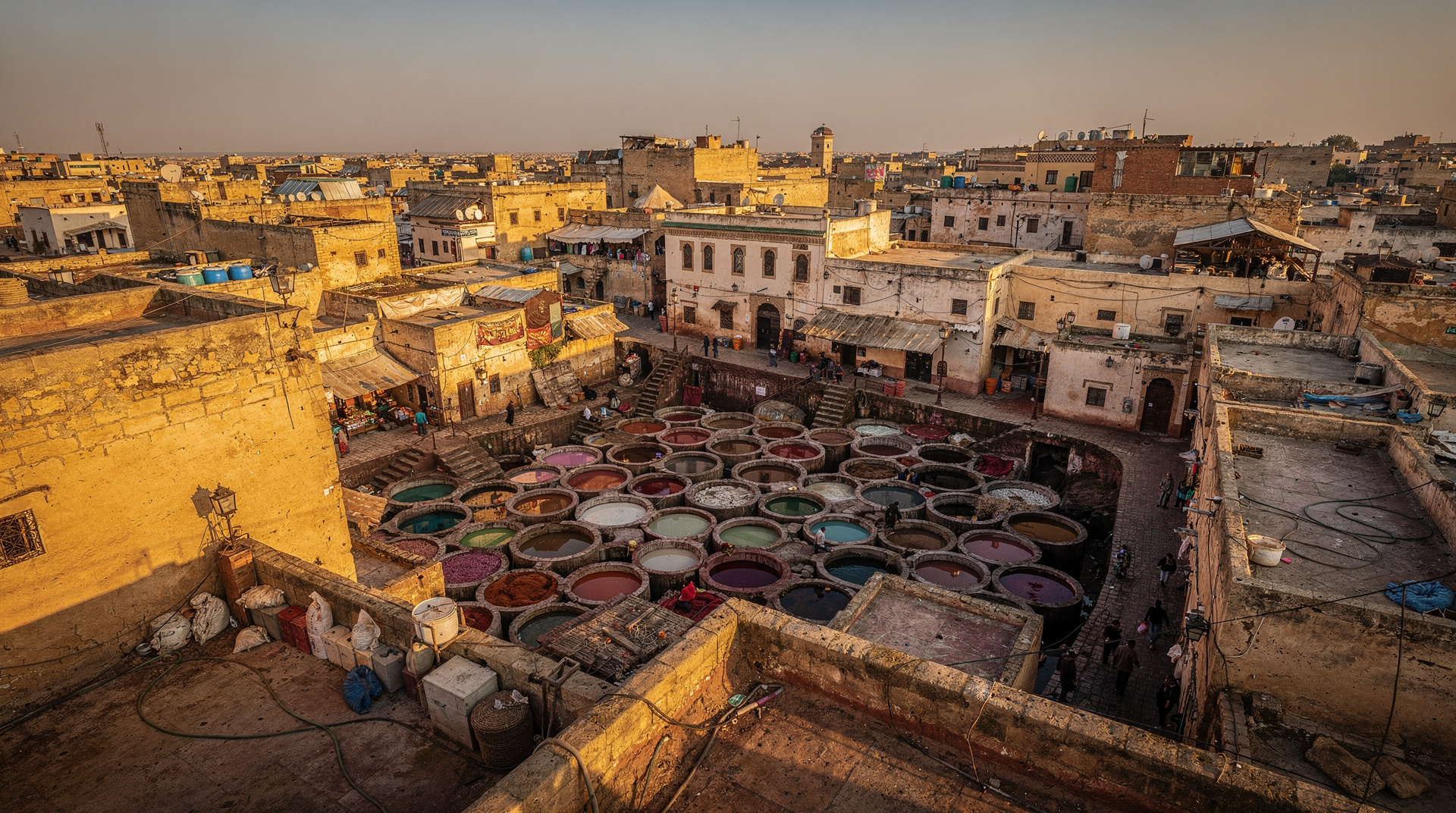
The leather in the Chouara tannery goes through three distinct stages, each visible from the overlook terraces:
Stage 1 — Preparation: Fresh animal hides (cow, goat, sheep, and camel) arrive and are soaked in vats of salt water to prevent decomposition, then transferred to lime pits to remove hair and outer skin layers.
Stage 2 — Softening: The de-haired hides are transferred to vats containing pigeon excrement (high in ammonia), which breaks down protein fibres and makes the leather supple. This is the source of the tannery’s powerful smell, which visitors notice from 200 metres away.
Stage 3 — Dyeing: Soft, white hides are moved to the circular colour vats. Traditional dyes include:
- Saffron (yellow)
- Indigo (blue)
- Henna (orange-red)
- Poppy (red)
- Mint (green)
- Antimony (black)
The dyeing takes several hours to achieve the deep, even colour associated with quality Chouara leather. Hides are then dried on the sloping terraces below, which visitors can also see from the overlooks.
What this produces: Leather with deep, even colour penetration (not surface coating), suppleness from organic processing, and a characteristic smell — slightly earthy, not chemical. This is fundamentally different from chrome-tanned industrial leather, which achieves similar suppleness through chemical treatment in hours rather than days.
Book tannery entry access in FesThe main leather products sold in Fes
Leather bags
The widest range of leather goods in the tannery district shops. Categories include:
- Shoulder bags: Soft leather in single colours (the deep saffron yellow and tan are the most distinctive Chouara colours). A medium-sized genuine leather shoulder bag: 400–800 MAD. Tourist-grade version with thinner leather and inferior stitching: 150–300 MAD.
- Briefcases and satchels: Structured bags with metal hardware. A well-made genuine leather satchel: 600–1,200 MAD.
- Clutches and small purses: Easier to assess quality at a glance due to smaller surface area. 150–400 MAD for genuine leather.
Quality checklist for bags:
- Press the leather — genuine tannery leather yields slightly to pressure and bounces back. Cheap bonded leather is stiff or crinkly.
- Check stitching at stress points (handles, zipper edges, corners) — genuine craftsmanship has evenly spaced, consistent stitching; souvenir goods have irregular or already-separating stitches.
- Look at the interior lining — quality bags are lined with fabric; cheap bags often have raw or roughly finished interiors.
- Smell the leather — genuine Chouara leather has an earthy, organic scent; synthetic or poorly tanned leather smells chemically sharp.
Poufs
The large leather floor cushions that appear in every riad and Moroccan-themed interior are poufs, and Fes is the best place in Morocco to buy a quality version. They are filled (in the finished version you can buy in shops) with wool or shredded fabric, though they are also sold unstuffed (flat) for easier transport, with instructions to stuff them at home with dried corn husks, old clothing, or similar material.
Sizes: Standard pouf diameter is 40–55cm; larger versions (70cm+) exist but are rare.
Prices:
- Unstuffed pouf, basic colour, medium: 200–400 MAD
- Unstuffed pouf, embroidered or quality leather: 400–700 MAD
- Pre-stuffed pouf (much heavier for transport): 600–1,000 MAD
Quality indicators: The leather should cover the pouf in panels stitched together. Check the stitching where the panels meet — it should be tight and even. The base should be finished (not raw leather with ragged edges). Embroidered poufs should have dense, even stitch coverage.
Transporting poufs: Most visitors buy unstuffed. A medium unstuffed pouf folds to roughly the size of a large dinner plate and fits in carry-on luggage.
Babouches (Moroccan slippers)
Fes produces a particular style of babouche — typically stiffer and more traditional than Marrakech’s versions, with a characteristic pointed toe for men’s styles and embroidered flat versions for women. The leather is tanned locally; the embroidery is done by specialist artisans in the medina.
Men’s babouches: Unlined, pointed toe, yellow or tan natural leather. 120–250 MAD for genuine leather. The yellow babouche is specifically associated with Fes — it is considered more formal than other colours.
Women’s babouches: Lower profile, embroidered leather or fabric uppers, padded sole. 150–350 MAD depending on embroidery complexity.
Test: Press the sole — a genuine leather sole has give; a synthetic rubber sole is uniformly hard. The interior should be smooth leather or fabric; cheap versions use cardboard inner soles that collapse quickly.
Leather jackets
Fes tannery-district shops also sell leather jackets, though this is where the quality variation is most pronounced. A well-made jacket using Chouara leather is a legitimate purchase; many of the jackets sold to tourists are assembled from lower-quality imported leather with Moroccan finishing.
What to look for: Even colour throughout (not just on visible panels), consistent panel thickness, quality metal hardware (zips, buckles). A genuine leather jacket at a reasonable price: 800–1,800 MAD. Be very sceptical of jackets offered below 500 MAD.
Price benchmarks and bargaining in the tannery district
The leather shops surrounding Chouara operate on negotiable prices, but typically with less theatricality than the main souk carpet sellers. You are less likely to be invited to sit for tea for 45 minutes; you are more likely to be shown directly to the goods, quoted a price, and expected to respond.
Standard starting position: Open at 50% of the quoted price (slightly higher than the 40% benchmark for souks generally — the goods here are more genuinely valued and the markup is somewhat smaller).
Red flag prices: If a “genuine leather” bag is quoted at 100 MAD, it is not genuine Chouara leather. The production costs alone prevent this. Use the benchmarks above to calibrate — if an opening price is below what the object could reasonably cost to make, the material is inferior to what is being claimed.
Fixed-price shops exist: Some tannery-district shops now operate with fixed prices and quality guarantees. These are not cheaper than negotiated prices but they save time and uncertainty. They will often display a government quality certification.
The tannery overlook: how it works
The standard way to see the tannery is through the surrounding leather shops, which provide free access to their rooftop terraces in exchange for the opportunity to show you their goods. There is no admission fee. The arrangement is:
- Approach any shop on Derb Chouara or the lanes immediately surrounding it
- Staff will guide you upstairs to the viewing terrace (usually 2-3 flights)
- You get 10-20 minutes of overlook access and photography
- You are then invited to look at the shop’s leather goods
- You are under no obligation to buy
The interaction is honest commercial exchange. You get the view; they get the opportunity to show you goods. Declining to buy is entirely normal and accepted gracefully by professional shops. Only shops using high-pressure tactics warrant a firm exit — most do not.
If you would rather see the tannery as part of a wider day with someone who knows the lanes, a guided medina tour that includes the Al-Attarine Madrasa and tannery is one option, and it removes the need to find the overlook yourself.
Best tannery viewing times: Mid-morning on weekdays, when all vats are in active use and the maximum colour range is visible. Friday afternoon and public holidays see reduced activity.
Common scams and how to avoid them
The “special price for you today”
Every day is a special day in the tannery shops. The “special price” framing is standard sales language, not a genuine limited-time offer. Ignore it as a factor in your decision.
The unofficial guide
Near the Chouara entrance points, unofficial guides offer to take you to “a tannery only locals know about” for a fee. The Chouara tannery is the main one — there are smaller tanneries in Fes but none with the same scale or viewing access. The fee is unnecessary; any leather shop will take you to the overlook for free.
Commission shops
Some guides operating on commission tours will claim that the shop they take you to is the only one with “government certification” or “genuine leather.” This is not true — good shops exist throughout the tannery district. A legitimate guided tour booked through a reputable operator does not use commission-based shop steering. For vetted guided tours, the Fes souks guide covers what to look for in a legitimate guide.
Bait-and-switch quality
A common practice: a high-quality piece is shown as a reference, then an inferior piece in the same style is quoted at the same price. Always handle and inspect the specific item you intend to purchase, not a display piece.
If you want to get your bearings before shopping, a Fes old medina walking tour with a local guide can help you learn the layout first, so you compare shops with a clearer head.
Caring for Fes leather after you get it home
Genuine Chouara leather rewards basic care and will look better with age rather than worse. Keep bags, poufs and jackets out of direct sun for long periods (the natural dyes can fade unevenly), and let anything that gets wet dry naturally away from direct heat rather than on a radiator. A light application of a neutral leather conditioner every six months keeps the surface supple, particularly for bags and jackets that see regular use.
Babouches and pouf leather generally need less attention — wipe with a slightly damp cloth if dusty, and let them dry flat. The organic tanning process that makes Chouara leather special also means it is slightly more porous than heavily chemical-tanned leather, so a proprietary leather protector spray applied once after purchase is a sensible extra step for bags you’ll use daily.
Comparing the main leather-buying options in Fes
| Option | Bargaining | Typical quality | Best for |
|---|---|---|---|
| Tannery-district shops (Derb Chouara) | Standard, open at 50% | High, genuine Chouara leather | Widest range, tannery overlook access |
| Fes artisan cooperatives | Fixed prices | High, verified maker information | No-hassle buying, ethical sourcing |
| Souk Cherratin (compare: Marrakech) | Standard | Good but more variable | Comparison shopping if also visiting Marrakech |
| Fixed-price certified shops | Fixed prices | High, quality-guaranteed | Buyers who dislike negotiating |
Alternatives and comparison shopping
Marrakech: Leather goods are widely available in Souk Cherratin, but they are mostly produced with leather from Marrakech’s own (smaller) tanneries rather than Chouara. Quality can be good but is not consistently as high. The Marrakech souks guide covers the Cherratin area.
Fes artisan cooperatives: Several cooperatives in and around Fes medina sell leather goods at fixed prices with clear maker information. These are the cleanest buying experience — no bargaining, no commission pressure, and the money goes more directly to artisans.
Chefchaouen: A smaller leather market with locally produced sandals and simple bags. See the Chefchaouen shopping guide for what is available there.
Practical information
How to find the tannery district: From Bab Bou Jeloud, follow the Talaa Kebira souk artery east for approximately 20 minutes, then look for signs to Chouara. Your riad can mark the route on an offline map before you leave. Many shops now have markers on Google Maps.
Carrying leather home: Even small poufs and bags can be carried as checked luggage. Quality leather goods should be wrapped to protect the surface. Leather items (non-exotic, non-protected species) face no import restrictions in the EU, UK, or USA.
Currency: MAD. Most tannery district shops are cash-only, though the larger more tourist-facing stores sometimes accept cards. The nearest ATMs to the tannery are near Bab Bou Jeloud.
For the broader Fes medina experience — madrasas, blue pottery, spice markets — see the Fes souks guide and the Fes destination guide. For a wider view of Fes’s craft scene beyond leather, the Fes blue pottery guide and the artisan cooperatives guide are useful companions.
Frequently asked questions about Buying leather goods in Fes
Is Fes leather better quality than Marrakech leather?
Generally yes, for goods produced with Chouara-tanned leather. The Chouara tannery’s production process is larger and more established than Marrakech’s tanneries, and the leather produced there has a consistency and quality that experienced buyers recognise. For specific items (bags, poufs, babouches), buy in Fes if you have the choice.
Do I have to buy something at the tannery to use the overlook?
No. The access is free in exchange for the opportunity to show you goods. Declining to buy after viewing is normal and accepted. Only shops using aggressive pressure tactics warrant a quick exit — most tannery-district merchants are professional about this.
How do you ship a leather pouf to Europe or the US?
For a single pouf, the cheapest option is checked airline baggage. For multiple poufs or larger pieces, the major Fes leather shops can arrange DHL or Aramex shipping with a quoted delivery time of 5–10 days. Get a written receipt with the item description, dimensions, and agreed price before allowing shipping.
What is the genuine colour of Fes leather?
The most iconic Chouara colour is the deep saffron yellow, followed by the earthy tan (natural undyed), deep red (poppy/henna), and rich brown. Bright fashion colours (neon pink, lime green) are produced with chemical dyes rather than the traditional plant-based process — not fake, but not traditional Chouara colouring.
How do I care for Fes leather once I get it home?
Keep it out of prolonged direct sun, let it air-dry naturally if it gets wet, and apply a neutral leather conditioner roughly every six months for bags and jackets in regular use. Poufs and babouches need only occasional wiping with a slightly damp cloth.
Can leather goods from Fes be shipped rather than carried?
Yes. The major tannery-district shops can arrange DHL or Aramex shipping for multiple items or larger pieces, typically 5–10 days to Europe. Get a written receipt describing the item, dimensions, and agreed price before the shop ships it.