Hammam etiquette in Morocco: the complete practical guide
What should I bring to a Moroccan hammam?
Bring a fouta (sarong) or swimwear, flip-flops, a kessa mitt, black soap (savon beldi), a small towel, and coins for tips. Most hammams sell black soap and kessa mitts at the entrance if you arrive without. Leave valuables at your accommodation.
Your first hammam: what nobody tells you in advance
The Moroccan hammam is not complicated. Millions of Moroccan families use neighbourhood hammams every week without instruction or ceremony. But arriving without any information leads to confusion, missed steps, and occasionally awkward situations that are entirely avoidable with a brief briefing.
This guide covers every practical question about the hammam experience — from what goes in your bag to what to say to the keyyasa, from tipping customs to what happens if your children are in tow. For first-timers who want a fully guided hammam with transport and everything provided, the traditional Moroccan hammam and spa experience in Marrakech — 2-3 hours with kessa scrub, black soap, and optional massage, from €25pp provides all the supplies and a keyyasa, making it the lowest-friction entry point.
| At a glance | |
|---|---|
| Where | Neighbourhood hammams in any Moroccan town; tourist hammams and hotel spas concentrated in Marrakech, Fes, and Essaouira |
| Cost | Neighbourhood: around 15-30 MAD entry + 5-40 MAD keyyasa tip. Tourist/spa: roughly €15-60 for a full scrub-and-soap package |
| Time needed | 60-90 minutes for adults, 30-40 minutes for children |
| Getting there | Neighbourhood hammams are walkable in most medinas; tourist hammams often include hotel pickup |
| Best time | Weekday mornings for quieter neighbourhood sessions; book tourist hammams 2-3 days ahead in October and April |
What to bring to a neighbourhood hammam
The essentials
Fouta or swimwear: A fouta is a thin cotton sarong, sold in any souk for 30-60 MAD. You wrap it around your body for modesty and movement between rooms. In a neighbourhood hammam, many local women are comfortable with nudity in the all-female space — as a foreign visitor, swimwear or a wrapped fouta is entirely normal and no one will comment either way.
For men: swimming shorts are standard and appropriate in any Moroccan hammam.
Flip-flops or plastic sandals: The hammam floor is wet, shared, and slippery. These are essential for hygiene and safety. Leave them at the edge of the hot room when you go in — they stay in the warm or cool room.
Kessa mitt (gant kessa): The rough exfoliating glove is central to the hammam. You can buy it at the hammam entrance or nearby souk for 10-30 MAD. Choose the rougher-weave versions (dark green or grey) for a thorough scrub, the softer versions (yellow or white) for sensitive skin.
Savon beldi (black soap): Dark, olive-oil based paste soap that you apply before the kessa scrub. Available at the hammam entrance (5-15 MAD per portion) or in any souk. Buy a small clay pot or plastic container of it if you plan multiple hammam visits.
Small towel: For drying after the session. Large towels are unnecessary and awkward to manage in the humid rooms.
Change of clothes: What you wear into the hammam will be damp from steam and perspiration. Pack clean clothes in a bag.
Small change (MAD coins and small bills): For the entry fee (15-30 MAD in neighbourhood hammams) and tip for the keyyasa (5-20 MAD). Hammam staff rarely have change for large bills.
Optional but useful
Rhassoul clay powder: If you want the full traditional sequence, bring rhassoul (or buy it at the entrance). Mix with warm water in your bucket to a paste consistency after the kessa scrub step.
Argan oil: Apply to slightly damp skin after the hammam and before dressing. A small 50ml bottle travels easily. This is the traditional post-hammam conditioning step.
Rose water: Optional addition to the rhassoul paste or for a final face rinse.
Plastic bag: For your wet swimwear, kessa, and used fouta.
What NOT to bring
- Expensive jewellery or watches (leave at your accommodation)
- Wallet or cash beyond what you need for the hammam (leave at the cool room desk if there’s an attendant, or in your locked bag)
- Large bags (the cool room has minimal storage)
- Shampoo (you’re not washing your hair in the normal sense — rhassoul does the work)
- Conditioner (argan oil post-hammam is the conditioner)
Understanding the rooms and what to do in each
The cool room (changing room)
This is where you arrive, pay entry, leave your clothes, and receive your bucket. The attendant at the desk handles entry fees and may sell soap, kessa mitts, and other supplies.
Leave your shoes here (not inside the hot and warm rooms). Store your bag here, ideally with the attendant or in a locker if available.
Change into your swimwear or wrap your fouta. Fill your bucket with warm water from the tap or ask the attendant.
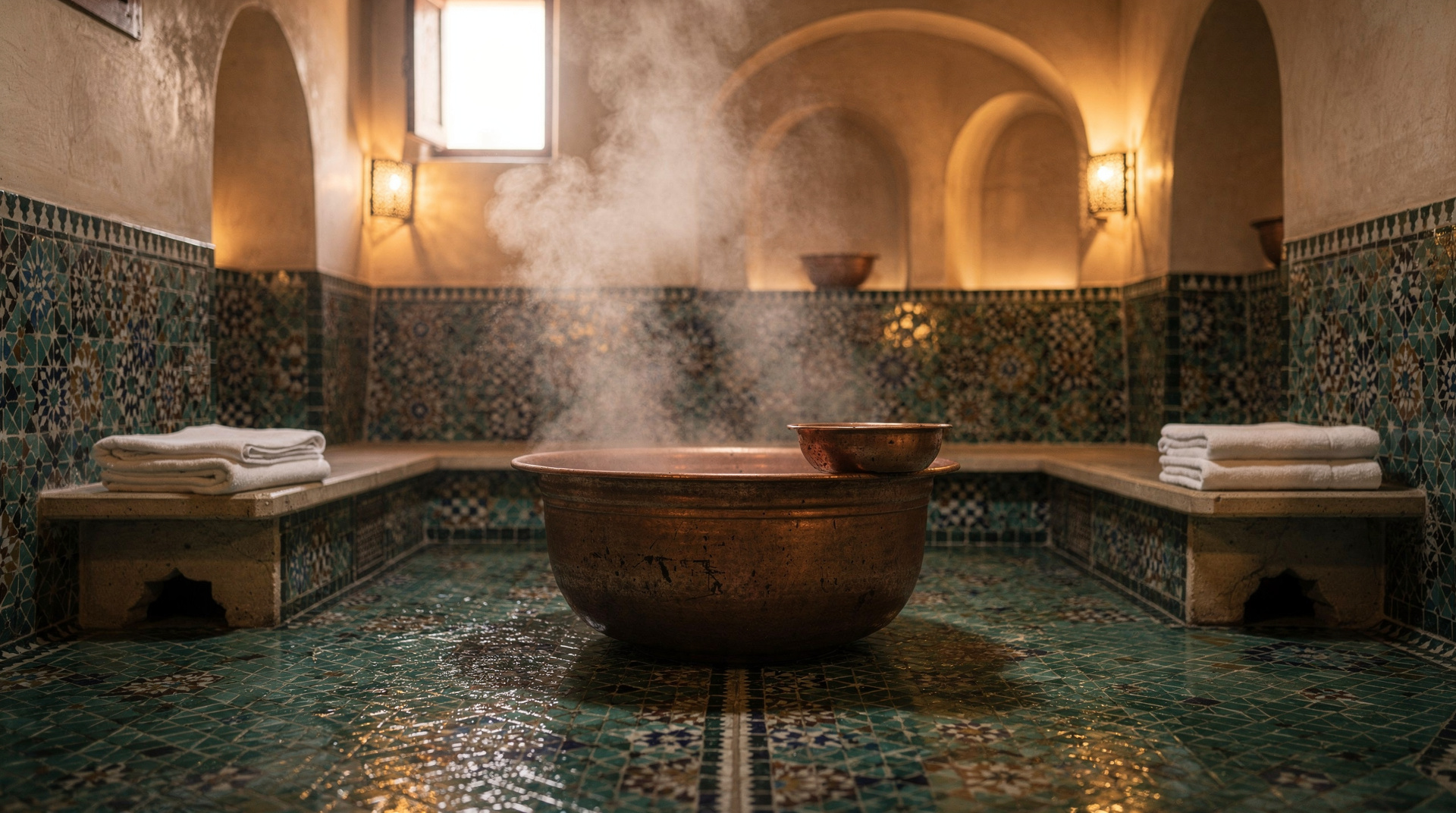
The warm room
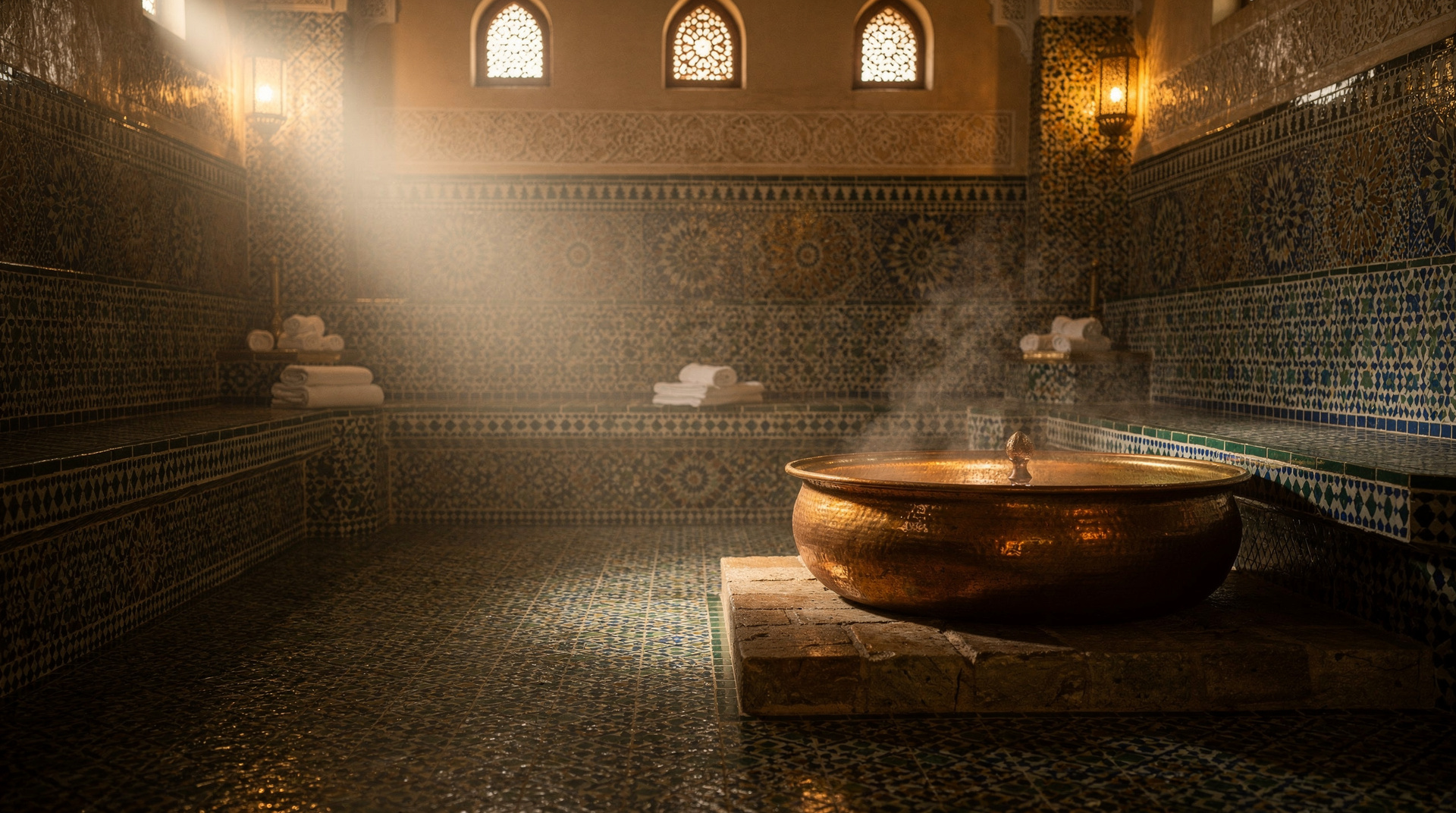
Move to the warm room to acclimatise before entering the hot room. Temperature is typically 35-42°C. This is where you will eventually receive your scrub. Sit, relax, let the heat begin its work.
Apply black soap now if you haven’t already — spread it on your skin (legs, arms, torso) and let it sit for 5-10 minutes while you continue warming.
The hot room
The highest-temperature room (45-55°C, high humidity). This is where you complete the warming and sweating process, opening pores fully. Stay 10-20 minutes. Pour warm water over yourself periodically from your bucket — do not pour cold water in the hot room (it disrupts the steam balance and is considered rude).
Return to the warm room for the scrub.
The scrub
In the warm room, apply the kessa mitt to your skin (or request a keyyasa to do it). The scrub works best when your skin has been genuinely warmed through — if you’re not seeing skin cells rolling off within 30 seconds of scrubbing, you haven’t spent enough time in the hot room.
Scrub in circular motions, using moderate pressure. Legs, arms, torso, back (ask the keyyasa or a companion to do your back). Avoid the face with the kessa mitt — the skin is more delicate.
Rinse the scrubbed areas thoroughly. Apply rhassoul clay if you have it, wait 5-8 minutes, rinse again.
Cooling down
Return to the cool room or warm room for the final rest. This transition period is as important as the heat exposure — let your body temperature normalise before dressing. Rush this and you’ll leave sweating. Take 10-15 minutes in the cooler space before dressing.
Apply argan oil to damp skin before dressing if you have it.
The keyyasa: using a professional scrubber
A keyyasa (or keyyis for a male attendant) is a professional hammam attendant who performs the kessa scrub for you. This is the traditional way — visiting the hammam was always a social and service experience, not purely a solo self-care routine.
How to request a keyyasa
You can request a keyyasa at the front desk when you pay entry, or signal to the attendant inside the warm room. The service costs 20-40 MAD on top of the entry fee in a neighbourhood hammam. In tourist hammams, it’s usually bundled into the treatment price.
What the keyyasa does
The keyyasa performs a thorough kessa scrub covering your full body — including your back, which is the area most people miss when scrubbing themselves. A good keyyasa reads the skin and adjusts pressure: firmer on calloused areas (feet, elbows), gentler on sensitive patches.
After the kessa, the keyyasa typically applies rhassoul or rinses you down and may apply black soap. The full sequence takes 20-30 minutes.
Communication with the keyyasa
Basic signals are universal: pointing to an area that needs more attention, a thumbs up for right pressure, a flat hand held up for stop. The phrase “shwiya” (Moroccan Arabic for “a little”) combined with gesturing to the keyyasa’s pressure works to moderate intensity. “Bezzaf” means “too much.”
Tipping the keyyasa
5-20 MAD is appropriate in a neighbourhood hammam. In tourist hammams, 20-50 MAD (in line with 20-30% of the treatment cost). Always tip in cash directly to the keyyasa, not through the desk.
Women-only vs mixed hammams
Traditional neighbourhood hammams
All traditional neighbourhood hammams are single-sex. Many operate on time schedules: mornings for women (typically 7am-1pm), afternoons for men (1pm-9pm or later). Some operate separate entrances and simultaneous schedules. A sign at the door or a quick look inside will tell you which session is operating.
As a foreign woman visitor, entering during women’s hours is appropriate. During men’s hours, men can enter. Do not enter opposite-sex sessions even if the door is unlocked — the schedule is a social norm, not just a business arrangement.
Tourist and luxury hammams
Tourist-oriented hammams and hotel spas often offer couples sessions in private hammam rooms. This is a modern adaptation for the tourist market and does not exist in traditional neighbourhood hammams. If you want a couples hammam experience, book a private suite at a luxury spa (see the luxury spas guide) or a couples package at a tourist hammam.
Taking children to the hammam
Children accompany parents to neighbourhood hammams routinely in Morocco. Toddlers and young children go with the same-sex parent in most cases.
Practical notes for children:
- The hot room may be too intense for very young children (under 5). The warm room is sufficient and safe — children can be scrubbed effectively without the full 55°C hot room experience.
- Flip-flops sized for children — wet floors are slippery for small feet.
- Children find the kessa scrub interesting and usually tolerate it well if you demonstrate first.
- The process is shorter for children — 30-40 minutes total vs 60-90 for adults.
- Babies (under 18 months) are not appropriate for hammam visits — heat sensitivity and unpredictable temperature tolerance make it inadvisable.
Common mistakes first-time hammam visitors make
Arriving immediately after a meal
The hot room raises core body temperature significantly. On a full stomach, the combination of heat and blood diversion to digestion causes nausea. Wait 2 hours after eating before a hammam session. Drink water beforehand.
Shaving the day before
The kessa scrub on freshly shaved skin is uncomfortable to painful. Allow at least 48 hours between shaving and a hammam scrub session.
Rushing through the hot room
Spending only 5 minutes in the hot room doesn’t open the pores sufficiently for the kessa to be effective. The skin needs genuine warming through — 10-20 minutes. If you’re not sweating after 5 minutes, stay longer.
Skipping the cooling-down phase
Leaving the hammam immediately after the hot room causes profuse sweating once you’re dressed (the body continues releasing heat). The 10-15 minute cool-down in the changing room is necessary for comfort and for the skin to settle.
Using the kessa mitt on your face
The kessa’s abrasive weave is designed for body skin (thick, regenerative). Face skin is thinner and more sensitive. Use a softer cloth or your hands only on the face.
Bringing your phone into the steam rooms
Steam destroys phone components rapidly. Leave your phone in your bag in the cool room.
Negotiating prices aggressively
In neighbourhood hammams, prices are fixed and low. Negotiating the 20 MAD entry fee is embarrassing and inappropriate — the hammam is a community service, not a tourist attraction.
Timing: when to go
Neighbourhood hammams: Women’s hours are typically morning (7am-1pm) and sometimes evening (by appointment or in larger hammams). Midweek mornings are quietest. Friday afternoons see higher demand as people prepare for the weekly prayer gathering. Avoid peak hours (early morning rush 7-9am and late morning 11am-1pm).
Tourist hammams: Book in advance — walk-in availability can be limited at peak times (October, April). Morning slots (9-11am) are typically less busy than afternoon.
Luxury hotel spas: Book at least 2-3 days in advance for popular times. See the luxury spas guide for specific booking tips by venue.
Language basics for the hammam
A few phrases go a long way:
- “Wach kayn keyyasa?” — Is there a keyyasa available? (Moroccan Arabic)
- “Shukran” — Thank you
- “Bezzaf” — Too much / Enough
- “Shwiya” — A little
- “Mezyan” — Good / Fine (the keyyasa’s pressure is correct)
- “Weqfi” — Stop
- “Rhassoul men fadlak/fadlik” — Rhassoul please (m/f)
Even without language, pointing, nodding, and the keyyasa’s experience with tourists bridges the gap. Don’t let language concern prevent you from using a neighbourhood hammam — the experience transcends it.
Connecting to the broader hammam picture
This guide covers the how. The traditional hammams guide covers the what and where — the cultural context, price comparison between neighbourhood and tourist hammams, and the best hammam locations in Marrakech and Fes.
Those who want the hammam experience combined with a hotel pickup and professional setup should look at the Marrakech 3-hour traditional hammam with massage and hotel transfer — includes pickup, scrub, and full massage, from €35pp, which handles the logistics for visitors who want to focus on the experience rather than the navigation.
The rhassoul and argan beauty rituals guide explains the products in depth. For the upscale version, the luxury spas guide covers La Mamounia, Royal Mansour, and the standalone options.
Frequently asked questions about hammam protocol
Do I have to be naked in a Moroccan hammam?
No. Swimwear or a wrapped fouta is entirely acceptable in any hammam. In neighbourhood hammams, Moroccan women are often comfortable with nudity among women — as a visitor, match whatever level of coverage you’re comfortable with. In tourist and luxury hammams, swimwear is standard.
What if I’m uncomfortable with the keyyasa touching my body?
The keyyasa’s scrub is a professional service conducted with neutral, practical touch — similar to receiving a physiotherapy treatment. If specific contact is uncomfortable, communicate clearly using the signals above (flat hand palm-out means stop). A good keyyasa responds immediately. If you’re very uncomfortable with body contact from a stranger, the self-service scrub is perfectly valid.
Is it safe to go to a neighbourhood hammam as a solo tourist?
Yes — neighbourhood hammams are busy community spaces and genuinely safe. The risk is navigating the process without help, which this guide addresses. Take your fouta, flip-flops, kessa, and soap. Watch what others do in the room if unsure. The keyyasa will guide you through the process if you make it clear you’re unfamiliar.
How do I know if a hammam is hygienic?
Look for: continuous water flow (water is always running from the boiler, not stagnant), clean floors with visible tile (not accumulated residue), fresh kessa mitts (not visibly worn from multiple uses), and staff who change foutas between clients. Neighbourhood hammams are cleaned between sessions and the high water temperature manages most bacterial concerns.
How much should I budget for a full hammam experience?
At a neighbourhood hammam, 40-70 MAD total covers entry, supplies, and a keyyasa tip. At a tourist hammam, expect €15-35pp for a bundled package. Luxury hotel spas range €35-100+pp depending on whether a massage is included — see the luxury spas guide for property-by-property pricing.
Can I use a hammam if I have skin conditions?
Consult your dermatologist if you have active eczema, psoriasis, or open wounds. For most skin conditions, the hammam is beneficial. Very sensitive skin may find the kessa too harsh — use a softer cloth or skip the kessa entirely and focus on the steam and rhassoul. Inform the keyyasa of any sensitive areas before they begin.
Should I go before or after a hammam-adjacent activity?
Avoid stacking a hammam right before or after a long trek or a full day in the sun — the Atlas multi-day trek or a day in Agafay is exhausting enough without the added heat load of a hot room the same afternoon. A hammam pairs well the evening after a travel day, or as a deliberate rest day between two active days — many riads schedule it that way, and the best riads in Marrakech guide flags which properties have their own small hammam on site.
Choosing a hammam: neighbourhood, tourist, or hotel spa
The three tiers differ mainly in price, privacy, and how much guidance you get, not in the core sequence described above.
| Type | Typical cost | What you get | Best for |
|---|---|---|---|
| Neighbourhood hammam | 15-30 MAD entry, 5-20 MAD keyyasa tip | Self-service or basic keyyasa scrub, communal, no English guaranteed | Budget travellers, cultural immersion, solo confident visitors |
| Tourist hammam | €15-35pp | Bundled kessa + black soap + rhassoul, English-speaking staff, sometimes couples rooms | First-timers who want structure without full luxury pricing |
| Hotel/luxury spa | €35-100+pp | Private suite, professional therapist, often combined with massage | Honeymoons, special occasions, travellers prioritising comfort over authenticity — see the luxury spas guide |
If budget is the deciding factor, a neighbourhood hammam delivers the same physical result as a luxury spa version for a fraction of the price — the difference is entirely in ambience and language support, not in the scrub itself.