Couscous in Morocco: the Friday ritual explained
When and how is couscous eaten in Morocco?
Couscous is the national dish of Friday — traditionally served at the communal family lunch after midday prayers. The version with seven vegetables and meat broth is the classic. Restaurants serve it on Fridays; other days it may not be available at smaller local places. Never confuse instant couscous with the hand-rolled, triple-steamed Moroccan version.
The Friday dish: why couscous is more than a meal
| At a glance | |
|---|---|
| Where | Best on Fridays at local restaurants; daily at tourist restaurants |
| Cost | Around 80-300 MAD per person depending on venue |
| Time needed | A sit-down lunch, typically 1-1.5 hours |
| Getting there | Local restaurants in any medina; ask ahead if it’s a Friday-only menu |
| Best time | Friday, after midday prayers, for the authentic communal version |
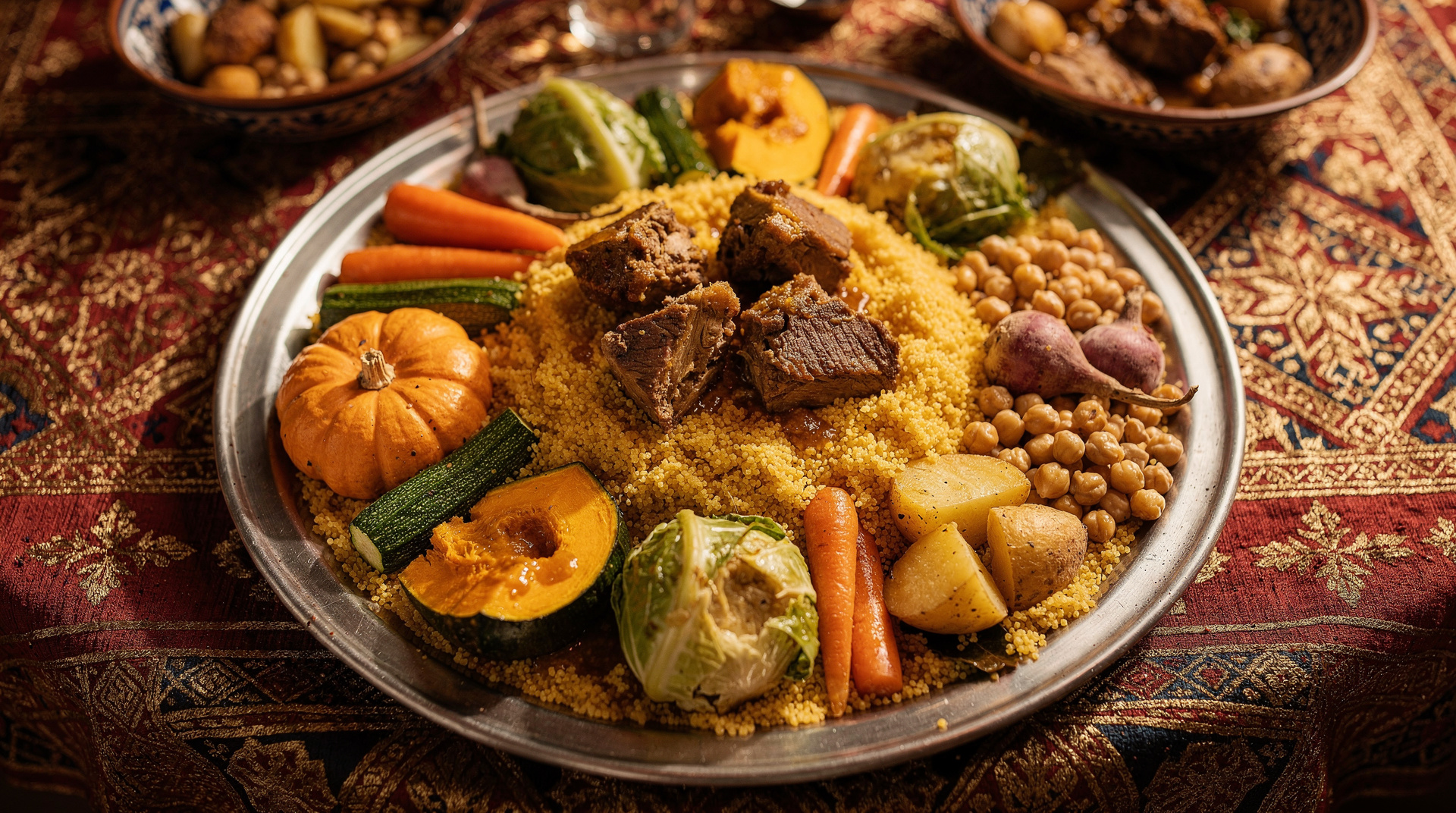
In Morocco, Friday is not just the end of the working week — it is the day of communal prayer and the day of couscous. After the midday Jumu’ah prayer at the mosque, the extended family gathers around the largest table in the house, and a towering mound of hand-steamed couscous arrives with meat, seven vegetables, and a broth that has been cooking since morning. To eat this at a Moroccan family table is to understand something fundamental about the country’s food culture.
The rest of the world knows couscous as something that cooks in five minutes from a box. What Moroccan cooks produce is categorically different: a grain that has been hand-rolled from fine semolina, steamed three times in a couscoussier over a simmering broth, raked and aerated between steamings, and finished with butter and rose water. The difference in texture and flavour is like comparing fresh pasta to dried.
This guide covers the full couscous tradition — the Friday ritual, the seven vegetables, the regional variations, the sweet-onion tfaya, the Berber mountain versions, and where across Morocco you’ll find versions worth eating.
The couscoussier and the technique
The couscous vessel — the couscoussier — is a two-part steamer: a large base pot for the broth and a perforated top vessel for the grain. Steam rises through the perforations and passes through the couscous, cooking it slowly and separating each grain.
The three-steam process:
First steaming (20 minutes): The dry couscous grains go into the top of the couscoussier. After steaming, they’re turned out onto a large flat tray (gsaa), broken up by hand, and moistened with salted water.
Second steaming (20 minutes): Back into the couscoussier. After this steam, the grains go back onto the gsaa, raked with fingers, moistened again, and worked with olive oil or butter so they don’t clump.
Third steaming (15-20 minutes): The final pass creates a grain that is light, separate, and fully cooked. At serving, more butter is worked through the couscous by hand, and the mound is shaped on the serving platter before the vegetables and broth are added.
No home cook and no restaurant that takes Moroccan cooking seriously cuts corners on this process. The instant version (precooked and dried) is a convenience product for weeknight cooking outside Morocco — it is not what you’ll find at a traditional Friday table.
Couscous with seven vegetables
The couscous bis sab’a khodra (with seven vegetables) is the canonical Friday version. The choice of vegetables reflects the season and the cook’s preferences, but traditional selections include:
- Turnip
- Carrot
- Courgette (zucchini)
- Pumpkin or butternut squash
- Cabbage
- Onion
- Chickpeas (sometimes counted as the seventh “vegetable” or added separately)
- Tomato (less common but appears in some regional versions)
The vegetables cook in the same broth as the meat — typically lamb shoulder or chicken — which is what flavours them. They’re added to the broth in stages according to cooking time, so everything finishes simultaneously.
Why seven? The number seven is considered auspicious in Moroccan culture and appears throughout the food tradition (seven spices in ras el hanout, seven-course ceremonial meals). In practice, most families use between five and eight vegetables depending on what’s available.
Tfaya: the sweet onion and raisin topping
Tfaya is the couscous topping that most visitors don’t know to ask for. It’s a slow-cooked preparation of caramelised onions and plumped golden raisins, spiced with cinnamon and sweetened slightly with honey. Served as a separate element alongside the main dish, it’s piled on the couscous mound as a finishing layer.
The combination of the savoury couscous and broth, the tender vegetables, the lamb, and the sweet caramelised onion with raisins creates the definitive Moroccan sweet-savoury contrast. Tfaya couscous is considered the festive version — it appears at celebrations and at restaurants that take the dish seriously.
How to order it: In most medina restaurants, ask specifically for “couscous avec tfaya” or “couscous avec oignons et raisins.” It costs slightly more than the standard version (20-40 MAD extra) but is substantially more interesting.
Couscous with meat: the protein options
The meat in Friday couscous varies by family preference and occasion:
Lamb shoulder: The most traditional choice. A whole shoulder or large pieces are slow-cooked in the broth until they can be pulled apart by hand. At serving, the lamb is placed in the centre of the couscous mound.
Chicken: A lighter version, equally common. Often prepared with preserved lemon or saffron in the broth. More commonly found in restaurants for everyday service.
Beef: Less traditional for Friday couscous but appears in some regional and family variations.
Mechoui (whole roasted lamb): For large celebrations, the lamb may be roasted separately rather than braised in the broth. This creates drier, charred meat alongside the steamed couscous — a different but excellent combination.
Merguez: Spiced lamb sausages sometimes served alongside the standard couscous at casual restaurants and street food contexts.
Berber couscous variations
The High Atlas, the Rif mountains, and the Souss region all have distinct couscous traditions that differ significantly from the urban Moroccan version. Understanding these helps when you’re eating in rural areas or seeking out regional variations.
Atlas Mountain couscous (couscous berbère): Coarser grain than the city version — often hand-rolled from whole-grain barley or a barley-wheat mix rather than refined semolina. The broth is simpler (water, onion, herbs), the vegetables are whatever grows nearby (turnips, dried figs, potatoes, chickpeas). The result is earthier, less refined, and deeply satisfying in a mountain context. Often served from a communal wooden bowl (jfna).
Rif couscous: Northern Morocco’s version tends to use more vegetables and less meat, influenced by proximity to the coast and to Andalusian food traditions. Couscous with fresh broad beans in spring is a Rif specialty.
Souss and anti-Atlas couscous: Argan oil appears as the finishing fat instead of butter — the region produces Morocco’s argan oil and it works into the food at every level. The combination of argan-finished couscous with coarse-ground dried figs is specific to this region and almost impossible to find outside it.
See the Berber culture guide for the broader context of Amazigh food traditions across Morocco’s mountain regions.
Couscous bidaoui: the Casablanca style
Casablanca’s couscous tradition (bidaoui means “of Casablanca”) is considered by many Moroccan food specialists to be the most refined urban version. The city’s bourgeois food culture produced a highly calibrated couscous: finer grain, more carefully balanced broth, and an almost obsessive attention to the grain’s texture.
Key differences from Marrakech-style: the vegetables are cooked more precisely (each to its own doneness rather than all together), the broth is more deeply reduced, and the finished couscous is richer with butter. Casablanca restaurants serving traditional bidaoui couscous are harder to find in the tourist circuit but worth seeking.
Where to eat couscous in Morocco
On Fridays: local restaurants and family-style venues
The best couscous in Morocco is not in tourist restaurants — it’s at local restaurants that serve only on Fridays, at families who will invite you if you have the connection, and at the handful of serious Moroccan restaurants that make it year-round.
Marrakech:
- Al Fassia (Guéliz): The Friday couscous here is considered a benchmark. The women-run kitchen produces a version that rivals family cooking. Reserve ahead. Expect 180-300 MAD per person.
- Chez Chegrouni (Jemaa el-Fnaa): Reliable everyday Moroccan cooking including couscous on Fridays. 90-130 MAD.
- Dar Moha: Elaborate presentation but genuinely executed. 300-500 MAD.
Fes:
- Dar Hatim: Family-style restaurant in the medina, excellent couscous Friday lunches at local prices (80-120 MAD).
- The Ruined Garden: Good mid-range option with consistent execution. 150-200 MAD.
Casablanca:
- Rick’s Café: Tourist-famous but the couscous here is genuinely prepared. 200-350 MAD.
- Sqala: Beautiful 18th-century bastion restaurant. Friday couscous is popular with Casablancans. 150-280 MAD.
Ordering couscous: what visitors get wrong
Expecting it any day of the week: At local restaurants and home-style venues, couscous is a Friday dish. Show up on a Tuesday and ask, and you’ll often be told it’s not available. Tourist restaurants will usually have it daily, but the quality reflects this — it’s pre-made and reheated.
Mistaking instant for real: If couscous arrives in under ten minutes, it’s instant — precooked, dried, rehydrated with boiling water. This is fine for a quick meal but is not the traditional preparation. Ask “est-ce que c’est fait maison?” (is it homemade?) before ordering.
Not taking the broth: The pot of broth that arrives alongside the couscous is meant to be poured over the grain before eating. Don’t leave it untouched. It’s also served in cups as a “soup” to sip alongside the main dish.
Skipping the communal format: At family-style restaurants, the couscous arrives on a large shared platter. Eat from your section, use a spoon or your right hand folded into a ball to pick up grain, and don’t reach across the plate to someone else’s section.
Cooking couscous: what a class teaches
A dedicated cooking class in Marrakech or Fes will often include couscous in the curriculum. Be aware that the full three-steam process takes 3-4 hours — so classes that include couscous in a 2-hour session are either shortcutting the steaming or using a pre-started preparation.
What a good class teaches: how to work the grain between steamings, what butter and rose water do to the texture and flavour, why the broth quality determines the couscous quality, and how to calibrate the seven vegetables by cooking time so they finish together.
If you are in Fes, a market visit followed by a hands-on cooking class is a good way to see where the vegetables come from before you cook them. Check the itinerary first to confirm that couscous is actually on the menu.
Book the La Maison Arabe cooking workshop — one of Marrakech’s most comprehensive culinary classesCouscous versus tagine: the key differences
The tagine guide and the tagine vs couscous comparison cover this in detail, but the short version: tagine is an everyday dish, available daily in restaurants, achievable by a single home cook, and quicker to prepare. Couscous is a communal occasion dish — it feeds a crowd, requires hours of preparation, and carries the weight of the Friday family tradition. Both are fundamental to Moroccan food culture; they’re not interchangeable.
For the street food context and the full picture of how these dishes fit into Morocco’s food landscape, see the related guides below.
Buying couscous to take home
Moroccan couscous makes an excellent souvenir if you buy the right version. The spice souks carry hand-rolled couscous in different grain sizes — fine (for salads and light preparations), medium (the standard), and coarse (for the Berber version). Avoid pre-packaged instant versions unless that’s what you want.
Prices in the spice souks: 15-30 MAD per 500g for hand-rolled couscous versus 5-10 MAD for the instant version. The quality difference justifies the price.
Frequently asked questions about Moroccan couscous
Is Moroccan couscous always served with meat?
No — vegetarian couscous with seven vegetables and no meat is common and often the best version for understanding the grain itself. Many families prepare a purely vegetable version for health or preference. At restaurants, ask for “couscous végétarien” and confirm it’s made with a vegetable broth.
What does “couscous royal” mean on restaurant menus?
Couscous royal is the restaurant version with multiple proteins — typically lamb, chicken, and merguez sausage — served together over the grain. It’s a crowd-pleaser version designed for tourist menus and not a traditional Moroccan category. Order it if you want to try multiple proteins in one dish, but don’t mistake it for the traditional Friday lunch.
Can I buy a couscoussier to take home?
Yes. A couscoussier from the medina souks costs 150-400 MAD depending on size and quality. The copper versions from Fes are the most beautiful. The enamel versions from general hardware stores are more practical for regular use. Both work well — the key is the seal between the two parts (it’s often sealed with a strip of dampened cloth to prevent steam escaping from the sides).
How is Moroccan couscous different from what I find in European supermarkets?
The supermarket product is precooked and dried — it rehydrates in five minutes with boiling water and is a convenience product. Moroccan hand-rolled couscous is raw semolina that requires the three-steam process. The difference in texture (fluffy, separate grains vs clumped and slightly gummy) and flavour is significant. Even the fine semolina is a different product.
Is couscous gluten-free?
No — couscous is made from durum wheat semolina and contains gluten. There is no traditional Moroccan gluten-free couscous; millet-based couscous exists but is a West African tradition, not Moroccan.
Can I learn to make couscous in a half-day cooking class?
Only partially. The full three-steam process takes 3-4 hours on its own, so a 2-hour class will typically shortcut a step or use a pre-started preparation. If couscous is specifically what you want to learn, book a class that allocates real time to it — see the cooking classes in Marrakech or Fes guides for operators that do.
The couscoussier: buying one and using it at home
The couscoussier is one of the most useful kitchen tools to bring home from Morocco. At its simplest, it’s a two-part steamer — a large base pot and a perforated insert — that’s designed for couscous but works for steaming vegetables, fish, and dumplings as well.
Types available in Moroccan souks:
- Aluminium couscoussier: The functional everyday version used in most Moroccan homes. Lightweight, conducts heat well. 150-350 MAD at household goods stalls in medina souks. Buy this one if you actually intend to cook with it.
- Copper or brass couscoussier: More decorative, heavier, more traditional in appearance. 400-800 MAD and up. Beautiful but requiring more maintenance.
- Enamel couscoussier: Practical, easy to clean, good heat distribution. Common in Moroccan supermarkets and household goods shops. 200-400 MAD.
The seal: A traditional trick to prevent steam escaping from the join between the two parts is to roll a strip of dampened cloth (or even damp newspaper) and press it around the seal point before fitting the top vessel. This forces all the steam through the perforations and into the grain.
Size: A 28-30cm diameter couscoussier is the right size for a family meal. Smaller versions (for 2-4 people) exist but are less common in Moroccan markets.
Couscous beyond the meal: other uses of the grain
Moroccan cooks use couscous beyond the main Friday dish in ways that visitors rarely encounter:
Couscous as breakfast: Seffa — fine couscous steamed and finished with butter, milk, sugar, and cinnamon — is eaten as a sweet breakfast or dessert. It’s made from the finest couscous grain (not the coarse seven-vegetable version) and the preparation is lighter. Served warm, it resembles a North African porridge.
Couscous at celebrations: The sweet version with dates, raisins, and nuts (couscous tfaya at its most elaborate) appears at wedding celebrations and religious festivals. This is the dessert-like version — heavily sweetened, perfumed with orange blossom water, piled high and decorated with almonds and dried fruit.
Couscous soup: Leftover couscous from Friday lunch is sometimes added to chicken broth with herbs for a quick Saturday soup. The grain absorbs the broth and swells — a hearty one-pot recovery meal.
Couscous and the cultural calendar
The couscous tradition intersects with the Moroccan calendar in several ways:
Ashura: The tenth day of Muharram (the Islamic New Year month) is marked with charitable acts and, in many Moroccan households, with a special sweet couscous preparation distributed to neighbours. The seffa at Ashura is a community sharing act.
Mawlid: The Prophet’s birthday celebration often involves large communal couscous meals — families cook extra and distribute to those who have less. The communal meal at Mawlid is specifically couscous, not tagine.
After a birth: Moroccan tradition involves bringing couscous to the household of a newly born child — specifically a sweet couscous with milk, honey, and dates. The food marks the new life.
After a death: In the mourning period (three days, traditionally), neighbours bring food to the bereaved family — couscous is the standard offering. The communal dish becomes the grief-sharing dish.
These calendar connections — which a restaurant menu will never mention — are what make the Friday couscous tradition something more than a food preference. The grain carries cultural meaning across the major moments of Moroccan life.
Learning to make it yourself
If eating couscous makes you want to cook it, both major cooking-class hubs teach the full technique. The cooking classes in Marrakech guide and the cooking classes in Fes guide both cover operators who include couscous in their curriculum — just confirm the class runs long enough (3-4 hours) to do the three-steam process properly rather than shortcutting it.
If you’re building a wider Marrakech food itinerary around your couscous meal, pair it with a day trip from Marrakech or a stop at the Ourika Valley for context on where the seven vegetables typically come from. If you would rather see Atlas village life and the food culture around it, a Berber village and Atlas Mountains day trip from Marrakech is one option. And if negotiating the price of a souvenir couscoussier or hand-rolled couscous feels daunting, the bargaining in Morocco guide covers the etiquette.