Chefchaouen vs Fes: Blue Town or Medina Chaos?
Should I visit Chefchaouen or Fes?
Visit both — they're 3-4 hours apart and offer completely opposite experiences. If you must choose: Fes for cultural depth and historical weight, Chefchaouen for visual appeal and a relaxed pace. Fes is one of Morocco's essential experiences; Chefchaouen is beautiful but more of a complement than a destination in isolation.
The Rif Mountains versus the ancient medina
At a glance
| Where | Northern Morocco — Chefchaouen (Rif Mountains) and Fes (interior imperial city), 150km / 3-4h apart |
| Cost | Chefchaouen guesthouses from around 200-450 MAD/person; Fes riads similar, plus a guide (300-500 MAD/day) recommended |
| Time needed | Chefchaouen: 1-2 days adequate; Fes: minimum 2 nights, ideally 3 |
| Getting there | CTM/Supratours bus or private taxi between the two, 3-4h |
| Best time | Spring (Apr-May) and autumn (Oct-Nov) for both; Chefchaouen is also a viable summer base |
Chefchaouen and Fes are both in northern Morocco and are often visited together on the same trip — but they couldn’t be more different in character. Chefchaouen is small (40,000 people), photogenic, relaxed, and oriented almost entirely around the aesthetic experience of its blue-painted medina. Fes is enormous (one million people), labyrinthine, historically dense, and requires genuine effort to navigate and understand.
Most northern Morocco itineraries include both. But if you’re choosing where to spend limited time, this comparison helps you prioritise.
The quick comparison table
| Factor | Chefchaouen | Fes |
|---|---|---|
| Medina size | Small — 1-2 days adequate | Enormous — 3+ days to scratch the surface |
| Navigation | Easy — the blue medina is compact | Very difficult — 9,000+ alleys, few landmarks |
| Atmosphere | Relaxed, artsy, café culture | Intense, traditional, functional city |
| Photography | Outstanding — the blue walls are everywhere | Excellent at specific sites (tanneries, madrasas) |
| Historical significance | Regional Rif city, founded 1471 | Imperial city, one of world’s oldest universities |
| UNESCO status | No (Rif mountains area) | Yes — Fes el-Bali |
| Day trips | Akchour waterfalls, Rif hiking | Meknes, Volubilis, Ifrane forest |
| Food scene | Decent, simple | Excellent — Fassi cuisine is Morocco’s finest |
| Craft / shopping | Blankets, wool goods, local hash trade | Ceramics, leather, marquetry, metalwork |
| Tourist density | High in medina core | High at tanneries, lower elsewhere |
| Guide necessity | No | Strongly recommended for first day |
| Distance from Tangier | 2h30 | 3h |
| Distance from each other | 3-4h by bus | 3-4h by bus |
The case for Chefchaouen
Chefchaouen’s appeal is visual and atmospheric. Founded in 1471, the medina sits in a natural bowl in the Rif Mountains — whitewashed walls painted in dozens of shades of blue, red-tiled roofs, flower pots on every ledge, cats on every step. The effect is genuinely enchanting, particularly in the lower medina around Uta el-Hammam square and in the residential lanes climbing toward the kasbah.
What works well at Chefchaouen:
- You can navigate independently from day one — the medina is compact enough that getting lost just means a pleasant detour
- The pace is genuinely relaxed. Café culture, long lunches, watching the afternoon light shift on the blue walls
- The Rif mountain setting adds dramatic backdrop — the surrounding hills, visible from several vantage points, give the city a sense of place that flat-city medinas lack
- Hiking the Rif foothills above the city takes 30 minutes from the medina and gives a completely different perspective
- Akchour Waterfalls — a full-day hiking destination 30km away — is one of Morocco’s best waterfall landscapes
- Chefchaouen is genuinely off-season friendly — less oppressively hot than southern cities in summer, pleasant in spring and autumn
- The accommodation is excellent value — riads and guesthouses that would cost 150 EUR in Marrakech run 50-80 EUR here
The honest limitations:
- Two days is sufficient. The medina is compact; by day two you’ve seen everything. Longer stays are for people who specifically want the mountain hiking or a slow-travel experience
- The blue paint has become its own tourist trap — shop owners repaint strategically for photos and the Instagram economy has heavily commodified what was once an organic aesthetic
- Cultural depth is limited compared to the imperial cities — Chefchaouen is beautiful but not historically dense
A private Chefchaouen blue city walking tour provides the neighbourhood context and architectural history that transforms the experience beyond Instagram shots.
For the waterfall hiking, the Akchour Waterfalls day trip from Chefchaouen handles the transport and trail navigation to one of northern Morocco’s best landscapes.
The case for Fes
Fes is one of the world’s great medieval cities — a fully functioning urban centre of 150,000 people living within boundaries established in the 9th century. Founded in 808 CE, Fes became the intellectual and religious capital of Morocco. The Al-Qarawiyyin mosque-university (established 859 CE) claims to be the world’s oldest continuously operating university. The medina contains the full infrastructure of medieval Islamic city planning: separate craft guilds each occupying distinct quarters, neighbourhood mosques, communal bathhouses, and neighbourhood bread ovens that still function today.
What works well at Fes:
- Historical depth that no other Moroccan city matches. The monuments — Al-Attarine madrasa, Bou Inania madrasa, Chouara tanneries — are extraordinary
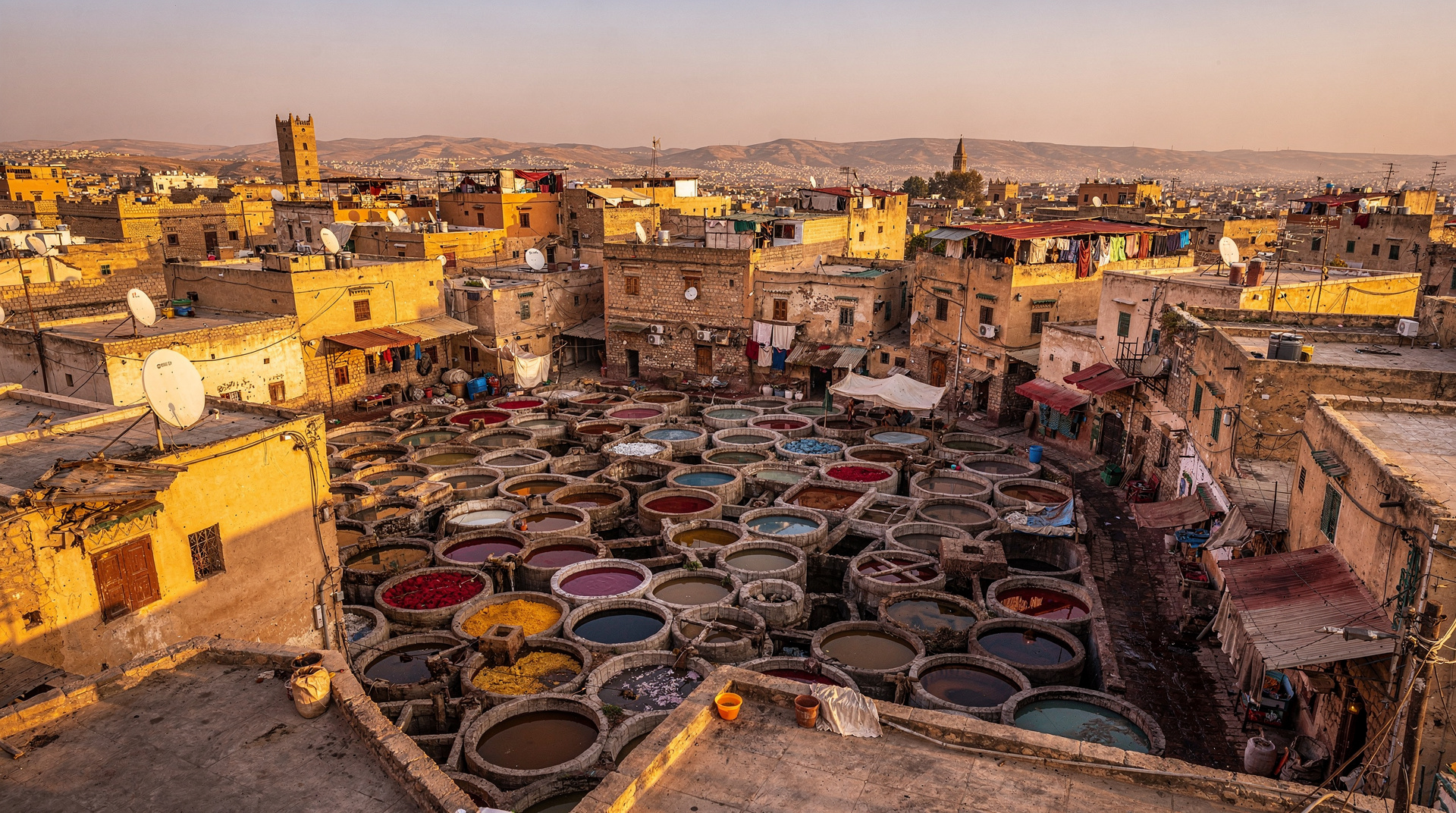
- The tanneries are one of the world’s most visually memorable working industrial sites — leather dyed in the same vats using the same methods since the 11th century
- Fassi cuisine is considered Morocco’s most refined — bastila (pigeon pastilla), fresh harira, specific lamb preparations — better here than anywhere else
- The craft infrastructure is intact in a way it isn’t elsewhere: proper coppersmiths, real weavers, actual marquetry workshops still occupying guild quarters
- The experience of being genuinely disoriented in a living medieval city — 9,000 alleys, no cars allowed in the old medina, mule traffic only — is like nowhere else
- Day trips from Fes include Meknes (1h, excellent imperial city), Volubilis Roman ruins (1.5h), and Ifrane/Azrou cedar forests with Barbary macaques (1h)
The honest friction points:
- Navigation is genuinely hard. Without a guide, most first-time visitors get lost within 30 minutes and find the experience frustrating rather than exciting
- The city can feel overwhelming — crowds at the tanneries, persistent shopkeeper interactions, the sheer scale and complexity
- Budget for a licensed guide for your first full day — 300-500 MAD (30-50 EUR) for a qualified guide, not the “unofficial” touts at the main gates
- The medina is enormous — you’ll walk 15-20km in a full day of exploration
A Fes full-day cultural tour covers the major monuments with the historical context that makes them comprehensible rather than just beautiful ruins.
By traveller type
First-time Morocco visitors: Fes is the more essential experience — it’s historically and culturally the deepest Moroccan city. Chefchaouen is the more visually rewarding, but if you’re prioritising understanding Morocco, Fes wins.
Photographers: Chefchaouen for the blue-wall aesthetics and concentrated photographic density. Fes for the tanneries, the madrasa interiors, and the craft quarter light.
Relaxed travellers / slow travel: Chefchaouen. The pace is gentler, navigation is stress-free, and the mountain setting encourages lingering.
Hikers: Chefchaouen — the Rif Mountains and Akchour provide excellent accessible hiking that Fes can’t match.
History enthusiasts: Fes, clearly. The historical density per square kilometre is extraordinary.
Budget travellers: Chefchaouen — significantly cheaper accommodation and food for a comparable experience.
Verdict by scenario
Only 1 day for northern Morocco: Fes, without hesitation. The monuments justify the visit even if you only scratch the surface.
2 days: Split them — one night in Fes, one in Chefchaouen (or vice versa). The bus between them takes 3-4 hours.
3 days: 2 nights in Fes (enough to cover Fes el-Bali and the Fes Jdid, plus a day trip to Meknes), 1 night in Chefchaouen.
Coming from Tangier: Chefchaouen (2.5h) before Fes (3-4h from Chefchaouen) is the logical sequence.
Coming from Marrakech: Fes first (via the Sahara loop or direct bus), Chefchaouen as the northern extension before heading to Tangier or Casablanca.
Can you combine both?
Yes — this is the standard northern Morocco circuit. Fes and Chefchaouen are 150km apart (3-4h by CTM bus or private taxi). Most travellers doing a week or more in northern Morocco visit both.
A practical sequence:
- Day 1-2: Fes (medina, tanneries, Meknes day trip)
- Day 3: Bus to Chefchaouen (depart morning, arrive midday)
- Day 3-4: Chefchaouen (medina, kasbah, Akchour hike)
- Day 5: Continue to Tangier (2.5h) for departure or Tetouan coastal detour
From Tangier, you can reverse this entire sequence if arriving from Spain. See the northern Morocco itinerary for a detailed routing guide. The Fes destination guide has detailed neighbourhood-by-neighbourhood coverage of the medina.
Practical planning notes for either base
Wherever you decide to sleep more nights, book accommodation ahead in both cities during spring and autumn peak season. The best riads in Fes guide and the best riads in Chefchaouen guide both cover options by budget and location relative to the medina gates. If you’re weighing a Chefchaouen day trip from a Fes base rather than an overnight split, the Chefchaouen day trip from Fes guide lays out honestly why an overnight beats the long drive.
In Fes, the shopping is deeper and more specialised than Chefchaouen’s — the Fes souks guide covers the craft quarters by trade. In Chefchaouen, shopping is lower-pressure and more casual — see the Chefchaouen shopping guide for what to buy and where. And if the Akchour hike is a deciding factor for you, the Akchour day trip from Chefchaouen has the full route and timing.
Frequently asked questions about Chefchaouen vs Fes
Is Chefchaouen worth visiting in its own right, or just for photos?
Both. The visual appeal is real and significant — the blue medina is genuinely beautiful, not just photogenic. But the city also rewards slow exploration: the pace, the mountain setting, the café culture, and the Akchour hiking are all worthwhile beyond photography.
How many days do you need in Fes?
Minimum 2 nights (2 full days). Day one: the main monuments of Fes el-Bali (tanneries, Bou Inania madrasa, Al-Qarawiyyin) with a guide. Day two: the Andalusian quarter, Fes Jdid, and shopping. With 3 nights you can add a Meknes/Volubilis day trip without feeling rushed.
Is it safe to walk around Chefchaouen alone?
Yes. Chefchaouen is one of Morocco’s safest and most tourist-friendly cities. The medina is compact and well-signposted. Solo female travellers generally find it more comfortable than Marrakech or Fes.
Why is Chefchaouen painted blue?
The origin is debated. The most cited explanation is that Jewish refugees from Iberia brought the tradition of painting buildings blue as a symbol of heaven in the 15th century. The practice spread and became a defining aesthetic of the city. Today, many residents repaint blue specifically to maintain the tourist appeal.
What’s the best time to visit Chefchaouen?
Spring (April-May) and autumn (October-November) for the best weather. Summer is pleasant in the Rif Mountains compared to southern Morocco — temperatures stay 25-30°C rather than the 40+ of the south — making Chefchaouen a viable summer destination.
Can I day trip to Chefchaouen from Fes?
Technically possible but not ideal. The bus takes 3-4h each way, giving you only a few hours in the city. Better to spend at least one night and experience the evening light and the city without the day-tripper crowds.
Should I visit Fes or Chefchaouen first on a north-to-south trip?
If arriving from Tangier, Chefchaouen first makes sense geographically (2h30 vs 3h to Fes) and eases you in before the more intense Fes medina. If arriving from Marrakech heading north, Fes first is the natural order, with Chefchaouen as the calmer finale before Tangier or Casablanca. Either sequence works; let your arrival point decide.