Chefchaouen shopping guide: the blue city's relaxed markets
What should you buy in Chefchaouen and is shopping here different from Marrakech?
Buy woven wool blankets, natural soaps, handmade leather sandals, and painted blue-and-white crafts. Shopping in Chefchaouen is significantly more relaxed than Marrakech or Fes — prices are lower, pressure is minimal, and the craft tradition is genuinely local.
Shopping in the city that isn’t trying to sell you anything
At a glance
| Where | Chefchaouen medina, centred on Plaza Uta el-Hammam |
| Cost | Roughly 25-600 MAD per item depending on craft (soaps cheapest, blankets priciest) |
| Time needed | Half a day covers the highlights; a full day if you want to browse without rushing |
| Getting there | Walkable from any medina riad; the commercial stretch runs about 300m from the plaza to Bab Souk |
| Best time | Morning (9-11am) or late afternoon (4-6pm) — midday brings Fes/Tangier tour groups |
The first thing that surprises most visitors to Chefchaouen is the quiet. After the medinas of Marrakech and Fes, where persistent vendors track you down alleys and every glance at a carpet triggers an invitation to sit for tea, Chefchaouen’s market streets feel almost leisurely. Shopkeepers here are present, available, and happy to chat — but not chasing. If you walk past without stopping, no one follows.
This has partly to do with Chefchaouen’s scale (the medina is small enough to cross in 20 minutes) and partly with the city’s character. It was isolated from the wider Moroccan economy for much of the 20th century — the Spanish protectorate brought relative stability; entry was restricted to non-Muslims until the 1920s — and it retains a self-contained quality that has never fully shifted into tourism-first mode.
The shopping here is different in another important way: the crafts are genuinely local. The woven wool blankets sold in Chefchaouen are made in the Rif Mountains. The natural soaps are produced in the region. The leather sandals in the narrow alleyways are made by cobblers who have worked in the same spots for generations. You are not buying mass-produced goods shuttled up from Marrakech workshops, though some of those do exist in the more tourist-facing stalls near the main plaza.
The layout of Chefchaouen’s medina
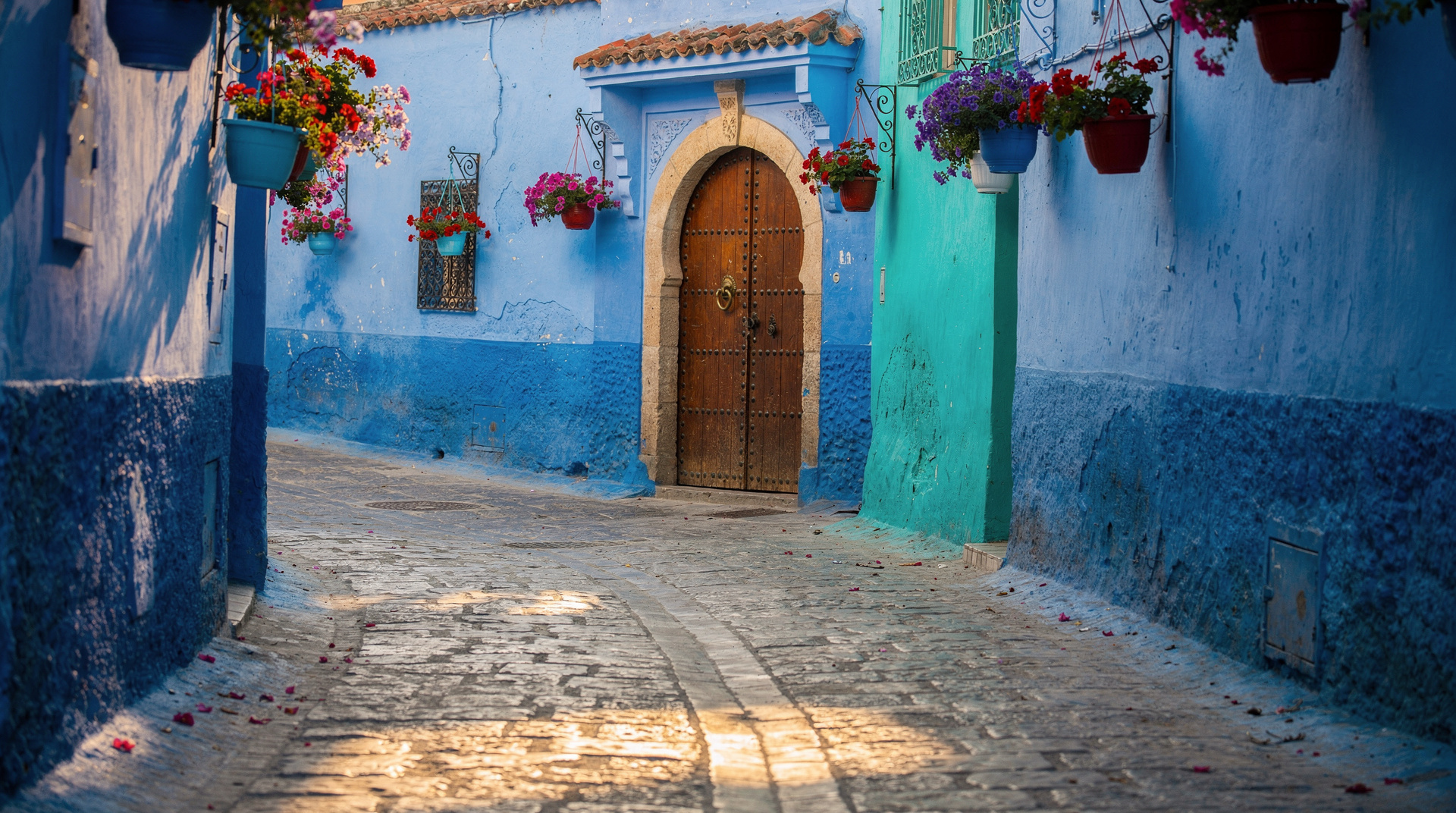
Chefchaouen’s medina is far smaller and more navigable than Fes or Marrakech. The main market hub is Plaza Uta el-Hammam, the large square anchored by the Grande Mosquée and the kasbah museum. From here, shopping streets radiate outward — Calle Ras el-Maa heads toward the natural spring and waterfall at the medina’s edge, while the main souk arteries lead up through progressively quieter residential streets painted in every shade of blue from cobalt to powder to periwinkle.
The most commercial section — where fixed stalls sell to tourists continuously — runs for about 300 metres between Plaza Uta el-Hammam and Bab Souk. Above this area, the medina becomes residential and the occasional doorstep shop sells at genuine local prices. This upper section is worth exploring on foot even if you are not buying.
What Chefchaouen is known for producing
Woven wool blankets and djellabas
The Rif Mountains have a weaving tradition distinct from the rest of Morocco. The wool is heavier and coarser than the fine Berber textiles of the High Atlas, reflecting the cooler temperatures of the northern mountains. Chefchaouen blankets (handiras) typically feature bold geometric stripes in natural cream, grey, and brown wool with occasional blue or red accent yarns. They are functional, warm, and export-friendly — they fold flat and weigh relatively little.
A genuine handmade wool blanket: 300–600 MAD for a single-bed size, 500–900 MAD for double. Machine-woven imitations with acrylic yarn feel lighter and slicker — run your hand across the surface and squeeze a fold; genuine wool has texture and body. Ask to see the weave from the back: hand-woven pieces show slight irregularity; machine woven pieces are perfectly uniform.
Djellabas (full-length hooded robes) are also sold here in both lightweight summer and heavier winter versions. A well-made wool djellaba: 400–700 MAD.
Natural soaps and cosmetics
Chefchaouen has a small but genuine artisan soap industry producing bars made with locally sourced olive oil, argan oil, and natural botanicals. Unlike the mass-produced glycerine soaps sold throughout Morocco’s tourist markets, these are cold-process or hot-process soaps with genuine oils as the primary ingredient.
Look for shops that display the soap-making process visually and can explain the ingredients. Prices: 20–50 MAD per bar, depending on size and oil content. The shops selling 10 bars for 20 MAD are selling commercial glycerine product — not bad, just not artisan.
Beldi soap (savon beldi) — a traditional Moroccan soft black soap made from potassium-rich ash and olive oil — is also widely sold. It is used in hammam rituals as a pre-scrub treatment. A 250g container: 40–70 MAD.
Leather sandals
Several small cobbler workshops in the medina produce handmade leather sandals to order or from pre-made stock. The style is simpler than Marrakech’s embroidered babouches — flat-soled, open, with leather straps that can be adjusted. The leather is locally sourced tanned hide.
A pair of made-to-order sandals in genuine leather: 200–400 MAD depending on complexity. Allow 24–48 hours for custom orders. The same shops sell stock in standard sizes for immediate purchase at slightly lower prices.
Painted blue and white crafts
Blue is Chefchaouen’s colour obsession, and it has predictably colonised the craft goods sold in the medina. Ceramic plates, tiles, small wooden items, and decorative objects painted in the city’s signature blue-and-white palette are everywhere. The quality ranges from tourist kitsch (thin ceramics with quickly applied paint) to genuinely well-made pieces.
The better quality ceramics are heavier, have a proper glaze coat, and show consistent brushwork. The cheaper items chip easily and the paint can be uneven. For serious ceramic purchases, the Fes blue pottery guide explains what distinguishes quality Moroccan ceramics — the principles apply to Chefchaouen’s painted pieces too.
Small painted wooden crafts (frames, boxes, decorative items): 40–100 MAD for good quality.
A guided medina walk
Chefchaouen is small enough to navigate solo, but a guided medina walk adds useful context about the city’s Jewish and Andalusian history, the significance of the blue paint (origin disputed — theories involve Jewish residents, Sufi symbolism, or simply tradition), and the craft traditions of the Rif. Local guides know the workshops off the main tourist path where you can watch artisans at work rather than just buying finished goods.
Book a guided Chefchaouen medina tourA 2-hour guided walk covers the main craft quarters, the kasbah, and several of the medina’s most photogenic corners with context that makes the colours and architecture more legible. If you prefer a more personal pace, a private walking tour of the old town is another option.
Comparing shopping in Chefchaouen vs Marrakech and Fes
The most common observation from visitors who have done all three is that Chefchaouen is the most enjoyable purely as a shopping experience — not because it has the best selection (Marrakech wins that) or the highest quality crafts (Fes edges it for leather and ceramics), but because the absence of pressure makes the process pleasant.
In Marrakech, the souks require a certain degree of mental armour. You need to be clear about your intentions, comfortable with declining, and alert to the various misdirection tactics that are part of the commercial ecosystem. In Fes, the pressure is lower but the complexity of the medina means navigation consumes mental energy that would otherwise go toward shopping.
In Chefchaouen, you can wander into a shop, handle every item on the shelves, ask the price, say it’s more than you wanted to spend, and leave — and the shopkeeper will say goodbye warmly. This sounds like a low bar but against the Marrakech baseline it feels like a revelation.
What this means practically: Chefchaouen is a good place to buy items you were not sure you wanted. The lower-pressure environment lets you consider more carefully without the artificial urgency that souk sales techniques manufacture.
Price benchmarks in Chefchaouen (2026)
- Woven wool blanket (single bed size): 300–600 MAD
- Wool djellaba: 400–700 MAD
- Natural olive oil soap (100g bar): 25–50 MAD
- Leather sandals (stock): 150–300 MAD
- Leather sandals (custom order): 200–400 MAD
- Painted ceramic plate (medium): 80–150 MAD
- Painted wooden photo frame: 60–100 MAD
- Crochet hat or bag (locally made): 80–200 MAD
- Small clay tagine (functional): 100–200 MAD
These prices assume light bargaining. The fixed-price shops (some exist and are labelled) charge slightly more but save the negotiation energy.
Things to avoid buying in Chefchaouen
Cannabis products: The Rif Mountains are Morocco’s primary cannabis-growing region, and Chefchaouen sits at the edge of this area. Hash is openly sold in some parts of the medina and surrounding region. Possession and purchase is illegal in Morocco, regardless of where you are or who is selling. The risks — arrest, bribery demands from corrupt police, imprisonment — are real and serious. This is not a grey area.
Mass-produced items shipped from Marrakech: Some stalls near the plaza sell the same mass-produced ceramics, scarves, and souvenir items found throughout Morocco’s tourist circuit. There is nothing wrong with these if you like the look, but they are not Chefchaouen crafts and should not be priced as such.
“Antique” anything: The same caution applies here as throughout Morocco — genuine antiques require export documentation; most “antiques” in small souk stalls are reproduction pieces.
Artisan cooperatives and fair trade shops
Chefchaouen has several shops and cooperatives operating on fixed-price, fair-trade principles that support local artisans directly. These are worth seeking out if you want to buy without bargaining and ensure your purchase supports the maker.
Association Dar Taliba: A cooperative workshop near the medina supporting local women’s craft production. Sells woven textiles, embroidered items, and pottery.
Bab Ssour Cooperative: Near one of the medina gates, this small cooperative sells leather goods and textiles at fixed prices with producer information.
For a broader understanding of Morocco’s cooperative craft economy, the artisan cooperatives guide covers the most significant women’s cooperatives across the country, including argan oil, weaving, and pottery operations.
Combining shopping with day trips
Chefchaouen works well as a base for two or three nights — enough time to shop at a relaxed pace, explore the medina thoroughly, and take a day trip into the surrounding Rif Mountains. The Akchour waterfalls and Talassemtane National Park offer hiking that is among the best in northern Morocco. See the Rif Mountains hiking guide for routes, logistics, and safety considerations.
For getting to Chefchaouen, see the northern Morocco destination guide — the city is accessible by bus from Fes (4.5 hours), Tangier (3 hours), and Casablanca (5.5 hours), or by shared taxi from Tetouan (45 minutes).
Practical tips for shopping in Chefchaouen
Best time: Morning (9–11am) and late afternoon (4–6pm) have the best light for photography and a more active craft scene. Midday brings tour groups from Fes and Tangier that compress the main plaza area.
Bargaining: Expected but gentle. Opening offers in Chefchaouen are typically closer to final prices than in Marrakech — a 20–30% discount from the opening price is more normal here than the 60% that sometimes applies in Marrakech’s main souk corridors.
Cash: Bring MAD. There is an ATM near Plaza Uta el-Hammam and several more near the bus station below the medina. Credit cards are rarely accepted in individual craft stalls.
Language: Spanish is more widely spoken here than in southern Morocco (a legacy of the Spanish protectorate). French is also understood. English is spoken in tourist-facing shops but less commonly in residential parts of the medina.
Photography: The blue streets are the most photographed in Morocco. Locals have mixed feelings about being photographed without consent — ask before photographing people, especially residents going about their daily business. The streets themselves are public space.
Shopping as part of a wider Chefchaouen visit
If you’re only in Chefchaouen for a few hours on a day trip from Fes, prioritise the main plaza stretch and accept you’ll miss the quieter upper-medina shops. With an overnight or two, the shopping opens up considerably — mornings before the tour buses arrive are noticeably calmer, and you have time to combine a browse with the Akchour day trip from Chefchaouen on a second day. If you would rather not organise the transport yourself, a guided day trip to the Akchour waterfalls is one option.
For where to base yourself while you shop, see the best riads in Chefchaouen guide. If you’re weighing Chefchaouen against a Fes-based shopping trip instead, Chefchaouen vs Fes compares the two medinas directly, including craft quality and pressure levels.
Carrying your purchases home
Wool blankets and djellabas are bulky but light — they compress well in a packing cube and rarely cause weight problems. Ceramics are the real risk: wrap any purchase in clothing inside checked luggage rather than a carry-on, and buy from a shop that will wrap items in newspaper or bubble wrap on request (most will, even without being asked). If you’re buying a genuinely large or fragile piece, ask the shop about shipping — some of the fixed-price cooperatives can arrange it, though costs and delivery times vary enough that it’s worth confirming before you commit to a large order.
Frequently asked questions about Chefchaouen shopping guide
Is shopping in Chefchaouen cheaper than Marrakech?
For equivalent items, slightly. The bigger difference is the lower pressure environment rather than dramatically different prices. For genuine locally made crafts (Rif blankets, leather sandals), Chefchaouen is competitively priced because there is less tourist markup on authentic regional goods.
How many days should I allow for shopping in Chefchaouen?
One full day covers the medina shopping thoroughly. If you are also hiking (Akchour is a full day) or visiting the kasbah museum, allow two to three days in the city altogether.
What is the blue paint made of and why is everything blue?
The blue colouring of Chefchaouen’s walls and doors dates to at least the early 20th century. The most widely accepted explanation links it to the city’s significant Jewish population (blue symbolising heaven and spirituality in Jewish tradition) — but Andalusian architectural influences and local custom are also cited. There is no single definitive origin. The current blue varies from property to property and is actively maintained by residents.
Can I bargain in fixed-price cooperative shops in Chefchaouen?
Generally no, and you shouldn’t try. Fixed-price shops and cooperatives — including places like Association Dar Taliba and Bab Ssour Cooperative — set prices to pay artisans fairly, and haggling defeats the point. Save your bargaining energy for the independent stalls, where a 20-30% discount from the opening price is normal.