Best riads in Chefchaouen: blue city stays with rooftop views
What are the best places to stay in Chefchaouen?
Dar Echchaouen and Casa Perleta lead on design and views. For budget stays, Casa Hamza and Dar Meziana offer clean rooms with rooftop access under €60/night. Chefchaouen properties are smaller than Marrakech riads — expect 4-10 rooms, family management, and genuinely intimate stays.
Staying in the blue city: what you actually find
Chefchaouen is one of Morocco’s most photographed cities, but it’s not a large place. The medina covers about one square kilometre and has a permanent population of around 45,000. This scale means accommodation is genuinely small — most properties have 4-12 rooms, all are family or small-team managed, and the atmosphere is closer to a guesthouse than a hotel.
The good news: Chefchaouen’s accommodation scene consistently delivers on what it promises. The blue-washed lanes, rooftop views over terracotta tiles and the Rif Mountains, and the cooler mountain air (this is the Rif, at 600m altitude) make even modest properties feel special. The challenge is picking well from a crowded field where many properties look identical on a booking platform.
This guide separates the best from the average across price tiers and explains what to prioritise when choosing.
At a glance
| Where | Inside the medina (recommended) vs. just outside near Ain Tissimane |
| Cost | Roughly €25-55/night budget, €55-120 mid-range, €120-250 premium |
| Time needed | 2-3 nights is the sweet spot; see the suggested structure below |
| Getting there | Bus from Fes or Tangier (around 4 hours); no train station |
| Best time | Spring and autumn for mild weather; book 6-8 weeks ahead for July-August |
What makes a Chefchaouen property worth booking
Rooftop access is the primary differentiator. The view from a good rooftop in the medina — blue-painted plaster walls dropping away to the valley, the Jebel Rif mountains behind, and the old mosque minaret nearby — is the defining Chefchaouen visual experience. Properties with private or semi-private rooftop terraces are significantly better than those without.
Location within the medina matters in Chefchaouen more than many travellers expect. The Plaza Uta el-Hammam (the main square) is convenient but noisy — restaurants and cafes operate until midnight and the sound carries. Lanes 5-10 minutes walk from the plaza are quieter and still close enough to be walkable.
Room size and natural light vary significantly. Many traditional dars in Chefchaouen have small windows and dark rooms — the thick stone walls keep rooms cool but can feel oppressive. Upper-floor rooms with windows that open onto the lane or terrace are the best option.
Management quality matters more at smaller properties than anywhere else. A 6-room guesthouse run by an attentive family who know every good restaurant, hiking trail, and local market in the area provides a qualitatively different experience from the same building run by an absent owner with a cleaning service.
Top riads and dars by tier
Premium tier (€120–250/night)
Dar Echchaouen One of the most polished properties in the medina. 8 suites, each individually decorated with high-quality Moroccan craft — hand-embroidered textiles, handmade zellige, carved plasterwork. The rooftop has the best 360-degree views in this guide: the medina, the mountains, and on clear mornings the distant Rif range. The breakfast here is consistently one of the best in Chefchaouen.
Standout: Rooftop views, suite quality, breakfast Limitation: Not cheap by Chefchaouen standards; small scale means it books months ahead in peak season
Casa Perleta A Spanish-Moroccan fusion property (the owner has Spanish roots) that shows in the decor — warmer colours, slightly more European sensibility alongside traditional Moroccan elements. 10 rooms, roof terrace, and a small library area that makes it popular with slow travellers and writers. Location in the upper medina means good views and quieter lanes.
Standout: Design, rooftop, library and common areas Limitation: Upper medina location requires more walking than some competitors
Lina Ryad A well-established mid-to-premium property with 12 rooms, a pool (rare in Chefchaouen), and a restaurant with reliable Moroccan cooking. The pool is a significant differentiator — in summer when Chefchaouen gets warm (less extreme than Marrakech but still 28-32°C in July-August), this matters. Popular with families and couples who want facilities.
Standout: Pool, restaurant, family-suitable scale Limitation: Slightly less intimate than smaller properties; pool fills up in high season
Mid-range tier (€55–120/night)
Riad Chigou 8 rooms, excellent location near the medina centre. The courtyard is genuine — old tile work, central fountain, orange trees — and the management team is well-reviewed for helpfulness. Breakfast includes home-made jam and fresh bread from the nearby bakery. A reliable pick at a fair price.
Standout: Genuine courtyard, location, helpful management Limitation: Some rooms are small; confirm room size when booking
Dar Meziana A 7-room property in a quieter medina lane. Dar Meziana is popular with repeat visitors — the owner is a long-time Chefchaouen resident with genuine knowledge of the town and mountains. The rooftop has reliable mountain views. Breakfast quality has improved significantly in the past two years based on recent reviews.
Standout: Local knowledge of host, mountain views, repeat-visitor following Limitation: No pool; the lane can be hard to find on a first visit
Casa Hamza One of the most popular budget-to-mid-range properties in Chefchaouen. 10 rooms, rooftop with medina views, consistent management. It’s not the most design-forward property but everything works: rooms are clean, the breakfast is good, and the location near the medina entrance is straightforward to find. Good for first-time visitors who want simplicity.
Standout: Reliability, location, price Limitation: Less character than smaller independent properties
Riad Baraka A small property (6 rooms) in a blue-painted alley that photographs beautifully. Popular with photographers and Instagram-focused travellers — be aware that some guests book specifically to shoot the lane, which can make the immediate surroundings busy during peak hours. The rooms themselves are comfortable and well-maintained.
Standout: Location in a famous blue alley, intimate scale Limitation: The blue-lane photoshoot traffic can be intrusive
Budget tier (€25–55/night)
Hostel Souika Technically a hostel but with private rooms available. The rooftop here is surprisingly good — city views and mountain backdrop — and the communal atmosphere is friendly without being party-focused. Good for solo travellers.
Dar Terrae A basic guesthouse with rooms from €30/night. Not design-forward but scrupulously clean, well-located, and genuinely managed. One of the better budget picks in the medina.
Pension La Castellana Historic budget accommodation in the medina, run by the same family for over two decades. Basic rooms, shared bathrooms in some configurations, but the location and price are hard to beat. Good for travellers who prioritize location over facilities.
The Chefchaouen accommodation market: what’s changed
Chefchaouen’s accommodation prices have risen significantly since 2019 — driven by the city’s exponential growth as a social media destination. Properties that were €40-60/night five years ago now charge €80-120 for equivalent rooms. The budget tier remains accessible but the genuine bottom end (€20-30/night for a clean room with rooftop access) has essentially disappeared as operators have priced to demand.
The upside of this is quality investment. Properties that were rough around the edges in 2019 have renovated, and new openings since 2022 have generally been at a higher standard than the legacy guesthouses. The mid-range tier (€55-120) in 2026 is better than it was, even if it costs more.
Location guide: which part of the medina to choose
Near Plaza Uta el-Hammam (central): Convenient, sociable, noisy after 10pm. Good if you want to eat dinner and walk home; less ideal if you’re a light sleeper.
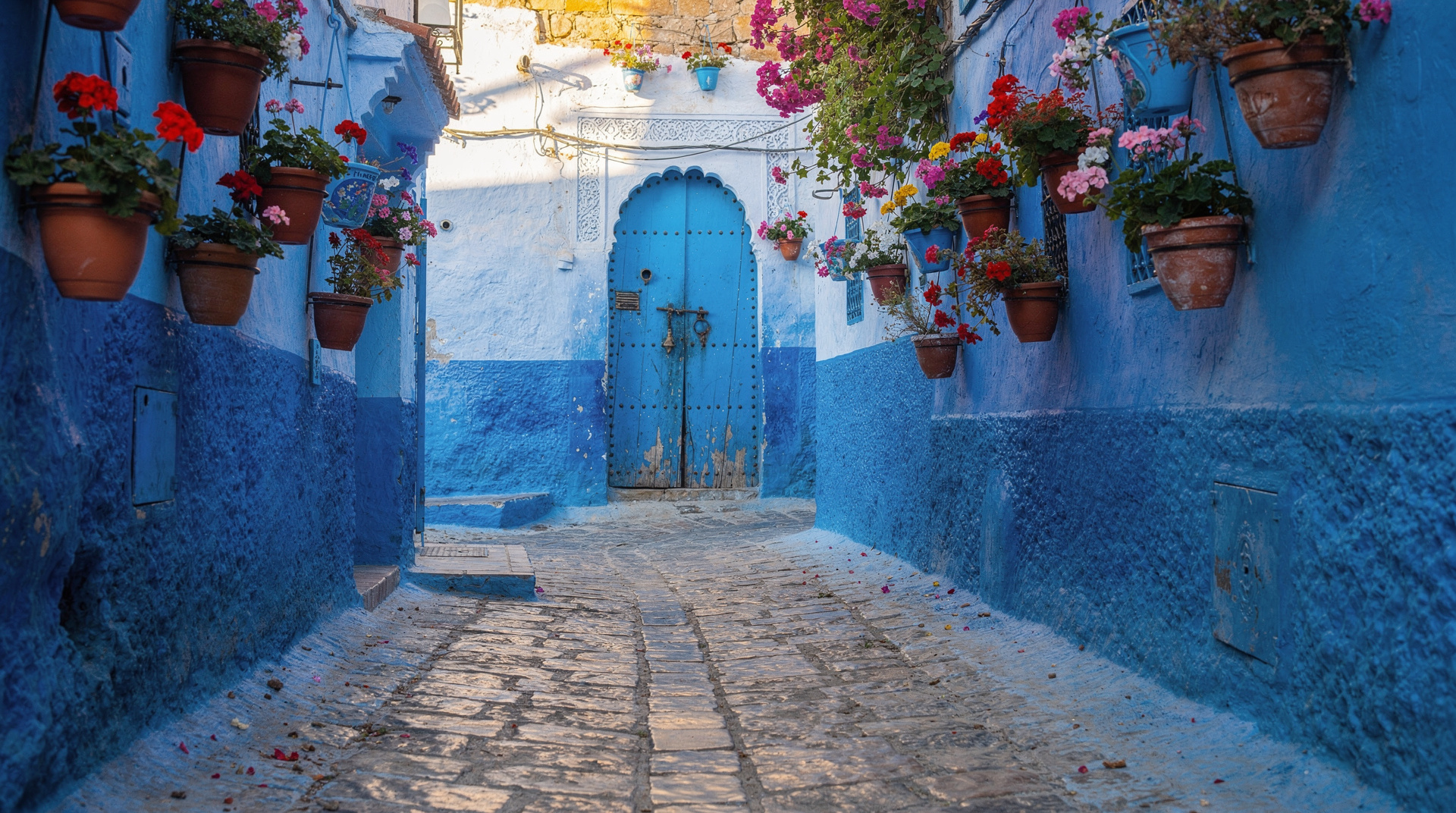
Upper medina (Bab Onsar area): Quieter, better mountain views, requires more walking. The lane network up here is genuinely beautiful — blue walls, flower pots, cats. The trade-off is distance from restaurants.
Lower medina (near Ain Tissimane): Close to the traditional washing area and the Spanish mosque viewpoint. Less photogenic lanes but quieter than the core.
Outside the medina (Ain Tissimane road): A few guesthouses sit just outside the medina walls with parking access and easier luggage handling. You lose the immersive medina atmosphere but gain practical convenience.
Chefchaouen property comparison table
| Property | Tier | Price/night | Rooftop | Pool | Best for |
|---|---|---|---|---|---|
| Dar Echchaouen | Premium | €150–250 | Yes | No | Design, views |
| Casa Perleta | Premium | €120–200 | Yes | No | Design, slow travellers |
| Lina Ryad | Premium | €140–230 | Yes | Yes | Families, facilities |
| Riad Chigou | Mid-range | €70–110 | Yes | No | Location, value |
| Dar Meziana | Mid-range | €60–100 | Yes | No | Local knowledge |
| Casa Hamza | Mid-range | €55–90 | Yes | No | Reliability, first timers |
| Hostel Souika | Budget | €30–55 | Yes | No | Solo, social |
| Dar Terrae | Budget | €28–50 | No | No | Basic, clean |
Hiking from your riad: what’s accessible
One of Chefchaouen’s underutilised advantages is the hiking network. Several trails begin within walking distance of the medina:
Ras el-Maa and the Spanish mosque: A 20-minute walk from Plaza Uta el-Hammam, following the Ras el-Maa stream. The Spanish mosque is the classic Chefchaouen sunset viewpoint. Any medina property in this guide reaches it on foot.
Jebel Tissouka circuit: A half-day hike (4-5 hours) into the Rif National Park. Accessible from the upper medina. Your guesthouse can point you to the trailhead — this is not a trip that requires a guide for the main trail, though a local guide adds context.
Akchour Waterfalls: A full-day excursion (see below) rather than a walkable trail from the medina.
For hiking context, the properties in the upper medina — Casa Perleta and Dar Meziana specifically — give you the shortest walk to the trailhead for Jebel Tissouka.
Day trips from Chefchaouen
A day trip to Akchour Waterfalls is the most popular excursion from Chefchaouen — a 45-minute drive followed by a scenic hike through the Talassemtane National Park to a series of waterfalls and a natural rock bridge. Most guesthouses can arrange private transport, or you can book through GetYourGuide.
For exploring the blue city itself, a private walking tour of the blue city on your first morning is useful for orientation — a local guide explains the Andalusian and Berber influences on the architecture and takes you to viewpoints that aren’t obvious from a map.
Booking tips specific to Chefchaouen
Book early for summer. July and August see the highest tourist volumes in Chefchaouen — a combination of European summer holidays and Moroccan domestic tourism. Availability at any quality property requires booking 6-8 weeks ahead.
Check arrival logistics. Chefchaouen has no train station. Bus connections run from Fes (4 hours), Tangier (4 hours), and Rabat (4 hours). Shared grand taxis run from Fes and Tangier. The bus station is a 20-minute walk (or short taxi) from the medina entrance. Make sure your guesthouse knows your arrival time.
Minimum stay requests. Several properties in the premium tier request a 2-night minimum during peak season. Budget properties generally accept single nights.
Weather. Chefchaouen is in the Rif Mountains and gets genuine winter — cold nights (3-8°C) from December through February, occasional snow, and rain. The medina in winter is beautiful and quiet, but confirm your property has heating (many older guesthouses have wood stoves or gas heaters rather than central heating).
For broader context on northern Morocco, the Chefchaouen destination guide covers all transport, sights, and logistics. If you’re combining Chefchaouen with Fes, the best riads in Fes guide covers the equivalent accommodation options there. For itinerary context, the 10-day Morocco itinerary and 14-day itinerary both include Chefchaouen as part of a northern Morocco circuit.
The Tangier destination guide is useful if you’re entering Morocco through the north — many travellers do the Tangier-Chefchaouen-Fes circuit. The budget Morocco itinerary shows how to do this circuit with minimal transport cost using shared taxis and buses.
What Chefchaouen looks like beyond the photographs
Most people arrive in Chefchaouen expecting the blue. The blue is real — the medina is genuinely painted in shades of blue from cobalt to pale lavender, and the effect in morning light is exceptional. But Chefchaouen has more texture than its Instagram reputation suggests.
The market: The central market (souq) below the plaza operates with genuine daily-life function — vegetables, spices, live chickens, household goods — alongside the craft stalls aimed at visitors. The Chefchaouen specialties worth seeking out: handwoven kif (cannabis hemp) products (baskets, bags — the material is legal in this context), locally grown honey, and the distinctive blue-and-white ceramic work specific to the Rif region.
The food: Chefchaouen has fewer restaurants than Marrakech or Fes but the quality is higher relative to price. The city is known for goat cheese (specific to this mountain area), fresh trout from the Ras el-Maa river, and msemen (semolina flatbreads) made on cast-iron griddles at street stalls. Several restaurants on the plaza serve consistent, affordable tagines — the lamb mechui with prunes and almonds is the local version of a dish you’ll find across Morocco, and the altitude and mountain lamb make it notably better here.
The cats: Chefchaouen’s medina has a substantial feline population, which is true of most Moroccan medinas but more concentrated here. The cats are healthy, tame, and part of the atmosphere — each guesthouse in this guide has at least one resident.
Chefchaouen’s blue: the actual history
The blue paint has several explanations, none definitive. The most commonly cited: Jewish refugees who fled Spain during the Inquisition in 1492 settled here and painted buildings blue to represent heaven — a symbol of the divine. Another explanation: the paint reflects sunlight and keeps mosquitoes away. A third: it simply became a tradition, each generation maintaining what the previous one established.
The shade of blue is not uniform. Walk from one end of the medina to the other and you’ll notice the blue shifts — darker blue near Bab Onsar, lighter lavender in the lower lanes, and intense cobalt in the main tourist corridor. Individual property owners choose their shade, and the cumulative effect is of organic variation rather than imposed uniformity.
Food and coffee: the best places near your riad
Bab Ssour café area: The lanes around Bab Ssour (the main gate) have several reliable breakfast spots. Café Chaouen Snack on the plaza serves harira (lentil soup) and msemen for under 20 MAD — the best budget breakfast in the medina.
Restaurant Lala Mesouda: One of the most consistently reviewed mid-range restaurants in Chefchaouen. The rooftop setting, 10 minutes walk from most medina properties, serves trout from the local river and a good lamb tagine. Dinner for two: ~200-280 MAD (€20-28).
Café Clock Chefchaouen: A branch of the Fes original, serving international-leaning café food — avocado toast alongside msemen and eggs. Better coffee than most medina café alternatives.
Chez Hicham: A family-run restaurant in the upper medina near Casa Perleta, well-regarded for couscous Fridays (the traditional Muslim Friday couscous, the best preparation of couscous in the city for a visitor to access).
Three days in Chefchaouen: a suggested structure
Day 1: Arrive in the afternoon. Walk from the bus station or taxi drop-off into the medina on your own — the first impression without a guide is the right one. Check in, drop luggage, walk the main blue lanes before sunset. Dinner at Lala Mesouda.
Day 2: Morning: sunrise walk to the Spanish mosque viewpoint (leave your guesthouse at 5:45am in summer, 6:30am in winter). Breakfast at your guesthouse. Mid-morning: guided medina tour, souq, and artisan workshops. Afternoon: free exploration, visit the Ethnographic Museum in the 15th-century Kasbah (entry 10 MAD). Evening: dinner at Chez Hicham.
Day 3: Day trip to Akchour Waterfalls (depart 9am, return by 5pm). Final evening in the medina — sunset from the Spanish mosque again, the light is different on each visit.
This 3-day structure suits most Chefchaouen stays. The 14-day Morocco itinerary integrates this into a full northern Morocco circuit that continues to Fes.
If you’re planning the wider trip, the first-time visitors guide and the Morocco packing list are worth reading before you go, and the is Morocco safe guide covers general safety context that applies just as much to a quiet mountain town as to the bigger cities.
Frequently asked questions about Best riads in Chefchaouen
Is 2 nights enough in Chefchaouen?
Two nights covers the essentials — the blue medina, sunset at the Spanish mosque, one day trip. Three nights, as in the structure above, gives you room for the Akchour Waterfalls day trip without feeling rushed. If Chefchaouen is a highlight rather than a stopover on your 14-day itinerary, three nights is the better call.
Do Chefchaouen riads accept walk-ins?
Some budget properties do, especially outside July-August, but it’s risky given how small the accommodation scene is — most properties have under 12 rooms. Booking ahead, even a day or two, avoids arriving to a full guesthouse with no easy alternative nearby.